
Life, 1885-10-15 · page 2 of 16
Life — October 15, 1885 — page 2: what you’re looking at
What you’re looking at
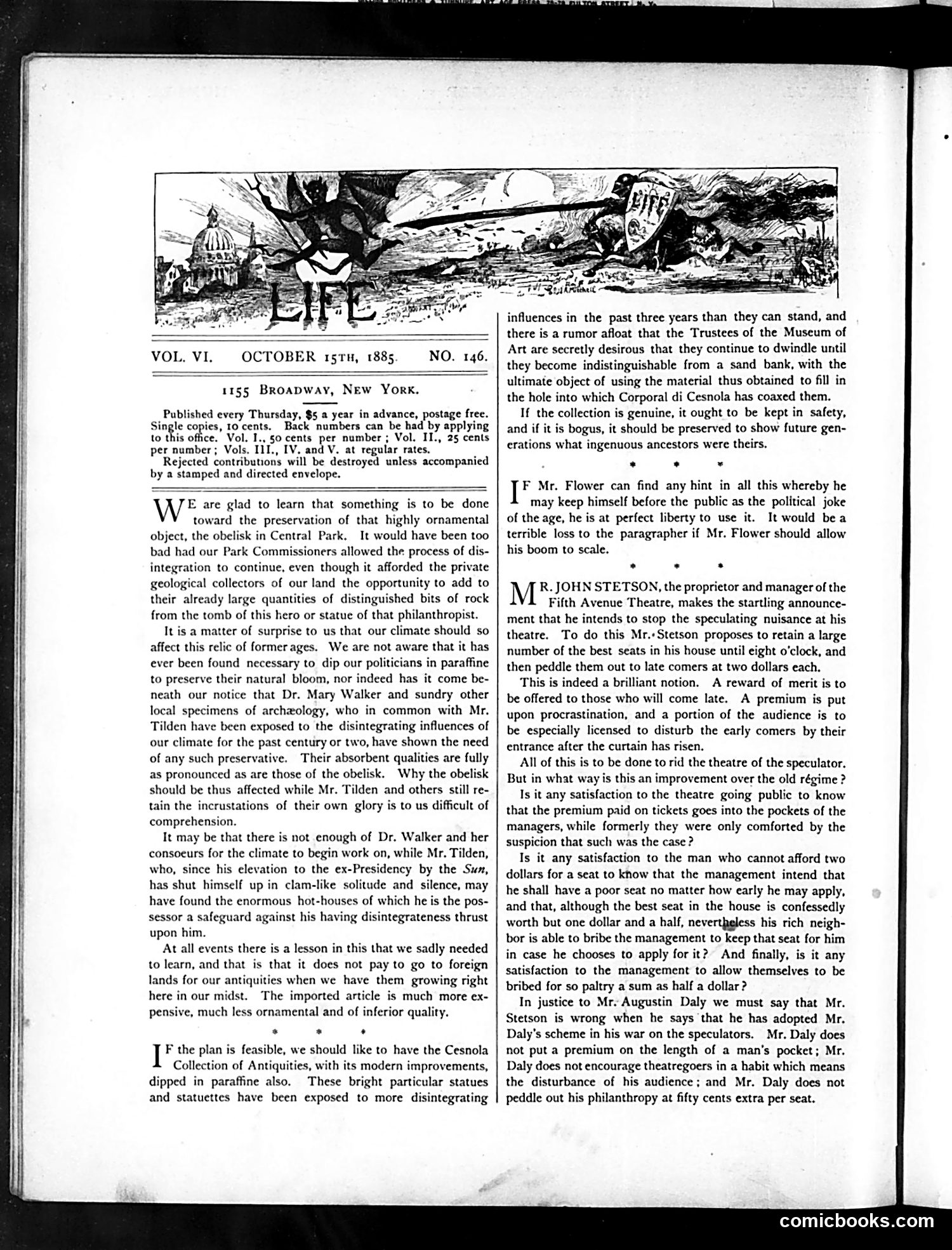
The masthead cartoon depicts a skeletal, grim figure labeled "LIFE" emerging from or looming over a landscape, with a domed building (likely the Capitol) visible on the left. The figure appears to represent Death or Mortality rather than vitality—a darkly ironic use of the magazine's name. The text discusses preservation of antiquities, the Cesnola Collection of artifacts, and Central Park's obelisk. It also critiques theater manager John Stetson's scheme to charge premium prices for late-arriving patrons at the Fifth Avenue Theatre, comparing this unfavorably to another manager's (Daly's) approach. The satire targets Stetson's commercialism and suggests his "reward for merit" scheme (charging latecomers extra) is exploitative rather than philanthropic.
📄 Transcribed text from this page (OCR, searchable)
Machine-transcribed from the original scan — historical spelling and the odd misread are preserved.
VOL. VI. OCTOBER 15tTu, 1885 NO. 1155 Broapway, New York. Published every Thursday, $5 a year in advance, postage free. Single copies, to cents. Back numbers can be had by applying to this office. Vol. I., 50 cents per number ; Vol. II., 25 cents per number; Vols, nr, IV, and V. at regular rates. Rejected contributions will be destroyed unless accompanied by a stamped and directed envelope. WE are glad to learn that something is to be done toward the preservation of that highly ornamental object, the obelisk in Central Park. It would have been too bad had our Park Commissioners allowed the process of dis- integration to continue, even though it afforded the private geological collectors of our land the opportunity to add to their already large quantities of distinguished bits of rock from the tomb of this hero or statue of that philanthropist. It is a matter of surprise to us that our climate should so affect this relic of former ages. We are not aware that it has ever been found necessary to dip our politicians in paraffine to preserve their natural bloom, nor indeed has it come be- neath our notice that Dr. Mary Walker and sundry other local specimens of archzology, who in common with Mr. Tilden have been exposed to the disintegrating influences of our climate for the past century or two, have shown the need of any such preservative. Their absorbent qualities are fully as pronounced as are those of the obelisk. Why the obelisk should be thus affected while Mr. Tilden and others still re- tain the incrustations of their own glory is to us difficult of comprehension. It may be that there is not enough of Dr. Walker and her consoeurs for the climate to begin work on, while Mr. Tilden, who, since his elevation to the ex-Presidency by the Sun, has shut himself up in clam-like solitude and silence, may have found the enormous hot-houses of which he is the pos- sessor a safeguard against his having disintegrateness thrust upon him. At all events there is a lesson in this that we sadly needed to learn, and that is that it does not pay to go to foreign lands for our antiquities when we have them growing right here in our midst. The imported article is much more ex- pensive, much less ornamental and of inferior quality. . . . F the plan is feasible, we should like to have the Cesnola Collection of Antiquities, with its modern improvements, dipped in paraffine also. These bright particular statues and statuettes have been exposed to more disintegrating influences in the past three years than they can stand, and there is a rumor afloat that the Trustees of the Museum of Art are secretly desirous that they continue to dwindle until they become indistinguishable from a sand bank, with the ultimate object of using the material thus obtained to fill in the hole into which Corporal di Cesnola has coaxed them. If the collection is genuine, it ought to be kept in safety, and if it is bogus, it should be preserved to show future gen- erations what ingenuous ancestors were theirs. * * * F Mr. Flower can find any hint in all this whereby he may keep himself before the public as the political joke of the age, he is at perfect liberty to use it. It would bea terrible loss to the paragrapher if Mr. Flower should allow his boom to scale. . . . R. JOHN STETSON, the proprietor and manager of the Fifth Avenue Theatre, makes the startling announce- ment that he intends to stop the speculating nuisance at his theatre. To do this Mr.+Stetson proposes to retain a large number of the best seats in his house until eight o'clock, and then peddle them out to late comers at two dollars each. This is indeed a brilliant notion. A reward of merit is to be offered to those who will come late. A premium is put upon procrastination, and a portion of the audience is to be especially licensed to disturb the early comers by their entrance after the curtain has risen. All of this is to be done to rid the theatre of the speculator, is this an improvement over the old régime ? Is it any satisfaction to the theatre going public to know that the premium paid on tickets goes into the pockets of the managers, while formerly they were only comforted by the suspicion that such was the case ? Is it any satisfaction to the man who cannot afford two dollars for a seat to know that the management intend that he shall have a poor seat no matter how early he may apply, and that, although the best seat in the house is confessedly worth but one dollar and a half, neverthgless his rich neigh- bor is able to bribe the management to keep that seat for him in case he chooses to apply for it? And finally, is it any satisfaction to the management to allow themselves to be bribed for so paltry a sum as half a dollar? In justice to Mr. Augustin Daly we must say that Mr. Stetson is wrong when he says that he has adopted Mr. Daly's scheme in his war on the speculators. Mr. Daly does not put a premium on the length of a man’s pocket; Mr. Daly does not encourage theatregoers in a habit which means the disturbance of his audience; and Mr. Daly does not peddle out his philanthropy at fifty cents extra per seat. comicbooks.com