
Life, 1885-10-15 · page 10 of 16
Life — October 15, 1885 — page 10: what you’re looking at
What you’re looking at
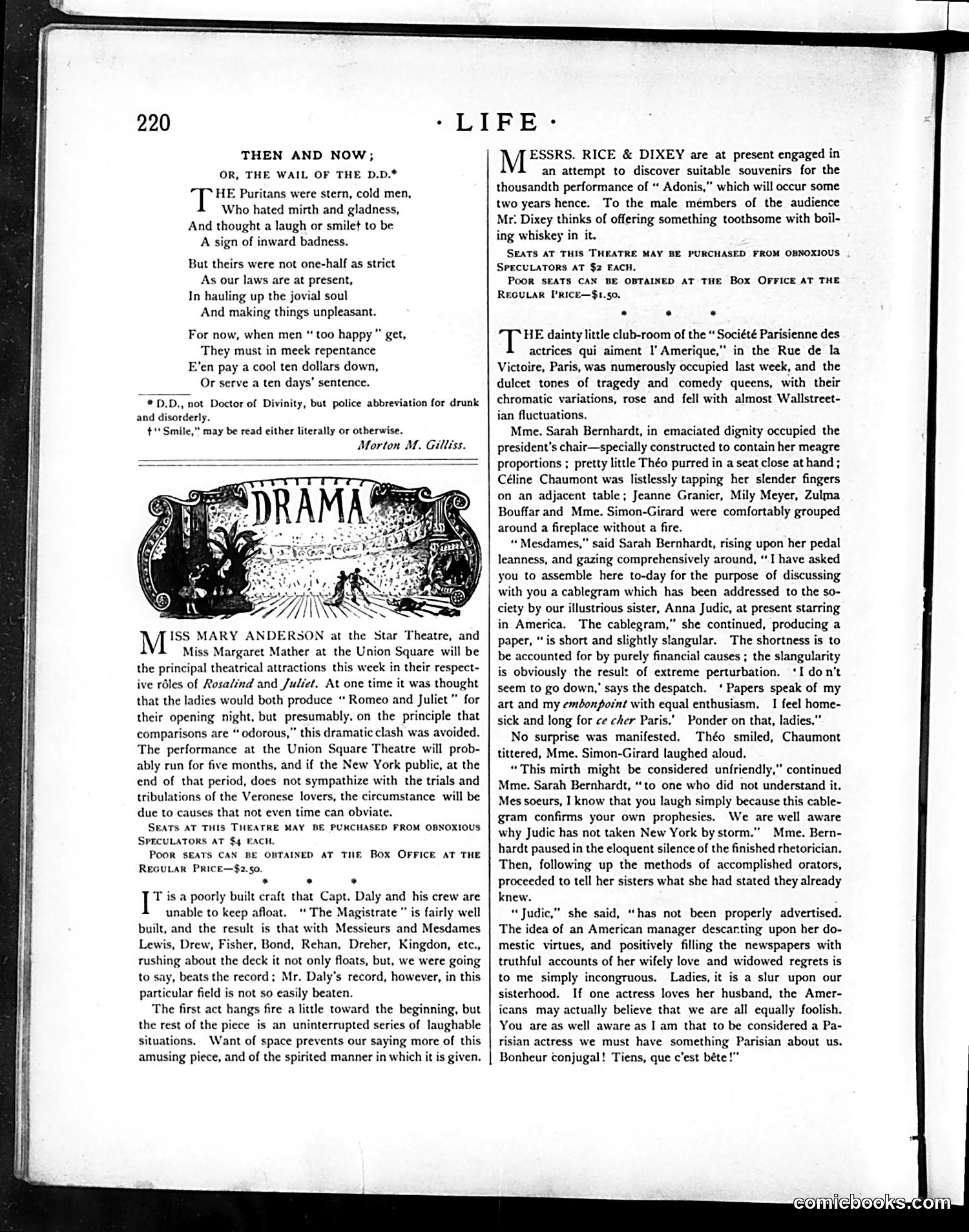
This page from Life magazine (circa 1880s) contains theatrical reviews and social satire: **"Then and Now"** satirizes American puritanism and modern laws. The poem contrasts stern Puritans—who disapproved of laughter—with contemporary society, which ironically punishes excessive happiness through fines ($10) or jail time (10 days) for drunkenness and disorderly conduct ("D.D."). The satire suggests modern restrictions are equally joyless, just legalized. **Theater reviews** discuss performances by actresses Mary Anderson and Margaret Mather in Shakespeare roles, Rice & Dixey in "Adonis," and Captain Daly's troupe in "The Magistrate." The satire targets ticket scalpers ("obnoxious speculators") who charged inflated prices ($4 vs. $2.50 regular price). **The Paris actresses section** mocks American obsession with French culture, depicting Sarah Bernhardt and other Parisian actresses discussing a cablegram from Anna Judic, an American-based actress. The tone suggests disapproval of Americans' provincial fascination with European performers. Overall: social commentary on American hypocrisy, commercialism, and cultural pretension.
📄 Transcribed text from this page (OCR, searchable)
Machine-transcribed from the original scan — historical spelling and the odd misread are preserved.
- LIFE: THEN AND NOW; OR, THE WAIL OF THE D.D.* HE Puritans were stern, cold men, Who hated mirth and gladness, And thought a laugh or smilet to be A sign of inward badness. But theirs were not one-half as strict As our laws are at present, In hauling up the jovial soul And making things unpleasant. For now, when men “ too happy” get, They must in meek repentance E’en pay a cool ten dollars down, Or serve a ten days’ sentence. not Doctor of Divinity, but police abbreviation for drunk and disorderly. t'* Smile,” may be read either literally or otherwise. Morton M. Gilliss. ISS MARY ANDERSON at the Star Theatre, and Miss Margaret Mather at the Union Square will be the principal theatrical attractions this week in their respect- ive réles of Rosalind and Juliet. At one time it was thought that the ladies would both produce “ Romeo and Juliet” for their opening night, but presumably, on the principle that comparisons are “ odorous,” this dramatic clash was avoided. The performance at the Union Square Theatre will prob- ably run for five months, and if the New York public, at the end of that period, does not sympathize with the trials and tribulations of the Veronese lovers, the circumstance will be due to causes that not even time can obviate. SEATS AT THIS THEATRE MAY BE PURCHASED FROM OBNOXIOUS SPECULATORS AT $4 EACH. POOR SEATS CAN BE OBTAINED AT THE BOX OFFICE AT THE REGULAR Price—$2.50. . . T is a poorly built craft that Capt. Daly and his crew are unable to keep afloat. ‘ The Magistrate " is fairly well built, and the result is that with Messieurs and Mesdames Lewis, Drew, Fisher, Bond, Rehan, Dreher, Kingdon, etc., rushing about the deck it not only floats, but, we were going to say, beats the record; Mr. Daly's record, however, in this particular field is not so easily beaten. The first act hangs fire a little toward the beginning, but the rest of the piece is an uninterrupted series of laughable situations. Want of space prevents our saying more of this amusing piece, and of the spirited manner in which it is given. ESSRS. RICE & DIXEY are at present engaged in an attempt to discover suitable souvenirs for the thousandth performance of “ Adonis,” which will occur some two years hence. To the male members of the audience Mr. Dixey thinks of offering something toothsome with boil- ing whiskey in it. SEATS AT THIS THEATRE MAY BE PURCHASED FROM OBNOXIOUS SPECULATORS AT $2 EACH. PooR SEATS CAN BE OBTAINED AT THE Box OFFICE AT THE REGULAR PRICE—$1.50. HE dainty little club-room of the “ Société Parisienne des actrices qui aiment 1’ Amerique,” in the Rue de la Victoire, Paris, was numerously occupied last week, and the dulcet tones of tragedy and comedy queens, with their chromatic variations, rose and fell with almost Wallstreet- ian fluctuations, Mme. Sarah Bernhardt, in emaciated dignity occupied the president's chair—specially constructed to contain her meagre proportions ; pretty little Théo purred in a seat close at hand ; Céline Chaumont was listlessly tapping her slender fingers on an adjacent table; Jeanne Granier, Mily Meyer, Zulma Bouffar and Mme. Simon-Girard were comfortably grouped around a fireplace without a fire. “ Mesdames,” said Sarah Bernhardt, rising upon her pedal leanness, and gazing comprehensively around, “I have asked you to assemble here to-day for the purpose of discussing with you a cablegram which has been addressed to the so- ciety by our illustrious sister, Anna Judic, at present starring in America. The cablegram,” she continued, producing a paper, “is short and slightly slangular. The shortness is to be accounted for by purely financial causes ; the slangularity is obviously the result of extreme perturbation. ‘I don't seem to go down,’ says the despatch. ‘ Papers speak of my art and my embonpornt with equal enthusiasm. I feel home- sick and long for ce cher Paris.’ Ponder on that, ladies.” No surprise was manifested. Théo smiled, Chaumont tittered, Mme. Simon-Girard laughed aloud. “This mirth might be considered unfriendly,” continued Mme. Sarah Bernhardt, “to one who did not understand it. Mes soeurs, I know that you laugh simply because this cable- gram confirms your own prophesies. We are well aware why Judic has not taken New York by storm.” Mme. Bern- hardt paused in the eloquent silence of the finished rhetorician. Then, following up the methods of accomplished orators, proceeded to tell her sisters what she had stated they already knew. “Judic,” she said, “has not been properly advertised. The idea of an American manager descarting upon her do- mestic virtues, and positively filling the newspapers with truthful accounts of her wifely love and widowed regrets is to me simply incongruous. Ladies, it is a slur upon our sisterhood. If one actress loves her husband, the Amer- icans may actually believe that we are all equally foolish. You are as well aware as I am that to be considered a Pa- risian actress we must have something Parisian about us. Bonheur conjugal! Tiens, que c'est béte!”