
Life, 1885-10-15 · page 6 of 16
Life — October 15, 1885 — page 6: what you’re looking at
What you’re looking at
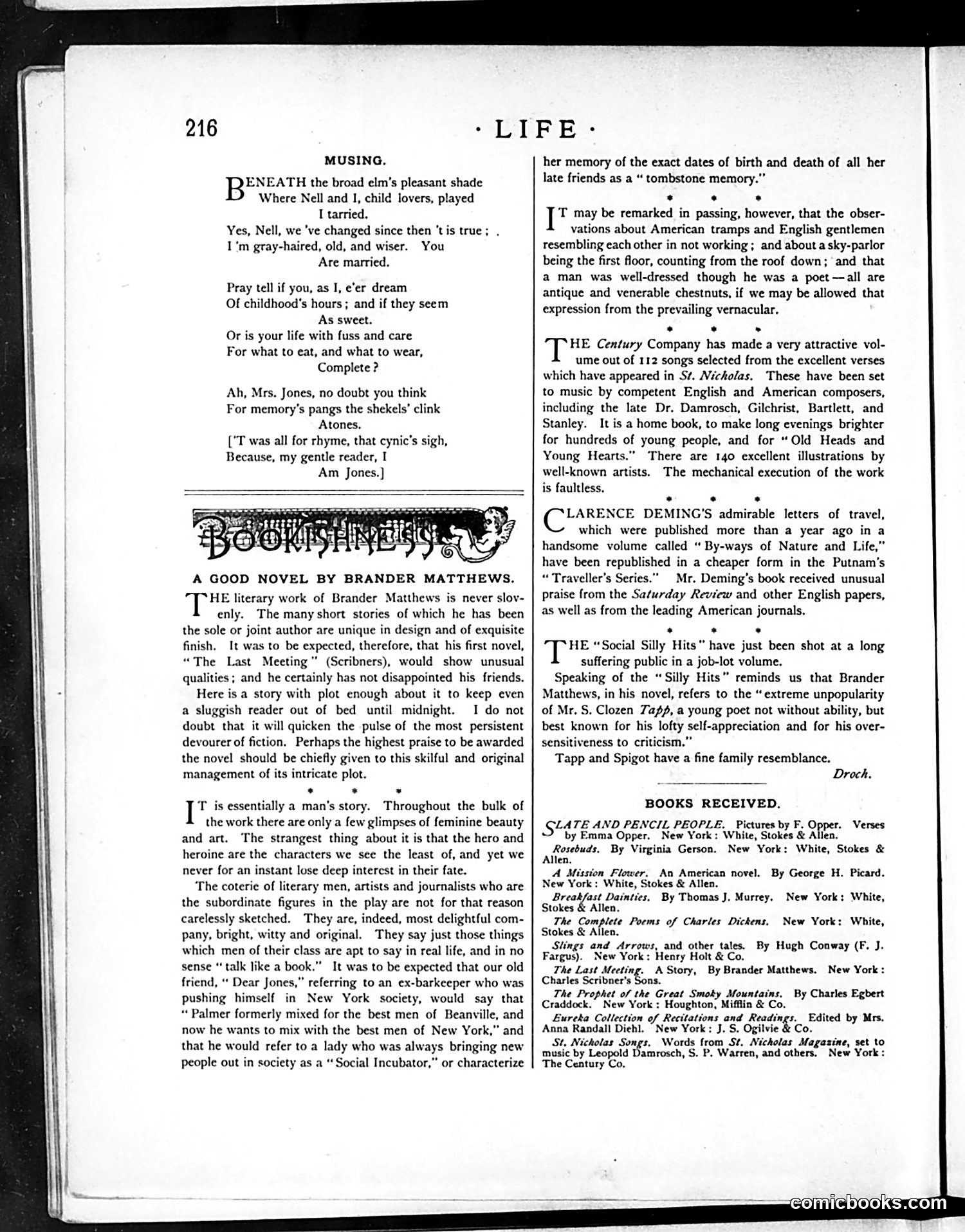
This page from *Life* magazine (page 216) contains literary criticism and book reviews rather than political cartoons. The main content includes: - **"Musing"**: A poem about childhood and aging, reflecting nostalgically on the past - **Book Review**: Favorable critique of Brander Matthews' novel "The Last Meeting," praising its plot and character development - **"Books Received"**: A listing of recently published books with publishers There is a decorative header illustration for the book review section showing ornamental design elements, but no political satire or social commentary cartoons appear on this page. The content is purely literary in nature, typical of *Life*'s cultural coverage during this period.
📄 Transcribed text from this page (OCR, searchable)
Machine-transcribed from the original scan — historical spelling and the odd misread are preserved.
> LIFE: her memory of the exact dates of birth and death of all her late friends as a “ tombstone memory.” MUSING. ENEATH the broad elm’s pleasant shade Where Nell and I, child lovers, played I tarried, Yes, Nell, we 've changed since then ‘tis true; . I'm gray-haired, old, and wiser. You Are married. Pray tell if you, as I, e’er dream Of childhood’s hours ; and if they seem As sweet. Or is your life with fuss and care For what to eat, and what to wear, Complete ? Ah, Mrs. Jones, no doubt you think For memory’s pangs the shekels’ clink Atones. ('T was all for rhyme, that cynic’s sigh, Because, my gentle reader, I Am Jones.] A GOOD NOVEL BY BRANDER MATTHEWS. HE literary work of Brander Matthews is never slov- enly. The many short stories of which he has been the sole or joint author are unique in design and of exquisite finish. It was to be expected, therefore, that his first novel, “The Last Meeting” (Scribners), would show unusual qualities ; and he certainly has not disappointed his friends. Here is a story with plot enough about it to keep even a sluggish reader out of bed until midnight. I do not doubt that it will quicken the pulse of the most persistent devourer of fiction. Perhaps the highest praise to be awarded the novel should be chiefly given to this skilful and original management of its intricate plot. . * . T is essentially a man's story. Throughout the bulk of the work there are only a few glimpses of feminine beauty and art. The strangest thing about it is that the hero and heroine are the characters we see the least of, and yet we never for an instant lose deep interest in their fate. The coterie of literary men, artists and journalists who are the subordinate figures in the play are not for that reason carelessly sketched. They are, indeed, most delightful com- pany, bright, witty and original. They say just those things which men of their class are apt to say in real life, and in no sense “ talk like a book.” It was to be expected that our old friend, “ Dear Jones,” referring to an ex-barkeeper who was pushing himself in New York society, would say that “Palmer formerly mixed for the best men of Beanville, and now he wants to mix with the best men of New York,” and that he would refer to a lady who was always bringing new people out in society as a “ Social Incubator,” or characterize * . . T may be remarked in passing, however, that the obser- vations about American tramps and English gentlemen resembling each other in not working; and about a sky-parlor being the first floor, counting from the roof down; and that a man was well-dressed though he was a poet —all are antique and venerable chestnuts, if we may be allowed that expression from the prevailing vernacular. . . . HE Century Company has made a very attractive vol- ume out of 112 songs selected from the excellent verses which have appeared in S¢. Nicholas. These have been set to music by competent English and American composers, including the late Dr. Damrosch, Gilchrist, Bartlett, and Stanley. It is a home book, to make long evenings brighter for hundreds of young people, and for “Old Heads and Young Hearts.” There are 140 excellent illustrations by well-known artists. The mechanical execution of the work is faultless. . . . LARENCE DEMING'S admirable letters of travel, which were published more than a year ago in a handsome volume called “ By-ways of Nature and Life,” have been republished in a cheaper form in the Putnam's “ Traveller's Series.” Mr. Deming’s book received unusual praise from the Saturday Review and other English papers, as well as from the leading American journals. . . . HE “Social Silly Hits” have just been shot at a long suffering public in a job-lot volume. Speaking of the “Silly Hits” reminds us that Brander Matthews, in his novel, refers to the “extreme unpopularity of Mr. S. Clozen Zapf, a young poet not without ability, but best known for his lofty self-appreciation and for his over- sensitiveness to criticism.” Tapp and Spigot have a fine family resemblance. Droch. BOOKS RECEIVED. LATE AND PENCIL PEOPLE. Pictures by F. Opper. by Emma Opper. New York: White, Stokes & Allen. Reseouas: By Virginia Gerson. New York: White, Stokes & Allen. A Mission Flower, An American novel. New York: White, Stokes & Allen. Breakfast Dainties, By Thomas J. Murrey. Stokes a, The Complete Poems of Charles Dickens, Stokes & Allen. Slings and Arrows, and other tales. By Hugh Conway (F. J. Fargus). New York: Henry Holt & Co. By Brander Matthews. New York: Verses By George H. Picard. New York: White, New York: White, Charles Scribner's Sons. The Prophet of the Great Smoky Mountains. Craddock. New York : Houghton, Mifflin & Co. Eureka Collection of Recitations and Readings. Edited by Mrs. Anna Randall Diehl. New York; J. S. Ogilvie & Co. St, Nicholas Songs. Words from St, Nicholas Magazine, set to music by Leopold Damrosch, S. P, Warren, and others. New York : The Century Co. By Charles Egbert