
A complete issue · 16 pages · 1885
Life — January 29, 1885
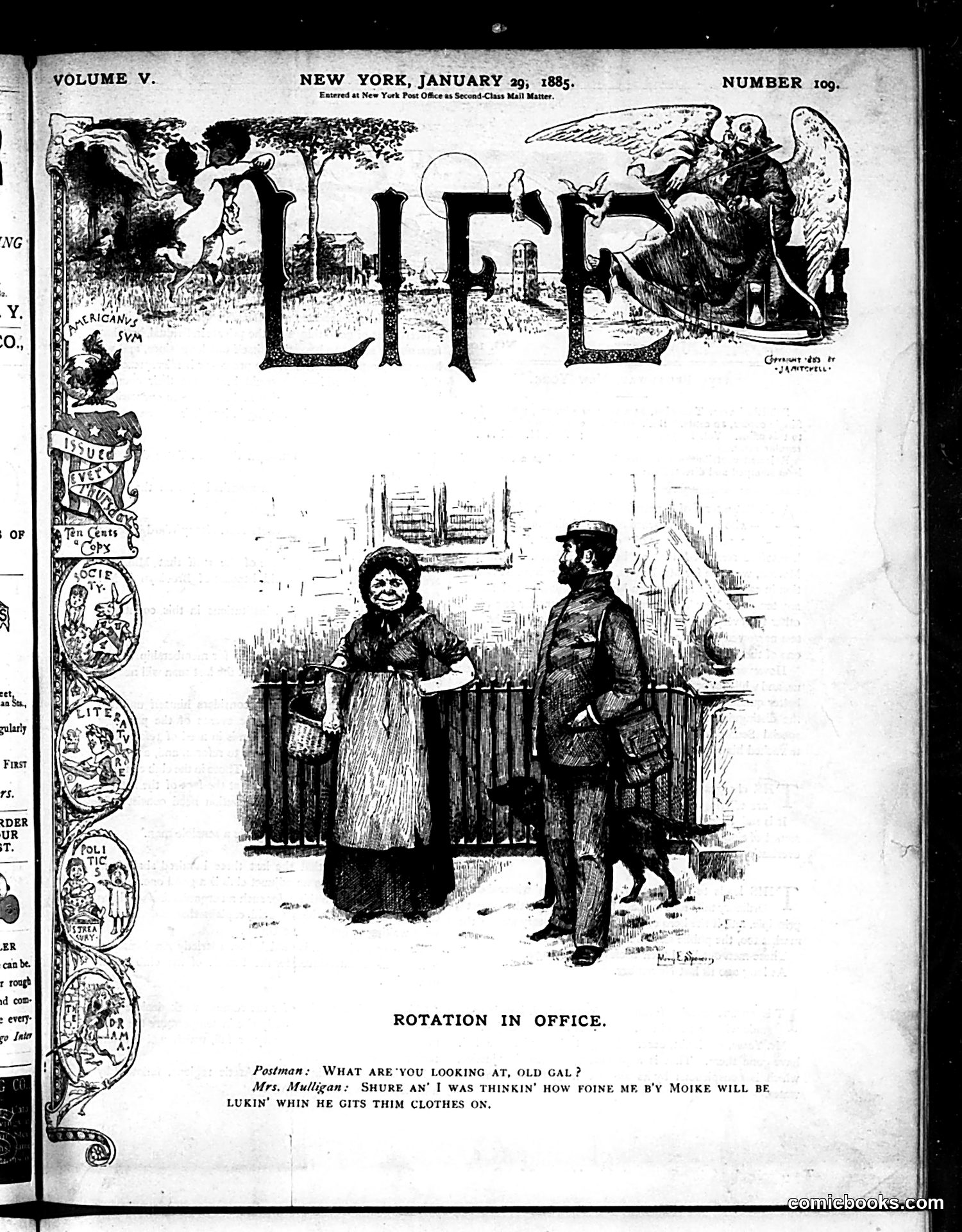
This political cartoon satirizes the spoils system practice of "rotation in office"—replacing government workers when a new political party takes power. The scene shows a postman and a woman at a fence. The postman says he's looking at "an old gal" (the current officeholder), implying she'll be replaced. Mrs. Mulligan responds that she thought "how poine me b'y Moike will be lukin' whin he gits thim clothes on"—suggesting her relative Moike will get the job next. The Irish dialect and names ("Moike," "b'y") reflect 1880s stereotypes about Irish-American political patronage networks. The cartoon mocks how government positions were distributed through personal connections and party loyalty rather than merit, with jobs constantly changing hands based on politics rather than competence.
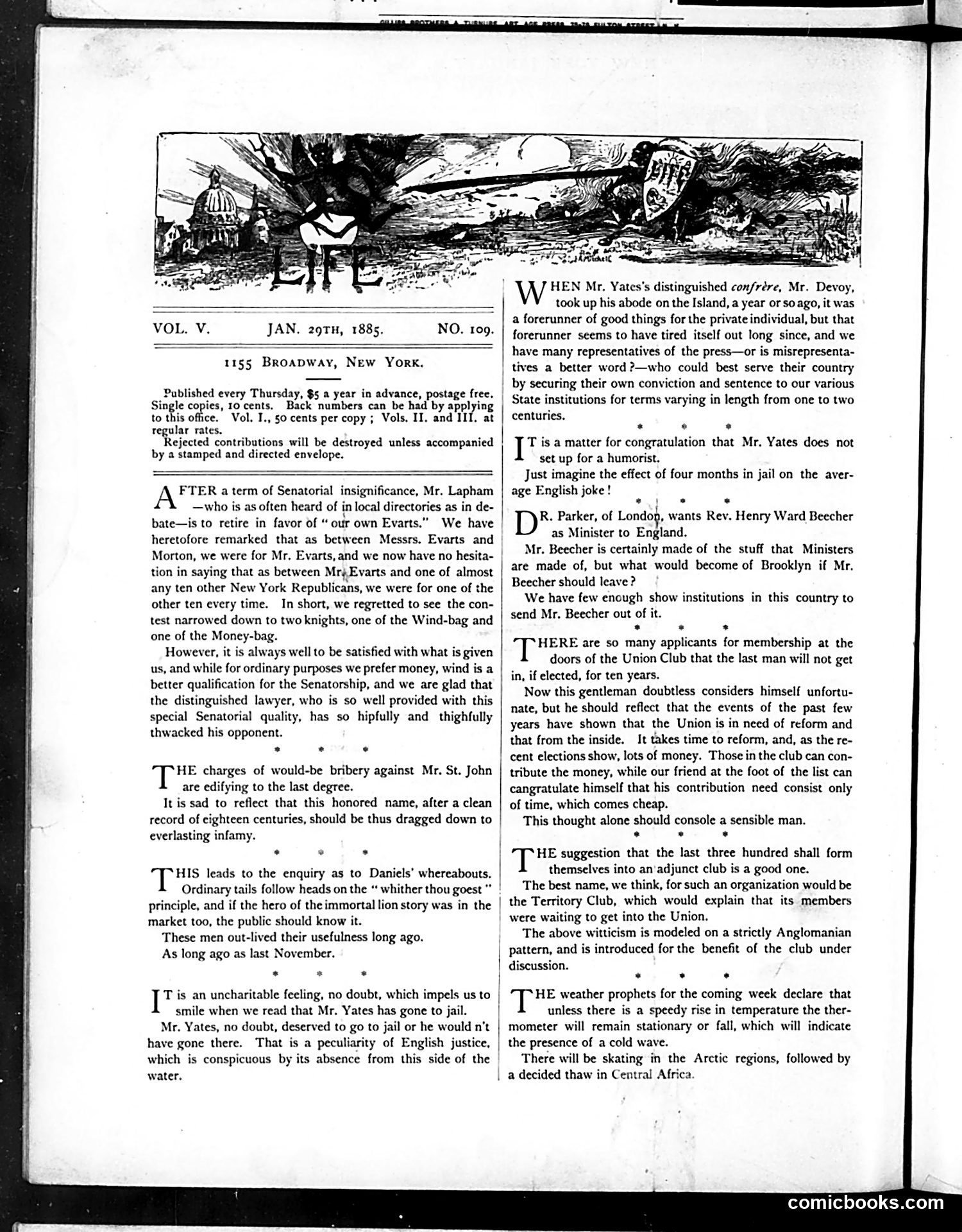
The header cartoon appears to depict a chaotic scene with dark, dramatic imagery—possibly satirizing political turmoil or social disorder of the period, though specific figures are unclear from this reproduction. The editorial content references several contemporary figures: Mr. Yates (apparently jailed), Mr. Lapham (a New York Senator), Mr. Evarts and Mr. Morton (Republican politicians), and Rev. Henry Ward Beecher (a prominent Brooklyn minister). The pieces mock political insignificance, bribery accusations against St. John, and controversies surrounding institutional membership (the Union Club). The satire targets elite New York politics and social institutions, suggesting corruption, hypocrisy among the powerful, and the absurdity of exclusive club politics. The tone is sardonic commentary on 1880s New York establishment figures and their questionable conduct.
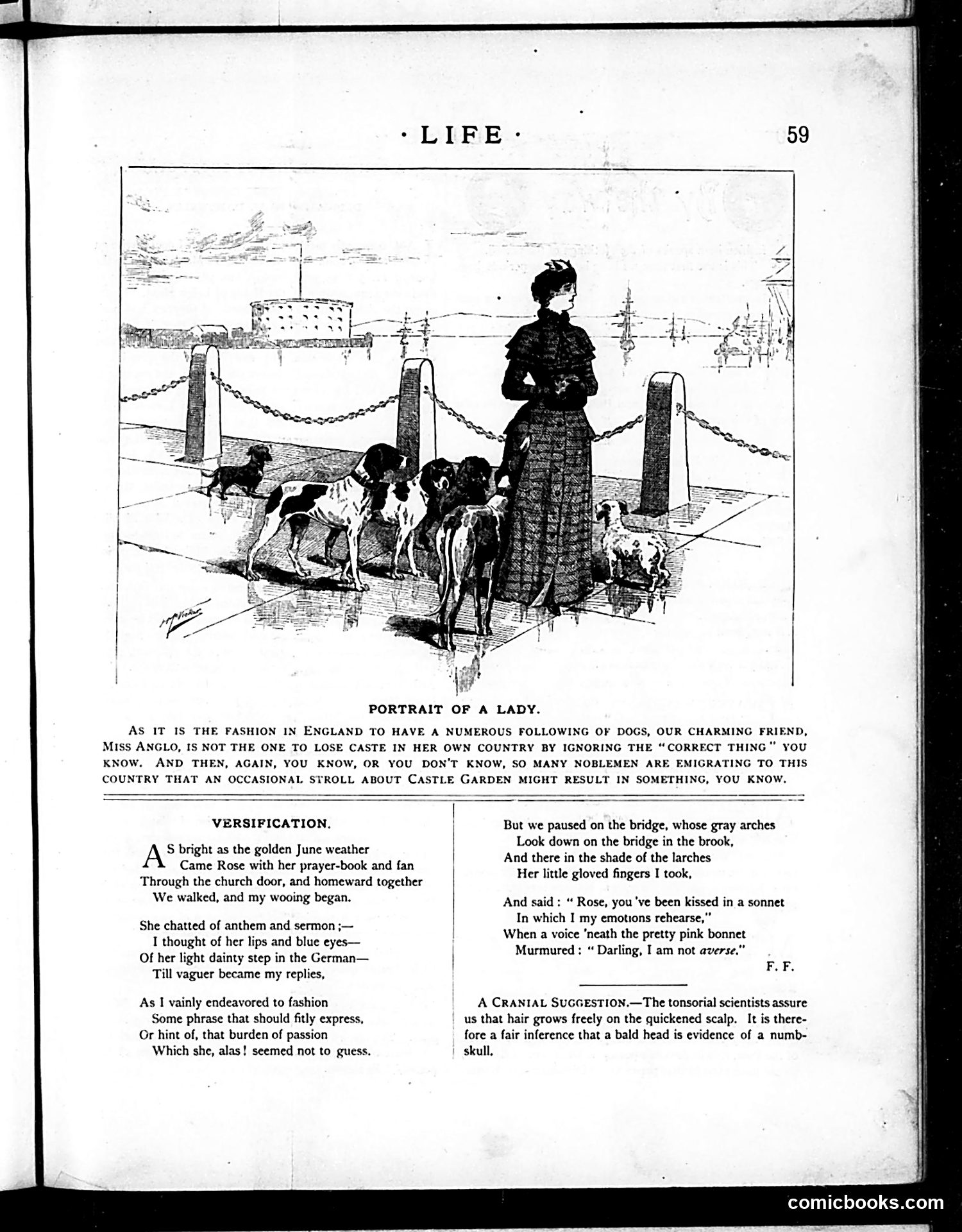
The main illustration, titled "Portrait of a Lady," satirizes English high society's fashion obsession. It depicts a wealthy woman walking multiple dogs along what appears to be a waterfront promenade—likely a fashionable public space where the elite displayed their status. The accompanying caption mocks how English aristocratic women maintained large dog retinues as status symbols, suggesting this practice was so common that "an occasional stroll about Castle Garden might result in something, you know." The poem "Versification" below appears to be romantic verse about a courtship walk, while "A Cranial Suggestion" offers a humorous jab at bald men, implying baldness indicates low intelligence. The satire targets vanity and superficiality in upper-class society.
This page contains satirical commentary and a ghost story rather than political cartoons. The left column includes brief satirical notes on contemporary topics: - A fashion item mocking women's "stockings of the period" - Commentary on Rhode Island and Delaware's understanding of national value - Satire about prohibition-era spending on liquor - A joke about cork's buoyancy despite its chemical composition - A typographical error complaint in the *Lowell Citizen* - Notes on actress Marion Elmore's upcoming management by her husband - A reference to Mrs. Spriggins' criticism of hero worship in theater The right side features "A Contemporaneous Ghost Story" dedicated to W.D. Howells, a fiction piece about encountering a ghost claiming to be from the future, critiquing contemporary literary references and anachronisms.
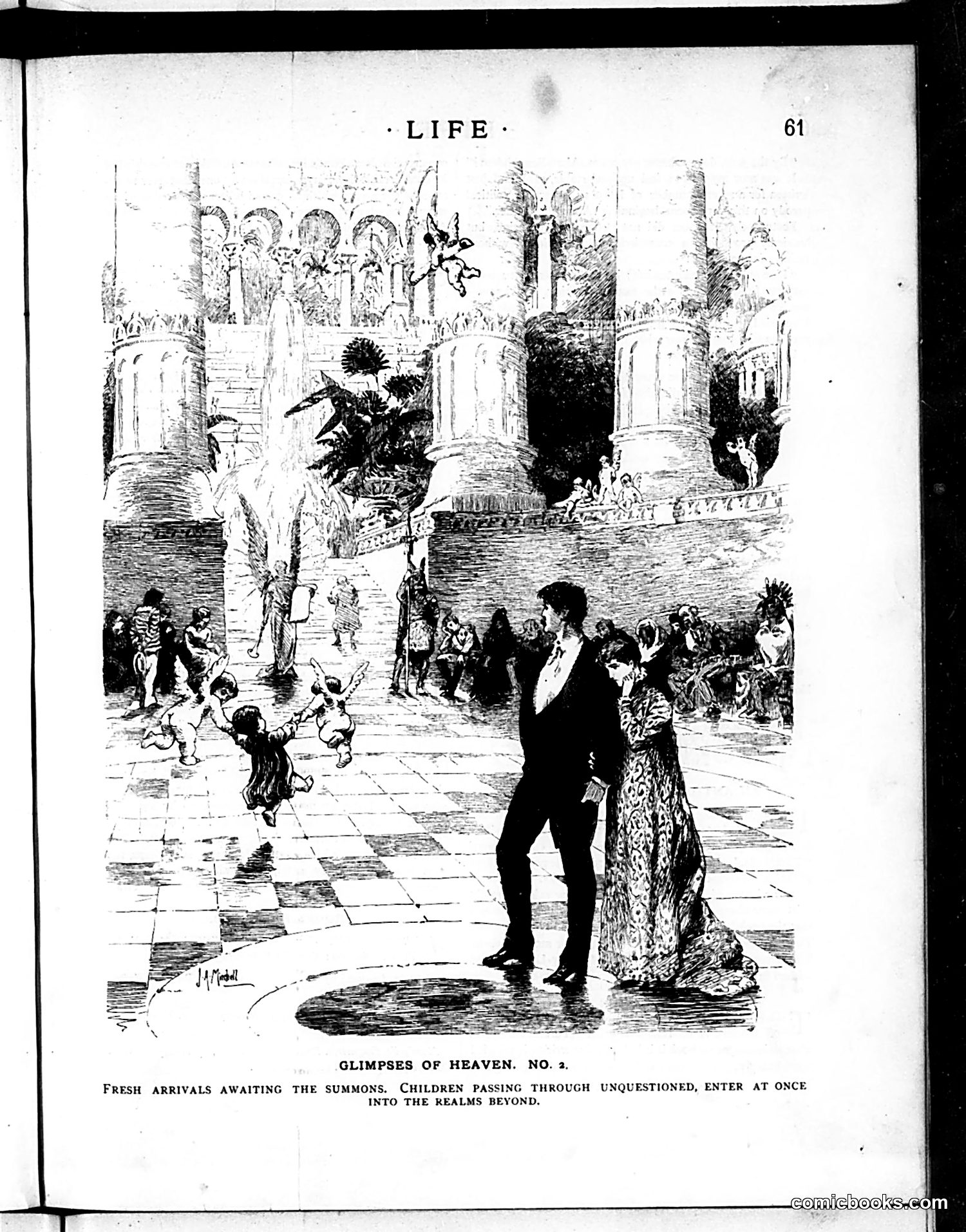
This satirical illustration depicts children entering heaven through grand classical architecture, with an adult couple in formal dress prominently positioned in the foreground. The caption states: "Fresh arrivals awaiting the summons. Children passing through unquestioned, enter at once into the realms beyond." The satire appears to contrast the innocence of children—who enter heaven without judgment—against implied adult corruption or moral compromise. The formal-dressed figures in the center likely represent worldly adults awaiting judgment, suggesting that material success and social status offer no advantage in the afterlife. This reflects common Victorian-era religious sentiment about childhood innocence versus adult moral failings, using heaven's entry requirements as social commentary on earthly hypocrisy.
This page contains literary book reviews rather than political cartoons. The content discusses several works including Mathilde Blind's novel "Tarantella" and poems by Edith M. Thomas. The reviews are satirical commentary on contemporary literature. One section criticizes "Tarantella" for being a romance disguised as realism, noting its "glaring faults" and unrealistic "Fancy-Land" elements. Another review mocks verbose poetry lacking melody and clarity, though praising some verses like "Dew of Parnassus" and "South and West." The page concludes with a "Books Received" section listing recent publications. This represents Life's literary criticism function—using satire to critique contemporary authors and their work rather than political figures.
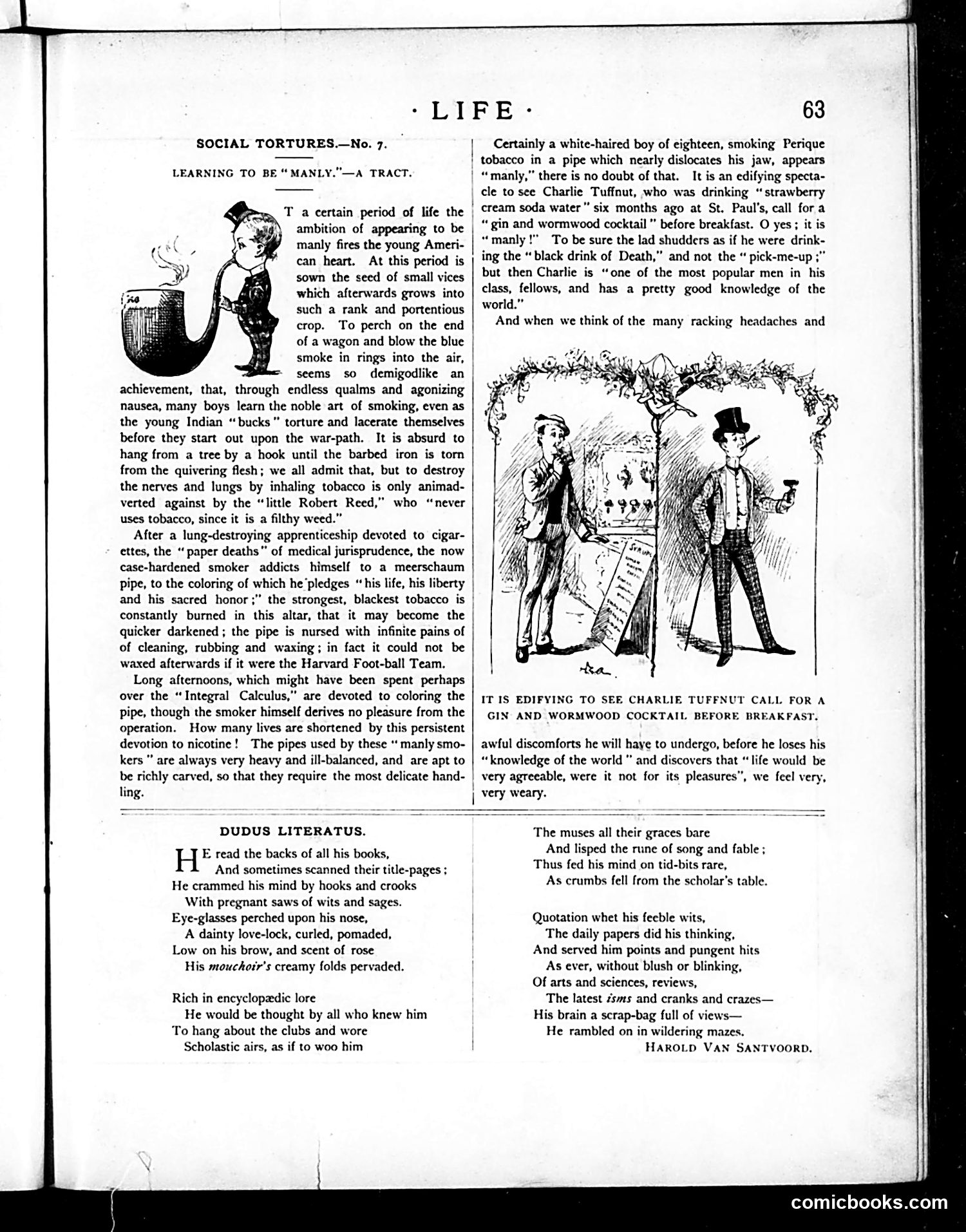
This satirical piece mocks young American men's adoption of smoking and drinking as markers of sophistication and adulthood. The text ridicules adolescents who torture themselves with cigarettes and alcohol to appear "manly," citing the example of "Charlie Tuffnut" drinking gin and wormwood cocktails before breakfast at St. Paul's. The cartoon depicts well-dressed men examining what appears to be a pipe or tobacco product, suggesting the ritualistic, performative nature of such vices among the upper class. The satire targets the paradox: these youths endure physical suffering—shortened lives, poor health—merely to signal worldliness and maturity. The piece critiques this shallow masculine posturing as ultimately self-destructive and foolish, suggesting that true manhood requires neither tobacco nor alcohol.
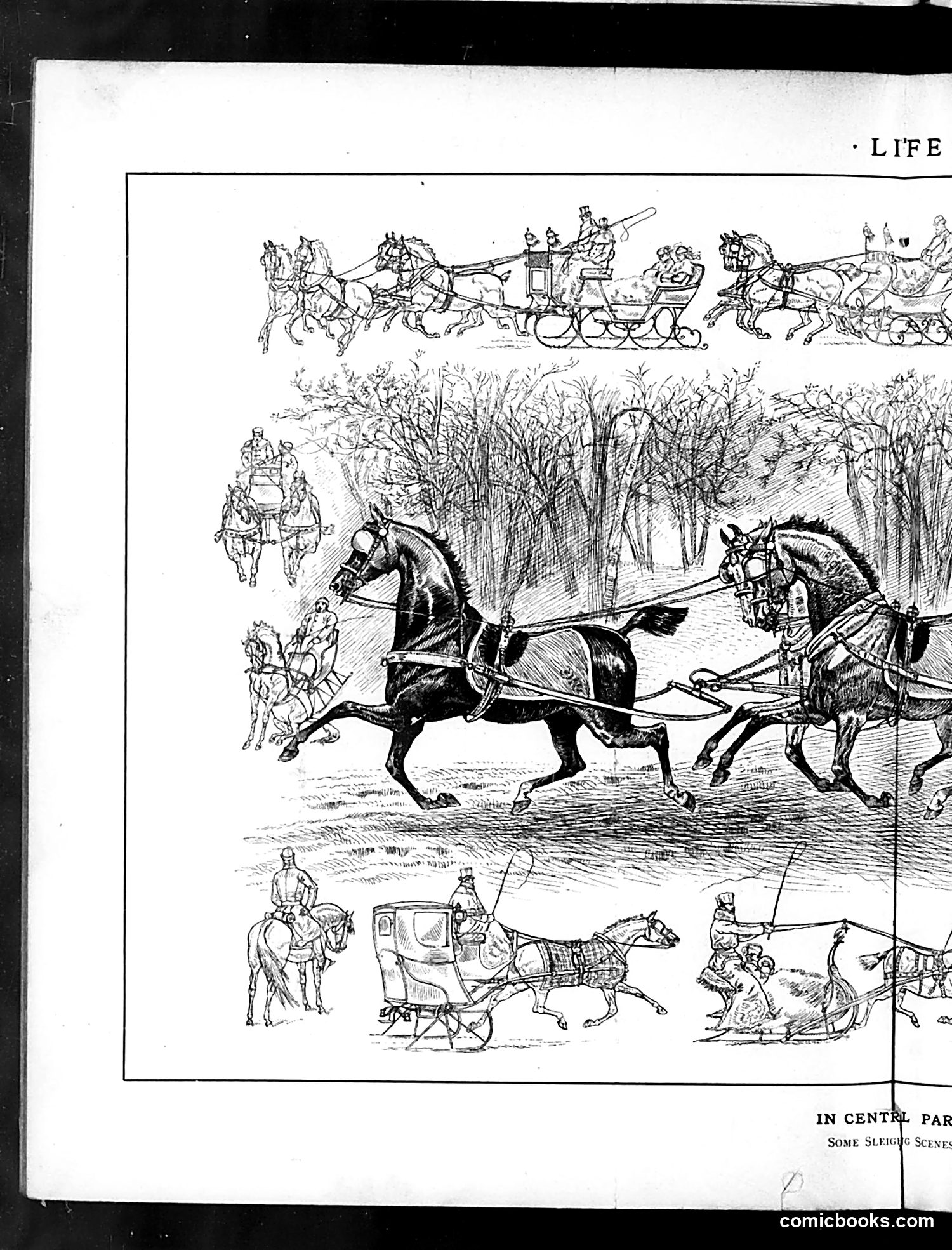
This page from *Life* magazine shows "Some Sleighing Scenes in Central Park" — a series of illustrations depicting winter recreational activities in New York's Central Park. The drawings depict various horse-drawn sleighs and carriages in motion, along with people riding and walking. The caption at bottom reads "IN CENTRAL PARK" and "SOME SLEIGHING SCENES," indicating this is straightforward observational illustration rather than political satire. The detailed ink sketches capture leisure activities of the era — wealthy New Yorkers enjoying winter transportation and recreation with fine horses and elaborate sleighs. This appears to be *Life*'s typical satirical-magazine content: humorous social observation of upper-class activities and fashions, rather than pointed political commentary. The artistic focus is on accurately depicting the scene's details and movement.
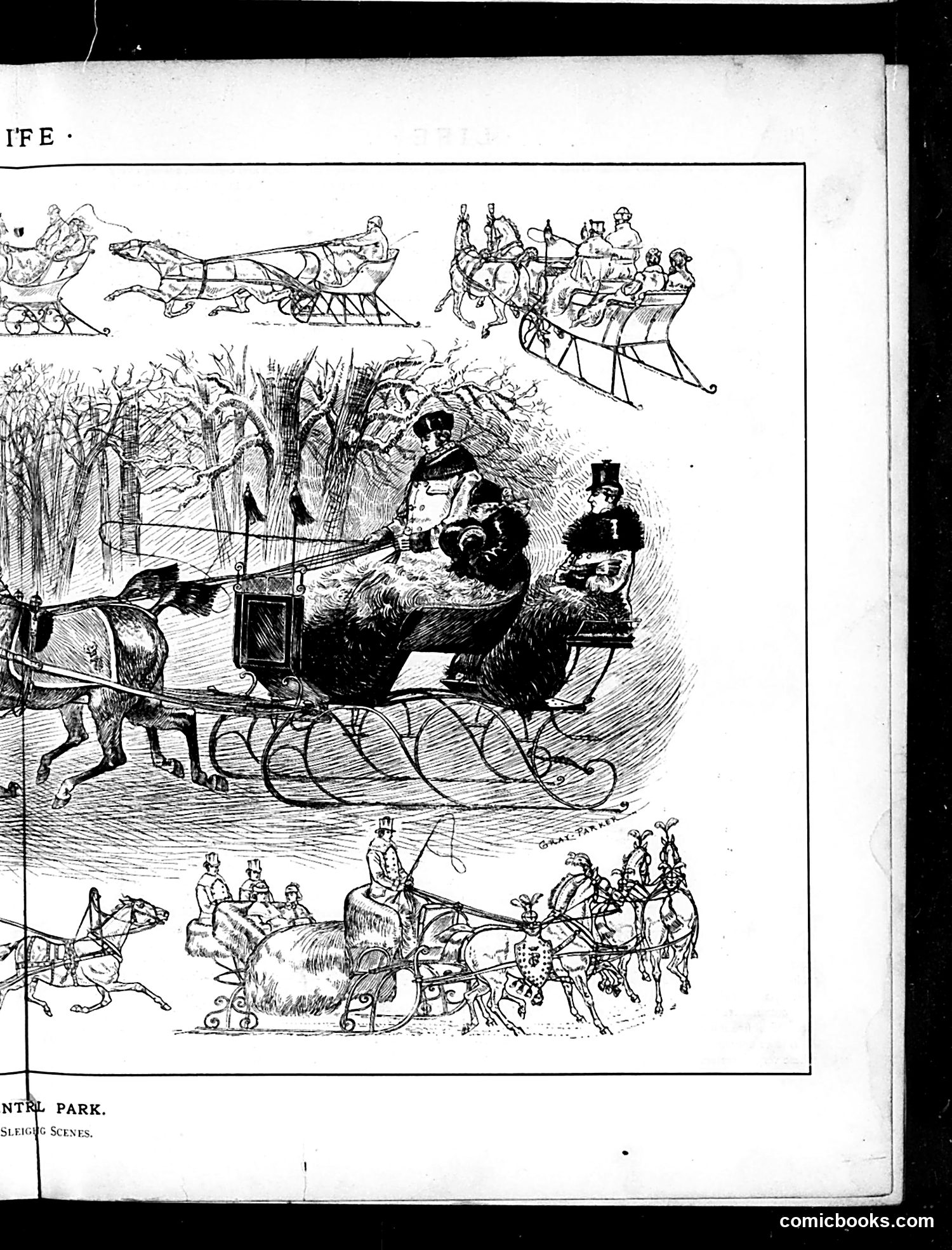
This page from *Life* magazine depicts winter sledding activities in Central Park with satirical commentary on fashionable New York society. The illustrations show elegantly dressed figures in sleighs drawn by horses, with exaggerated caricatures emphasizing their ostentatious clothing and postures. The humor appears to mock the pretensions of wealthy New Yorkers parading through the park—their elaborate fur coats, formal attire, and self-important demeanor while engaged in the simple activity of sledding. The contrast between the dignified poses and the undignified nature of sledding creates comic effect. This reflects *Life*'s typical satirical approach to lampooning upper-class affectations and the social performance of wealth in Gilded Age America. The specific individuals remain unclear without additional context.
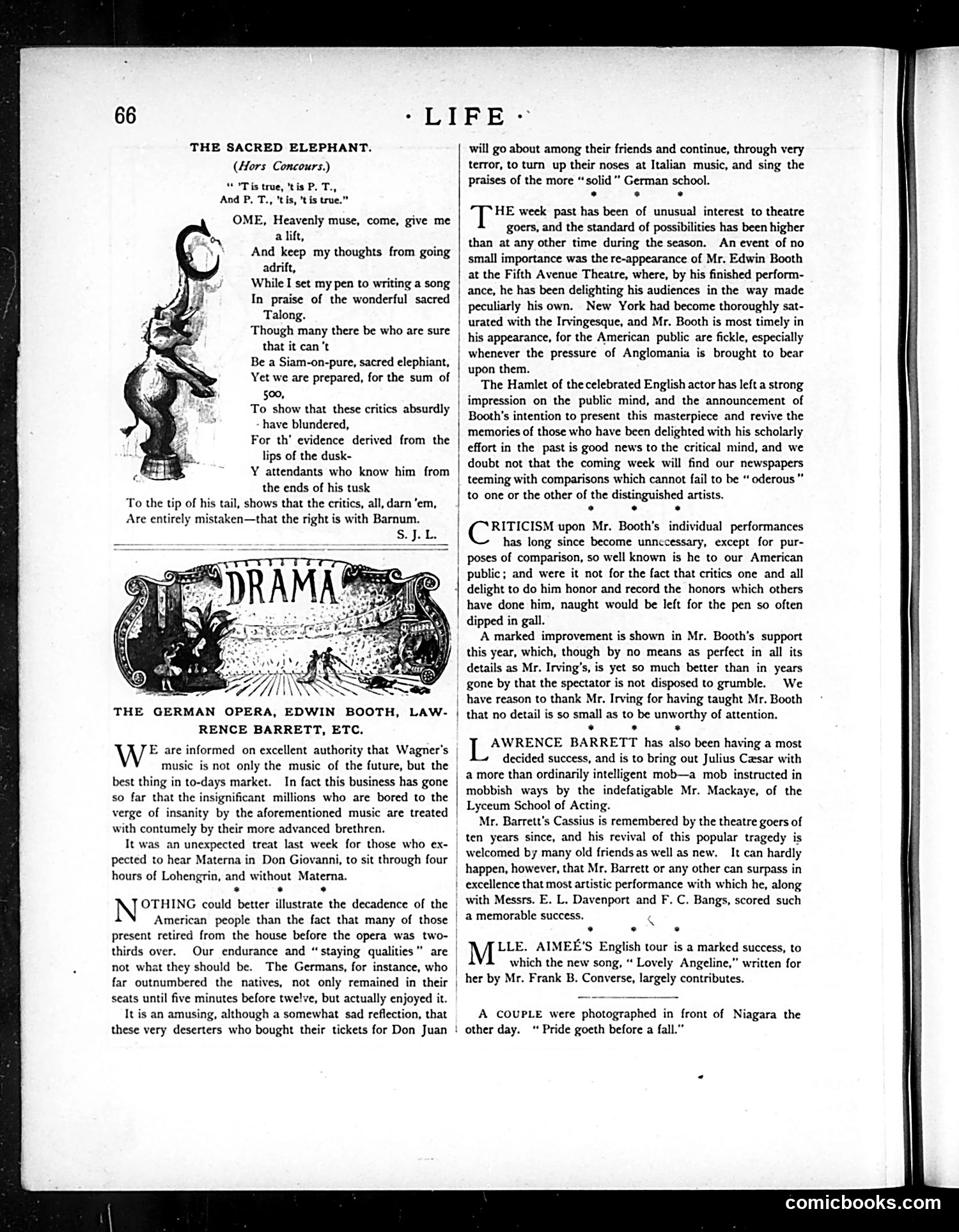
This page contains satirical commentary on contemporary American culture, circa the 1880s-1890s. **The Sacred Elephant cartoon** mocks P.T. Barnum's famous exhibition of "Jumbo," a celebrated elephant. The poem's playful language ("Siam-on-pure") jokes that Barnum will convince paying audiences of the elephant's authenticity despite skeptics' doubts—referencing Barnum's reputation for sensational (sometimes fraudulent) showmanship. **The theater section** critiques both Wagner's music and American cultural snobbery. Life mocks audiences who sit through tedious Lohengrin performances, then pretend to enjoy "solid" German opera while dismissing Italian music as inferior. The commentary on Edwin Booth versus English actor Henry Irving reflects competition between American and English theatrical traditions, with Booth's return positioned against the fashionable "Anglomania" afflicting American audiences. The underlying satire: Americans blindly follow European (especially German and English) cultural trends while dismissing homegrown talent, and pretend sophistication they don't genuinely feel.
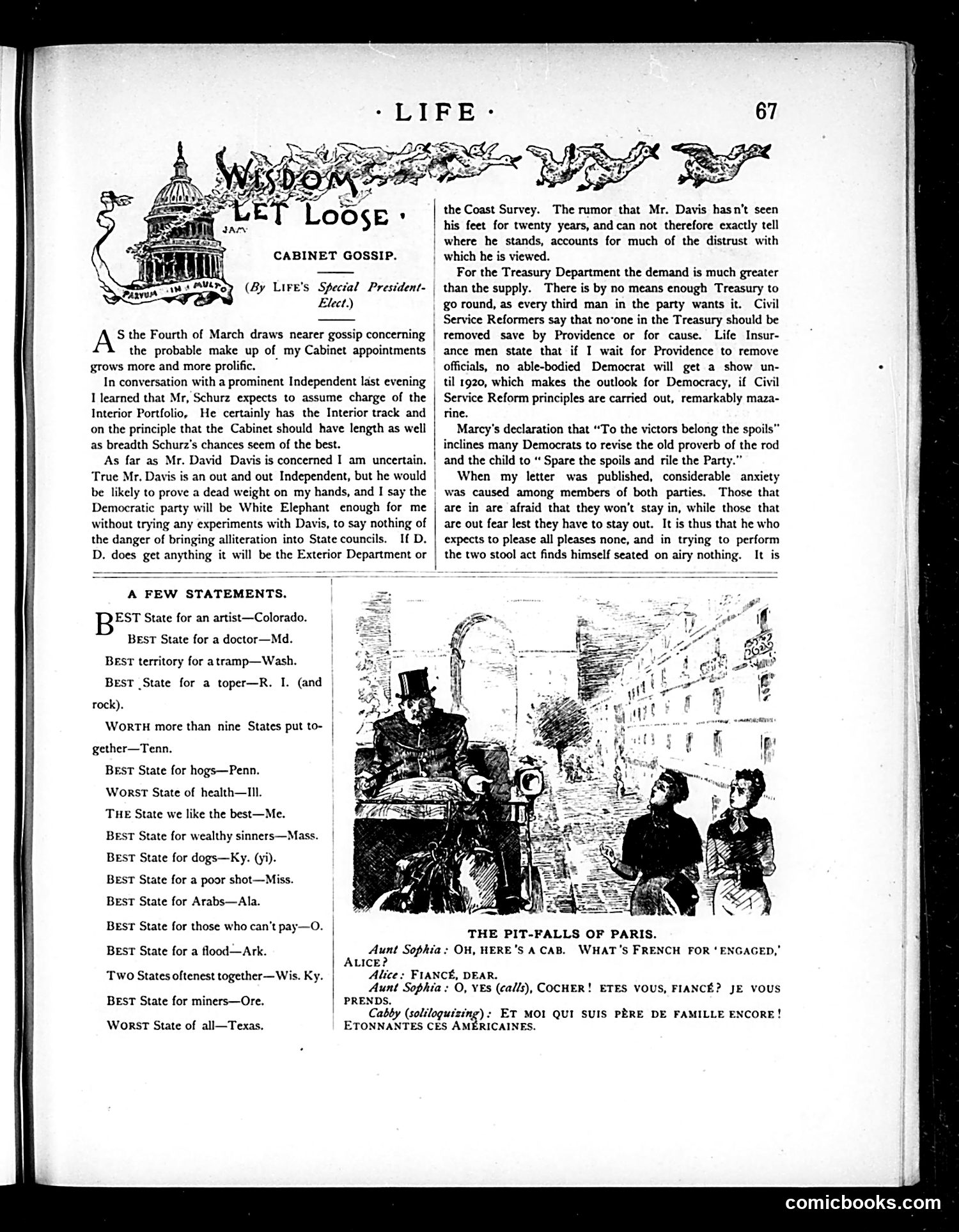
This page satirizes President-elect Hayes's upcoming cabinet selections (March 4, 1877). The "Cabinet Gossip" column mockingly discusses potential appointees like Carl Schurz and David Davis, with particular ridicule of Davis—described as so overweight he "hasn't seen his feet for twenty years" and thus "can not therefore exactly tell where he stands," a joke on his political uncertainty. The satire targets the "spoils system" debate: Democrats want patronage ("To the victors belong the spoils"), while Civil Service Reformers oppose removing officials without cause. Hayes is mocked for attempting to please both sides, finding himself "seated on airy nothing." The "Few Statements" section contains state-based jokes (Texas as "worst state of all," Kentucky for dogs, etc.)—period stereotypes rather than serious commentary. The cartoon "Pit-Falls of Paris" appears unrelated—a humorous scene where a cab driver mistakes "fiancé" (engaged) for his potential marital status, expressing shock at family obligations.
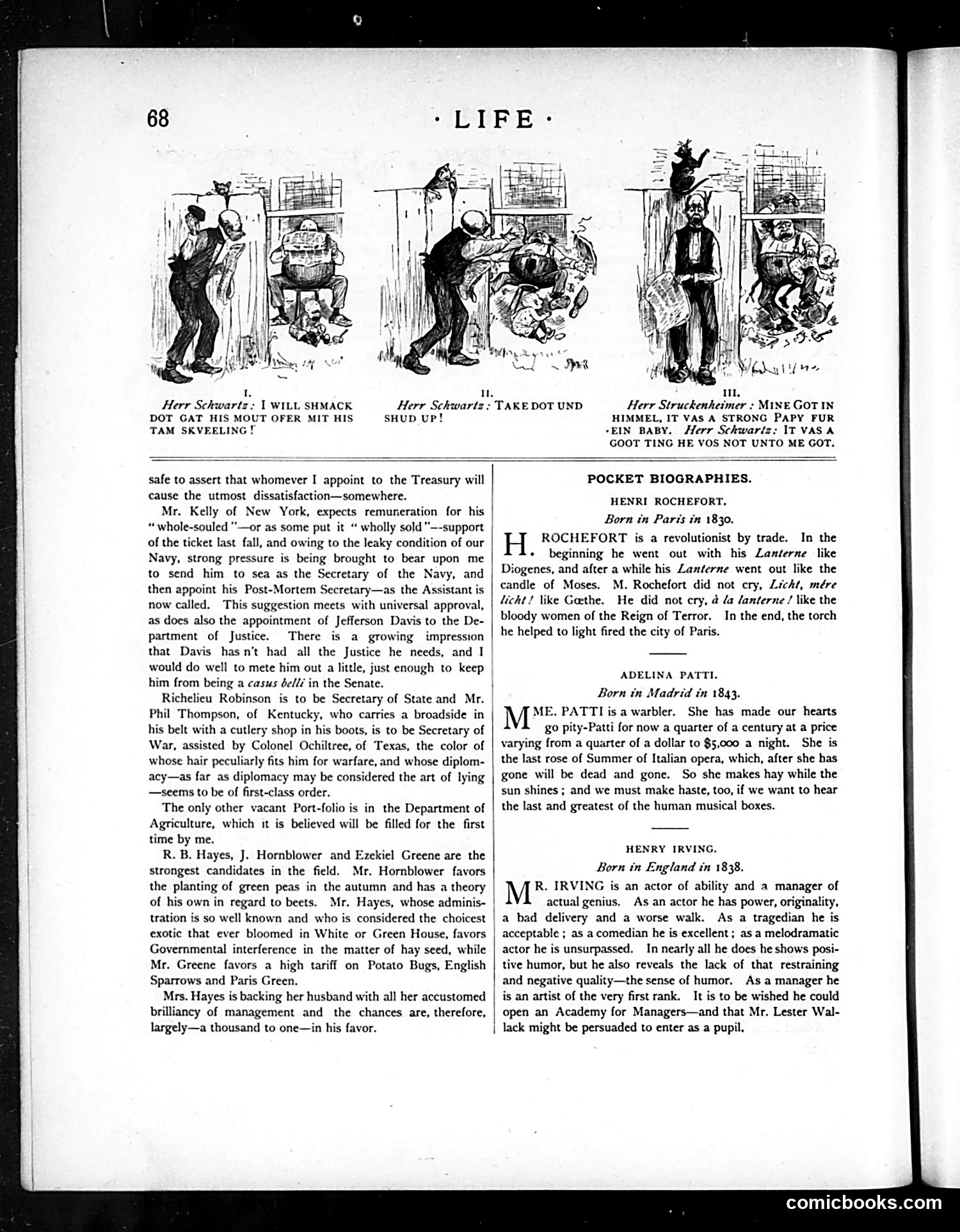
The three cartoon panels at top mock German immigrants through caricature and dialect humor. "Herr Schwartz" and companions speak in exaggerated German-accented English ("shmack," "mout ofer," "tam skveeling"), a common 19th-century American stereotype. The humor depicts working-class German fathers quarreling over child-rearing—one threatens to hit his child's mouth with his tam (cap), another boasts his baby is strong, the third jokes his child wasn't beaten. This reflects period anxieties about immigrant parenting styles and assimilation. The main text is satirical political commentary on presidential appointments, likely referencing the Hayes administration (mentioned explicitly). It mockingly describes various candidates for cabinet positions, using absurdist humor—suggesting the Agriculture Secretary should be chosen from men with theories about peas and beets. The "Pocket Biographies" section profiles public figures: Henri Rochefort (French revolutionary), Adelina Patti (opera singer), and Henry Irving (actor)—brief, witty character sketches typical of Life's satirical style.
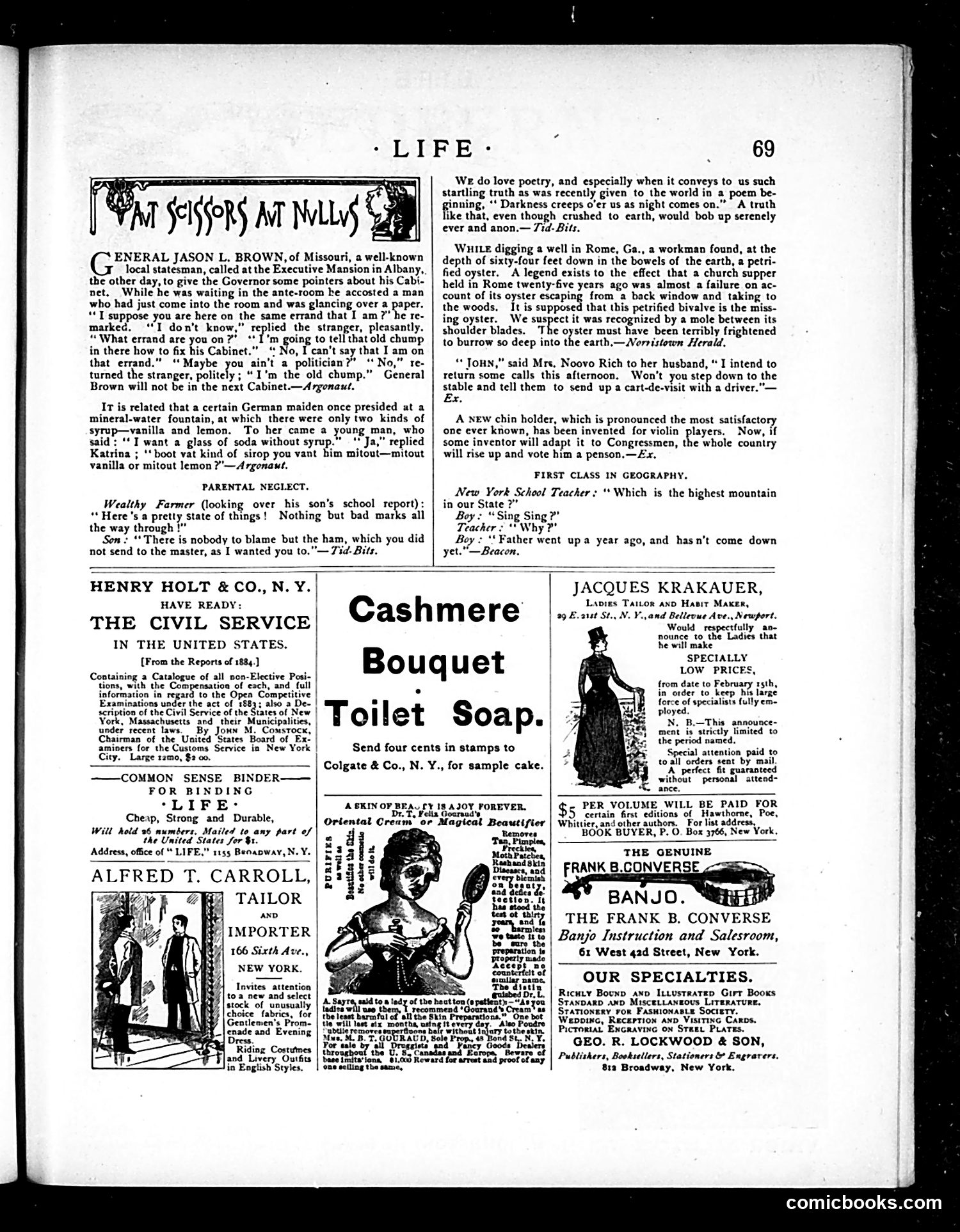
## Main Cartoons/Sketches: **"Scissors at Nulls"** presents a joke about political ambition. A self-important Missouri politician, General Jason L. Brown, approaches a stranger to boast about advising the Governor on Cabinet appointments. The stranger reveals he's actually "the old chump"—the Governor himself—deflating the general's pretensions with cutting wit. ## Supporting Humor: The page includes three brief comedic anecdotes ridiculing: - A German waitress's logical confusion (asking which syrup to *exclude* from "syrup-free" soda) - A farmer blaming his son's poor school marks on the teacher rather than parental negligence - A geography teacher's student claiming his father went up a mountain in New York and never returned ## Context: These sketches exemplify Life's satirical focus on human folly—pompous politicians, logical absurdities, and parental irresponsibility. The humor relies on irony and the exposed gap between characters' self-regard and reality. The page is primarily **advertisements** (soap, tailoring services, instruction manuals) typical of the era.
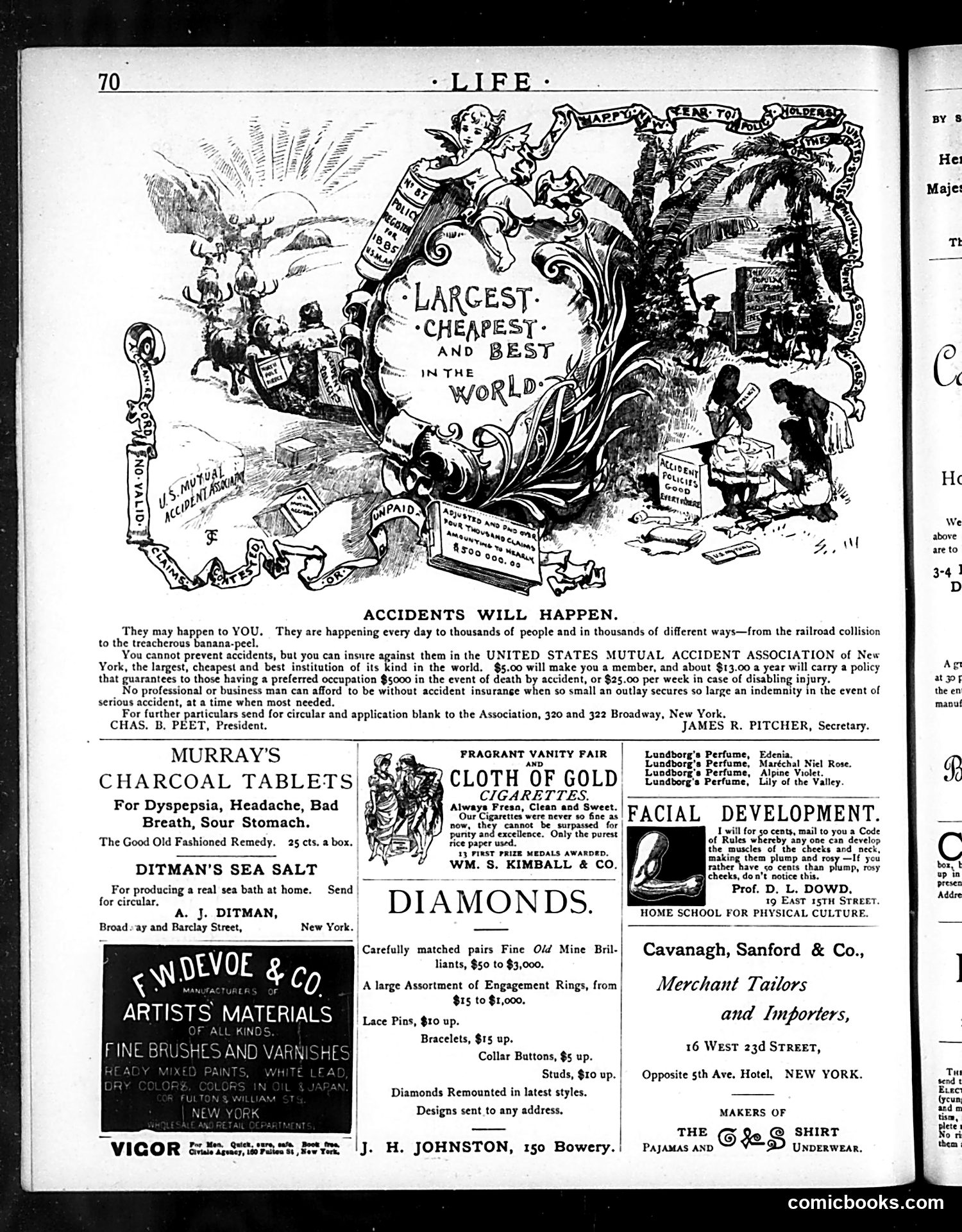
The dominant image is a large decorative advertisement for the **United States Mutual Accident Association**, an insurance company. The ornate frame contains chaotic scenes depicting various accidents—railway collisions, people falling, industrial mishaps—illustrating the message "ACCIDENTS WILL HAPPEN." The satire plays on contemporary anxieties about industrial-age dangers (railroads, machinery, everyday hazards like "the treacherous banana-peel"). The insurance company's pitch is darkly humorous: you cannot prevent accidents, but for just $5 membership and ~$13 yearly, working-class and professional men could secure substantial payouts ($5,000 death benefit or $25/week disability). The surrounding page consists entirely of period **advertisements**—for charcoal tablets, diamonds, perfumes, tailoring services, and other luxury goods—typical of Life's revenue model. The cartoon reflects real concerns about workplace safety and mortality in the Gilded Age, when accident insurance was genuinely novel and necessary.
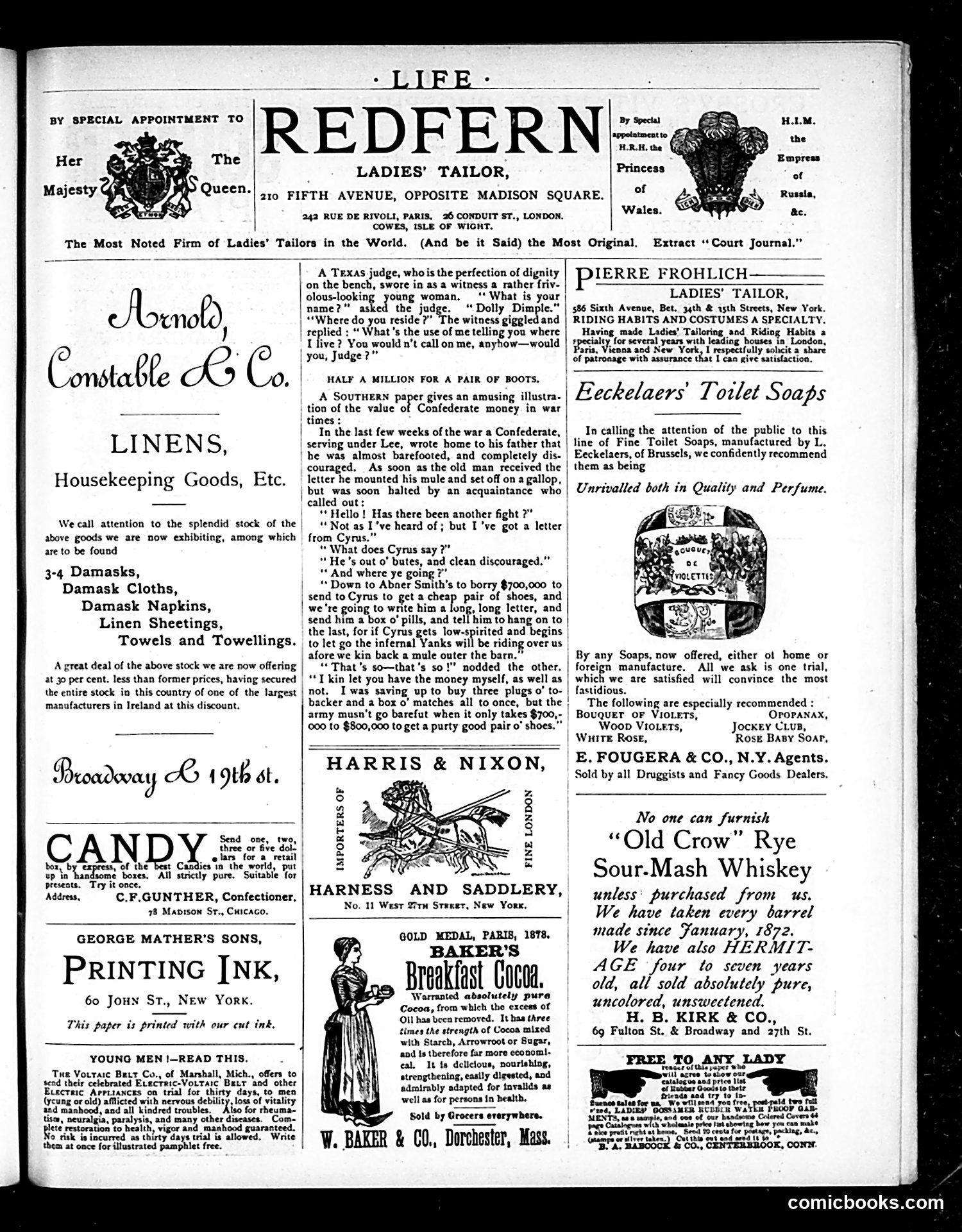
This is primarily an **advertising page** from Life magazine featuring luxury goods (ladies' tailors, linens, candy, printing ink) mixed with light humor pieces. The page contains two brief **satirical anecdotes**: 1. **"The Flirtatious Witness"**: A Texas judge swears in a frivolous young woman named "Dolly Dimple" who cheeky asks why he'd bother calling on her—mocking courtroom decorum and suggesting her appearance makes social calls unlikely. 2. **"Half a Million for Boots"**: A **Civil War-era joke** about Confederate currency's worthlessness. A Southern father is willing to spend $700,000-$800,000 in nearly-valueless Confederate money just to buy his son Cyrus a cheap pair of shoes, showing how inflation destroyed the currency's purchasing power by war's end. Both pieces use rustic Southern dialect for comedic effect. These are gentle period humor pieces rather than sharp political satire—the Confederate story reflects post-war nostalgia rather than serious commentary.
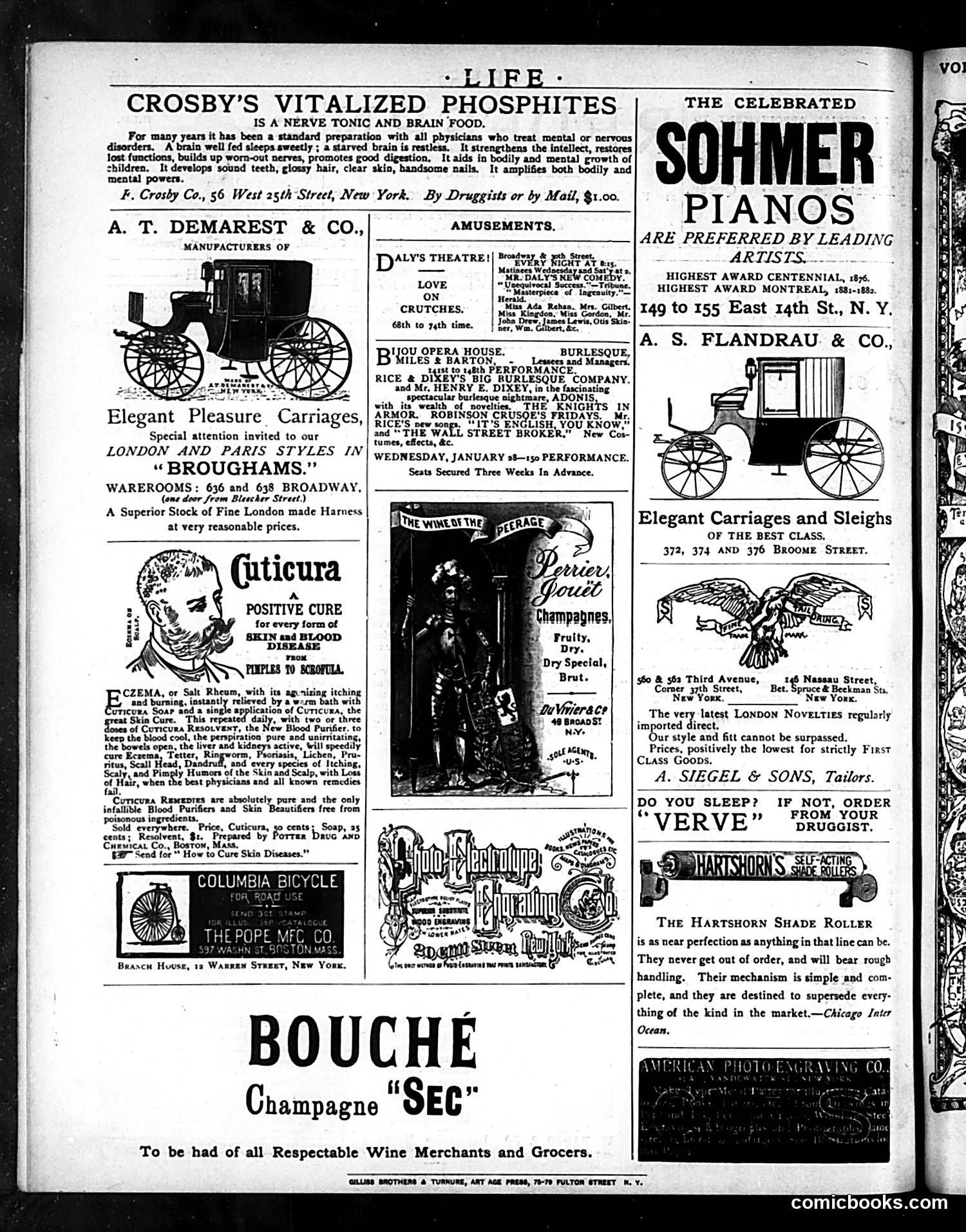
This is **primarily an advertisement page** from Life magazine, not a satirical cartoon page. It contains no political cartoons or satire. The page features period product advertisements typical of late 19th-century America, including: - **Patent medicines** (Crosby's Phosphites for nerve/brain health; Cuticura for skin diseases; Verve for sleep) - **Luxury goods** (Sohmer pianos, carriages and sleighs by multiple manufacturers) - **Champagne and wine** (Bouché brand) - **Theater notices** (Daly's Theatre, Bijou Opera House burlesque) The advertisements reflect Victorian anxieties about health, wealth, and status. The medical claims are extravagant by modern standards—Cuticura promises to cure virtually all skin conditions, while Crosby's Phosphites claims to restore intellect and build mental powers. **This is essentially a commercial page with no satirical content to analyze.**