
Life, 1885-01-29 · page 4 of 16
Life — January 29, 1885 — page 4: what you’re looking at
What you’re looking at
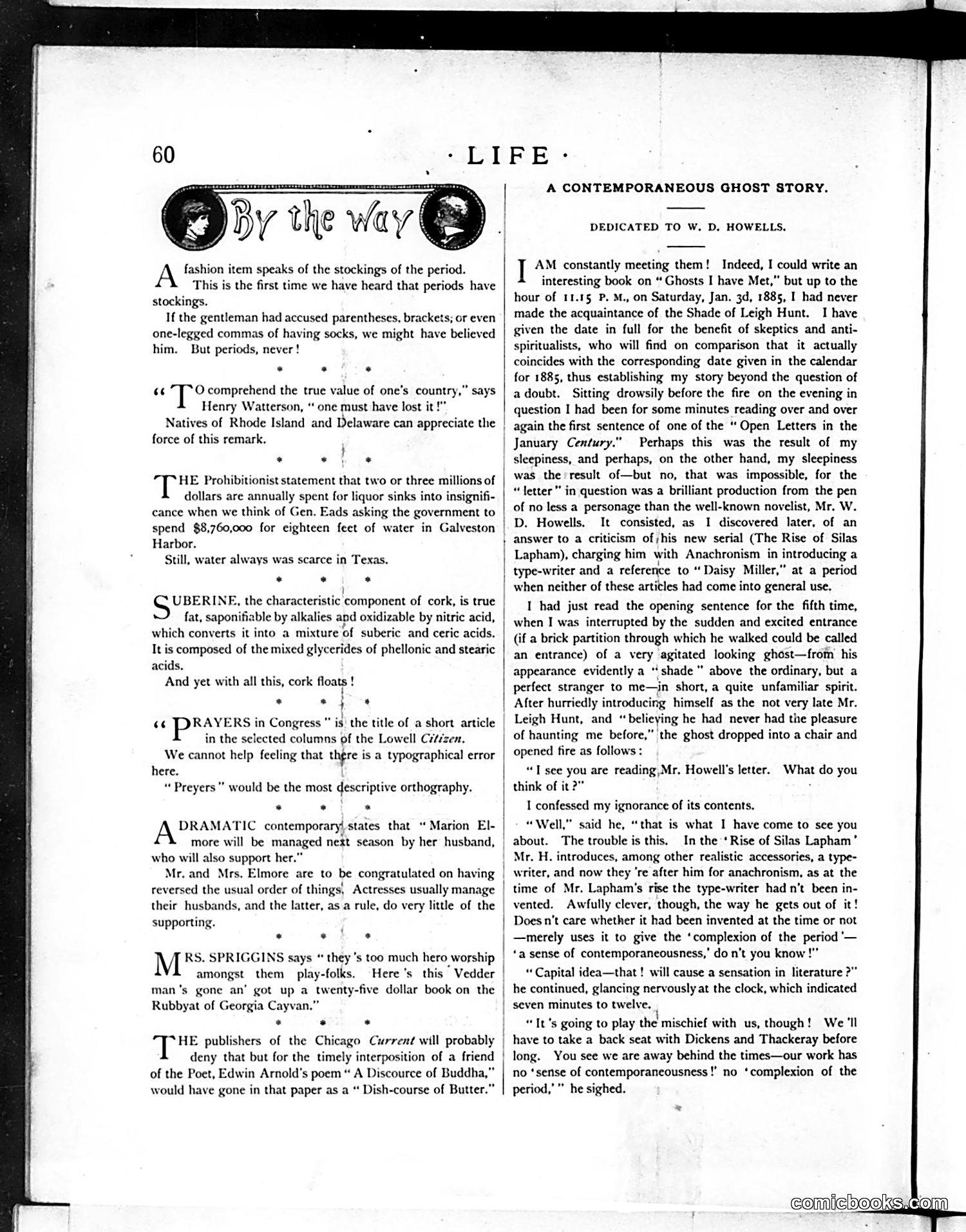
This page contains satirical commentary and a ghost story rather than political cartoons. The left column includes brief satirical notes on contemporary topics: - A fashion item mocking women's "stockings of the period" - Commentary on Rhode Island and Delaware's understanding of national value - Satire about prohibition-era spending on liquor - A joke about cork's buoyancy despite its chemical composition - A typographical error complaint in the *Lowell Citizen* - Notes on actress Marion Elmore's upcoming management by her husband - A reference to Mrs. Spriggins' criticism of hero worship in theater The right side features "A Contemporaneous Ghost Story" dedicated to W.D. Howells, a fiction piece about encountering a ghost claiming to be from the future, critiquing contemporary literary references and anachronisms.
📄 Transcribed text from this page (OCR, searchable)
Machine-transcribed from the original scan — historical spelling and the odd misread are preserved.
LIFE - A fashion item speaks of the stockings of the period. This is the first time we have heard that periods have stockings. If the gentleman had accused parentheses, brackets; or even one-legged commas of having socks, we might have believed him. But periods, never! . . * “ O comprehend the true value of one’s country,” says Henry Watterson, “ one must have lost it!" Natives of Rhode Island and Delaware can appreciate the force of this remark. . # eee HE Prohibitionist statement that two or three millions of dollars are annually spent for liquor sinks into insignifi- cance when we think of Gen. Eads asking the government to | spend $8,760,000 for eighteen fect of water in Galveston Harbor. Still, water always was scarce in Texas. * * * UBERINE, the characteristic component of cork, is true fat, saponifiable by alkalies and oxidizable by nitric acid, which converts it into a mixture of suberic and ceric acids. It is composed of the mixed glycerides of phellonic and stearic acids. And yet with all this, cork floats ! “ce RAYERS in Congress ” is: the title of a short article in the selected columns of the Lowell Cztzzen. We cannot help feeling that there is a typographical error here. “ Preyers” would be the most descriptive orthography. . . * DRAMATIC contemporary} states that “ Marion El- more will be managed next season by her husband, who will also support her.” Mr. and Mrs. Elmore are to be congratulated on having reversed the usual order of things, Actresses usually manage their husbands, and the latter, as a rule, do very little of the supporting. ‘ . * ° i RS. SPRIGGINS says “ they ’s too much hero worship amongst them play-folks. Here's this’ Vedder man's gone an’ got up a twenty-five dollar book on the | Rubbyat of Georgia Cayvan.” * . . AB HE publishers of the Chicago Current will probably deny that but for the timely interposition of a friend of the Poet, Edwin Arnold's poem “ A Discource of Buddha,” would have gone in that paper as a “ Dish-course of Butter.” A CONTEMPORANEOUS GHOST STORY. DEDICATED TO W. D. HOWELLS. AM constantly meeting them! Indeed, I could write an interesting book on “Ghosts I have Met,” but up to the hour of 11.15 P. M., on Saturday, Jan. 3d, 1885, I had never made the acquaintance of the Shade of Leigh Hunt. I have given the date in full for the benefit of skeptics and anti- spiritualists, who will find on comparison that it actually coincides with the corresponding date given in the calendar for 1885, thus establishing my story beyond the question of adoubt. Sitting drowsily before the fire on the evening in question I had been for some minutes reading over and over | again the first sentence of one of the “ Open Letters in the January Century.” Perhaps this was the result of my sleepiness, and perhaps, on the other hand, my sleepiness was the ‘result of—but no, that was impossible, for the “letter” in question was a brilliant production from the pen of no less a personage than the well-known novelist, Mr. W. D. Howells, It consisted, as I discovered later, of an answer to a criticism of;his new serial (The Rise of Silas Lapham), charging him with Anachronism in introducing a type-writer and a reference to “Daisy Miller,” at a period when neither of these artitles had come into general use. I had just read the opening sentence for the fifth time, when I was interrupted by the sudden and excited entrance (if a brick partition through which he walked could be called an entrance) of a very agitated looking ghost—from his appearance evidently a “shade " above the ordinary, but a perfect stranger to me—in short, a quite unfamiliar spirit. After hurriedly introducing himself as the not very late Mr. Leigh Hunt, and “belieying he had never had the pleasure of haunting me before,” the ghost dropped into a chair and opened fire as follows : “T see you are reading,Mr. Howell's letter. think of it?” I confessed my ignorance of its contents. “Well,” said he, “that is what I have come to sce you | about. The trouble is this. In the ‘ Rise of Silas Lapham’ Mr. H. introduces, among other realistic accessories, a type- writer, and now they ‘re after him for anachronism, as at the time of Mr. Lapham’s rise the type-writer had n't been in- vented. Awfully clever, though, the way he gets out of it! Does n't care whether it had been invented at the time or not | —merely uses it to give the ‘complexion of the period '— | ‘a sense of contemporaneousness,’ do n’t you know !”" “Capital idea—that ! will cause a sensation in literature ?” he continued, glancing nervously at the clock, which indicated seven minutes to twelve. | “It's going to play the mischief with us, though! We'll have to take a back seat with Dickens and Thackeray before | long. You see we are away behind the times—our work has no ‘sense of contemporancousness !’ no ‘complexion of the period,’ ” he sighed. What do you