
Life, 1885-01-29 · page 10 of 16
Life — January 29, 1885 — page 10: what you’re looking at
What you’re looking at
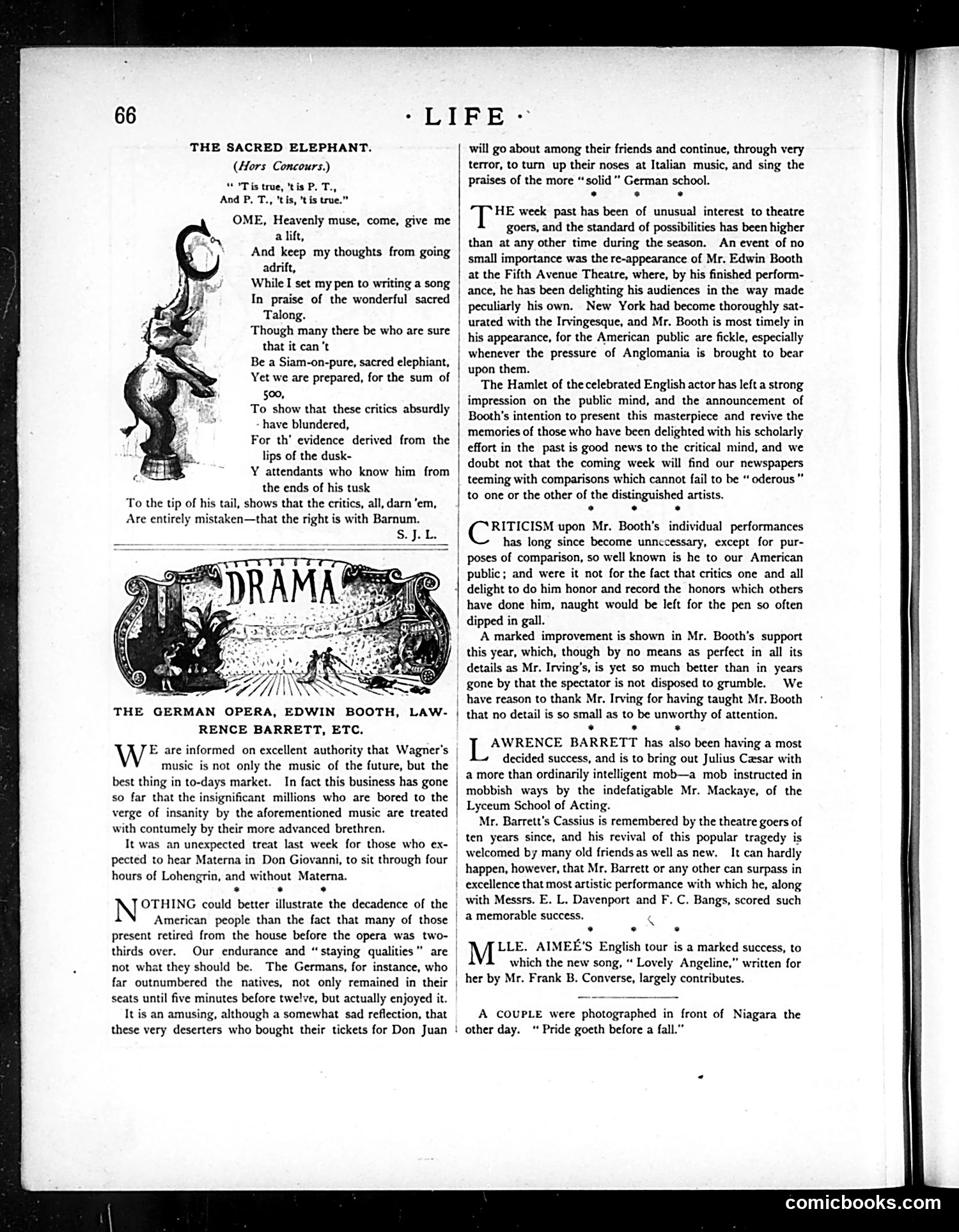
This page contains satirical commentary on contemporary American culture, circa the 1880s-1890s. **The Sacred Elephant cartoon** mocks P.T. Barnum's famous exhibition of "Jumbo," a celebrated elephant. The poem's playful language ("Siam-on-pure") jokes that Barnum will convince paying audiences of the elephant's authenticity despite skeptics' doubts—referencing Barnum's reputation for sensational (sometimes fraudulent) showmanship. **The theater section** critiques both Wagner's music and American cultural snobbery. Life mocks audiences who sit through tedious Lohengrin performances, then pretend to enjoy "solid" German opera while dismissing Italian music as inferior. The commentary on Edwin Booth versus English actor Henry Irving reflects competition between American and English theatrical traditions, with Booth's return positioned against the fashionable "Anglomania" afflicting American audiences. The underlying satire: Americans blindly follow European (especially German and English) cultural trends while dismissing homegrown talent, and pretend sophistication they don't genuinely feel.
📄 Transcribed text from this page (OCR, searchable)
Machine-transcribed from the original scan — historical spelling and the odd misread are preserved.
- LIFE - THE SACRED ELEPHANT. (Hors Concours.) “ "Tis true, 'tis P. T., And P, T., 'tis, "tis true.” OME, Heavenly muse, come, give me a lift, And keep my thoughts from going adrift, While I set my pen to writing a song In praise of the wonderful sacred Talong. Though many there be who are sure that it can’t Be a Siam-on-pure, sacred elephiant, Yet we are prepared, for the sum of 500, To show that these critics absurdly - have blundered, For th’ evidence derived from the lips of the dusk- Y attendants who know him from the ends of his tusk To the tip of his tail, shows that the critics, all, darn ‘em, Are entirely mistaken—that the right is with Barnum. THE GERMAN OPERA, EDWIN BOOTH, LAW- RENCE BARRETT, ETC, E are informed on excellent authority that Wagner's music is not only the music of the future, but the best thing in to-days market. In fact this business has gone so far that the insignificant millions who are bored to the verge of insanity by the aforementioned music are treated | with contumely by their more advanced brethren. It was an unexpected treat last week for those who ex- pected to hear Materna in Don Giovanni, to sit through four hours of Lohengrin, and without Materna. . . . OTHING could better illustrate the decadence of the American people than the fact that many of those present retired from the house before the opera was two- thirds over. Our endurance and “staying qualities” are not what they should be. The Germans, for instance, who far outnumbered the natives, not only remained in their | seats until five minutes before twelve, but actually enjoyed it. It is an amusing, although a somewhat sad reflection, that these very deserters who bought their tickets for Don Juan ‘ other day. will go about among their friends and continue, through very terror, to turn up their noses at Italian music, and sing the Praises of the more “solid” German school. . ° . HE week past has been of unusual interest to theatre goers, and the standard of possibilities has been higher than at any other time during the season. An event of no small importance was the re-appearance of Mr. Edwin Booth at the Fifth Avenue Theatre, where, by his finished perform- ance, he has been delighting his audiences in the way made peculiarly his own. New York had become thoroughly sat- | urated with the Irvingesque, and Mr. Booth is most timely in his appearance, for the American public are fickle, especially whenever the pressure of Anglomania is brought to bear upon them. The Hamlet of the celebrated English actor has left a strong | impression on the public mind, and the announcement of Booth’s intention to present this masterpiece and revive the memories of those who have been delighted with his scholarly effort in the past is good news to the critical mind, and we doubt not that the coming week will find our newspapers teeming with comparisons which cannot fail to be “ oderous ” to one or the other of the distinguished artists. ° . . RITICISM upon Mr. Booth’'s individual performances has long since become unnecessary, except for pur- poses of comparison, so well known is he to our American public; and were it not for the fact that critics one and all | delight to do him honor and record the honors which others have done him, naught would be left for the pen so often dipped in gall. A marked improvement is shown in Mr. Booth’s support this year, which, though by no means as perfect in all its details as Mr. Irving's, is yet so much better than in years gone by that the spectator is not disposed to grumble. We | have reason to thank Mr. Irving for having taught Mr. Booth that no detail is so small as to be unworthy of attention. . . . AWRENCE BARRETT has also been having a most decided success, and is to bring out Julius Casar with a more than ordinarily intelligent mob—a mob instructed in mobbish ways by the indefatigable Mr. Mackaye, of the Lyceum School of Acting. Mr. Barrett's Cassius is remembered by the theatre goers of ten years since, and his revival of this popular tragedy is welcomed by many old friends as well as new. It can hardly happen, however, that Mr. Barrett or any other can surpass in excellence that most artistic performance with which he, along with Messrs. E. L. Davenport and F. C. Bangs, scored such | a memorable success. ‘ LLE. AIMEE’S English tour is a marked success, to which the new song, “‘ Lovely Angeline,” written for her by Mr. Frank B. Converse, largely contributes. A COUPLE were photographed in front of Niagara the “ Pride goeth before a fall.” comicbooks.com