
Life, 1885-01-29 · page 2 of 16
Life — January 29, 1885 — page 2: what you’re looking at
What you’re looking at
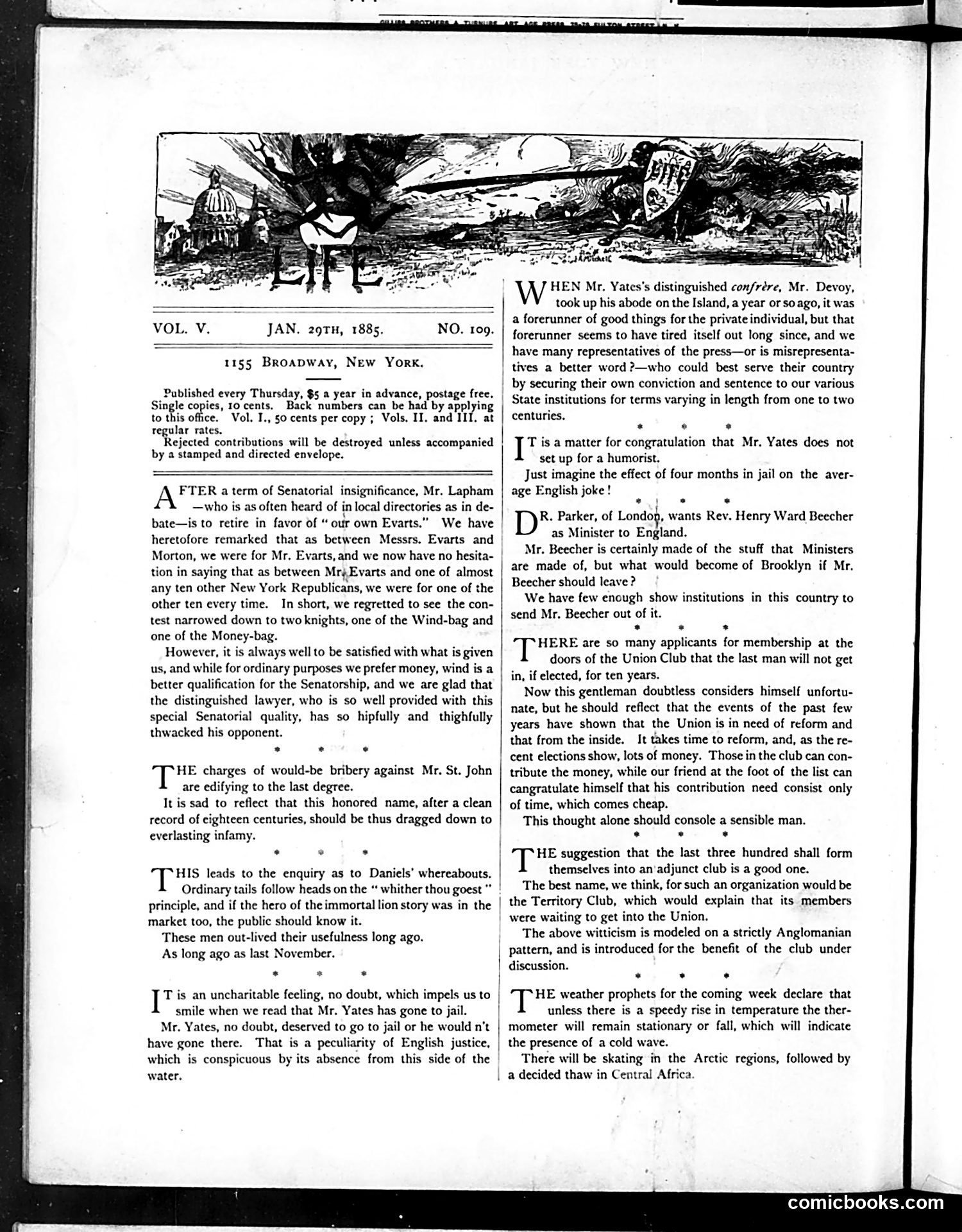
The header cartoon appears to depict a chaotic scene with dark, dramatic imagery—possibly satirizing political turmoil or social disorder of the period, though specific figures are unclear from this reproduction. The editorial content references several contemporary figures: Mr. Yates (apparently jailed), Mr. Lapham (a New York Senator), Mr. Evarts and Mr. Morton (Republican politicians), and Rev. Henry Ward Beecher (a prominent Brooklyn minister). The pieces mock political insignificance, bribery accusations against St. John, and controversies surrounding institutional membership (the Union Club). The satire targets elite New York politics and social institutions, suggesting corruption, hypocrisy among the powerful, and the absurdity of exclusive club politics. The tone is sardonic commentary on 1880s New York establishment figures and their questionable conduct.
📄 Transcribed text from this page (OCR, searchable)
Machine-transcribed from the original scan — historical spelling and the odd misread are preserved.
JAN. 297TH, 1885. 1155 Broapway, New York. Published every Thursday, $s a year in advance, postage free. Single copies, 10 cents. Back numbers can be had by applying to this office. Vol. I., 50 cents per copy ; Vols. II. and III. at regular rates. Rejected contributions will be destroyed unless accompanied by a stamped and directed envelope. FTER aterm of Senatorial insignificance, Mr. Lapham —who is as often heard of in local directories as in de- bate—is to retire in favor of “ our own Evarts.” We have heretofore remarked that as between Messrs. Evarts and Morton, we were for Mr. Evarts, and we now have no hesita- tion in saying that as between Mr}Evarts and one of almost any ten other New York Republicans, we were for one of the other ten every time. In short, we regretted to see the con- test narrowed down to two knights, one of the Wind-bag and one of the Money-bag. However, it is always well to be satisfied with what is given us, and while for ordinary purposes we prefer money, wind is a better qualification for the Senatorship, and we are glad that the distinguished lawyer, who is so well provided with this special Senatorial quality, has so hipfully and thighfully thwacked his opponent. . . . HE charges of would-be bribery against Mr. St. John are edifying to the last degree. It is sad to reflect that this honored name, after a clean record of eighteen centuries, should be thus dragged down to everlasting infamy. HIS leads to the enquiry as to Daniels’ whereabouts. Ordinary tails follow heads on the “ whither thou goest " ! principle, and if the hero of the immortal lion story was in the market too, the public should know it. These men out-lived their usefulness long ago. As long ago as last November. . * . T is an uncharitable feeling, no doubt, which impels us to | smile when we read that Mr. Yates has gone to jail. Mr. Yates, no doubt, deserved to go to jail or he would n't have gone there. That is a peculiarity of English justice, which is conspicuous by its absence from this side of the water, HEN Mr. Yates’s distinguished confrére, Mr. Devoy, took up his abode on the Island, a year or so ago, it was a forerunner of good things for the private individual, but that forerunner seems to have tired itself out long since, and we have many representatives of the press—or is misrepresenta- tives a better word ?—who could best serve their country by securing their own conviction and sentence to our various State institutions for terms varying in length from one to two centuries. * ° . T is a matter for congratulation that Mr. Yates does not set up for a humorist. Just imagine the effect of four months in jail on the aver- age English joke! * . R. Parker, of Londop, wants Rev. Henry Ward Beecher as Minister to England. Mr. Beecher is certainly made of the stuff that Ministers are made of, but what would become of Brooklyn if Mr. Beecher should leave ? We have few enough show institutions in this country to send Mr. Beecher out of it. . . . HERE are so many applicants for membership at the doors of the Union Club that the last man will not get | in, if elected, for ten years. Now this gentleman doubtless considers himself unfortu- nate, but he should reflect that the events of the past few years have shown that the Union is in need of reform and that from the inside. It takes time to reform, and, as the re- cent elections show, lots of money. Those in the club can con- tribute the money, while our friend at the foot of the list can cangratulate himself that his contribution need consist only of time, which comes cheap. This thought alone should console a sensible man. . . . i Bee suggestion that the last three hundred shall form themselves into an'adjunct club is a good one. The best name, we think, for such an organization would be the Territory Club, which would explain that its members were waiting to get into the Union. The above witticism is modeled on a strictly Anglomanian pattern, and is introduced for the benefit of the club under discussion. . . . HE weather prophets for the coming week declare that unless there is a speedy rise in temperature the ther- mometer will remain stationary or fall, which will indicate the presence of a cold wave. There will be skating in the Arctic regions, followed by | a decided thaw in Central Africa. comicbooks.com