
Life, 1885-01-29 · page 6 of 16
Life — January 29, 1885 — page 6: what you’re looking at
What you’re looking at
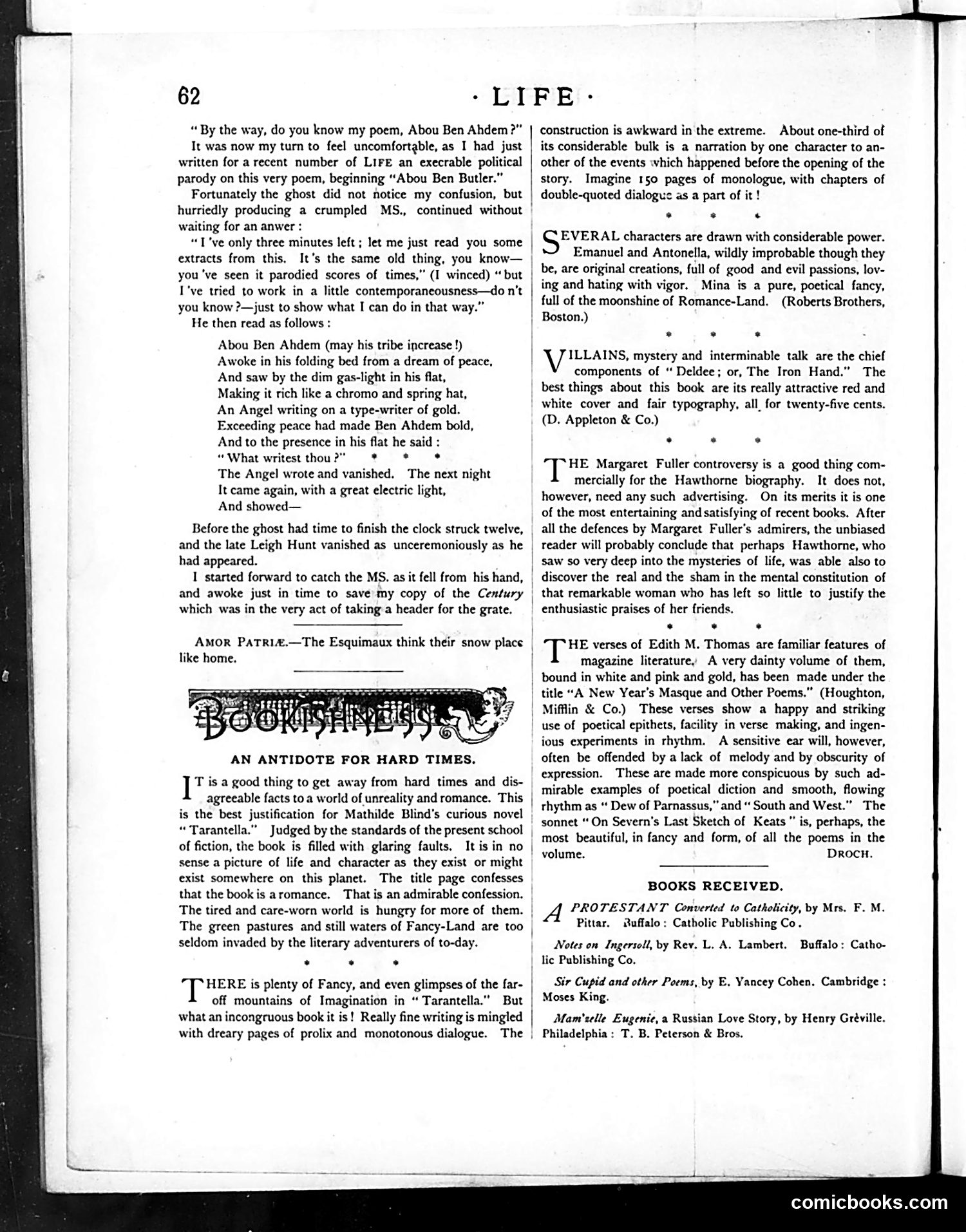
This page contains literary book reviews rather than political cartoons. The content discusses several works including Mathilde Blind's novel "Tarantella" and poems by Edith M. Thomas. The reviews are satirical commentary on contemporary literature. One section criticizes "Tarantella" for being a romance disguised as realism, noting its "glaring faults" and unrealistic "Fancy-Land" elements. Another review mocks verbose poetry lacking melody and clarity, though praising some verses like "Dew of Parnassus" and "South and West." The page concludes with a "Books Received" section listing recent publications. This represents Life's literary criticism function—using satire to critique contemporary authors and their work rather than political figures.
📄 Transcribed text from this page (OCR, searchable)
Machine-transcribed from the original scan — historical spelling and the odd misread are preserved.
62 -LIFE- “ By the way, do you know my poem, Abou Ben Ahdem ?” It was now my turn to feel uncomfortable, as I had just written for a recent number of LIFE an execrable political parody on this very poem, beginning “Abou Ben Butler.” Fortunately the ghost did not notice my confusion, but hurriedly producing a crumpled MS., continued without | waiting for an anwer : “T've only three minutes left ; let me just read you some | extracts from this. It's the same old thing, you know— you ve seen it parodied scores of times,” (I winced) “but | I've tried to work in a little contemporancousness—do n't | you know ?—just to show what I can do in that way.” | He then read as follows : Abou Ben Ahdem (may his tribe increase !) Awoke in his folding bed from a dream of peace, And saw by the dim gas-light in his flat, Making it rich like a chromo and spring hat, An Angel writing on a type-writer of gold. Exceeding peace had made Ben Ahdem bold, And to the presence in his flat he said : “What writest thou ?” bd ba * The Angel wrote and vanished. The next night It came again, with a great electric light, And showed— Before the ghost had time to finish the clock struck twelve, and the late Leigh Hunt vanished as unceremoniously as he had appeared. I started forward to catch the MS. asit fell from his hand, | and awoke just in time to save my copy of the Century which was in the very act of taking a header for the grate. | AMOR PATRI£.—The Esquimaux think their snow place _ like home. | construction is awkward in the extreme. About one-third of its considerable bulk is a narration by one character to an- other of the events which happened before the opening of the story. Imagine 150 pages of monologue, with chapters of double-quoted dialogue as a part of it! . * . GEVERAL characters are drawn with considerable power. Emanuel and Antonella, wildly improbable though they be, are original creations, full of good and evil passions, lov- ing and hating with vigor. Mina is a pure, poetical fancy, full of the moonshine of Romance-Land. (Roberts Brothers, | Boston.) ILLAINS, mystery and interminable talk are the chief components of “ Deldee; or, The Iron Hand.” The best things about this book are its really attractive red and white cover and fair typography, all, for twenty-five cents. (D. Appleton & Co.) . * . HE Margaret Fuller controversy is a good thing com- mercially for the Hawthorne biography. It does not, however, need any such advertising. On its merits it is one of the most entertaining and satisfying of recent books. After all the defences by Margaret Fuller's admirers, the unbiased reader will probably conclude that perhaps Hawthorne, who saw so very deep into the mysteries of life, was able also to discover the real and the sham in the mental constitution of that remarkable woman who has left so little to justify the enthusiastic praises of her friends. . . . HE verses of Edith M. Thomas are familiar features of magazine literature, A very dainty volume of them, | bound in white and pink and gold, has been made under the AN ANTIDOTE FOR HARD TIMES. T is a good thing to get away from hard times and dis- agreeable facts toa world of unreality and romance. This | is the best justification for Mathilde Blind’s curious novel “ Tarantella.” Judged by the standards of the present school of fiction, the book is filled with glaring faults. It isin no | sense a picture of life and character as they exist or might exist somewhere on this planet. The title page confesses that the book is aromance. That is an admirable confession. The tired and care-worn world is hungry for more of them. | The green pastures and still waters of Fancy-Land are too | seldom invaded by the literary adventurers of to-day. HERE is plenty of Fancy, and even glimpses of the far- | off mountains of Imagination in “ Tarantella.” But | what an incongruous book it is! Really fine writing is mingled | with dreary pages of prolix and monotonous dialogue. The | title “A New Year's Masque and Other Poems.” (Houghton, Mifflin & Co.) These verses show a happy and striking use of poetical epithets, facility in verse making, and ingen- ious experiments in rhythm. A sensitive ear will, however, often be offended by a lack of melody and by obscurity of expression. These are made more conspicuous by such ad- mirable examples of poetical diction and smooth, flowing rhythm as “ Dew of Parnassus,” and “South and West.” The sonnet “On Severn's Last Sketch of Keats” is, perhaps, the most beautiful, in fancy and form, of all the poems in the volume. Drocn. BOOKS RECEIVED. PROTESTANT Converted to Catholicity, by Mrs. F. M. Pittar. Ruffalo: Catholic Publishing Co. Notes on Ingersoll, by Rev. L. A. Lambert. Buffalo: Catho- lic Publishing Co. Sir Cupid and other Poems, by E. Yancey Cohen. Cambridge : Moses King. Mam'telle Eugenie, a Russian Love Story, by Henry Gréville. Philadelphia : T. B. Peterson & Bros. comicbooks.com