
Life, 1885-01-29 · page 12 of 16
Life — January 29, 1885 — page 12: what you’re looking at
What you’re looking at
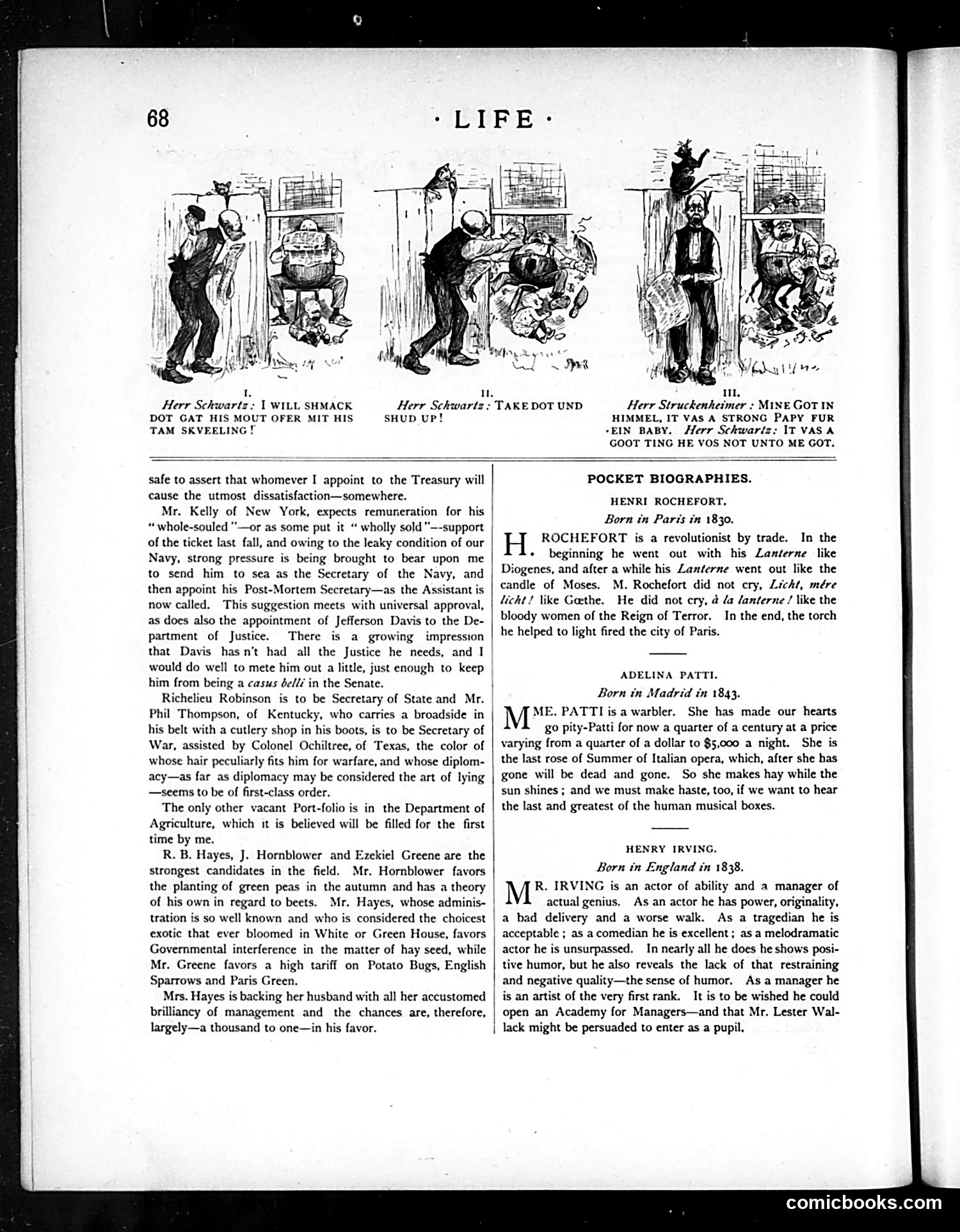
The three cartoon panels at top mock German immigrants through caricature and dialect humor. "Herr Schwartz" and companions speak in exaggerated German-accented English ("shmack," "mout ofer," "tam skveeling"), a common 19th-century American stereotype. The humor depicts working-class German fathers quarreling over child-rearing—one threatens to hit his child's mouth with his tam (cap), another boasts his baby is strong, the third jokes his child wasn't beaten. This reflects period anxieties about immigrant parenting styles and assimilation. The main text is satirical political commentary on presidential appointments, likely referencing the Hayes administration (mentioned explicitly). It mockingly describes various candidates for cabinet positions, using absurdist humor—suggesting the Agriculture Secretary should be chosen from men with theories about peas and beets. The "Pocket Biographies" section profiles public figures: Henri Rochefort (French revolutionary), Adelina Patti (opera singer), and Henry Irving (actor)—brief, witty character sketches typical of Life's satirical style.
📄 Transcribed text from this page (OCR, searchable)
Machine-transcribed from the original scan — historical spelling and the odd misread are preserved.
1 Herr Schwartz : | WILL SHMACK DOT GAT HIS MOUT OFER MIT HIS TAM SKVEELING ! SHUD UP! A Herr Schwartz : TAKE DOT UND 1, Herr Struckenheimer ; MINE GOT IN HIMMEL, IT VAS A STRONG PAPY FUR +EIN BABY. Herr Schwartz: IT VASA GOOT TING HE VOS NOT UNTO ME GOT. safe to assert that whomever I appoint to the Treasury will cause the utmost dissatisfaction—somewhere. Mr. Kelly of New York, expects remuneration for his “ whole-souled "—or as some put it “ wholly sold""—-support of the ticket last fall, and owing to the leaky condition of our Navy, strong pressure is being brought to bear upon me to send him to sea as the Secretary of the Navy, and then appoint his Post-Mortem Secretary—as the Assistant is now called. This suggestion meets with universal approval, as does also the appointment of Jefferson Davis to the De- partment of Justice. There is a growing impression that Davis hasn't had all the Justice he needs, and I would do well to mete him out a little, just enough to keep him from being a casus dell in the Senate. | Richelieu Robinson is to be Secretary of State and Mr. | Phil Thompson, of Kentucky, who carries a broadside in his belt with a cutlery shop in his boots, is to be Secretary of War, assisted by Colonel Ochiltree, of Texas, the color of whose hair peculiarly fits him for warfare, and whose diplom- | acy—as far as diplomacy may be considered the art of lying —seems to be of first-class order. The only other vacant Port-folio is in the Department of Agriculture, which it is believed will be filled for the first | time by me. R. B. Hayes, J. Hornblower and Ezekiel Greene are the strongest candidates in the field. Mr. Hornblower favors the planting of green peas in the autumn and has a theory of his own in regard to beets. Mr. Hayes, whose adminis- | tration is so well known and who is considered the choicest exotic that ever bloomed in White or Green House, favors Governmental interference in the matter of hay seed, while Mr. Greene favors a high tariff on Potato Bugs, English Sparrows and Paris Green. Mrs. Hayes is backing her husband with all her accustomed | brilliancy of management and the chances are, therefore, largely—a thousand to one—in his favor. POCKET BIOGRAPHIES. HENRI ROCHEFORT. Born in Paris in 1830. ROCHEFORT is a revolutionist by trade. In the + beginning he went out with his Lanterne like Diogenes, and after a while his Lanterne went out like the candle of Moses. M. Rochefort did not cry, Licht, mére Uicht! like Goethe. He did not cry, @ 4a danterne / like the bloody women of the Reign of Terror. In the end, the torch he helped to light fired the city of Paris. ADELINA PATTI. Born in Madrid in 1843. M ME. PATTI is a warbler. She has made our hearts go pity-Patti for now a quarter of a century at a price varying from a quarter of a dollar to $5,000 a night. She is the last rose of Summer of Italian opera, which, after she has gone will be dead and gone. So she makes hay while the sun shines ; and we must make haste, too, if we want to hear the last and greatest of the human musical boxes. HENRY IRVING. Born in England in 1838. R. IRVING is an actor of ability and a manager of actual genius. As an actor he has power, originality, a bad delivery and a worse walk. As a tragedian he is acceptable ; as a comedian he is excellent ; as a melodramatic actor he is unsurpassed. In nearly all he does he shows posi- tive humor, but he also reveals the lack of that restraining and negative quality—the sense of humor. As a manager he is an artist of the very first rank. It is to be wished he could open an Academy for Managers—and that Mr. Lester Wal- lack might be persuaded to enter as a pupil. comicbooks.com