
A complete issue · 17 pages · 1884
Life — December 25, 1884
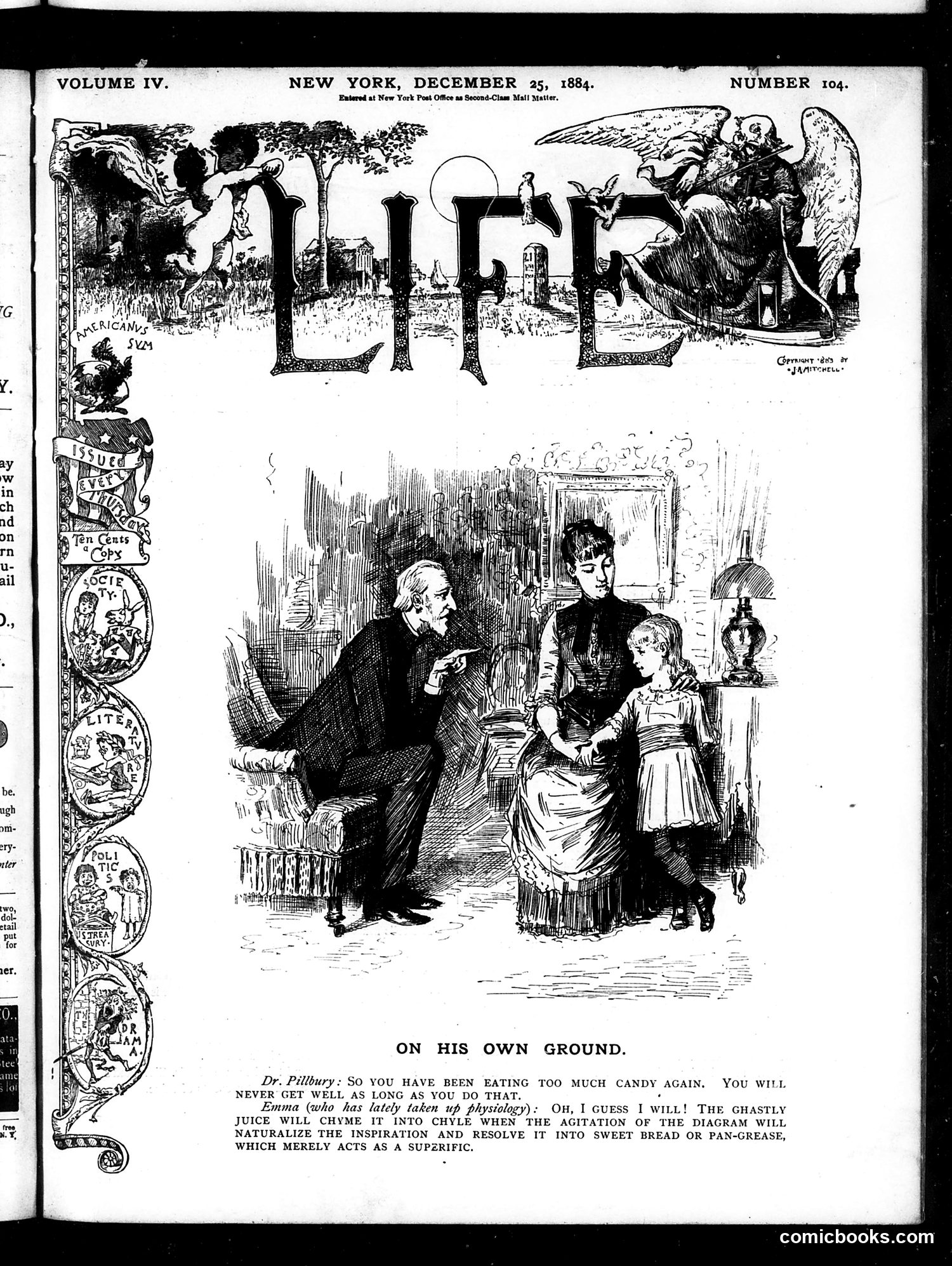
**Title:** "On His Own Ground" **Content:** A satirical domestic scene showing a doctor (Dr. Pillbury) confronting a young girl (Emma) about eating too much candy. Emma responds with pseudo-scientific jargon, claiming the candy's "ghastly juice" will convert to "chyle" through physiological processes, ultimately becoming "sweet bread or pan-grease" that merely acts as a "superficific" [likely "superficial"]. **Satire:** The humor targets both medical pretension and children's sophistry. Emma weaponizes half-understood medical terminology to justify her candy consumption, satirizing the era's fascination with pseudoscientific health explanations. The doctor is literally outmaneuvered "on his own ground"—his professional authority undermined by the child's clever (if nonsensical) pseudo-medical argument. **Context:** Reflects 1880s concerns about children's diet and the period's pseudoscientific medical discourse.
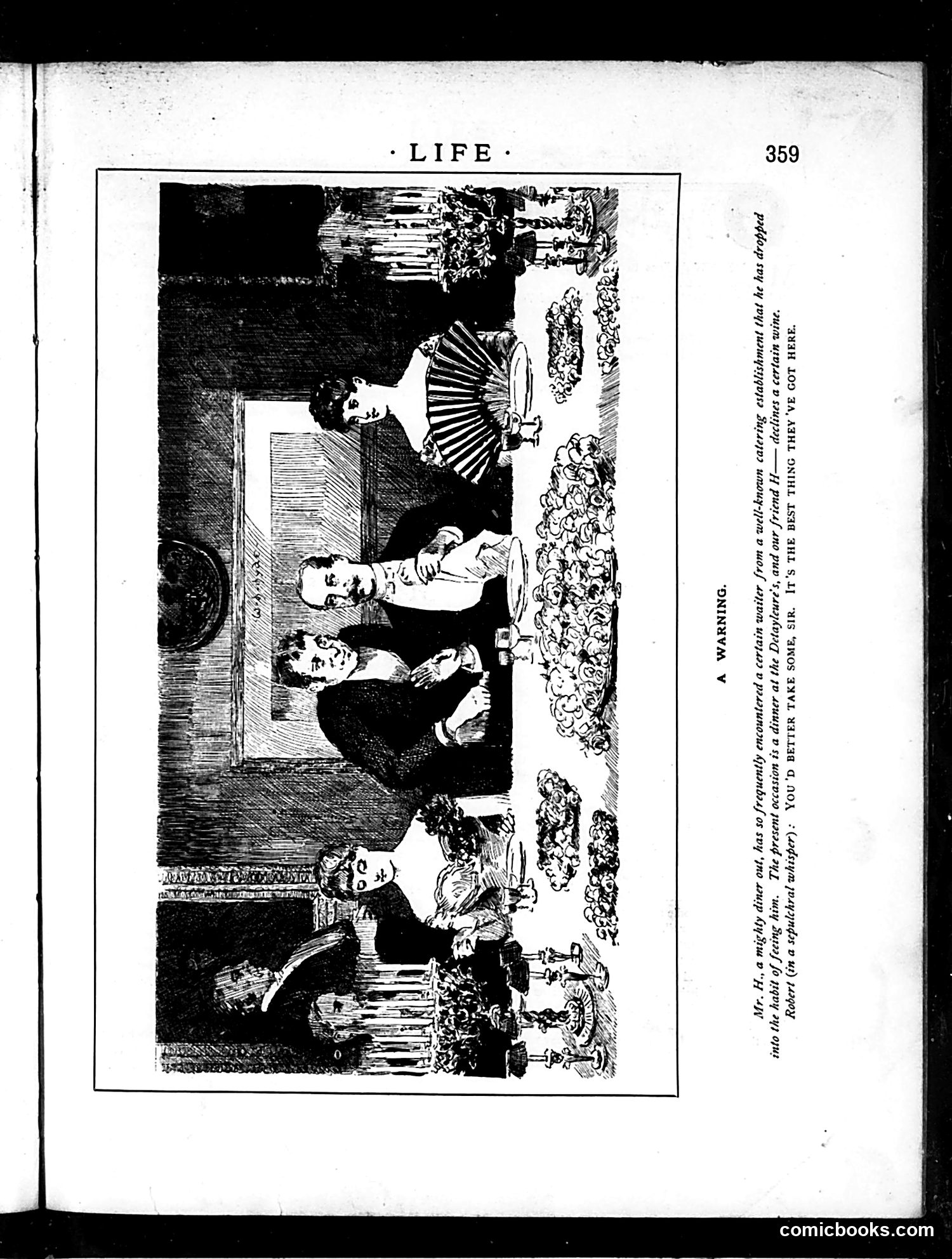
This satirical illustration depicts a domestic scene with the caption "A Warning." The image shows what appears to be a wealthy Victorian-era family in an ornate interior. A woman holds a large fan while a man reclines, and there's a child present. The accompanying text warns about "a rich widow caring, embezzled funds for a pickpocket" and references someone "better for a pickpocket salvation." The specific historical context is unclear from the available text, but the cartoon appears to satirize domestic financial mismanagement or cautionary tales about wealth and moral conduct common to late 19th/early 20th-century American satirical magazines. The exact political or social reference remains uncertain without additional context.
This page contains **satirical commentary** rather than political cartoons. The "By the Way" column offers brief jabs at contemporary figures and issues: - **Mr. Depew**: A railroad executive declining government service (likely Chauncey Depew, prominent Vanderbilt associate) - **Congressional aspirants**: Mocks politicians seeking Senate seats, suggesting they accumulate wealth through corrupt means - **The cholera reference**: Satirizes health officials claiming vigilance - **Oscar Wilde discussion**: Critiques Wilde's public persona and fashion choices, suggesting his attention-seeking is ridiculous The "Repartee" poem is humorous verse about a woman outsmarting a suitor's impertinent questions. The overall tone is **irreverent mockery** of the wealthy, politicians, and celebrities—typical of Life magazine's satirical stance during this Gilded Age period.
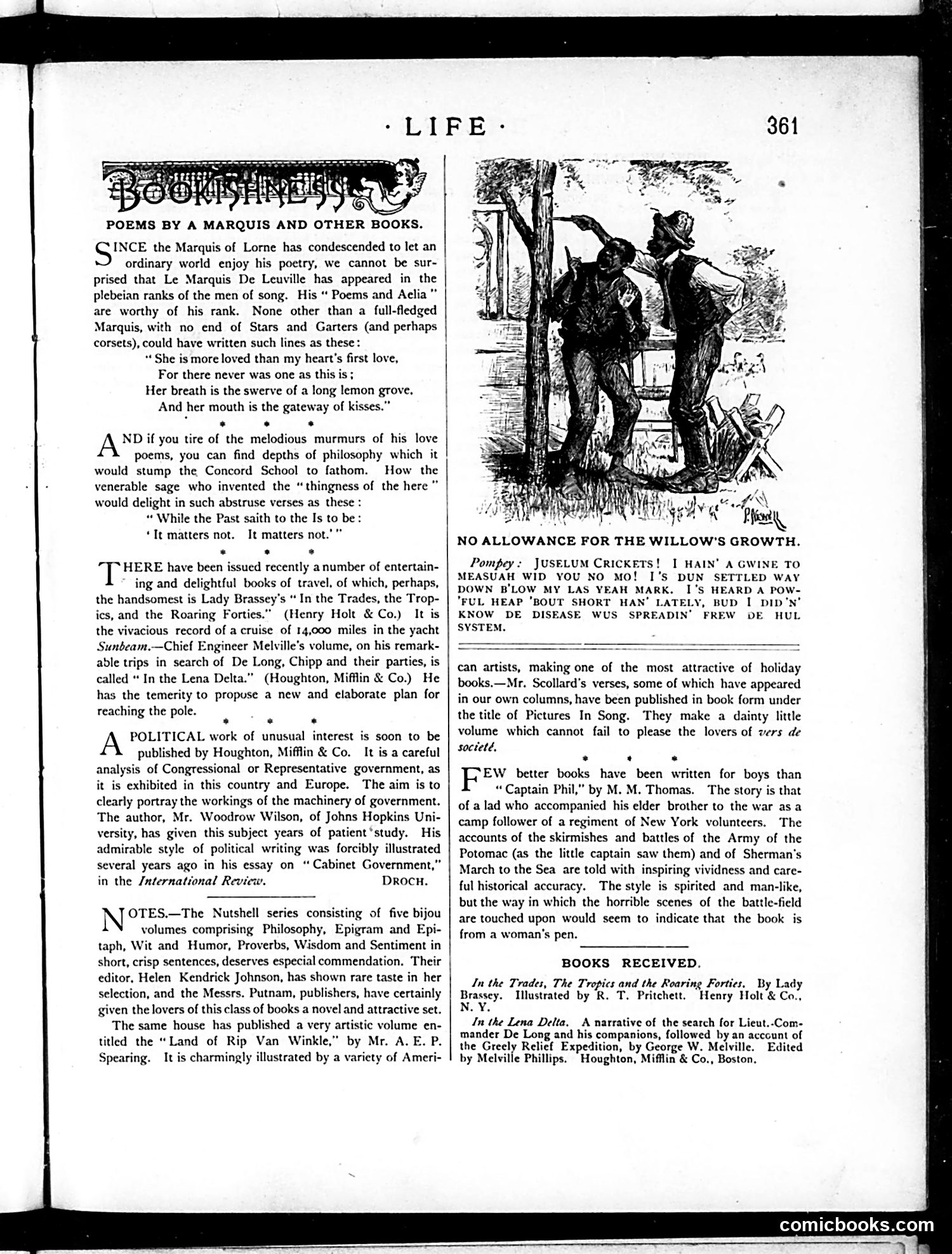
This page contains a book review section rather than political cartoons. The main illustration shows two figures in what appears to be a romantic or intimate scene beneath a tree—likely accompanying a review of "Poems and Asia" by Le Marquis De Leuville, a work praised for love poetry. The reviews discuss various newly published books, including works on government, exploration, and children's literature. One notable review praises "Captain Phil" by M. M. Thomas, a boys' adventure story about the American Civil War, specifically Sherman's March to the Sea, commending it for being written by a woman yet maintaining historical accuracy and masculine appeal. The content reflects late 19th-century literary culture and gender expectations about authorship.
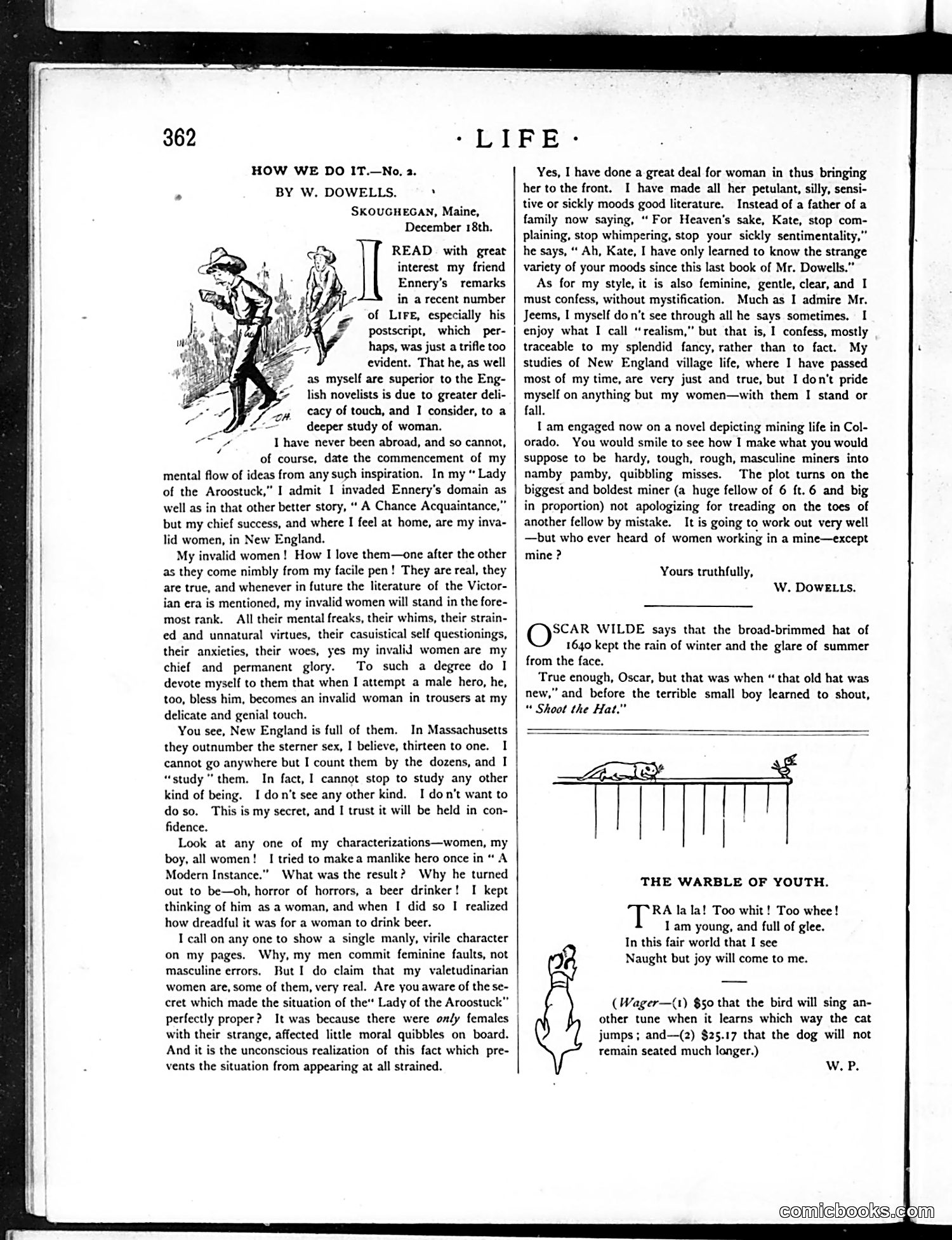
This page contains two distinct items: **"How We Do It—No. 2" by W. Dowells** is a letter responding to earlier criticism about Dowells' portrayal of women characters. The author defends his depictions of "invalid women" in New England settings, arguing they are realistic. He mentions current work on a novel about mining life in Colorado and jokes about depicting women miners—suggesting this would be novel subject matter. **"The Warble of Youth"** is a brief humorous poem about youthful exuberance, with a small illustration of a bird. Below it is a wagering joke about which direction a bird will sing versus how long a dog remains seated. The page is primarily textual commentary rather than political satire. It reflects early 20th-century literary debates about character representation and gender.
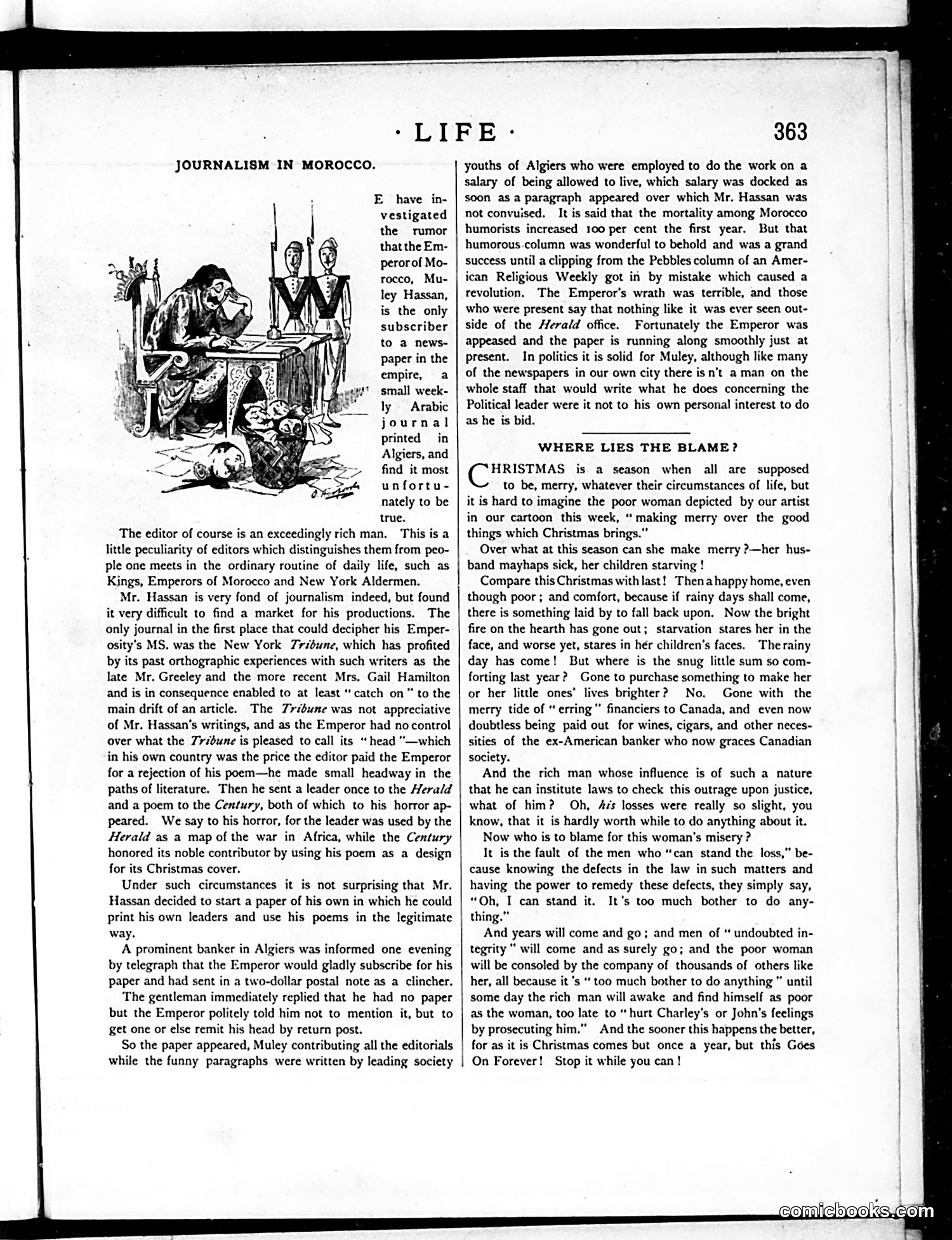
The main cartoon depicts **journalism in Morocco** during the colonial era. It shows a European editor at his desk with armed figures (likely representing colonial military or officials) looming behind him, suggesting **government control or intimidation of the press**. The text describes **Muley Hassan**, a Moroccan subscriber to a small Arabic-language weekly journal in Algiers. The satire mocks Hassan's attempts at journalism: his modest publication gained unexpected prominence when American and European newspapers mistakenly reprinted his work, causing the colonial Emperor to suppress it—apparently viewing independent journalism as a threat. The cartoon satirizes **press freedom limitations in colonial North Africa** and the absurdity of how colonial powers managed information and controlled narratives in their territories.
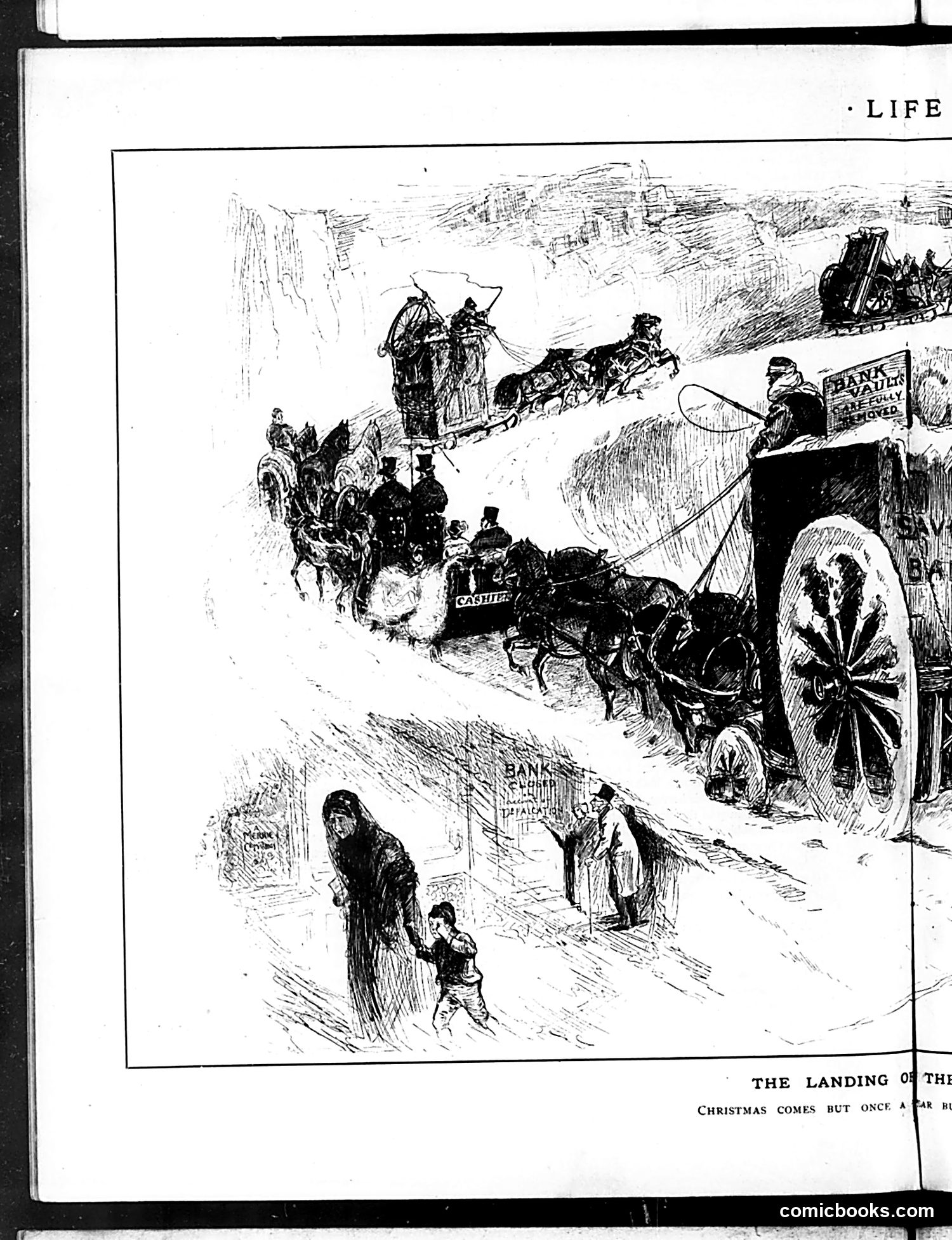
This is a satirical illustration depicting a snowy winter scene with horse-drawn sleighs and carriages arriving at what appears to be a bank or commercial establishment. The visible signage reads "BANK" multiple times. The caption reads "CHRISTMAS COMES BUT ONCE A" (text cuts off), suggesting commentary on the commercialization of Christmas or seasonal financial pressures. The scene contrasts the traditional imagery of Christmas arrival (sleighs, winter) with banking and commercial activity, likely satirizing how commercial interests and financial concerns dominate the holiday season, even in early 20th-century America. The sketch style is typical of Life magazine's political satire from this era, using humor to critique social and economic practices.
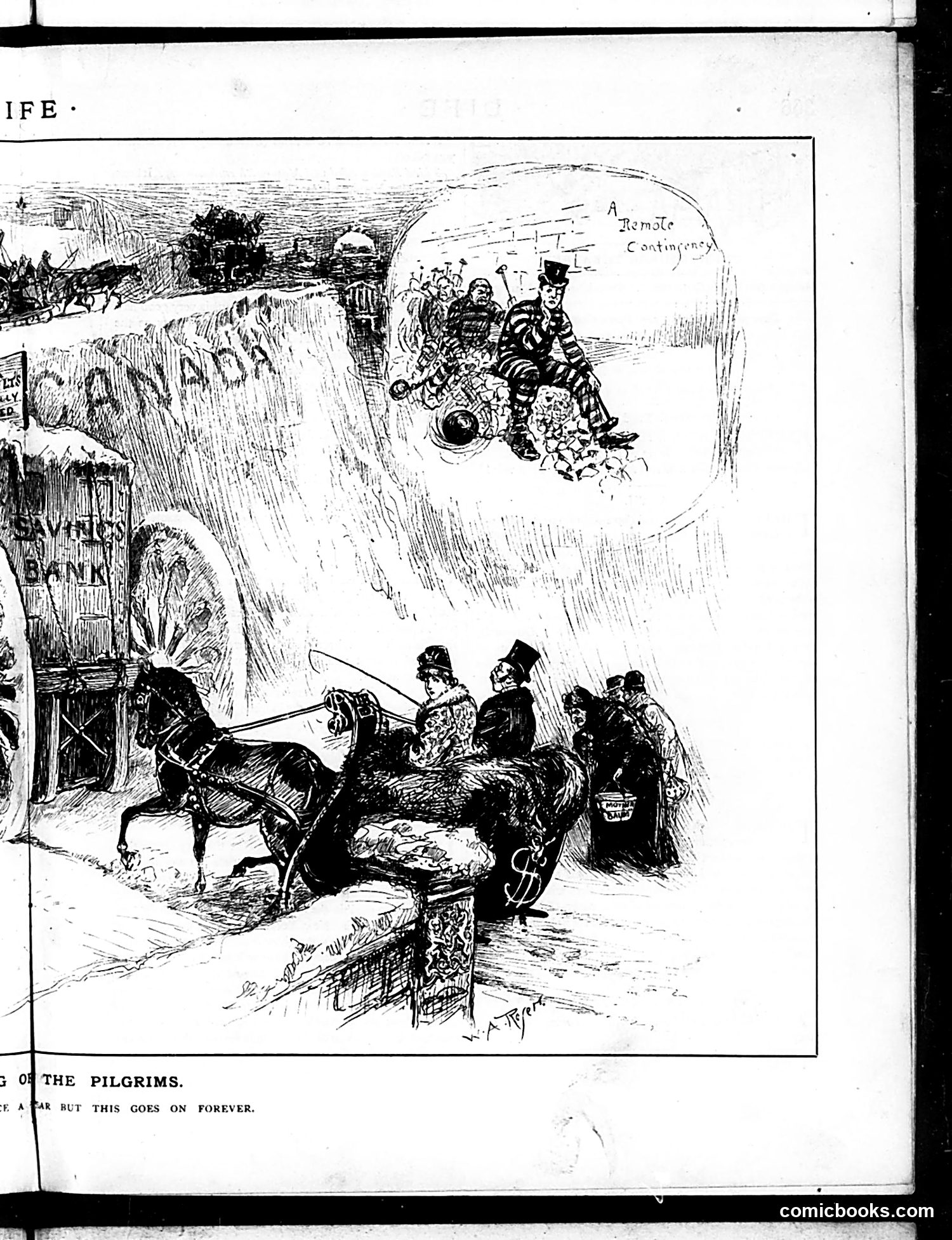
This satirical cartoon depicts wealthy figures in top hats being transported in a large carriage or cart by working-class men. The title "The Pilgrims" and caption "A Remark but This Goes on Forever" suggest commentary on class exploitation. The image appears to critique the labor system where wealthy elites are literally carried by the working poor—a visual metaphor for economic dependency and class inequality. The contrast between the well-dressed, idle passengers and the straining laborers pulling the heavy load emphasizes the burden placed on working people to support the leisure class. The phrase "goes on forever" implies this exploitative arrangement is perpetual and systemic, rather than temporary or justified. This reflects common Progressive Era critiques of wealth inequality and labor conditions in early 20th-century America.
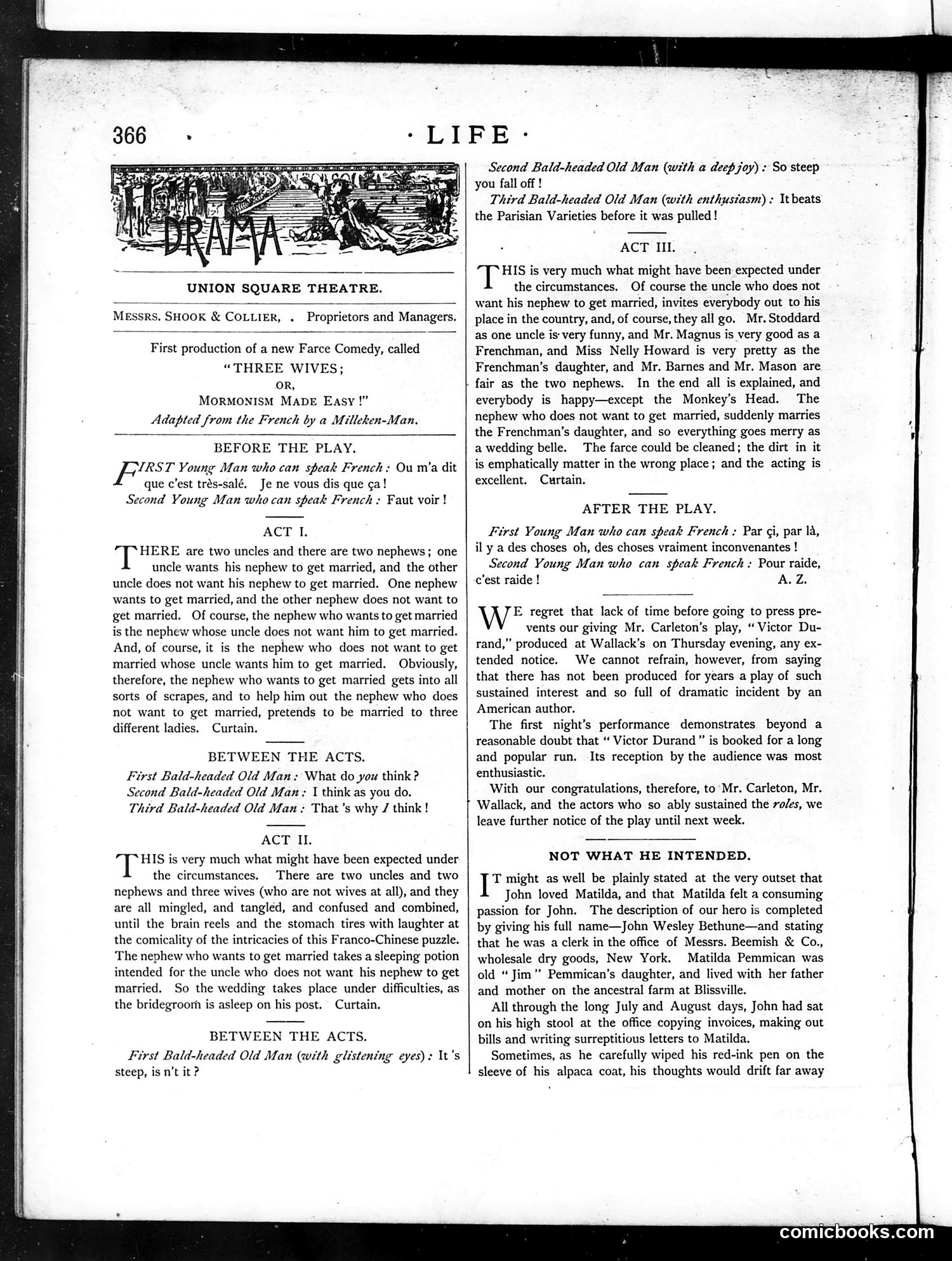
This page reviews a French farce comedy adapted for American audiences. The satire targets **Mormon polygamy**—a controversial practice that scandalized 19th-century America. The play's absurd plot (involving uncles, nephews, and fake marriages) parodies the marital complications polygamy creates. The "BETWEEN THE ACTS" segments mock theatrical audiences: three bald-headed old men offer increasingly vapid commentary, with the third claiming the show "beats the Parisian Varieties"—satirizing critics who mistake loud spectacle for quality theater. The review itself is favorable, praising performances by Stoddard, Magnus, Howard, Barnes, and Mason, while noting the farce contains "dirt" (crude material) that doesn't belong. A brief notice also congratulates Mr. Carleton on "Victor Durand," an American-authored play enjoying enthusiastic reception at Wallack's Theatre.
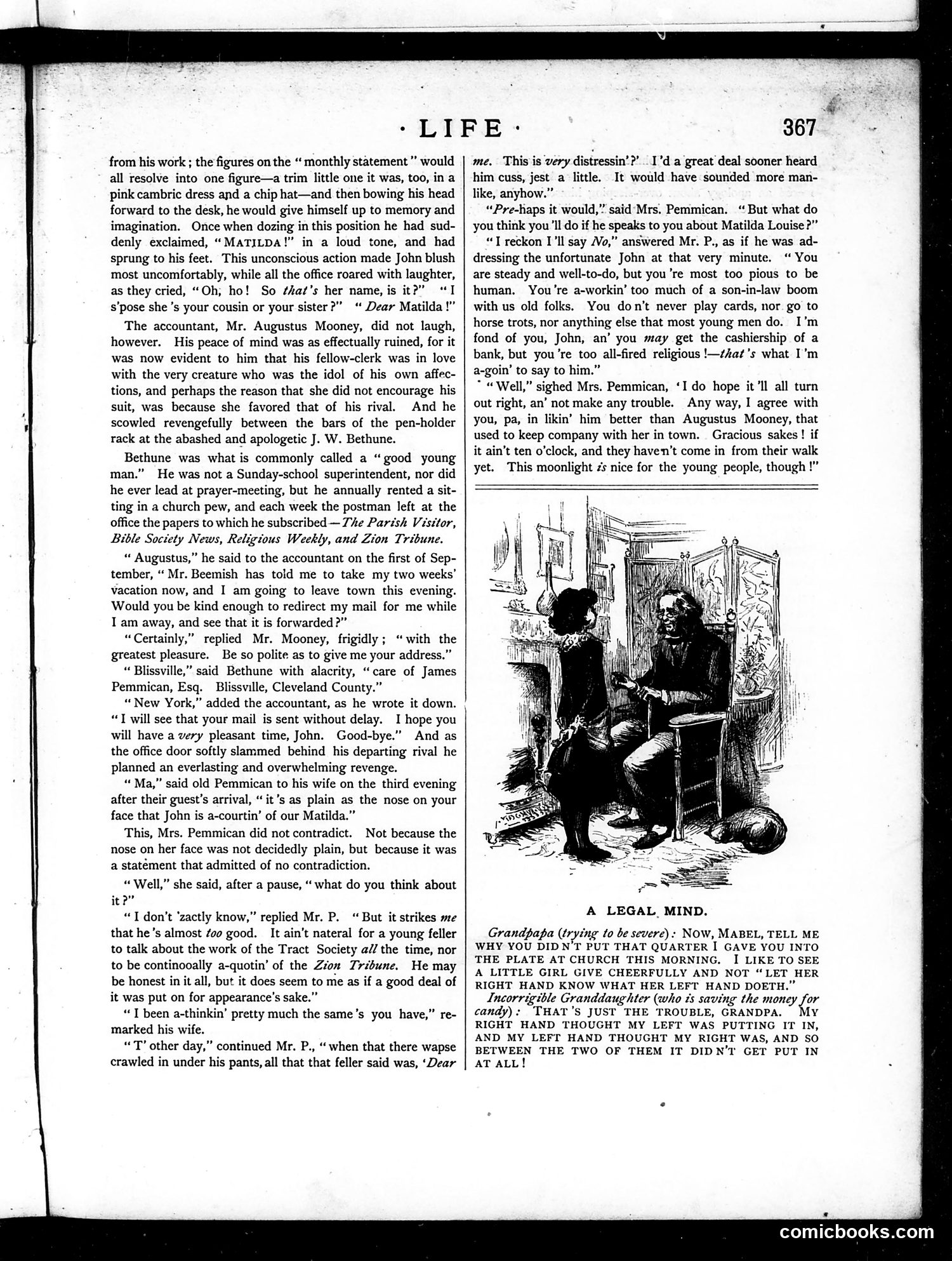
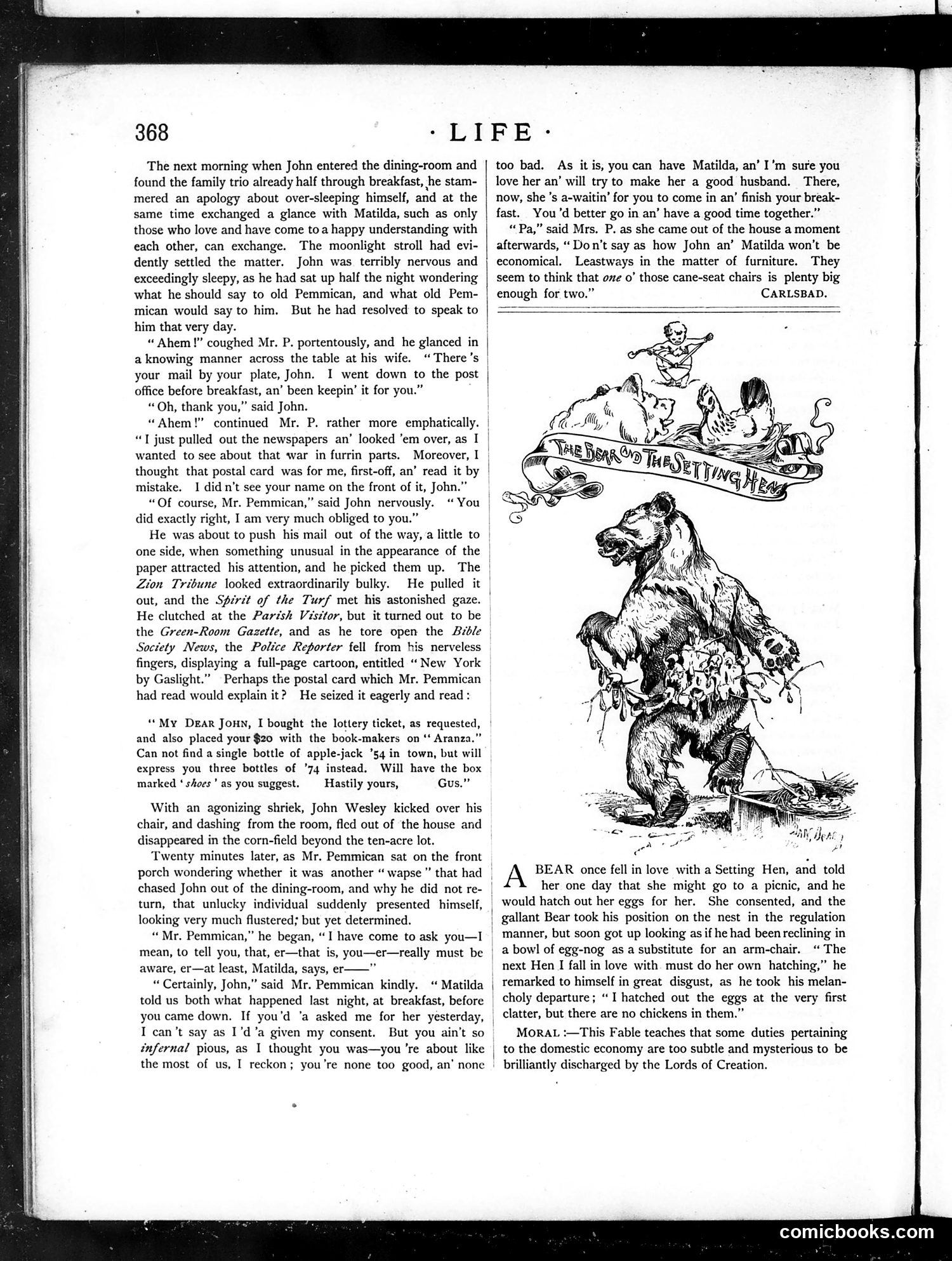
This page contains two distinct pieces. The narrative text follows John Wesley's romantic entanglement with Matilda Pemmican. The humor centers on John's panic: he receives mail intended for someone else—lottery tickets, gambling bets, and bootleg whiskey shipments—which Mr. Pemmican has already read. John flees in terror, believing his character is ruined before proposing. The accompanying illustration is a fable titled "A Bear Once Fell in Love with a Setting Hen," likely satirizing absurd romantic mismatches or foolish courtship. The moral warns against imprudent domestic arrangements, using animals to mock human pretension. Both pieces exemplify *Life* magazine's satirical style: mocking rural American courtship customs, parental authority, and the chaos that ensues when respectability is threatened by circumstance rather than actual wrongdoing. The humor relies on Victorian anxieties about reputation and propriety.
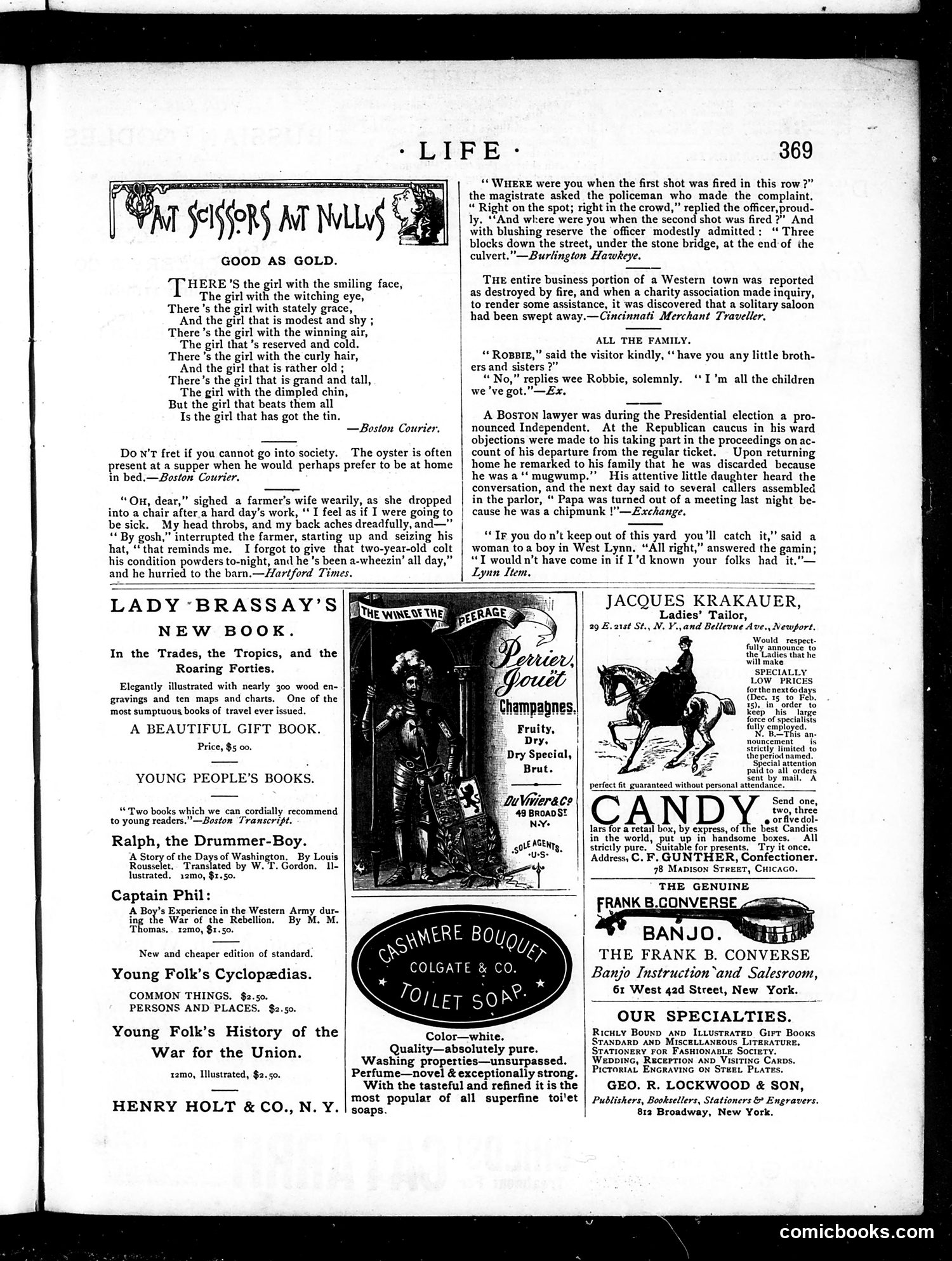
This page is primarily **advertisements and humorous anecdotes** rather than political cartoons. The humor pieces mock various social situations: a poem celebrates girls with money over beauty; anecdotes ridicule incompetent policemen, misguided farmers, and family miscommunications. One notable joke concerns a Boston lawyer called a "**mugwump**" (an independent politician who broke party loyalty during the Gilded Age), which his young daughter mishears as "**chipmunk**"—satirizing both adult political pretension and childhood innocence. The remaining content consists of **book advertisements** (Lady Brassay's travel guide, young people's literature) and **commercial ads** (tailoring services, soap, champagne, candy, banjos). The page reflects late 19th-century *Life* magazine's format: light satirical humor mocking everyday life and social conventions, interspersed with period advertisements. There are **no major political cartoons** visible on this page.
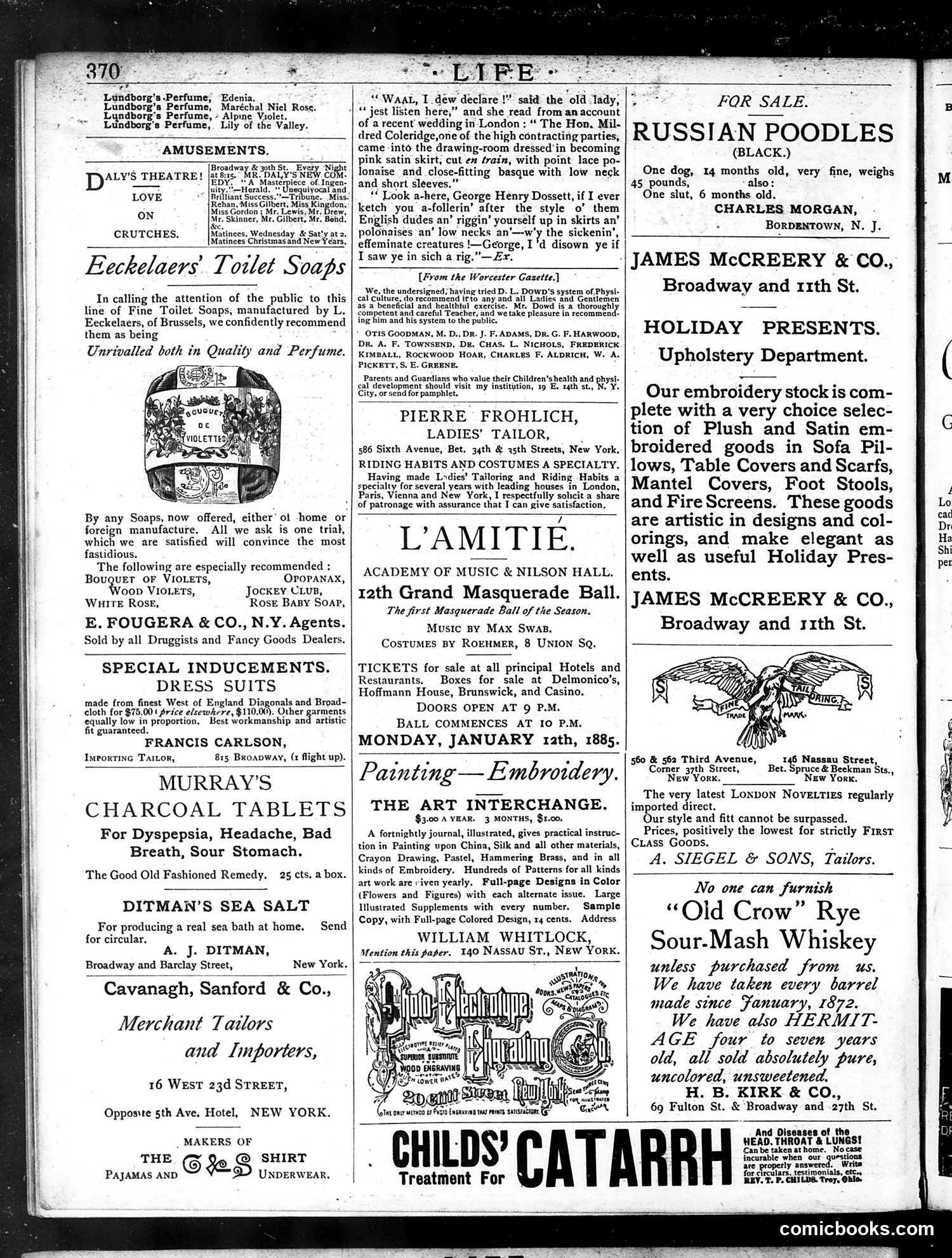
This page is primarily **advertisements and notices** from an 1885 issue of Life magazine, with minimal editorial cartooning. The one notable satirical piece is a brief joke labeled "—Ex." (from exchange/another publication) depicting an elderly woman scolding her husband George Henry Dossett. She warns him against imitating English fashion—specifically men wearing "skirts," "polonaises" (a type of overskirt), and "low necks." **The satire:** The joke mocks both the perceived effeminacy of English fashion trends and American anxiety about men adopting "feminine" clothing styles. The woman's rural dialect ("Waal," "ketch," "disown ye") suggests the humor derives partly from class distinction—unsophisticated Americans rejecting fancy European affectations. The piece ridicules English fashion as "sickenin'" and "effeminate," reflecting 19th-century masculine anxieties about sartorial boundaries between genders. The remaining content consists of period advertisements for perfumes, tailoring, soap, remedies, and entertainment venues—typical of Life's revenue model.
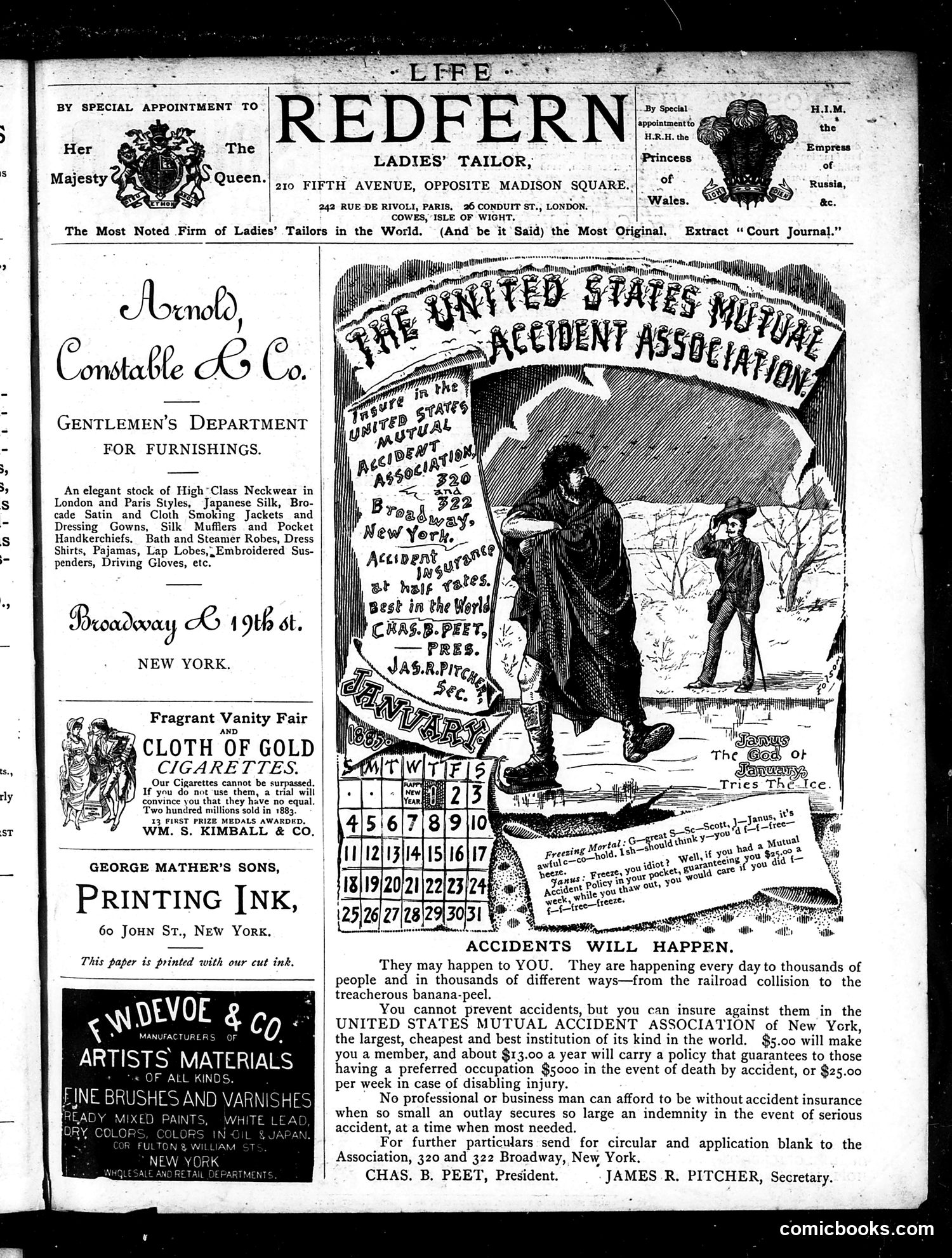
This page is primarily **advertising**, with one satirical cartoon illustrating an accident-insurance advertisement. The central cartoon depicts a man who has slipped on a banana peel—a classic slapstick scenario. The figure tumbles backward on ice or slippery ground, with the banana peel visible beneath him. The illustration's caption reads "Accidents Will Happen," introducing the page's main pitch: the United States Mutual Accident Association. The satire is gentle but pointed: the cartoon uses humor to sell a serious product by showing the *mundane, undignified ways* accidents occur in everyday life. A banana peel—trivial and embarrassing—becomes the visual hook for convincing readers that accident insurance is necessary. The page argues that even small premium costs ($5 membership, ~$13 yearly) protect against unpredictable mishaps. The surrounding ads (tailors, printing ink, cigarettes, art supplies) are typical period magazine advertising with no satirical content.
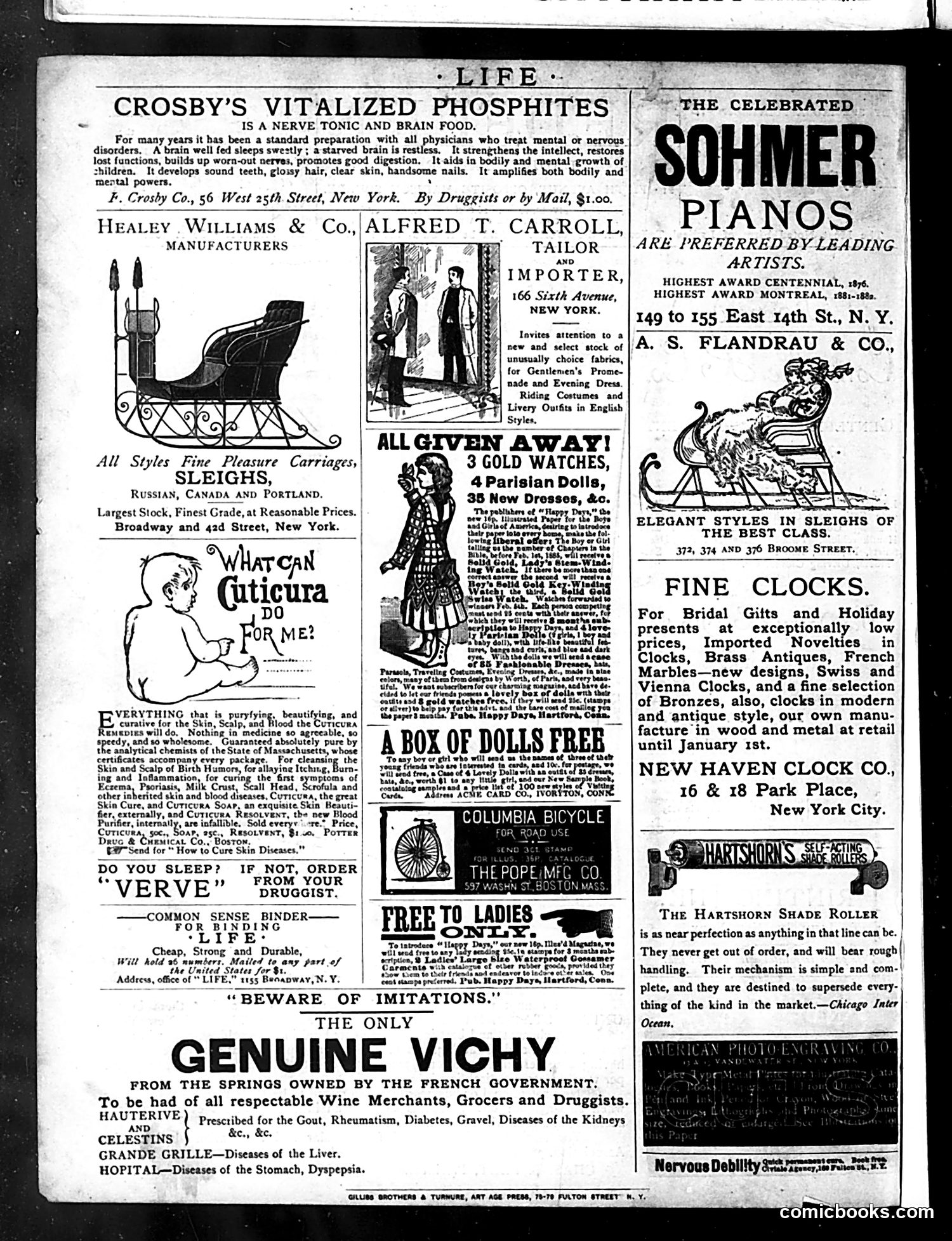
This is primarily an **advertising page** with no political cartoons or satire. It consists entirely of late 19th-century product advertisements. The ads reveal period concerns: Crosby's Phosphites promises to cure "nervous disorders" and strengthen intellects—reflecting Victorian anxieties about mental health and productivity. Cuticura addresses skin conditions with claims of purity verified by "analytical chemists," appealing to emerging scientific credibility. Multiple ads offer premiums and giveaways ("3 gold watches," "box of dolls free")—common marketing tactics of the era. The "Verve" sleeping aid and "Nervous Debility" references suggest widespread fatigue complaints among readers. Luxury goods dominate: pianos, sleighs, fine clocks, and tailoring services for "gentlemen's evening dress" target affluent urban consumers in New York. The genuine Vichy water advertisement emphasizes French government ownership—appealing to Old World prestige valued by American elites. This page documents consumer culture and patent medicine marketing before modern FDA regulation.

I can see this is a page from Life magazine, but the image is almost entirely black with only minimal visible content - a white curved mark near the top and some barely discernible text fragments along the left margin. The OCR text only provides a website reference ("comicbooks.com"). I cannot reliably identify any cartoon figures, political references, or satirical content from this heavily darkened or damaged scan. To properly analyze the cartoon's meaning, context, and historical significance for modern readers, I would need a clearer image where the actual artwork and text are legible. If you have a clearer version of this page, I'd be happy to provide the historical analysis you're seeking.