
Life, 1884-12-25 · page 10 of 17
Life — December 25, 1884 — page 10: what you’re looking at
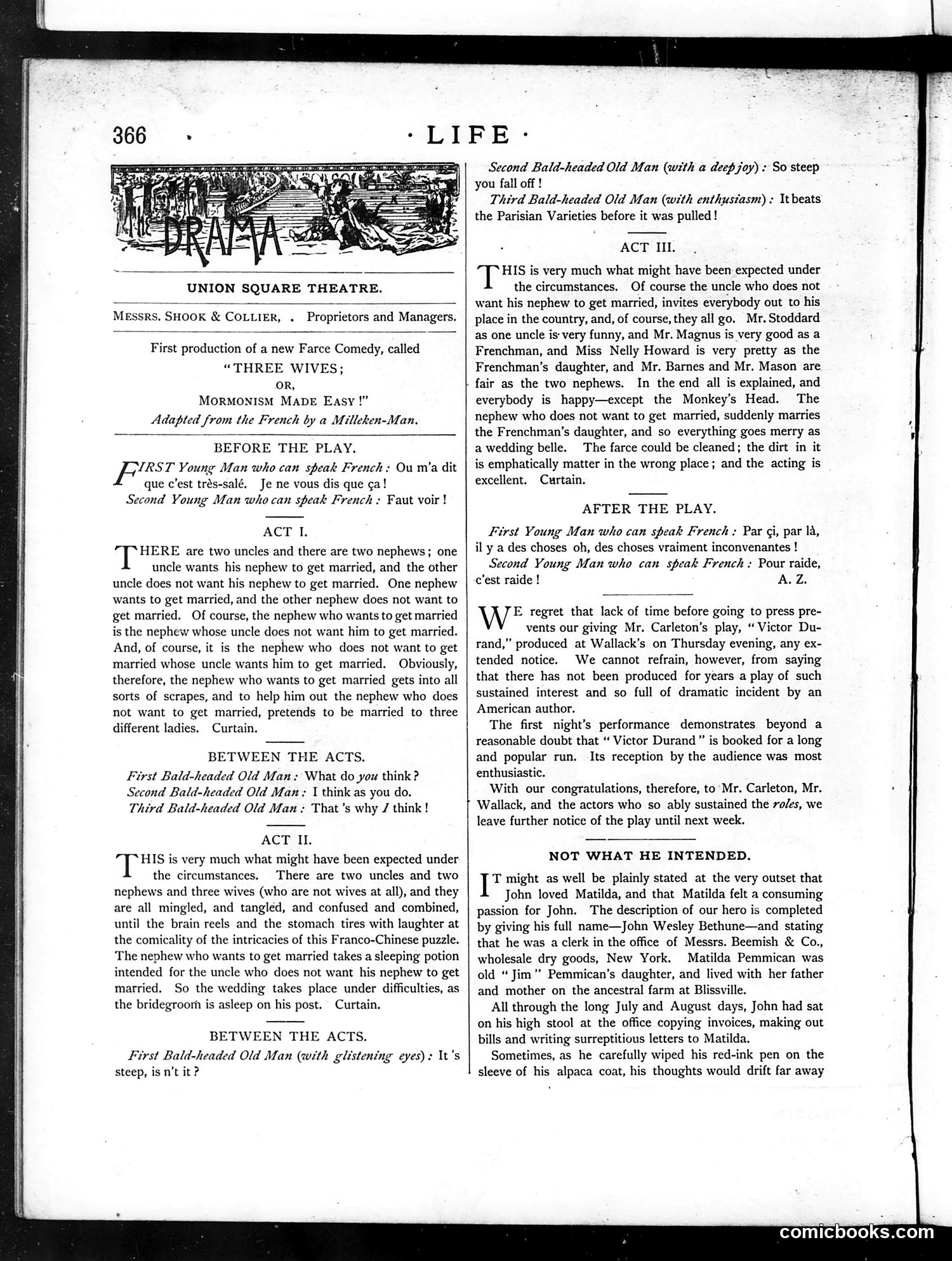
What you’re looking at
This page reviews a French farce comedy adapted for American audiences. The satire targets **Mormon polygamy**—a controversial practice that scandalized 19th-century America. The play's absurd plot (involving uncles, nephews, and fake marriages) parodies the marital complications polygamy creates. The "BETWEEN THE ACTS" segments mock theatrical audiences: three bald-headed old men offer increasingly vapid commentary, with the third claiming the show "beats the Parisian Varieties"—satirizing critics who mistake loud spectacle for quality theater. The review itself is favorable, praising performances by Stoddard, Magnus, Howard, Barnes, and Mason, while noting the farce contains "dirt" (crude material) that doesn't belong. A brief notice also congratulates Mr. Carleton on "Victor Durand," an American-authored play enjoying enthusiastic reception at Wallack's Theatre.
📄 Transcribed text from this page (OCR, searchable)
Machine-transcribed from the original scan — historical spelling and the odd misread are preserved.
‘LIFE: First production of a new Farce Comedy, called “THREE WIVES; OR, MORMONISM MADE Easy !” Adapted from the French by a Milleken-Man. BEFORE THE PLAY, YRST Young Man who can speak French: Ou m’a dit que c’est trés-salé. Je ne vous dis que ga! Second Young Man who can speak French ; Faut voir ! ACT I. HERE are two uncles and there are two nephews; one uncle wants his nephew to get married, and the other uncle does not want his nephew to get married. One nephew wants to get married, and the other nephew does not want to get married. Of course, the nephew who wants to get married is the nephew whose uncle does not want him to get married. And, of course, it is the nephew who does not want to get married whose uncle wants him to get married. Obviously, therefore, the nephew who wants to get married gets into all sorts of scrapes, and to help him out the nephew who does not want to get married, pretends to be married to three different ladies. Curtain. BETWEEN THE ACTS. First Bald-headed Old Man; What do you think ? Second Bald-headed Old Man: \ think as you do. Third Bald-headed Old Man: That’s why / think! ACT Il. HIS is very much what might have been expected under the circumstances. There are two uncles and two nephews and three wives (who are not wives at all), and they are all mingled, and tangled, and confused and combined, until the brain reels and the stomach tires with laughter at the comicality of the intricacies of this Franco-Chinese puzzle. The nephew who wants to get married takes a sleeping potion intended for the uncle who does not want his nephew to get married. So the wedding takes place under difficulties, as the bridegroom is asleep on his post. Curtain. BETWEEN THE ACTS. First Bald-headed Old Man (with glistening eyes): It's steep, is n’t it ? Second Bald-headed Old Man (with a deepjoy) : So steep you fall off ! Third Bald-headed Old Man (with enthusiasm) : \tbeats the Parisian Varieties before it was pulled! ACT IL ae HIS is very much what might have been expected under the circumstances. Of course the uncle who does not want his nephew to get married, invites everybody out to his place in the country, and, of course, they all go. Mr. Stoddard as one uncle is: very funny, and Mr. Magnus is very good as a Frenchman, and Miss Nelly Howard is very pretty as the Frenchman’s daughter, and Mr. Barnes and Mr. Mason are fair as the two nephews. In the end all is explained, and everybody is happy—except the Monkey’s Head. The nephew who does not want to get married, suddenly marries the Frenchman’s daughter, and so everything goes merry as a wedding belle. The farce could be cleaned; the dirt in it is emphatically matter in the wrong place; and the acting is excellent. Curtain. AFTER THE PLAY. First Young Man who can speak French : Par Gi, par la, il y a des choses oh, des choses vraiment inconvenantes ! Second Young Man who can speak French : Pour raide, c’est raide ! A.Z. E regret that lack of time before going to press pre- vents our giving Mr. Carleton’s play, “ Victor Du- rand,” produced at Wallack’s on Thursday evening, any ex- tended notice. We cannot refrain, however, from saying that there has not been produced for years a play of such sustained interest and so full of dramatic incident by an American author. The first night’s performance demonstrates beyond a reasonable doubt that “ Victor Durand” is booked for a long and popular run. Its reception by the audience was most enthusiastic. With our congratulations, therefore, to’Mr. Carleton, Mr. Wallack, and the actors who so ably sustained the voles, we leave further notice of the play until next week. NOT WHAT HE INTENDED. | fe might as well be plainly stated at the very outset that John loved Matilda, and that Matilda felt a consuming passion for John. The description of our hero is completed by giving his full name—John Wesley Bethune—and stating that he was a clerk in the office of Messrs. Beemish & Co., wholesale dry goods, New York. Matilda Pemmican was old “ Jim” Pemmican’s daughter, and lived with her father and mother on the ancestral farm at Blissville. All through the long July and August days, John had sat on his high stool at the office copying invoices, making out bills and writing surreptitious letters to Matilda. Sometimes, as he carefully wiped his red-ink pen on the sleeve of his alpaca coat, his thoughts would drift far away comicbooks.com