
Life, 1884-12-25 · page 12 of 17
Life — December 25, 1884 — page 12: what you’re looking at
What you’re looking at
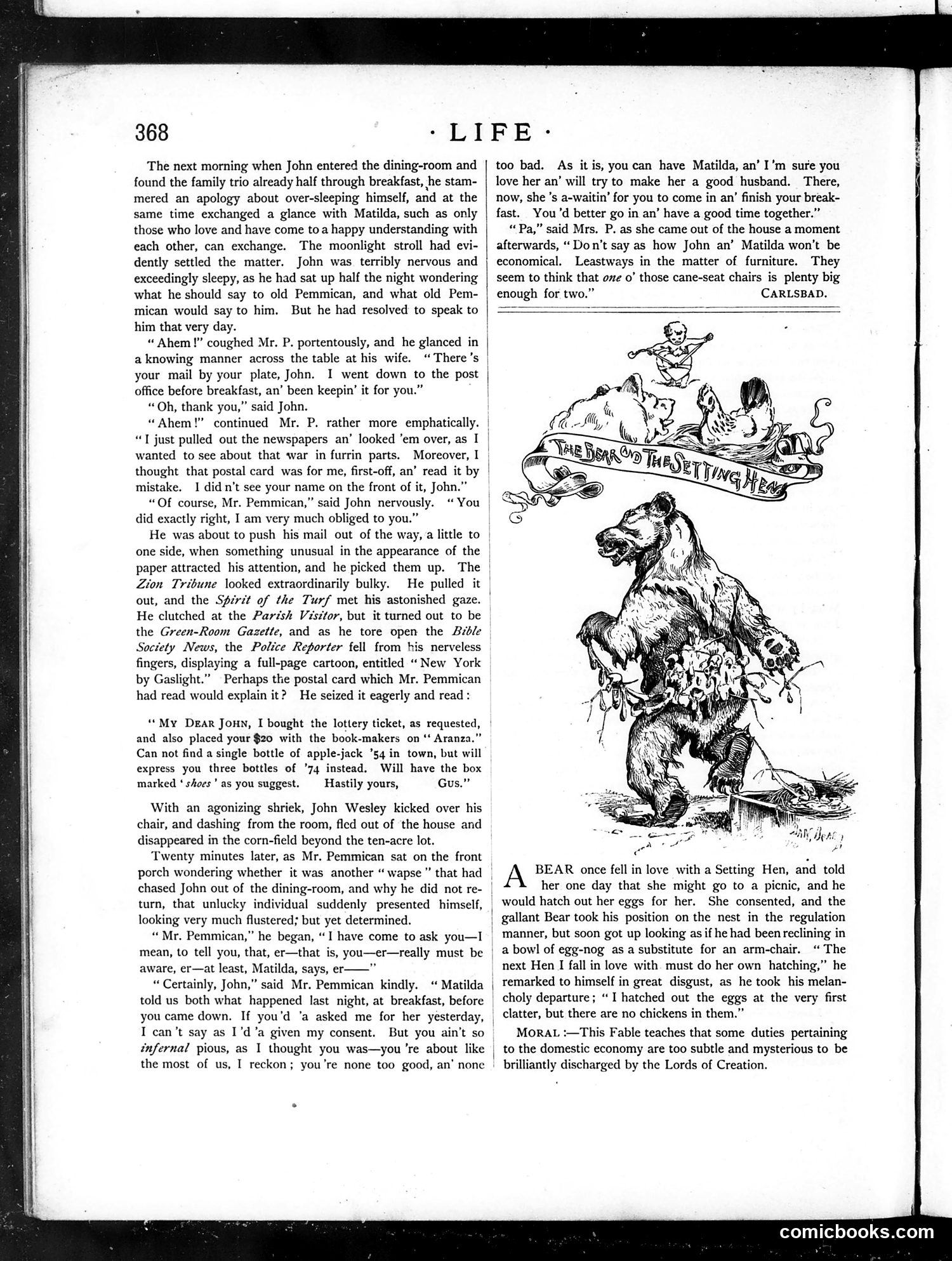
This page contains two distinct pieces. The narrative text follows John Wesley's romantic entanglement with Matilda Pemmican. The humor centers on John's panic: he receives mail intended for someone else—lottery tickets, gambling bets, and bootleg whiskey shipments—which Mr. Pemmican has already read. John flees in terror, believing his character is ruined before proposing. The accompanying illustration is a fable titled "A Bear Once Fell in Love with a Setting Hen," likely satirizing absurd romantic mismatches or foolish courtship. The moral warns against imprudent domestic arrangements, using animals to mock human pretension. Both pieces exemplify *Life* magazine's satirical style: mocking rural American courtship customs, parental authority, and the chaos that ensues when respectability is threatened by circumstance rather than actual wrongdoing. The humor relies on Victorian anxieties about reputation and propriety.
📄 Transcribed text from this page (OCR, searchable)
Machine-transcribed from the original scan — historical spelling and the odd misread are preserved.
368 The next morning when John entered the dining-room and found the family trio already half through breakfast, he stam- mered an apology about over-sleeping himself, and at the same time exchanged a glance with Matilda, such as only those who love and have come toa happy understanding with each other, can exchange. The moonlight stroll had evi- dently settled the matter. John was terribly nervous and exceedingly sleepy, as he had sat up half the night wondering what he should say to old Pemmican, and what old Pem- mican would say to him. But he had resolved to speak to him that very day. “ Ahem!” coughed Mr. P. portentously, and he glanced in a knowing manner across the table at his wife. “There’s your mail by your plate, John. I went down to the post office before breakfast, an’ been keepin’ it for you.” “Oh, thank you,” said John. - LIFE: too bad. As it is, youcan have Matilda, an’ I’m sure you love her an’ will try to make her a good husband. There, now, she ’s a-waitin’ for you to come in an’ finish your break- fast. You'd better go in an’ have a good time together.” “Pa,” said Mrs. P. as she came out of the house a moment afterwards, “Don’t say as how John an’ Matilda won't be economical. Leastways in the matter of furniture. They seem to think that ove o’ those cane-seat chairs is plenty big CARLSBAD. enough for two.” “Ahem!” continued Mr. P. rather more emphatically. | “I just pulled out the newspapers an’ looked ‘em over, as I | wanted to see about that war in furrin parts. thought that postal card was for me, first-off, an’ read it by mistake. 1 didn’t see your name on the front of it, John.” “Of course, Mr. Pemmican,” said John nervously. “ You did exactly right, I am very much obliged to you.” He was about to push his mail out of the way, a little to one side, when something unusual in the appearance of the paper attracted his attention, and he picked them up. The Zion Tribune \ooked extraordinarily bulky. He pulled it Moreover, I | out, and the Spzrit of the Turf met his astonished gaze. | He clutched at the Parish Visztor, but it turned out to be the Green-Room Gazette, and as he tore open the Brble Society News, the Police Reporter fell from his nerveless fingers, displaying a full-page cartoon, entitled “New York by Gaslight.” Perhaps the postal card which Mr. Pemmican had read would explain it? He seized it eagerly and read : ““My Dear Joun, I bought the lottery ticket, as requested, and also placed your $20 with the book-makers on ‘‘ Aranza.” Can not find a single bottle of apple-jack ’54 in town, but will express you three bottles of ’74 instead. Will have the box marked ‘ shoes’ as you suggest. Hastily yours, Gus.” With an agonizing shriek, John Wesley kicked over his chair, and dashing from the room, fled out of the house and disappeared in the corn-field beyond the ten-acre lot. Twenty minutes later, as Mr. Pemmican sat on the front porch wondering whether it was another “wapse” that had chased John out of the dining-room, and why he did not re- turn, that unlucky individual suddenly presented himself, looking very much flustered; but yet determined. “Mr. Pemmican,” he began, “I have come to ask you—I mean, to tell you, that, er—that is, you—er—really must be aware, er—at least, Matilda, says, ee——" “ Certainly, John,” said Mr. Pemmican kindly. “ Matilda told us both what happened last night, at breakfast, before you came down. If you’d ’a asked me for her yesterday, I can’t say as I’d’a given my consent. But you ain't so infernal pious, as I thought you was—you ’re about like the most of us, I reckon; you're none too good, an’ none BEAR once fell in love with a Setting Hen, and told her one day that she might go to a picnic, and he would hatch out her eggs for her. She consented, and the | gallant Bear took his position on the nest in the regulation manner, but soon got up looking as if he had been reclining in a bowl of egg-nog as a substitute for an arm-chair. “ The next Hen I fall in love with must do her own hatching,” he | remarked to himself in great disgust, as he took his melan- choly departure; “I hatched out the eggs at the very first clatter, but there are no chickens in them.” Morat :—This Fable teaches that some duties pertaining to the domestic economy are too subtle and mysterious to be brilliantly discharged by the Lords of Creation. comicbooks.com