
Life, 1884-12-25 · page 7 of 17
Life — December 25, 1884 — page 7: what you’re looking at
What you’re looking at
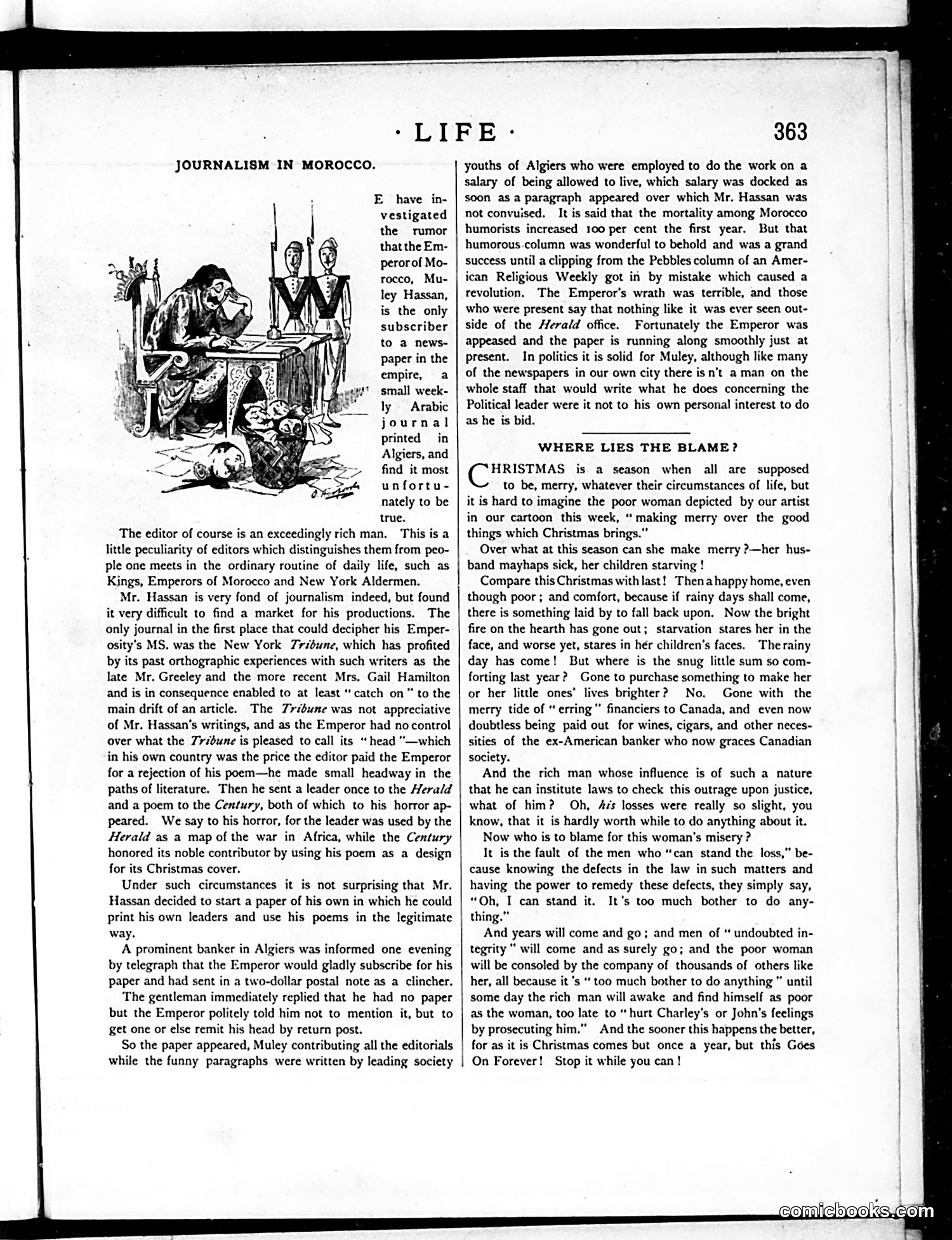
The main cartoon depicts **journalism in Morocco** during the colonial era. It shows a European editor at his desk with armed figures (likely representing colonial military or officials) looming behind him, suggesting **government control or intimidation of the press**. The text describes **Muley Hassan**, a Moroccan subscriber to a small Arabic-language weekly journal in Algiers. The satire mocks Hassan's attempts at journalism: his modest publication gained unexpected prominence when American and European newspapers mistakenly reprinted his work, causing the colonial Emperor to suppress it—apparently viewing independent journalism as a threat. The cartoon satirizes **press freedom limitations in colonial North Africa** and the absurdity of how colonial powers managed information and controlled narratives in their territories.
📄 Transcribed text from this page (OCR, searchable)
Machine-transcribed from the original scan — historical spelling and the odd misread are preserved.
JOURNALISM IN MOROCCO. : E_ have in- | vestigated the rumor that the Em- perorof Mo- rocco, Mu- ley Hassan, is the only subscriber to a news- paper in the empire, a small week- ly Arabic journal printed in Algiers, and find it most unfortu- nately to be true. The editor of course is an exceedingly rich man. This is a little peculiarity of editors which distinguishes them from peo- ple one meets in the ordinary routine of daily life, such as Kings, Emperors of Morocco and New York Aldermen. Mr. Hassan is very fond of journalism indeed, but found it very difficult to find a market for his productions. The only journal in the first place that could decipher his Emper- osity’s MS. was the New York 7rééune, which has profited by its past orthographic experiences with such writers as the late Mr. Greeley and the more recent Mrs. Gail Hamilton and is in consequence enabled to at least “catch on” to the main drift of an article. The 7rséune was not appreciative of Mr. Hassan’s writings, and as the Emperor had no control over what the 7rsbune is pleased to call its “head "—which in his own country was the price the editor paid the Emperor for a rejection of his poem—he made small headway in the paths of literature. Then he sent a leader once to the Herald and a poem to the Century, both of which to his horror ap- peared. We say to his horror, for the leader was used by the Herald as a map of the war in Africa, while the Century honored its noble contributor by using his poem as a design for its Christmas cover. Under such circumstances it is not surprising that Mr. Hassan decided to start a paper of his own in which he could print his own leaders and use his poems in the legitimate way. A prominent banker in Algiers was informed one evening by telegraph that the Emperor would gladly subscribe for his paper and had sent in a two-dollar postal note as a clincher. The gentleman immediately replied that he had no paper but the Emperor politely told him not to mention it, but to get one or else remit his head by return post. So the paper appeared, Muley contributing all the editorials while the funny paragraphs were written by leading society ‘LIFE: 363 youths of Algiers who were employed to do the work on a salary of being allowed to live, which salary was docked as soon as a paragraph appeared over which Mr. Hassan was not convuised. It is said that the mortality among Morocco humorists increased 100 per cent the first year. But that humorous.column was wonderful to behold and was a grand success until a clipping from the Pebbles column of an Amer- ican Religious Weekly got in by mistake which caused a revolution. The Emperor's wrath was terrible, and those who were present say that nothing like it was ever seen out- side of the Herald office. Fortunately the Emperor was appeased and the paper is running along smoothly just at present. In politics it is solid for Muley, although like many of the newspapers in our own city there is n't a man on the whole staff that would write what he does concerning the Political leader were it not to his own personal interest to do as he is bid. WHERE LIES THE BLAME? HRISTMAS is a season when all are supposed to be, merry, whatever their circumstances of life, but it is hard to imagine the poor woman depicted by our artist in our cartoon this week, “ making merry over the good things which Christmas brings.” Over what at this season can she make merry ?—her hus- band mayhaps sick, her children starving ! Compare this Christmas with last! Thenahappy home, even though poor ; and comfort, because if rainy days shall come, there is something laid by to fall back upon. Now the bright fire on the hearth has gone out; starvation stares her in the face, and worse yet, stares in her children’s faces. Therainy day has come! But where is the snug little sum so com- forting last year? Gone to purchase something to make her or her little ones’ lives brighter? No. Gone with the merry tide of “ erring” financiers to Canada, and even now doubtless being paid out for wines, cigars, and other neces- sities of the ex-American banker who now graces Canadian society. And the rich man whose influence is of such a nature that he can institute laws to check this outrage upon justice, what of him? Oh, A/s losses were really so slight, you know, that it is hardly worth while to do anything about it. Now who is to blame for this woman's misery ? It is the fault of the men who “can stand the loss,” be- cause knowing the defects in the law in such matters and having the power to remedy these defects, they simply say, “Oh, I can stand it. It's too much bother to do any- thing.” And years will come and go; and men of “ undoubted in- tegrity " will come and as surely go; and the poor woman will be consoled by the company of thousands of others like her, all because it 's “too much bother to do anything ” until some day the rich man will awake and find himself as poor as the woman, too late to “hurt Charley’s or John’s feelings by prosecuting him.” And the sooner this happens the better, | for as it is Christmas comes but once a year, but this Goes On Forever! Stop it while you can !