
Life, 1884-12-25 · page 6 of 17
Life — December 25, 1884 — page 6: what you’re looking at
What you’re looking at
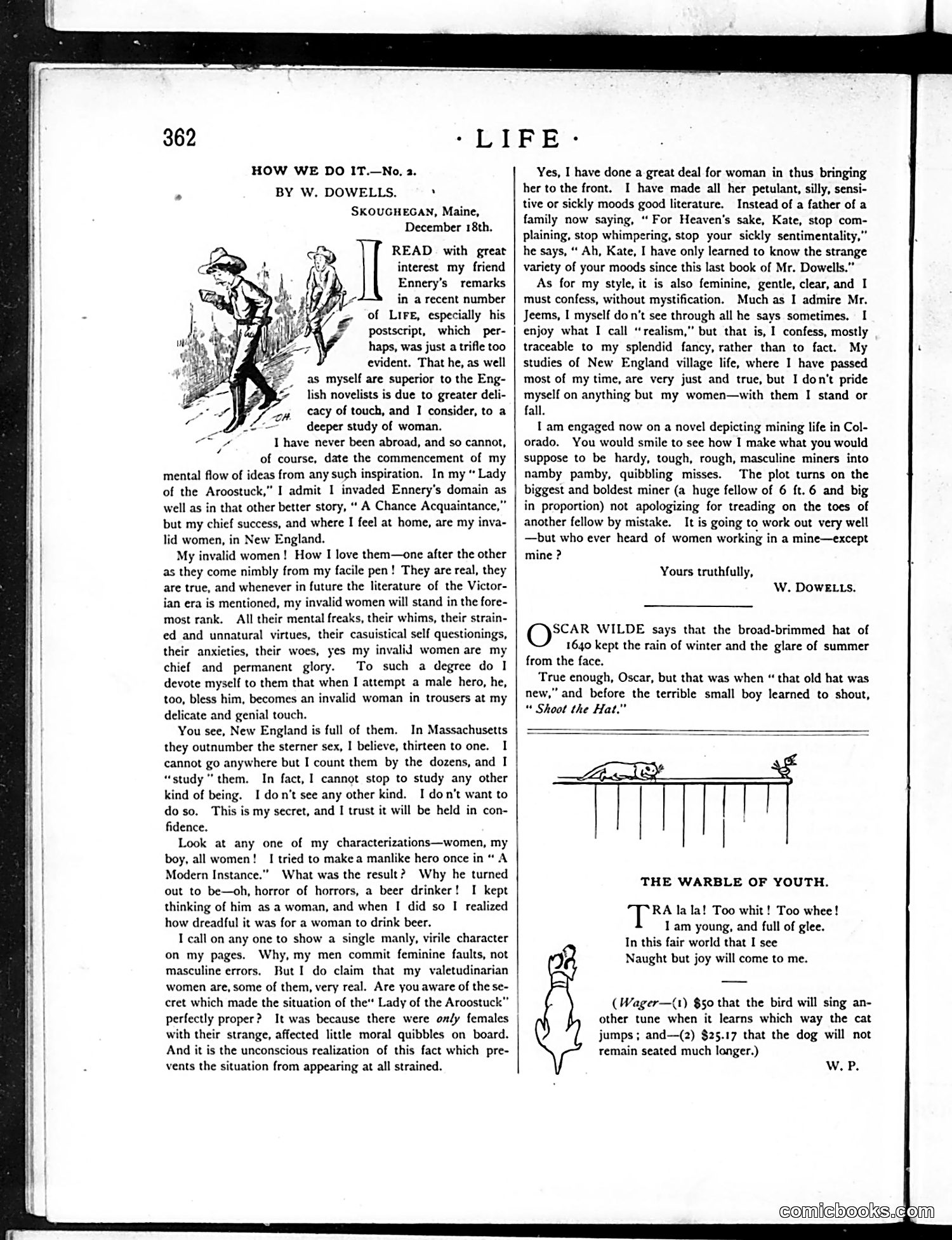
This page contains two distinct items: **"How We Do It—No. 2" by W. Dowells** is a letter responding to earlier criticism about Dowells' portrayal of women characters. The author defends his depictions of "invalid women" in New England settings, arguing they are realistic. He mentions current work on a novel about mining life in Colorado and jokes about depicting women miners—suggesting this would be novel subject matter. **"The Warble of Youth"** is a brief humorous poem about youthful exuberance, with a small illustration of a bird. Below it is a wagering joke about which direction a bird will sing versus how long a dog remains seated. The page is primarily textual commentary rather than political satire. It reflects early 20th-century literary debates about character representation and gender.
📄 Transcribed text from this page (OCR, searchable)
Machine-transcribed from the original scan — historical spelling and the odd misread are preserved.
-LIFE- HOW WE DO IT.—No, 2. BY W. DOWELLS. s SKOUGHEGAN, Maine, December 18th. READ with great interest my friend Ennery’s remarks in a recent number of Lire, especially his postscript, which per- haps, was just a trifle too evident. That he, as well as myself are superior to the Eng- lish novelists is due to greater deli- cacy of touch, and I consider, to a deeper study of woman. Ihave never been abroad, and so cannot, of course, date the commencement of my mental flow of ideas from any such inspiration. In my “ Lady of the Aroostuck,” I admit I invaded Ennery's domain as well as in that other better story, “ A Chance Acquaintance,” but my chief success, and where I feel at home, are my inva- lid women, in New England. My invalid women ! How I love them—one after the other as they come nimbly from my facile pen! They are real, they are true, and whenever in future the literature of the Victor- ian era is mentioned, my invalid women will stand in the fore- most rank. All their mental freaks, their whims, their strai ed and unnatural virtues, their casuistical self questionings, their anxieties, their woes, yes my invalid women are my chief and permanent glory. To such a degree do I devote myself to them that when I attempt a male hero, he, too, bless him, becomes an invalid woman in trousers at my delicate and genial touch. You see, New England is full of them. In Massachusetts they outnumber the sterner sex, I believe, thirteen to one. I cannot go anywhere but I count them by the dozens, and I “study "them. In fact, 1 cannot stop to study any other kind of being. I don’t see any other kind. I don’t want to do so. This is my secret, and I trust it will be held in con- fidence. Look at any one of my characterizations—women, my boy, all women! I tried to make a manlike hero once in “ A Modern Instance.” What was the result? Why he turned out to be—oh, horror of horrors, a beer drinker! I kept thinking of him as a woman, and when I did so I realized how dreadful it was for a woman to drink beer. I call on any one to show a single manly, virile character on my pages. Why, my men commit feminine faults, not masculine errors. But I do claim that my valetudinarian women are, some of them, very real. Are you aware of the se: cret which made the situation of thet Lady of the Aroostuck’ perfectly proper? It was because there were only females with their strange, affected little moral quibbles on board. And it is the unconscious realization of this fact which pre- vents the situation from appearing at all strained. Co Yes, I have done a great deal for woman in thus bringing her to the front. I have made all her petulant, silly, sensi- tive or sickly moods good literature. Instead of a father of a family now saying, ‘‘ For Heaven's sake, Kate, stop com- plaining, stop whimpering, stop your sickly sentimentality,” he says, “ Ah, Kate, I have only learned to know the strange variety of your moods since this last book of Mr. Dowells.” As for my style, it is also feminine, gentle, clear, and I must confess, without mystification. Much as I admire Mr. Jeems, I myself don’t see through all he says sometimes. I enjoy what I call “realism,” but that is, I confess, mostly traceable to my splendid fancy, rather than to fact. My studies of New England village life, where I have passed most of my time, are very just and true, but I don’t pride myself on anything but my women—with them I stand or fall. I am engaged now on a novel depicting mining life in Col- orado. You would smile to see how I make what you would suppose to be hardy, tough, rough, masculine miners into namby pamby, quibbling misses. The plot turns on the biggest and boldest miner (a huge fellow of 6 ft. 6 and big in proportion) not apologizing for treading on the toes of another fellow by mistake. It is going to work out very well —but who ever heard of women working in a mine—except mine ? Yours truthfully, W. DowELts. SCAR WILDE says that the broad-brimmed hat of 1640 kept the rain of winter and the glare of summer from the face. True enough, Oscar, but that was when “ that old hat was new,” and before the terrible small boy learned to shout, “ Shoot the Hat.” THE WARBLE OF YOUTH. RA la la! Too whit! Too whee! I am young, and full of glee. In this fair world that I see Naught but joy will come to me. (Wager—(1) $50 that the bird will sing an- other tune when it learns which way the cat jumps ; and—(2) $25.17 that the dog will not remain seated much longer.) W. P. comichooks.gom