
A complete issue · 16 pages · 1884
Life — October 2, 1884
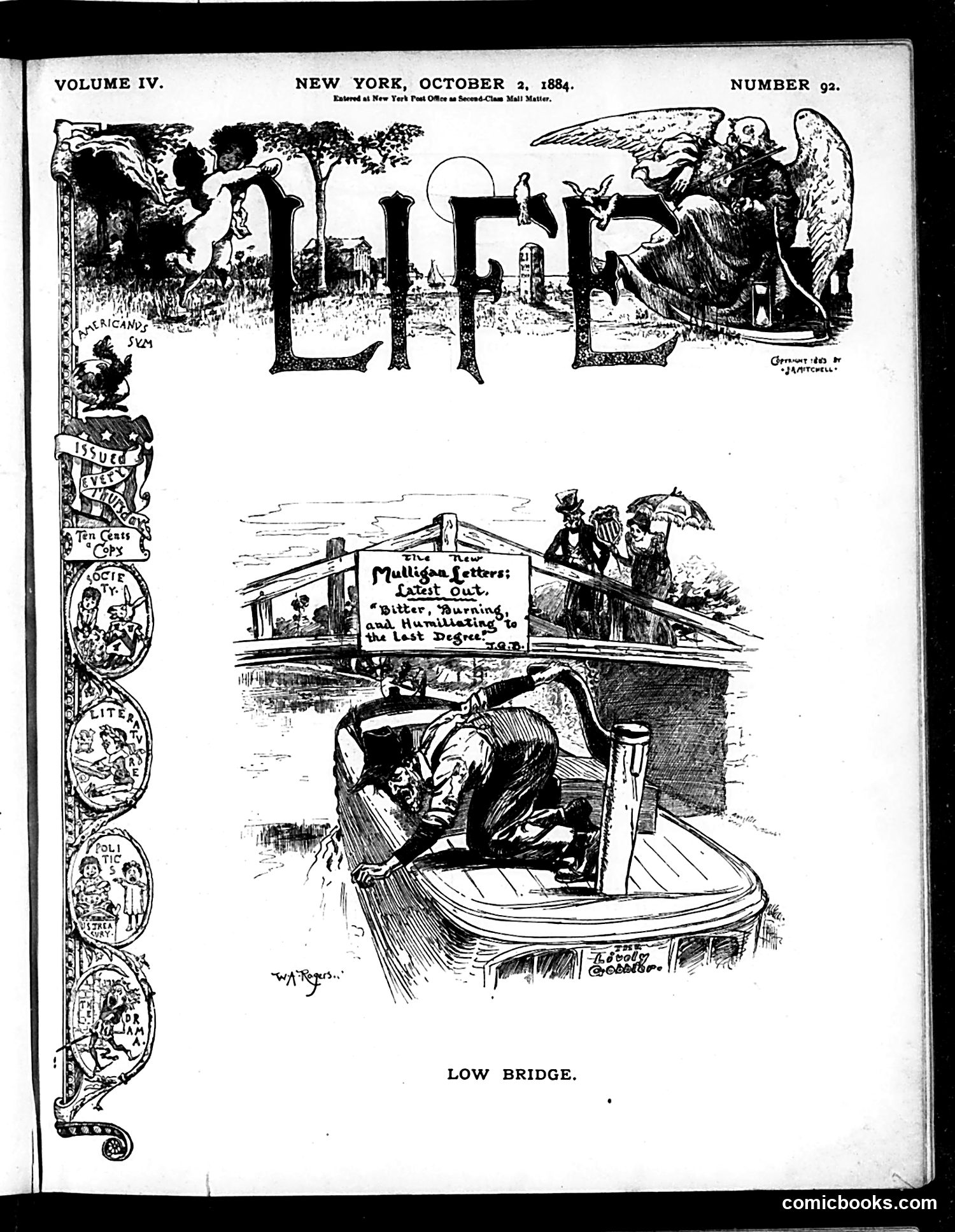
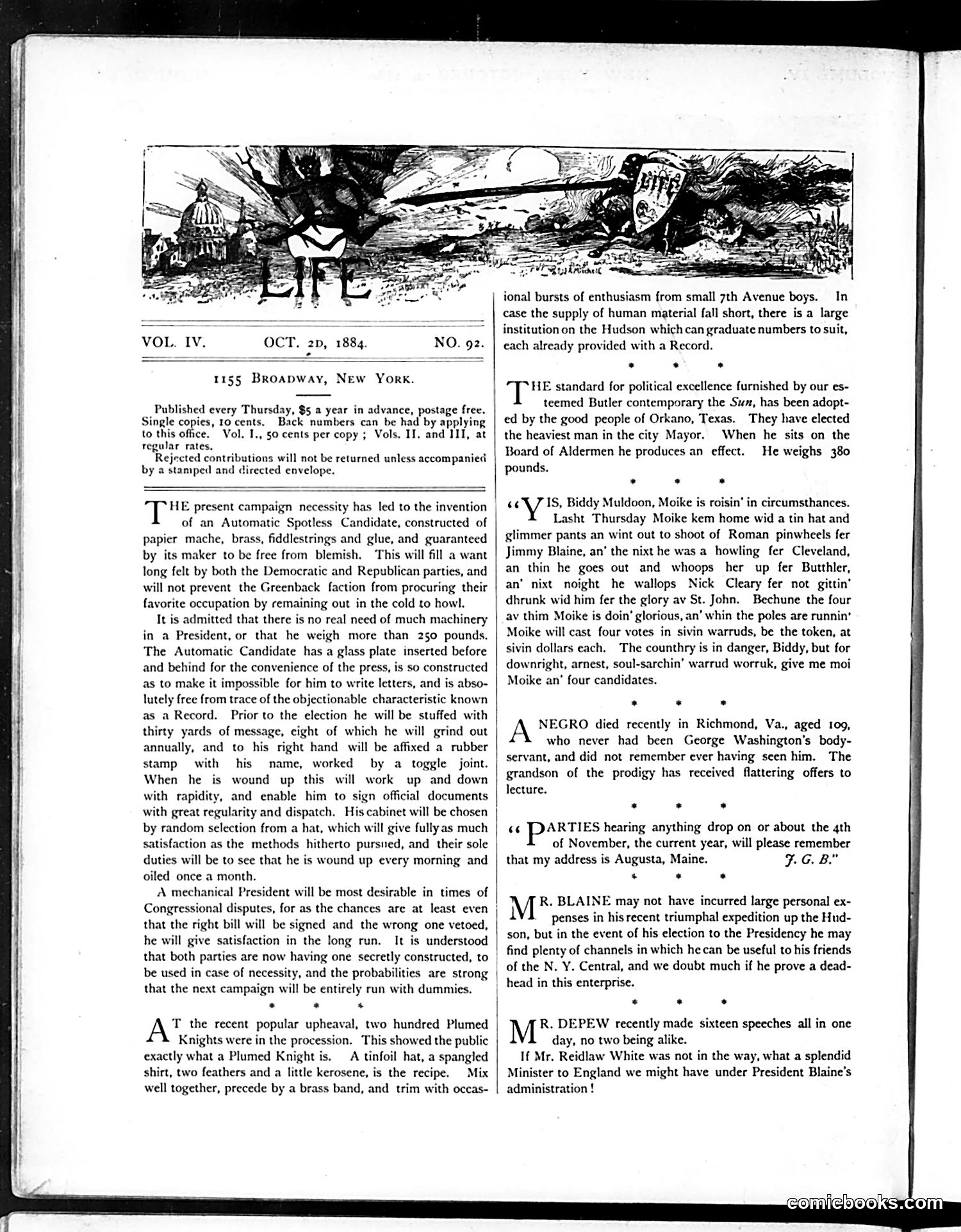
The masthead illustration depicts "LIFE" emerging from or connected to a tree, likely symbolic of the magazine's satirical perspective on American society. The page's text contains political satire about the 1884 presidential campaign. It mocks the "Automatic Candidate"—a mechanical voting device designed to prevent fraud and ensure impartial results. The passage humorously describes this contraption as capable of producing political candidates while remaining free from human bias. The text also references contemporary political figures and events, including mentions of congressional disputes and campaign machinery. References to "Plumed Knights" appear to satirize ornate political pageantry. Several short humorous anecdotes follow, typical of Life's satirical content addressing 1880s American politics and society.
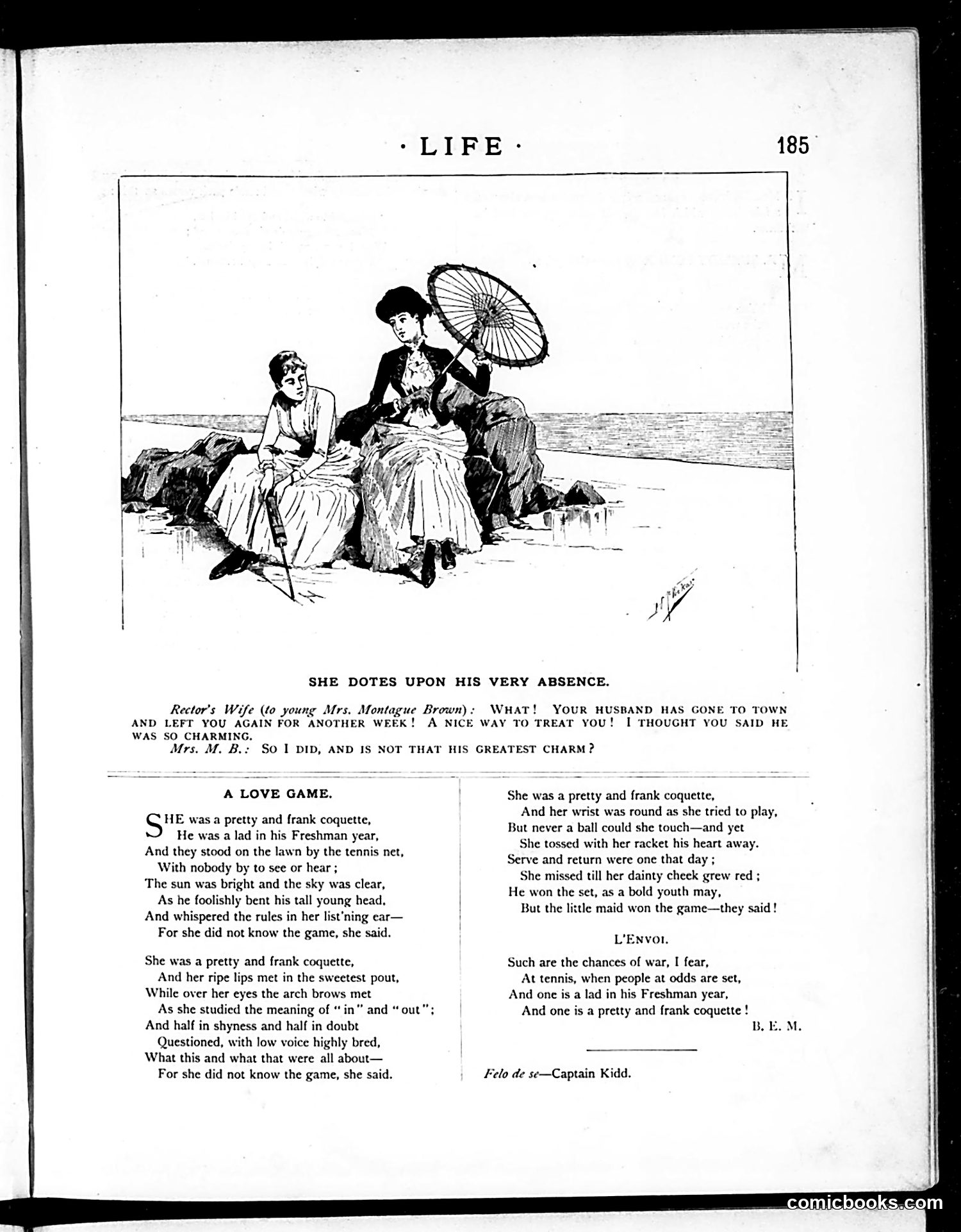
**The Cartoon:** The illustration shows two women on a beach with a parasol. The caption "She Dotes Upon His Very Absence" presents a satirical exchange between a rector's wife and young Mrs. Montague Brown. The wife complains her husband left for town again, noting she thought his greatest charm was his absence—a cutting joke about marital discord. **The Poetry Section:** Below are three poems about tennis and romance: "A Love Game" describes a young woman learning tennis while flirting with a man, "L'Envoi" makes wordplay about tennis and courtship, and a final attributed piece by "Captain Kidd." The page satirizes Victorian courtship rituals and marital relationships through humor about leisure activities and gender dynamics among the upper classes.
This page contains **gossip and literary commentary** rather than political cartoons. The "Boomlets" section offers brief satirical takes on contemporary figures: - **Mrs. Lockwood** allegedly wore a false bang - **Mr. Subsidy Pomeroy** received subsidies - **The Young Republican Club of Brooklyn** endorsed Mr. Blaine, criticized as settling "the whole campaign" - **Mr. Grover Cleveland** is attacked as a "tool of monopoly," with criticism of attorney Chauncey Depew and the Blaine circus The main content discusses **Mrs. McCaelb's poetry collection**, praised despite her widowhood. A lengthy section analyzes her poems' themes of loss and marriage, with extended quotations. The satire targets **political figures and their financial dealings** (monopoly, subsidies) while celebrating literary achievement independent of commercial profit—a common Life magazine position.
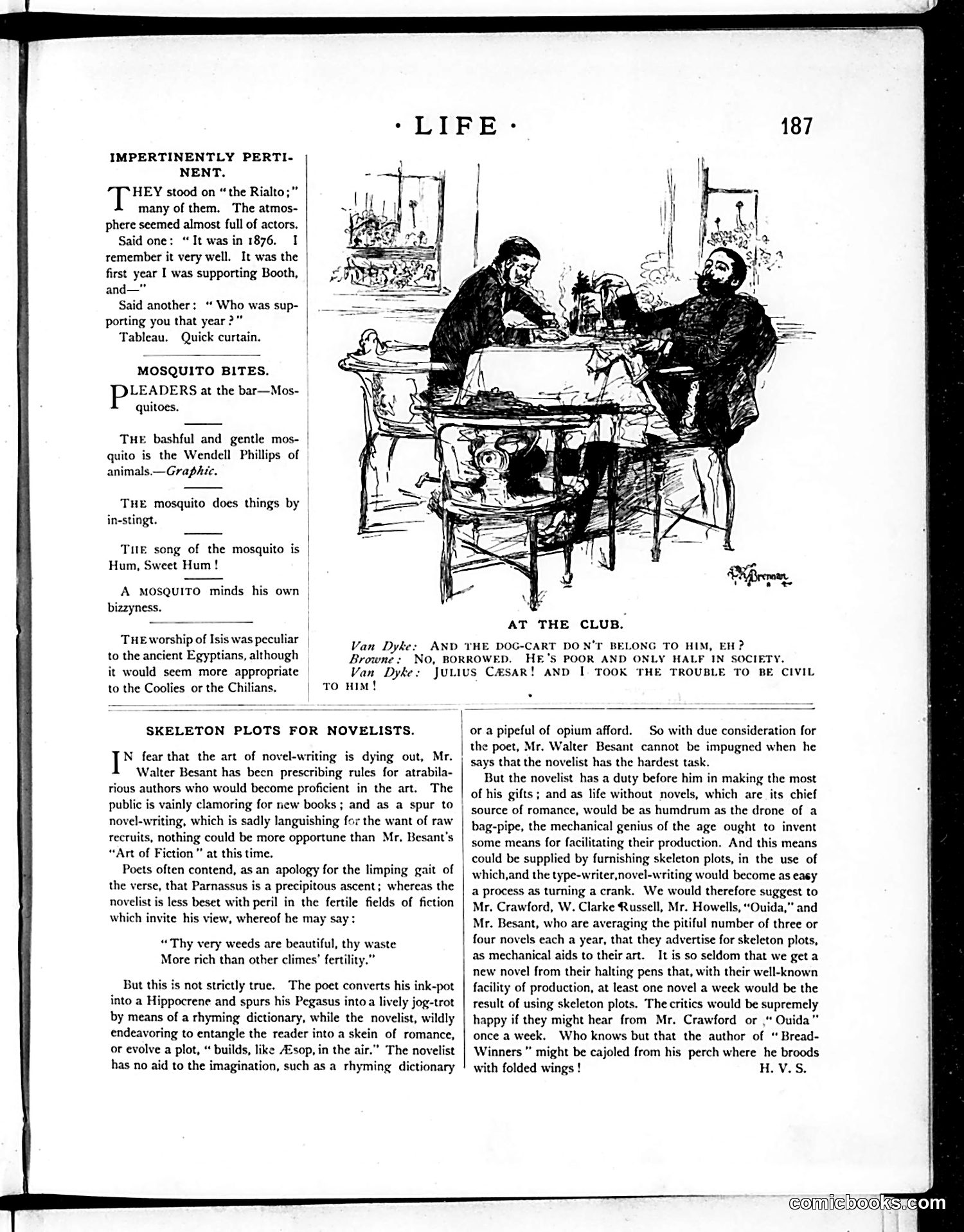
**"At the Club" Cartoon:** The illustration depicts two men at a dining table in what appears to be an exclusive club. The dialogue concerns a borrowed dog-cart (a light carriage). One character, Van Dyke, notes the dog-cart doesn't belong to his companion Broome, who responds that he borrowed it because he's "poor and only half a society." Van Dyke then quips about taking "the trouble to be civil" to Julius Caesar. The satire targets social pretension and class hierarchies of the era—specifically mocking how wealthy club members either owned expensive carriages or shamelessly borrowed them to maintain appearances of affluence. The Caesar reference humorously suggests even historical figures couldn't escape such social vanity. The accompanying articles discuss mosquitoes and novel-writing techniques, appearing unrelated to the cartoon.
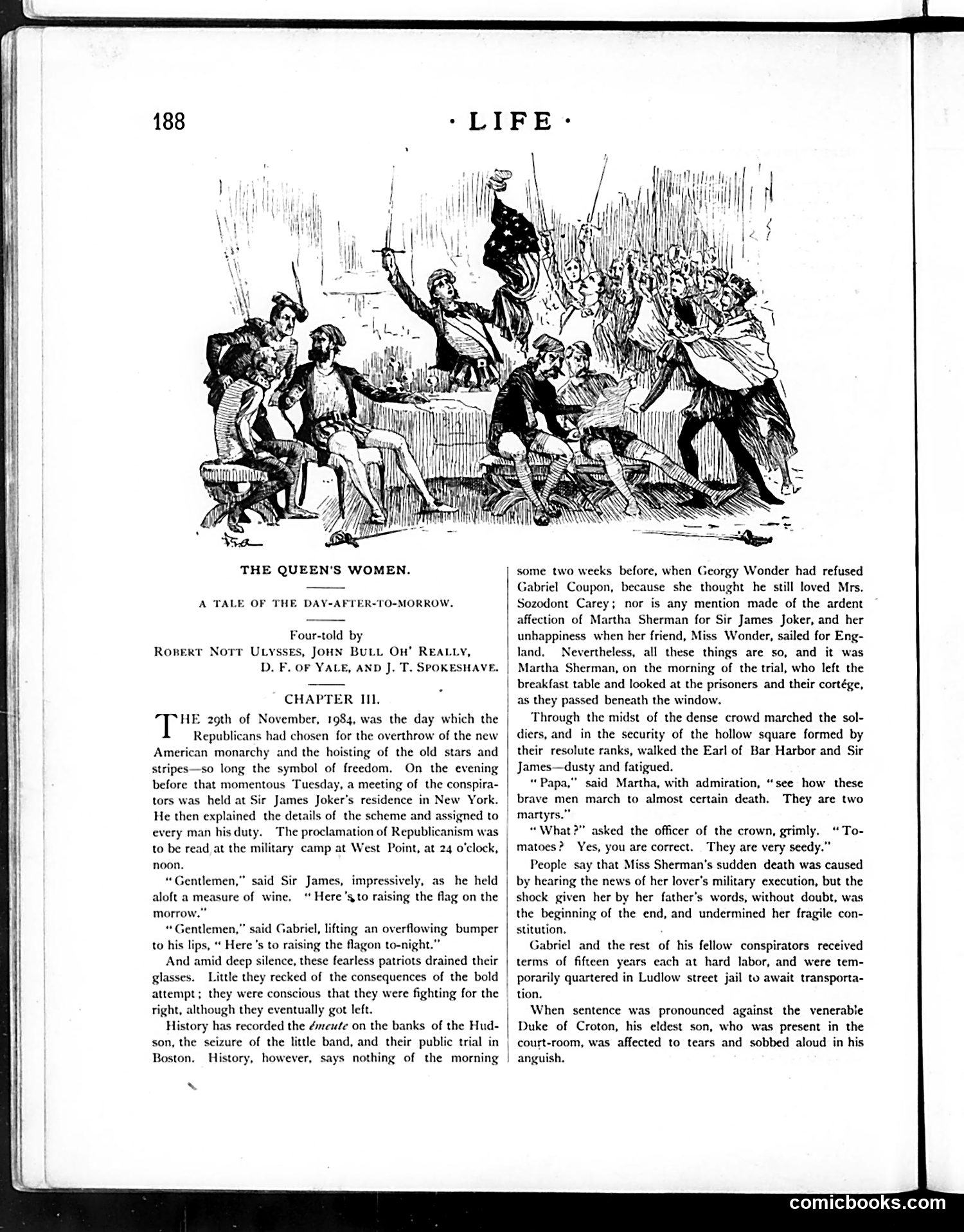
This is a satirical story by Robert Nott Ulysses and others, set on November 29, 1984. The narrative describes a fictional Republican plot to overthrow the American monarchy and restore the republic, involving conspirators meeting at Sir James Joker's residence in New York. The illustration depicts what appears to be a dramatic indoor scene with multiple figures in period dress, some wielding weapons or flags, suggesting political upheaval or revolutionary action. The specific identities of the caricatured figures are unclear from the image alone, but the overall satire mocks potential political conspiracies and suggests anxieties about governmental instability during this era of Life magazine publication.
This page contains the conclusion of a serialized short story titled "The Queen's Women," not a political cartoon. The narrative concludes "Chapter IV," which transfers the scene to London where exiled American political figures await developments. The story references the White House and mentions an "Executive of the New World's fallen republic" lodging in a hotel, suggesting a fictional scenario involving American political upheaval. Characters named Gabriel, George Wonder, and Mrs. Carey are reunited, with plot points involving romantic entanglement and social intrigue among the displaced American political class. The editor's note at bottom indicates this is a four-part serialized story by multiple Boston contributors. This appears to be serialized political fiction rather than satirical commentary.
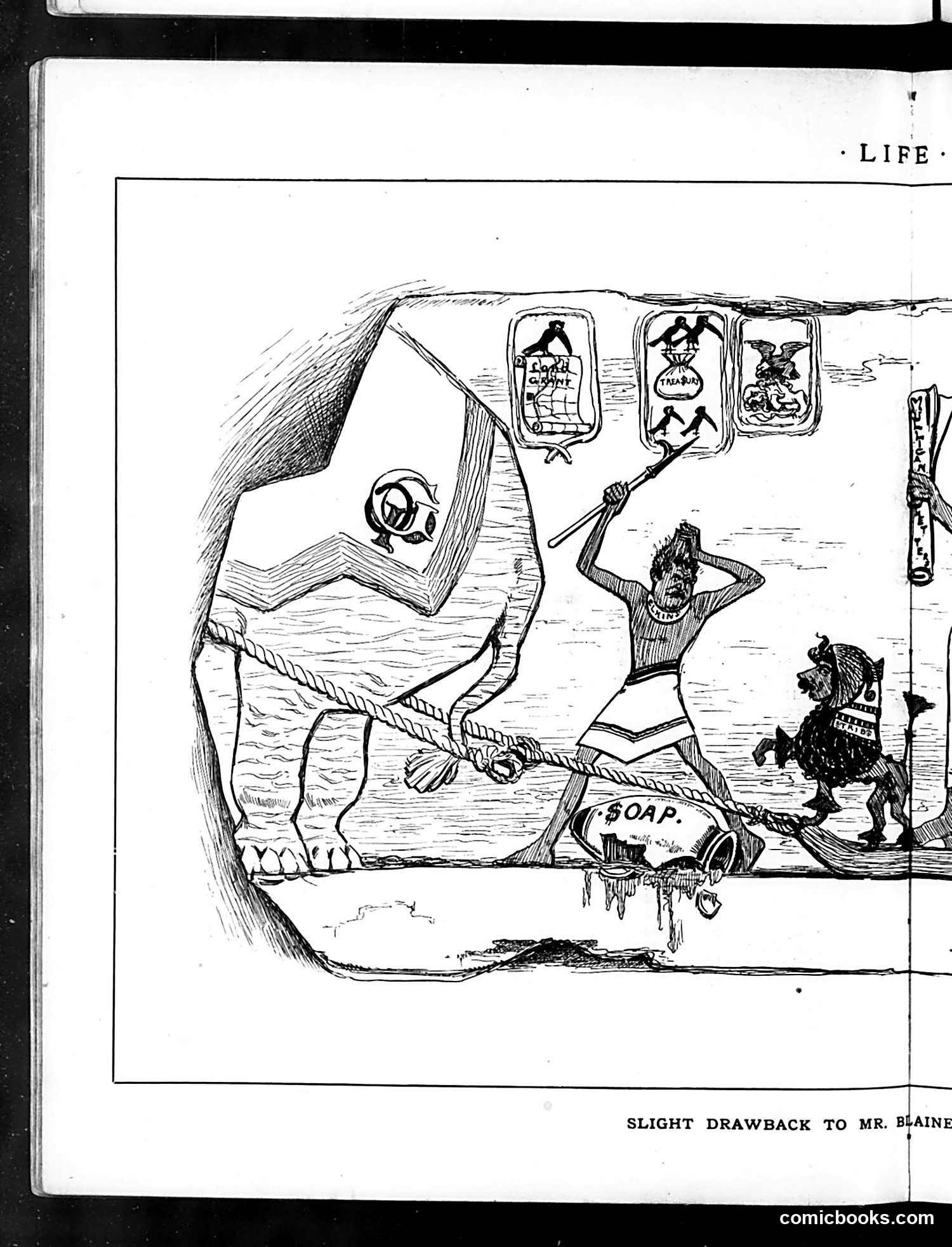
This political cartoon satirizes James G. Blaine (referenced in the caption), likely from the 1884 presidential campaign. The image depicts a large, grotesque figure emerging from what appears to be a tent or structure, holding a rope attached to a soap box. A man frantically waves a stick while a dog barks nearby. The framed images above show various scenes, possibly depicting scandals or controversies. The "soap box" label and the chaotic scene suggest the cartoon mocks Blaine's attempts to "clean up" his image or explain away scandals through public speaking and campaign rhetoric. The grotesque figure and desperate gestures emphasize that no amount of rhetoric could overcome serious political vulnerabilities—a "drawback" to his candidacy that even vigorous campaigning couldn't resolve.
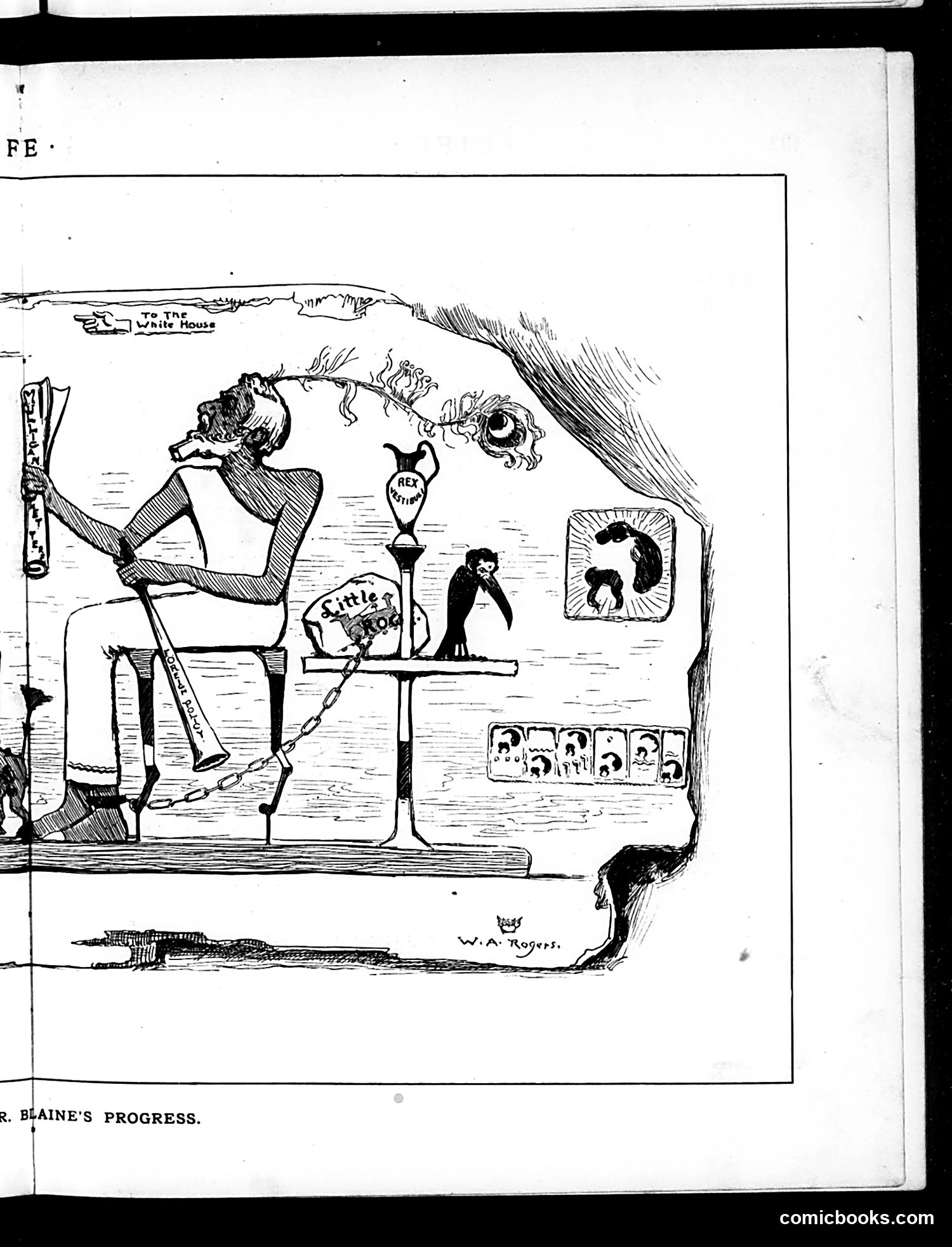
This political cartoon by W.A. Rogers satirizes James G. Blaine's political career trajectory. The drawing depicts Blaine as a figure juggling or managing various scandals and controversies—represented by the suspended objects and chaotic elements around him. The "Rex" trophy and "Little Frog" label suggest mockery of his pretensions to power and leadership. The White House appears in the upper left, likely indicating Blaine's aspirations to the presidency. The overall composition presents his political "progress" as precarious and absurd—he's balancing multiple problematic issues simultaneously. The chain attached to his figure suggests constraint or being bound by his scandals. This appears to be a critical commentary on Blaine's political viability and integrity during his career.
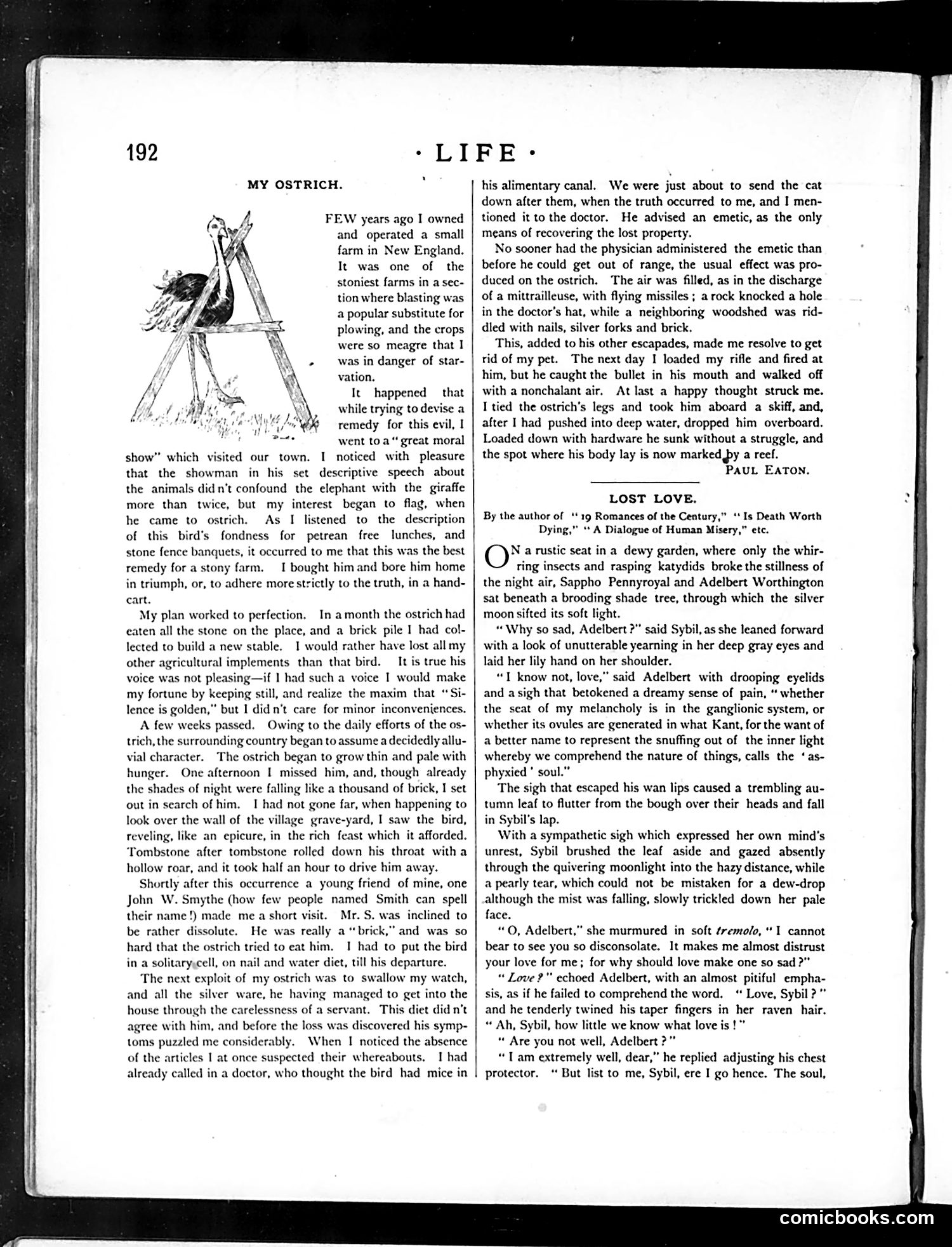
This humorous narrative piece satirizes the gullible farmer who makes foolish agricultural decisions based on traveling shows and dubious advice. The ostrich illustration shows the bird perched awkwardly on a fence. The joke targets rural naiveté: the narrator buys an ostrich after hearing a circus showman claim it eats stones—supposedly solving his rocky New England farm problem. The satire escalates through increasingly absurd consequences: the ostrich eats the farmer's valuables, destroys property, and proves impossible to kill or remove. The piece mocks both the credulous farmer and the charlatan showman who spreads misinformation about animals. It also gently ridicules rural life and agricultural desperation during lean times. The deadpan narrative tone—treating these ridiculous events matter-of-factly—amplifies the comedy. This reflects *Life* magazine's typical satirical humor targeting American folly and overconfidence.
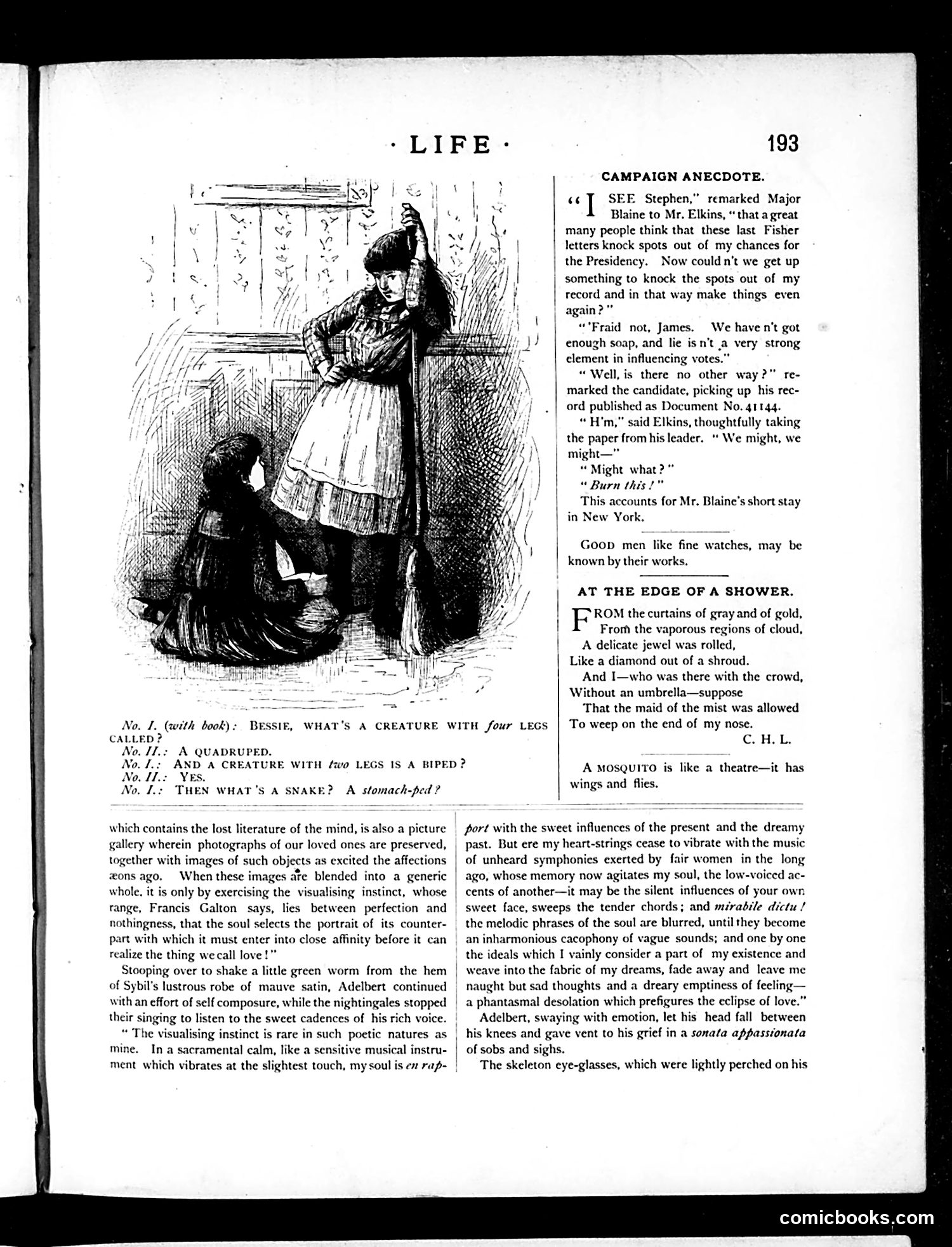
This page contains two distinct satirical pieces: **"Campaign Anecdote"** (top right) mocks Major Blaine's presidential campaign. The joke: when Blaine worries that Fisher's recent letters damage his candidacy, his advisor suggests burning Blaine's own published record (Document 41144) to "knock the spots out" of it—implying his record is so damaging it's beyond repair. The anecdote's punchline is that this explains why Blaine left New York hastily, suggesting he actually attempted this absurd cover-up. **The cartoon** (left) appears to be a logic puzzle illustrated with a woman and child, playing on the definition of animals by leg count—a quadruped has four legs, a biped has two, therefore a snake (with no legs) must be a "stomach-ped." It's a children's wordplay joke. The remaining text includes light verse and observations. The overall page reflects *Life* magazine's typical mix of political satire, humor, and whimsical poetry from the Gilded Age.
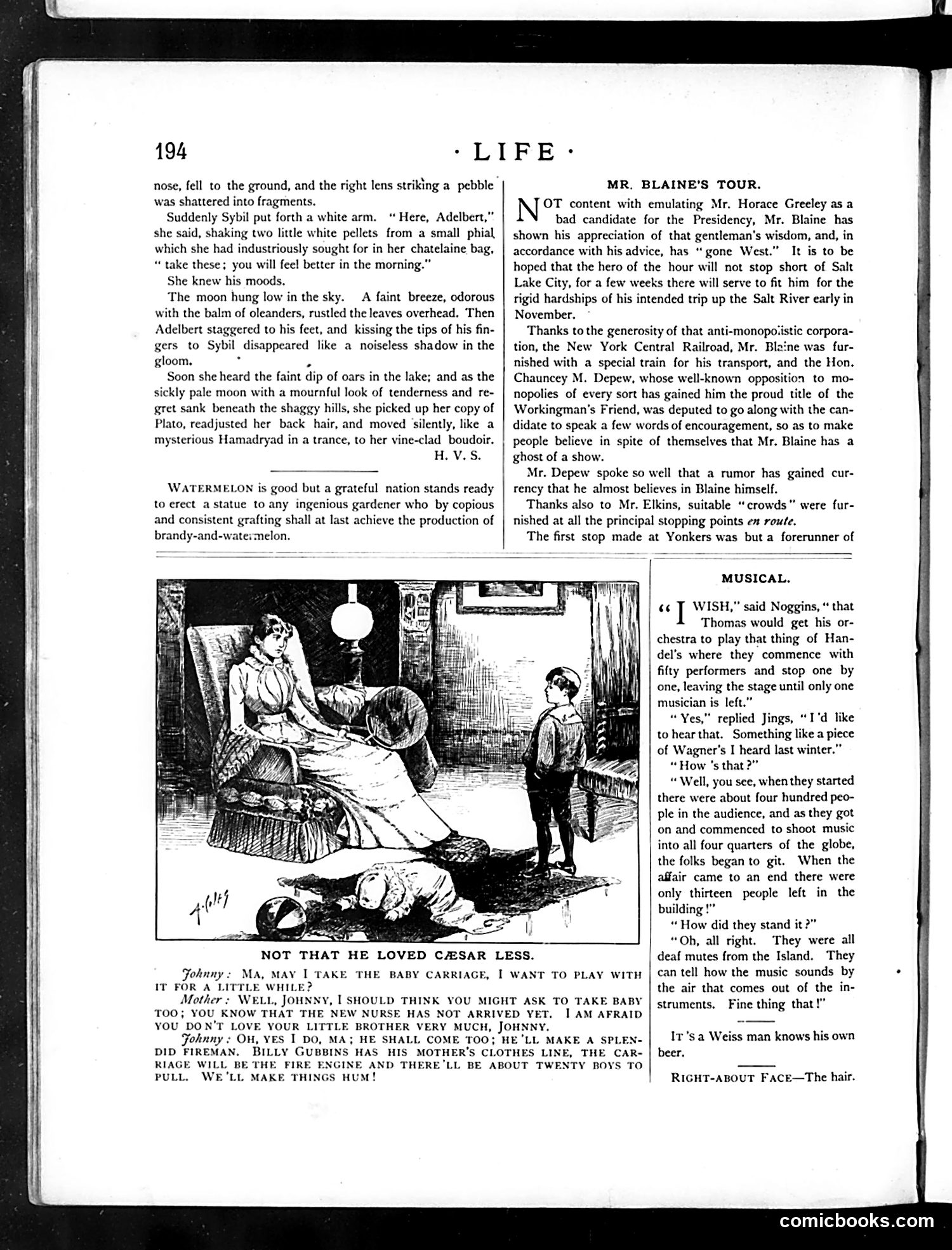
## Main Cartoon: "Not That He Loved Caesar Less" This depicts a domestic scene where a boy asks his mother to borrow the baby carriage to play with, promising to include his baby brother. The humor lies in his elaborate, self-serving justification: he'll use the carriage as a "fire engine" with neighborhood children pulling it, implying chaos and danger. The Shakespeare reference in the title alludes to Brutus's self-deceiving speech about Caesar—the boy similarly masks selfish intentions with false affection for his brother. ## "Mr. Blaine's Tour" Section Political satire mocking James G. Blaine's presidential campaign tour out West. The text attacks Blaine for following Horace Greeley's failed campaign advice, relying on railroad patronage from monopolies (ironic given anti-monopoly rhetoric), and requiring artificial "crowds" orchestrated by political operatives. The "Salt River" reference was period slang for electoral defeat. ## "Musical" Section Satirizes tedious classical music performances, comparing Wagner's lengthy compositions to an orchestra where musicians gradually leave until only thirteen remain—and those are deaf-mutes who "can tell how the music sounds."
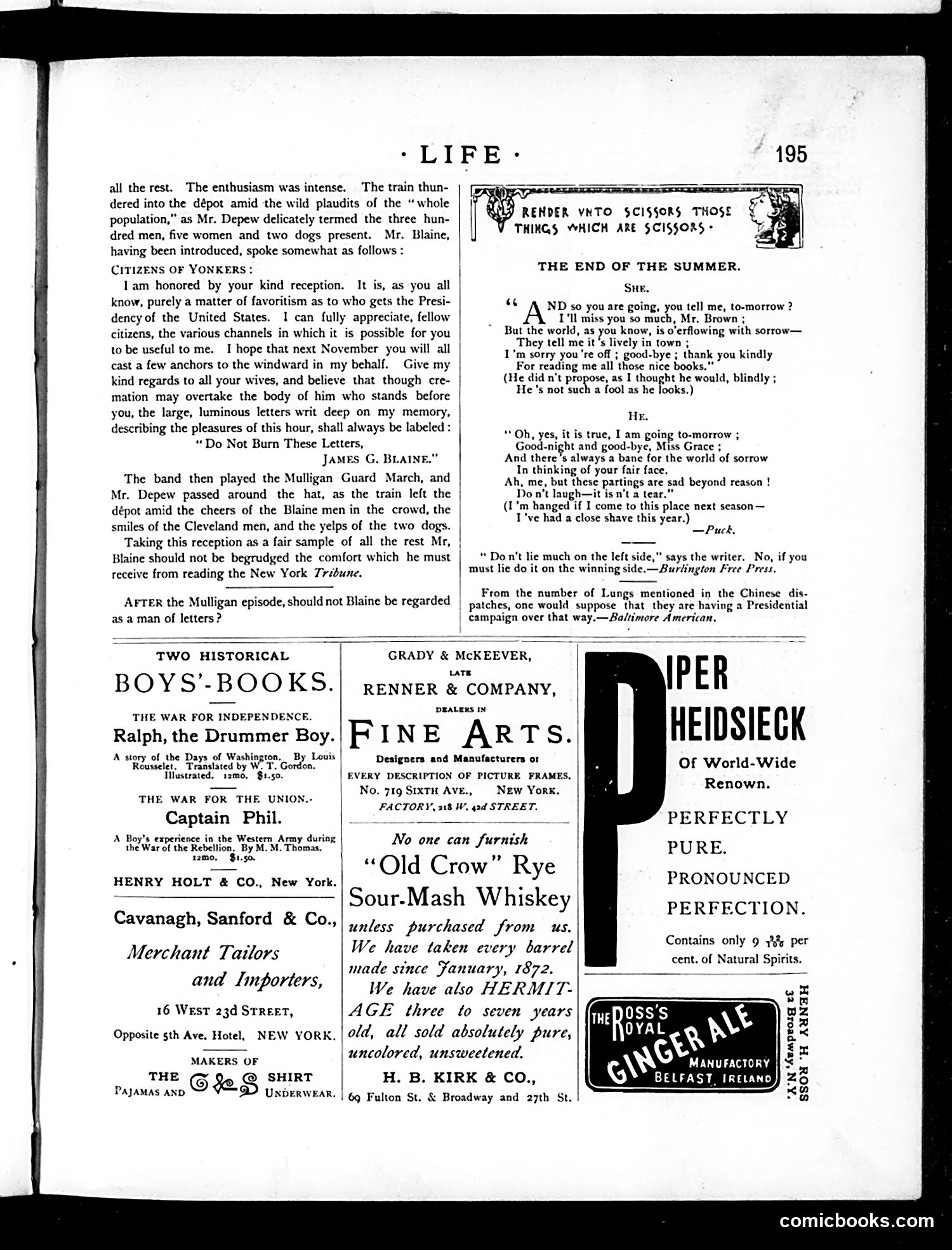
This page primarily documents a political reception for **James G. Blaine**, a presidential candidate, in Yonkers, New York. The satirical content mocks Blaine's speech to supporters, where he cynically admits that winning the presidency is "purely a matter of favoritism" and solicits political favors from attendees—asking them to "cast a few anchors to the windward" on his behalf. The humor lies in Blaine's transparent transactionalism: he treats the reception as a quid pro quo arrangement rather than genuine civic engagement. The detail that only "three hundred men, five women and two dogs" attended the supposedly triumphant event undercuts its significance. The page also includes a sentimental sketch titled "The End of the Summer" depicting a romantic parting between two characters, contrasting sharply with the political cynicism above. The remainder consists of period advertisements and book listings, typical of Life magazine's commercial content.
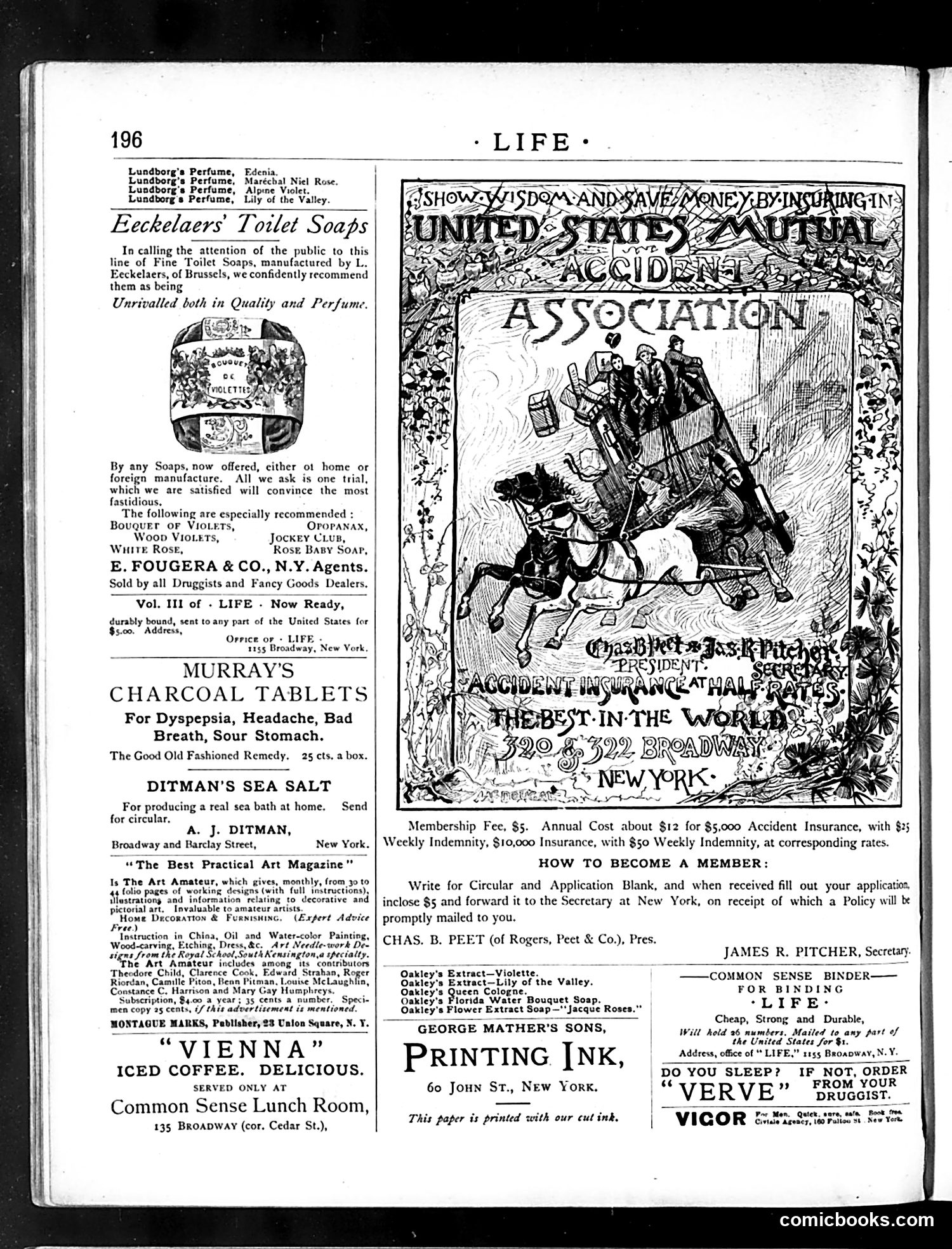
This page is primarily **advertisements** for toiletries, soaps, and services typical of late 19th-century America. However, the centerpiece is a satirical cartoon for the "United States Mutual Accident Association." The cartoon depicts a chaotic accident scene—a horse-drawn carriage overturned with figures tumbling about—accompanied by the tagline "Show Wisdom and Save Money by Insuring in United States Mutual Accident Association." **The satire**: The joke appears to be darkly humorous irony—the cartoon shows the *worst-case scenario* (a catastrophic accident) as the pitch for accident insurance. Rather than reassuring safety, the grotesque tumbling figures and wreckage humorously emphasize the very disasters the insurance claims to protect against. It's visual satire on insurance marketing: promising protection while graphically illustrating disaster. The surrounding ads for perfumes, soaps, and charcoal tablets reflect consumer goods marketed to middle-class readers of *Life* magazine during this period.
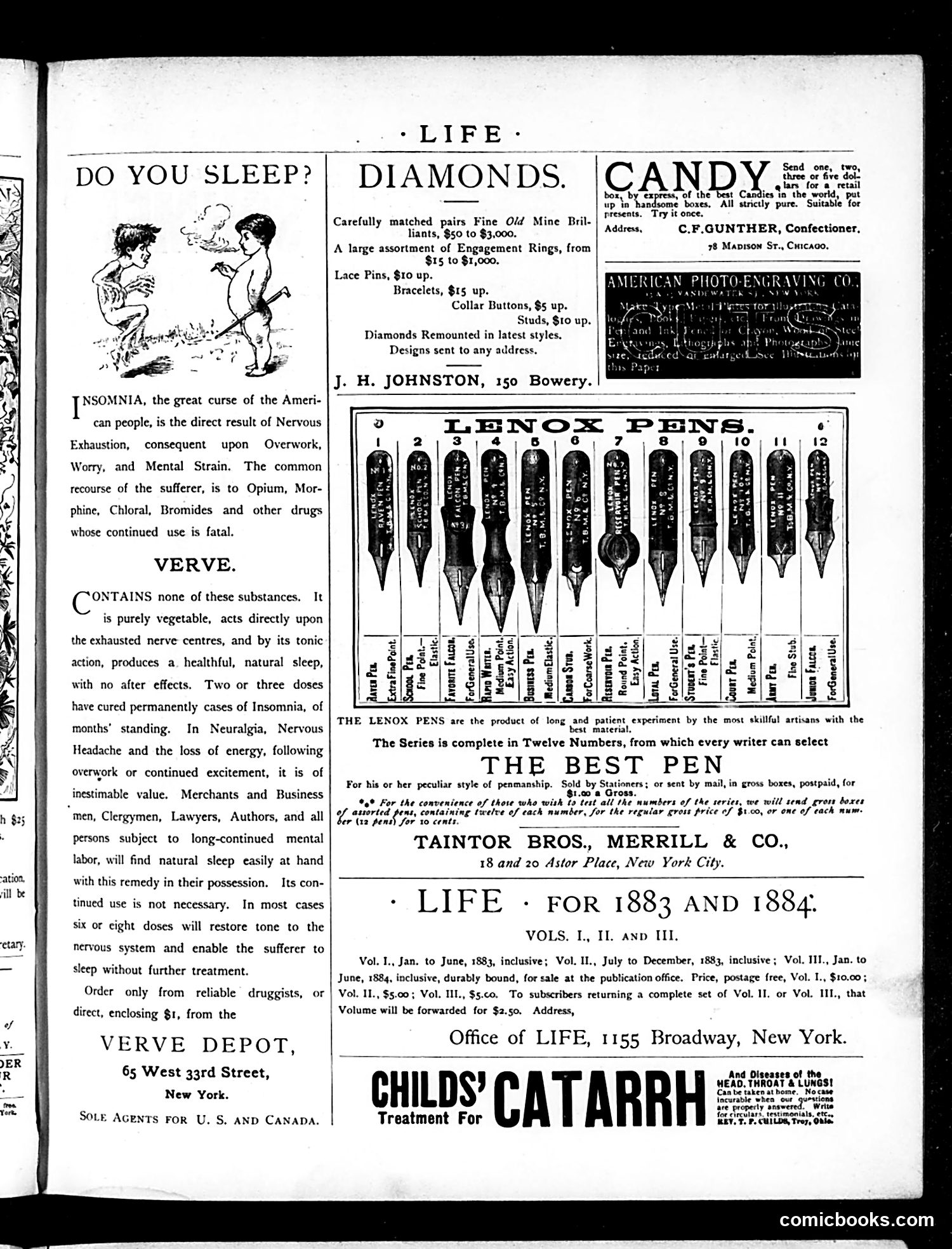
This page is primarily **advertising**, not satire or political commentary. The small cartoon at top left—labeled "DO YOU SLEEP?"—shows two cherubic figures and introduces an advertisement for "VERVE," a patent medicine claiming to cure insomnia without dangerous drugs like opium or chloral. The joke is mild: the cherubs represent sleep, and the ad promises natural sleep as an alternative to habit-forming substances—a reasonable health message for the era. The rest of the page contains commercial advertisements: diamonds from J.H. Johnston, candy from C.F. Gunther, Lenox pens, and treatments for catarrh and lung disease. The "Life for 1883 and 1884" section advertises bound volumes of the magazine itself. This reflects Life's business model: satirical editorial content subsidized by lucrative patent medicine and luxury goods advertising—industries that thrived in this unregulated period.
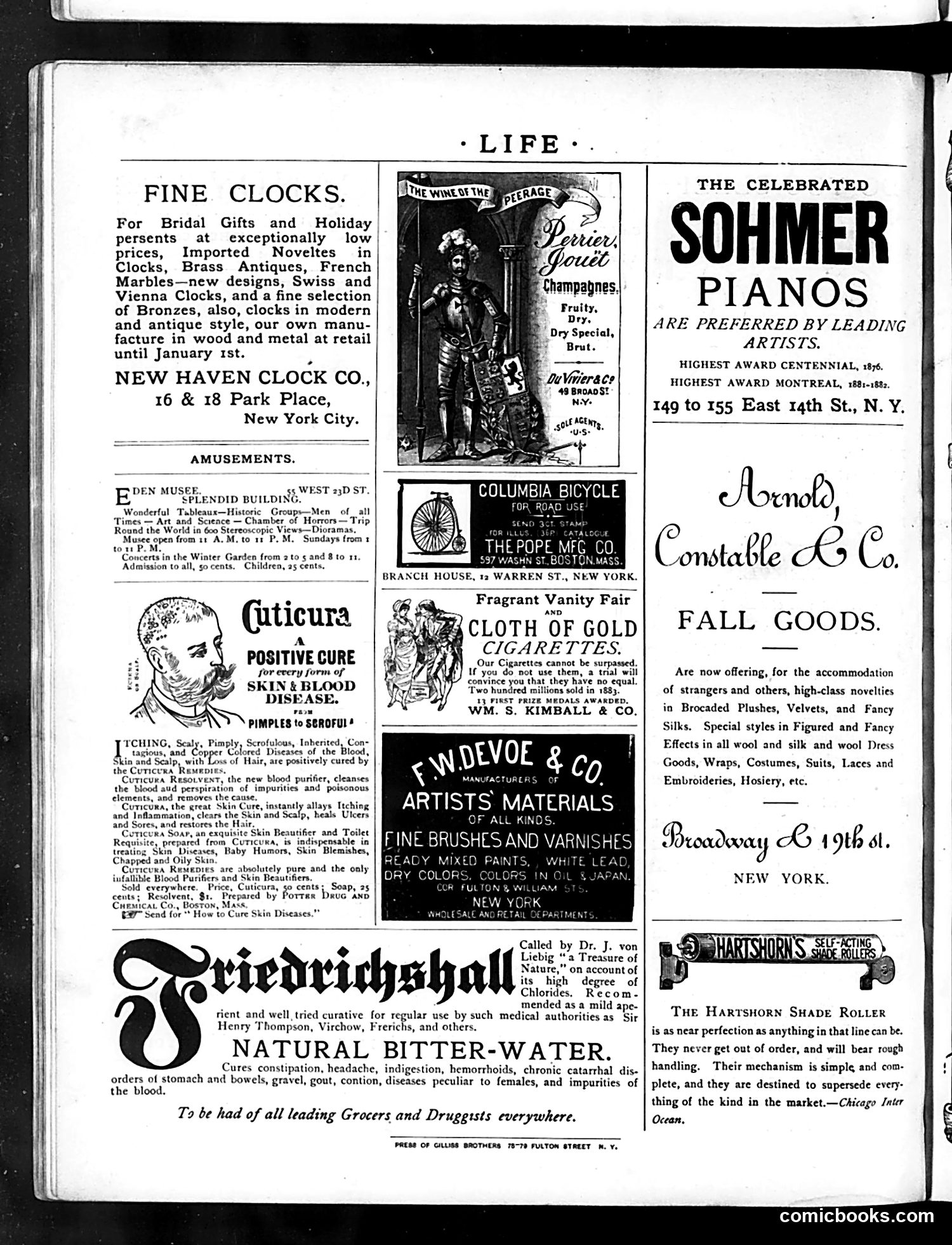
This page is **primarily advertising** with no political cartoons or satirical content. It consists entirely of commercial advertisements for various consumer products popular in the late 19th century. Notable ads include: - **Cuticura products**: A patent medicine claiming to cure skin diseases, blood disorders, and "scrofulous" conditions—typical of the era's dubious medical marketing - **Friedrichshall Natural Bitter-Water**: Another patent medicine promising digestive cures - **Fine clocks, pianos, bicycles, champagne**: Standard luxury goods marketed to affluent readers - **Cloth of Gold cigarettes**: Openly advertised cigarettes (pre-health-warning era) - **Amusement venues**: The Eden Musee wax museum The page reflects **Gilded Age consumer culture** and the prevalence of unregulated patent medicine advertising. There is no satire or political commentary—Life's editorial content appears on other pages. This demonstrates how late-19th-century magazines relied heavily on advertising revenue.