
Life, 1884-10-02 · page 5 of 16
Life — October 2, 1884 — page 5: what you’re looking at
What you’re looking at
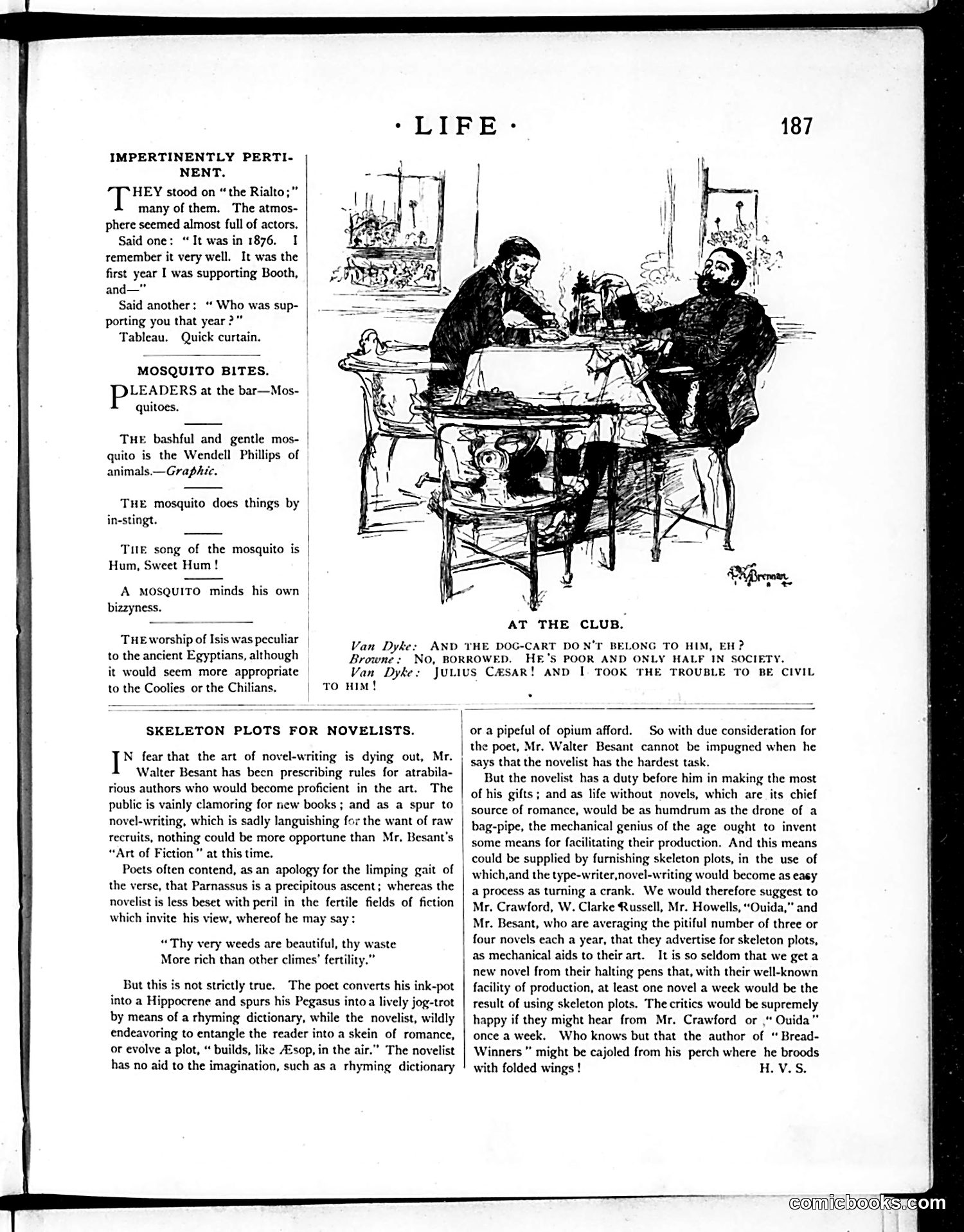
**"At the Club" Cartoon:** The illustration depicts two men at a dining table in what appears to be an exclusive club. The dialogue concerns a borrowed dog-cart (a light carriage). One character, Van Dyke, notes the dog-cart doesn't belong to his companion Broome, who responds that he borrowed it because he's "poor and only half a society." Van Dyke then quips about taking "the trouble to be civil" to Julius Caesar. The satire targets social pretension and class hierarchies of the era—specifically mocking how wealthy club members either owned expensive carriages or shamelessly borrowed them to maintain appearances of affluence. The Caesar reference humorously suggests even historical figures couldn't escape such social vanity. The accompanying articles discuss mosquitoes and novel-writing techniques, appearing unrelated to the cartoon.
📄 Transcribed text from this page (OCR, searchable)
Machine-transcribed from the original scan — historical spelling and the odd misread are preserved.
IMPERTINENTLY PERTI- NENT. HEY stood on “the Rialto;” many of them. The atmos- phere seemed almost full of actors. Said one: “ It was in 1876. I | remember it very well. It was the first year I was supporting Booth, and—" Said another: ‘“ Who was sup- porting you that year?” Tableau. Quick curtain. MOSQUITO BITES. LEADERS at the bar—Mos- quitoes. THE bashful and gentle mos- | quito is the Wendell Phillips of animals.—Graphic. THE mosquito does things by in-stingt. TE song of the mosquito is Hum, Sweet Hum! A MOSQUITO minds his own bizzyness. THE worship of Isis was peculiar to the ancient Egyptians, although it would seem more appropriate to the Coolies or the Chilians, Van Dyke: Browne: Van Dyke: TO HIM! No, BORROWED. AT THE CLUB. AND THE DOG-CART DON'T BELON TO HIM, EH? HE'S POOR AND ONLY HALF IN SOCIETY. JuLius C#saR! AND I TOOK THE TROUBLE TO BE CIVIL SKELETON PLOTS FOR NOVELISTS. N fear that the art of novel-writing is dying out, Mr. Walter Besant has been prescribing rules for atrabila- rious authors who would become proficient in the art. The public is vainly clamoring for new books ; and as a spur to novel-writing, which is sadly languishing for the want of raw recruits, nothing could be more opportune than Mr. Besant’s “Art of Fiction” at this time. Poets often contend, as an apology for the limping gait of the verse, that Parnassus is a precipitous ascent; whereas the novel: less beset with peril in the fertile fields of fiction which invite his view, whereof he may say: “Thy very weeds are beautiful, thy waste More rich than other climes’ fertilit But this is not strictly true. The poet converts his ink-pot into a Hippocrene and spurs his Pegasus into a lively jog-trot by means of a rhyming dictionary, while the novelist, wildly endeavoring to entangle the reader into a skein of romance, or evolve a plot, “ builds, like Esop, in the air.” The novelist has no aid to the imagination, such as a rhyming dictionary | or a pipeful of opium afford. So with due consideration for | the poet, Mr. Walter Besant cannot be impugned when he | says that the novelist has the hardest task. But the novelist has a duty before him in making the most of his gifts ; and as life without novels, which are its chief | source of romance, would be as humdrum as the drone of a bag-pipe, the mechanical genius of the age ought to invent some means for facilitating their production. And this means could be supplied by furnishing skeleton plots, in the use of which,and the type-writer,novel-writing would become as easy a process as turning a crank. We would therefore suggest to Mr. Crawford, W. Clarke Russell, Mr. Howells, “Ouida,” and Mr. Besant, who are averaging the pitiful number of three or four novels each a year, that they advertise for skeleton plots, as mechanical aids to their art. It is so seldom that we get a new novel from their halting pens that, with their well-known facility of production, at least one novel a week would be the result of using skeleton plots. The critics would be supremely happy if they might hear from Mr. Crawford or ,“ Ouida” once a week. Who knows but that the author of “ Bread- Winners " might be cajoled from his perch where he broods with folded wings ! H. V.S.