
Life, 1884-10-02 · page 7 of 16
Life — October 2, 1884 — page 7: what you’re looking at
What you’re looking at
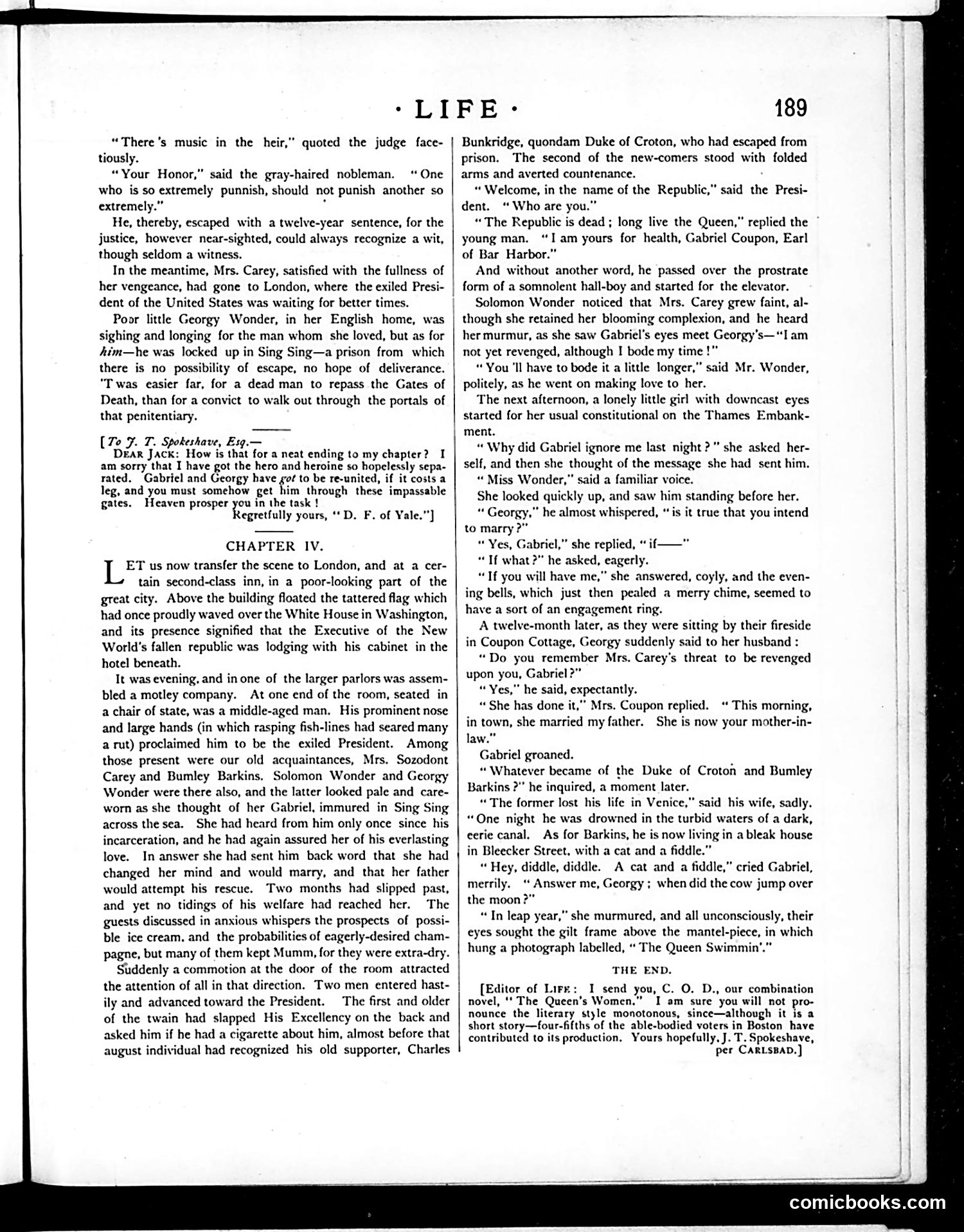
This page contains the conclusion of a serialized short story titled "The Queen's Women," not a political cartoon. The narrative concludes "Chapter IV," which transfers the scene to London where exiled American political figures await developments. The story references the White House and mentions an "Executive of the New World's fallen republic" lodging in a hotel, suggesting a fictional scenario involving American political upheaval. Characters named Gabriel, George Wonder, and Mrs. Carey are reunited, with plot points involving romantic entanglement and social intrigue among the displaced American political class. The editor's note at bottom indicates this is a four-part serialized story by multiple Boston contributors. This appears to be serialized political fiction rather than satirical commentary.
📄 Transcribed text from this page (OCR, searchable)
Machine-transcribed from the original scan — historical spelling and the odd misread are preserved.
‘LIFE: 189 “There's music in the heir,” quoted the judge face- tiously. “Your Honor,” said the gray-haired nobleman. “ One who is so extremely punnish, should not punish another so extremely.” 7 He, thereby, escaped with a twelve-year sentence, for the justice, however near-sighted, could always recognize a wit, though seldom a witness. In the meantime, Mrs. Carey, satisfied with the fullness of her vengeance, had gone to London, where the exiled Presi- | dent of the United States was waiting for better times. Poor little Georgy Wonder, in her English home, was sighing and longing for the man whom she loved, but as for Aim—he was locked up in Sing Sing—a prison from which there is no possibility of escape, no hope of deliverance. ‘Twas easier far, for a dead man to repass the Gates of Death, than for a convict to walk out through the portals of that penitentiary. [To 7. 7. Spokeshave, Esg.— DEAR Jack: How is that for a neat ending to my chapter? I am sorry that I have got the hero and heroine so hopelessly sepa- rated. Gabriel and Georgy have got to be re-united, if it costs a leg, and you must somehow get him through these impassable gates. Heaven prosper yen in the task ! egretfully yours, ‘D. F. of Yale."] CHAPTER IV. ET us now transfer the scene to London, and at a cer- tain second-class inn, in a poor-looking part of the great city. Above the building floated the tattered flag which had once proudly waved over the White House in Washington, and its presence signified that the Executive of the New World’s fallen republic was lodging with his cabinet in the hotel beneath. It was evening, and in one of the larger parlors was assem- bled a motley company. At one end of the room, seated in a chair of state, was a middle-aged man, His prominent nose and large hands (in which rasping fish-lines had seared many a rut) proclaimed him to be the exiled President. Among those present were our old acquaintances, Mrs. Sozodont Carey and Bumley Barkins, Solomon Wonder and Georgy Wonder were there also, and the latter looked pale and care- worn as she thought of her Gabriel, immured in Sing Sing across the sea. She had heard from him only once since his incarceration, and he had again assured her of his everlasting love. In answer she had sent him back word that she had changed her mind and would marry, and that her father would attempt his rescue. Two months had slipped past, and yet no tidings of his welfare had reached her. The guests discussed in anxious whispers the prospects of possi- ble ice cream, and the probabilities of eagerly-desired cham- pagne, but many of them kept Mumm, for they were extra-dry. Suddenly a commotion at the door of the room attracted the attention of all in that direction. Two men entered hast- ily and advanced toward the President. The first and older of the twain had slapped His Excellency on the back and asked him if he had a cigarette about him, almost before that august individual had recognized his old supporter, Charles Bunkridge, quondam Duke of Croton, who had escaped from prison. The second of the new-comers stood with folded arms and averted countenance. “Welcome, in the name of the Republic,” said the Presi- dent. “Who are you.” “The Republic is dead ; long live the Queen,” replied the young man. “Iam yours for health, Gabriel Coupon, Earl of Bar Harbor.” And without another word, he passed over the prostrate form of a somnolent hall-boy and started for the elevator. Solomon Wonder noticed that Mrs. Carey grew faint, al- | though she retained her blooming complexion, and he heard her murmur, as she saw Gabriel's eyes meet Georgy'’s—“I am not yet revenged, although I bode my time !” “You ‘Il have to bode it a little longer,” said Mr. Wonder, politely, as he went on making love to her. The next afternoon, a lonely little girl with downcast eyes started for her usual constitutional on the Thames Embank- ment. “Why did Gabriel ignore me last night?" she asked her- self, and then she thought of the message she had sent him. “ Miss Wonder,” said a familiar voice. She looked quickly up, and saw him standing before her. “ Georgy,” he almost whispered, “is it true that you intend to marry?” “Yes, Gabriel,” she replied, “if—" “If what?” he asked, eagerly. “Tf you will have me,” she answered, coyly, and the even- ing bells, which just then pealed a merry chime, seemed to have a sort of an engagement ring. A twelve-month later, as they were sitting by their fireside in Coupon Cottage, Georgy suddenly said to her husband : “Do you remember Mrs. Carey's threat to be revenged upon you, Gabriel?” “Yes,” he said, expectantly. “She has done it,”” Mrs. Coupon replied.“ This morning, in town, she married my father. She is now your mother-i law.” Gabriel groaned. “Whatever became of the Duke of Croton and Bumley Barkins ?” he inquired, a moment later. “The former lost his life in Venice,” said his wife, sadly. “One night he was drowned in the turbid waters of a dark, eerie canal. As for Barkins, he is now living in a bleak house in Bleecker Street, with a cat and a fiddle.” “ Hey, diddle, diddle. A cat and a fiddle,” cried Gabriel, merrily.“ Answer me, Georgy ; when did the cow jump over the moon?” “In leap year,” she murmured, and all unconsciously, their eyes sought the gilt frame above the mantel-piece, in which hung a photograph labelled, “ The Queen Swimmin’.” THE END. (Editor of Lire: I send you, C. O. D., our combination novel, ‘* The Queen's Women.” I am sure you will not pro- nounce the literary style monotonous, since—although it is a short story—four-fifths of the able-bodied voters in Boston have contributed to its production. Yours hopefully, J. T. Spokeshave, per Carissap.) comicbooks.com