
Life, 1884-10-02 · page 4 of 16
Life — October 2, 1884 — page 4: what you’re looking at
What you’re looking at
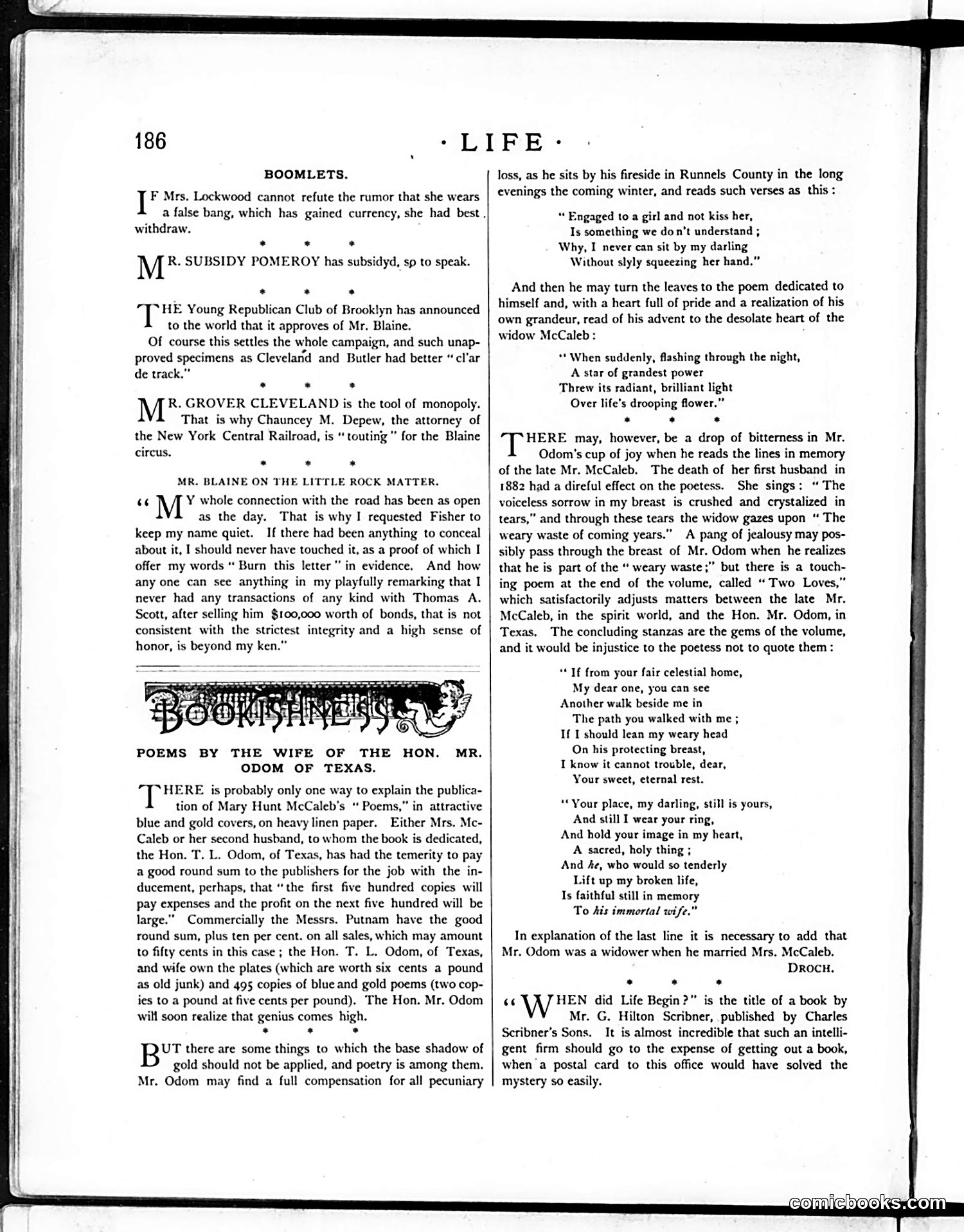
This page contains **gossip and literary commentary** rather than political cartoons. The "Boomlets" section offers brief satirical takes on contemporary figures: - **Mrs. Lockwood** allegedly wore a false bang - **Mr. Subsidy Pomeroy** received subsidies - **The Young Republican Club of Brooklyn** endorsed Mr. Blaine, criticized as settling "the whole campaign" - **Mr. Grover Cleveland** is attacked as a "tool of monopoly," with criticism of attorney Chauncey Depew and the Blaine circus The main content discusses **Mrs. McCaelb's poetry collection**, praised despite her widowhood. A lengthy section analyzes her poems' themes of loss and marriage, with extended quotations. The satire targets **political figures and their financial dealings** (monopoly, subsidies) while celebrating literary achievement independent of commercial profit—a common Life magazine position.
📄 Transcribed text from this page (OCR, searchable)
Machine-transcribed from the original scan — historical spelling and the odd misread are preserved.
————— 186 + LIFE: BOOMLETS. F Mrs. Lockwood cannot refute the rumor that she wears a false bang, which has gained currency, she had best .) withdraw. . . * M R. SUBSIDY POMEROY has subsidyd, sp to speak. * * . Te Young Republican Club of Brooklyn has announced to the world that it approves of Mr. Blaine. Of course this settles the whole campaign, and such unap- proved specimens as Cleveland and Butler had better “cl’ar de track.” . * . R. GROVER CLEVELAND is the tool of monopoly. That is why Chauncey M. Depew, the attorney of the New York Central Railroad, is “ touting" for the Blaine circus. . . . MR. BLAINE ON THE LITTLE ROCK MATTER. “ Y whole connection with the road has been as open as the day. That is why I requested Fisher to keep my name quiet. If there had been anything to conceal about it, I should never have touched it, as a proof of which I offer my words “ Burn this letter" in evidence. And how any one can see anything in my playfully remarking that 1 never had any transactions of any kind with Thomas A. Scott, after selling him $100,000 worth of bonds, that is not consistent with the strictest integrity and a high sense of honor, is beyond my ken.” POEMS BY THE WIFE OF THE HON. MR. ODOM OF TEXAS. oP HERE is probably only one way to explain the publica- tion of Mary Hunt McCaleb's “ Poems,” in attractive blue and gold covers, on heavy linen paper. Either Mrs. Mc- Caleb or her second husband, to whom the book is dedicated, the Hon. T. L. Odom, of Texas, has had the temerity to pay a good round sum to the publishers for the job with the in- ducement, perhaps, that “the first five hundred copies will pay expenses and the profit on the next five hundred will be large.” Commercially the Messrs. Putnam have the good round sum, plus ten per cent. on all sales, which may amount to fifty cents in this case; the Hon. T. L. Odom, of Texas, and wife own the plates (which are worth six cents a pound as old junk) and 495 copies of blue and gold poems (two cop- ies to a pound at five cents per pound). The Hon. Mr. Odom will soon realize that genius comes high. * . . UT there are some things to which the base shadow of gold should not be applied, and poetry is among them. Mr. Odom may find a full compensation for all pecuniary loss, as he sits by his fireside in Runnels County in the long evenings the coming winter, and reads such verses as this : “ Engaged to a girl and not kiss her, Is something we don't understand ; Why, I never can sit by my darling Without slyly squeezing her hand.” And then he may turn the leaves to the poem dedicated to himself and, with a heart full of pride and a realization of his own grandeur, read of his advent to the desolate heart of the widow McCaleb: “When suddenly, flashing through the night, A star of grandest power Threw its radiant, brilliant light Over life's drooping flower.” . . . HERE may, however, be a drop of bitterness in Mr. Odom’s cup of joy when he reads the lines in memory of the late Mr. McCaleb, The death of her first husband in 1882 had a direful effect on the poctess. She sings: “ The voiceless sorrow in my breast is crushed and crystalized in tears,” and through these tears the widow gazes upon “ The weary waste of coming years.” A pang of jealousy may pos- sibly pass through the breast of Mr. Odom when he realizes that he is part of the “ weary waste ;” but there is a touch- ing poem at the end of the volume, called “Two Loves,” which satisfactorily adjusts matters between the late Mr. McCaleb, in the spirit world, and the Hon. Mr. Odom, in Texas, The concluding stanzas are the gems of the volume, and it would be injustice to the poetess not to quote them: ‘If from your fair celestial home, My dear one, you can see Another walk beside me in The path you walked with me ; If I should lean my weary head On his protecting breast, I know it cannot trouble, dear, Your sweet, eternal rest. “*Your place, my darling, still is yours, And still I wear your ring, And hold your image in my heart, A sacred, holy thing ; And he, who would so tenderly Lift up my broken life, Is faithful still in memory To his immortal wife.” In explanation of the last line it is necessary to add that Mr. Odom was a widower when he married Mrs. McCaleb. Drocu. . . . “ HEN did Life Begin?” is the title of a book by Mr. G. Hilton Scribner, published by Charles Scribner's Sons, It is almost incredible that such an intelli- gent firm should go to the expense of getting out a book, when a postal card to this office would have solved the mystery so easily.