
Life, 1884-10-02 · page 6 of 16
Life — October 2, 1884 — page 6: what you’re looking at
What you’re looking at
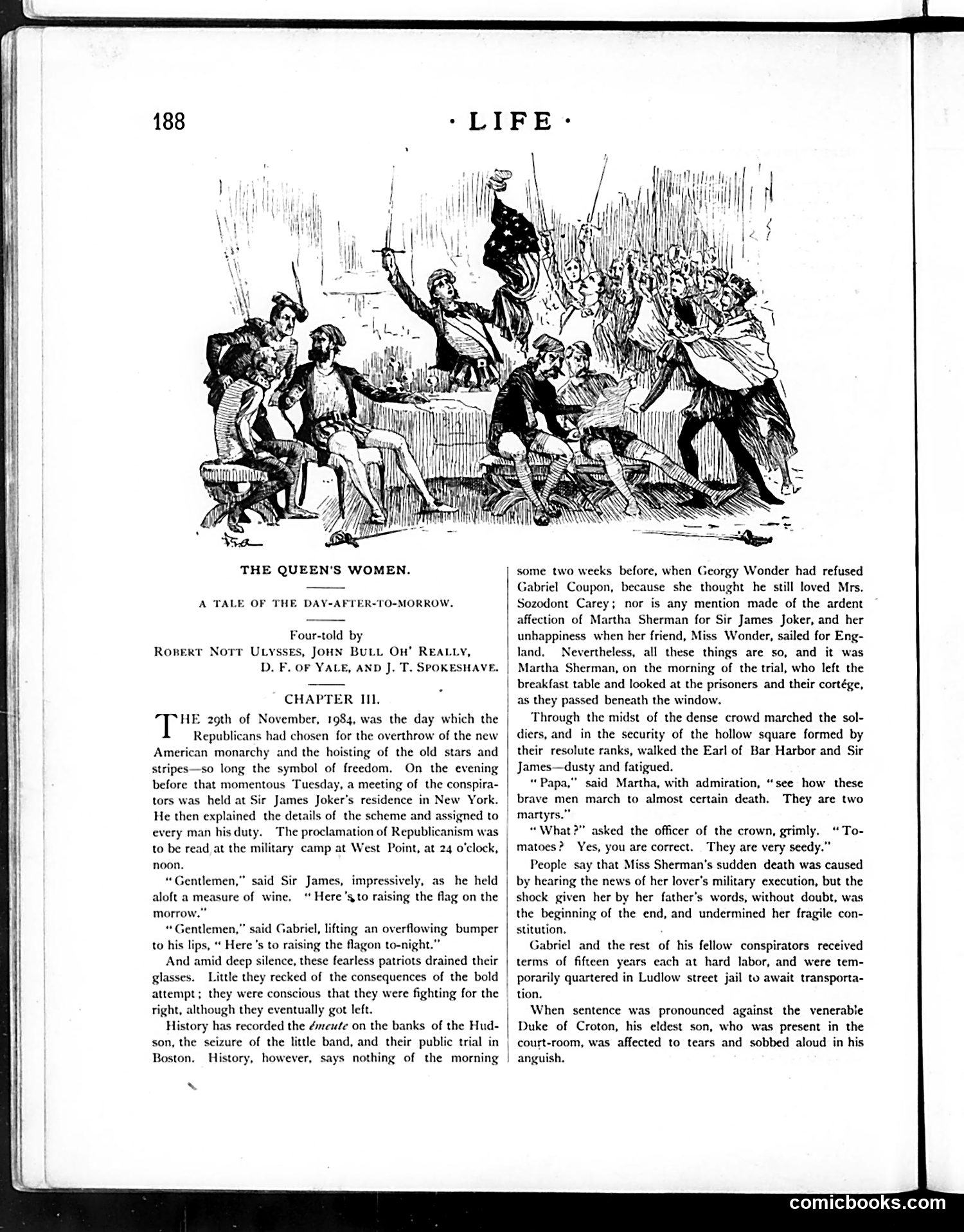
This is a satirical story by Robert Nott Ulysses and others, set on November 29, 1984. The narrative describes a fictional Republican plot to overthrow the American monarchy and restore the republic, involving conspirators meeting at Sir James Joker's residence in New York. The illustration depicts what appears to be a dramatic indoor scene with multiple figures in period dress, some wielding weapons or flags, suggesting political upheaval or revolutionary action. The specific identities of the caricatured figures are unclear from the image alone, but the overall satire mocks potential political conspiracies and suggests anxieties about governmental instability during this era of Life magazine publication.
📄 Transcribed text from this page (OCR, searchable)
Machine-transcribed from the original scan — historical spelling and the odd misread are preserved.
THE QUEEN'S WOMEN. A TALE OF THE DAY-AFTER-TO-MORROW. Four-told by Rowert Norr Utysses, JouN BULL On’ REALLY, D. F. OF YALE, AND J. T. SPOKESHAVE, CHAPTER IIL. HE 29th of November, 1984, was the day which the | Republicans had chosen for the overthrow of the new American monarchy and the hoisting of the old stars and stripes—so long the symbol of freedom. On the evening before that momentous Tuesday, a meeting of the conspira- tors was held at Sir James Joker's residence in New York. He then explained the details of the scheme and assigned to every man his duty. The proclamation of Republicanism was to be read at the military camp at West Point, at 24 o'clock, noon. “Gentlemen,” said Sir James, impressively, as he held aloft a measure of wine. “ Here 'sto raising the flag on the morrow.” “Gentlemen,” said Gabriel, lifting an overflowing bumper ing the flagon to-night.” And amid deep silence, these fearless patriots drained their glasses. Little they recked of the consequences of the bold attempt; they were conscious that they were fighting for the right, although they eventually got left. History has recorded the émeute on the banks of the Hud- son, the seizure of the little band, and their public trial in Boston, History, however, says nothing of the morning ‘ some two weeks before, when Georgy Wonder had refused Gabriel Coupon, because she thought he still loved Mrs. Sozodont Carey; nor is any mention made of the ardent affection of Martha Sherman for Sir James Joker, and her unhappiness when her friend, Miss Wonder, sailed for Eng- | land, Nevertheless, all these things are so, and it was Martha Sherman, on the morning of the trial, who left the breakfast table and looked at the prisoners and their cortége, | as they passed beneath the window. Through the midst of the dense crowd marched the sol- diers, and in the security of the hollow square formed by their resolute ranks, walked the Earl of Bar Harbor and Sir James—dusty and fatigued. “Papa,” said Martha, with admiration, “see how these brave men march to almost certain death. They are two | martyrs.” “What?” asked the officer of the crown, grimly. matoes? Yes, you are correct. They are very seedy.” People say that Miss Sherman's sudden death was caused by hearing the news of her lover's military execution, but the shock given her by her father’s words, without doubt, was the beginning of the end, and undermined her fragile con- stitution. Gabriel and the rest of his fellow conspirators received terms of fifteen years each at hard labor, and were tem- “To- | porarily quartered in Ludlow street jail to await transporta- ton. When sentence was pronounced against the venerable Duke of Croton, his eldest son, who was present in the court-room, was affected to tears and sobbed aloud in his | anguish. comicbooks.com