
Life, 1884-10-02 · page 10 of 16
Life — October 2, 1884 — page 10: what you’re looking at
What you’re looking at
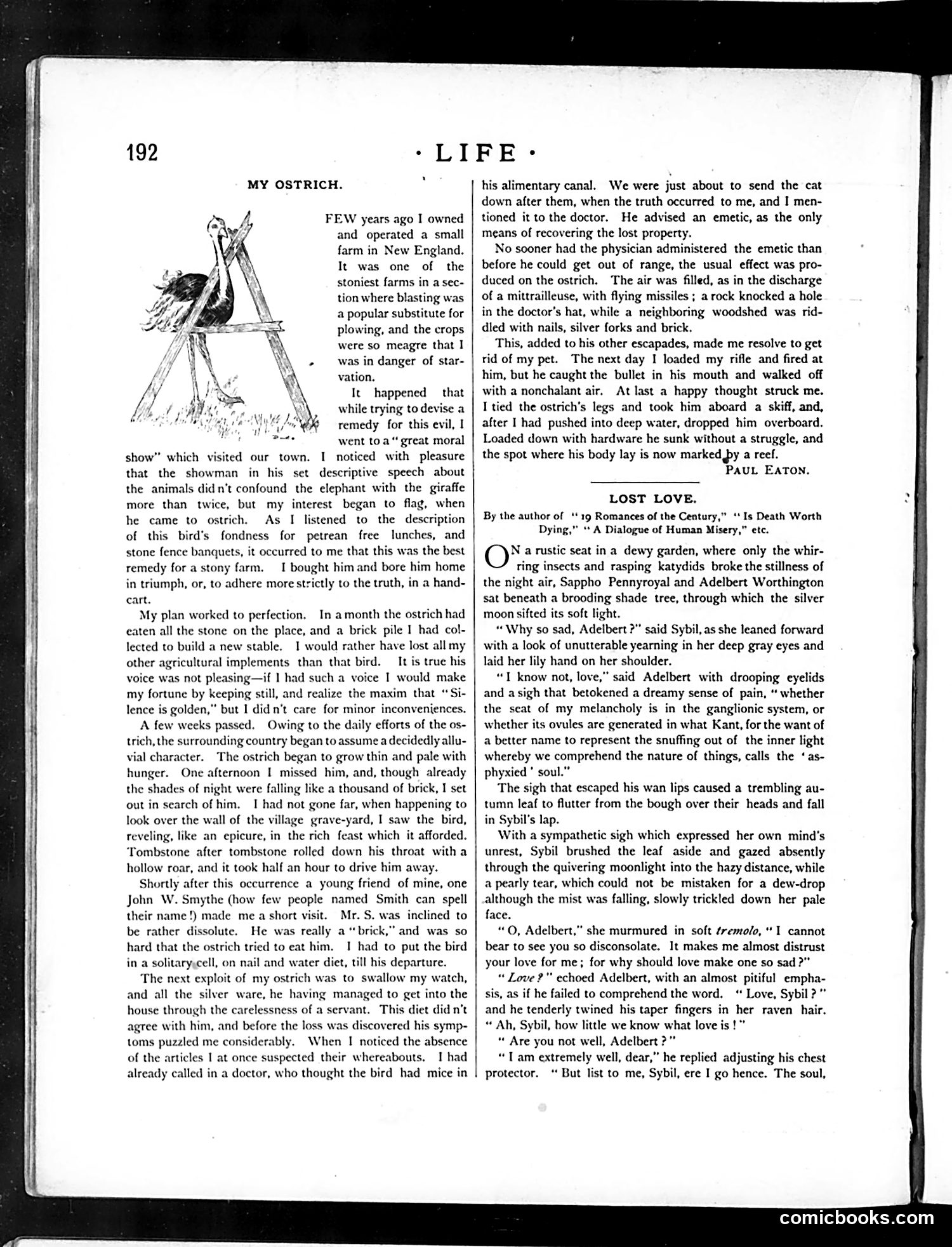
This humorous narrative piece satirizes the gullible farmer who makes foolish agricultural decisions based on traveling shows and dubious advice. The ostrich illustration shows the bird perched awkwardly on a fence. The joke targets rural naiveté: the narrator buys an ostrich after hearing a circus showman claim it eats stones—supposedly solving his rocky New England farm problem. The satire escalates through increasingly absurd consequences: the ostrich eats the farmer's valuables, destroys property, and proves impossible to kill or remove. The piece mocks both the credulous farmer and the charlatan showman who spreads misinformation about animals. It also gently ridicules rural life and agricultural desperation during lean times. The deadpan narrative tone—treating these ridiculous events matter-of-factly—amplifies the comedy. This reflects *Life* magazine's typical satirical humor targeting American folly and overconfidence.
📄 Transcribed text from this page (OCR, searchable)
Machine-transcribed from the original scan — historical spelling and the odd misread are preserved.
*LIFE- MY OSTRICH. FEW years ago I owned and operated a small farm in New England. It was one of the stoniest farms in a sec- tion where blasting was a popular substitute for plowing, and the crops were so meagre that I was in danger of star- vation. It happened — that while trying to devise a remedy for this evil, I went toa“ great moral show” which visited our town. I noticed with pleasure that the showman in his set descriptive speech about the animals didn’t confound the elephant with the giraffe more than twice, but my interest began to flag, when he came to ostrich, As I listened to the description of this bird’s fondness for petrean free lunches, and stone fence banquets, it occurred to me that this was the best remedy for a stony farm. I bought him and bore him home in triumph, or, to adhere more strictly to the truth, in a hand- cart. My plan worked to perfection. In amonth the ostrich had eaten all the stone on the place, and a brick pile I had col- lected to build a new stable. 1 would rather have lost all my other agricultural implements than that bird. _ It is true his voice was not pleasing—if I had such a voice I would make my fortune by keeping still, and realize the maxim that lence is golden,” but I didn’t care for minor inconveniences. A few weeks passed. Owing to the daily efforts of the os- trich, the surrounding country began to assume a decidedly allu- vial character. The ostrich began to grow thin and pale with hunger. One afternoon I missed him, and, though already the shades of night were falling like a thousand of brick, I set out in search of him. 1 had not gone far, when happening to look over the wall of the village grave-yard, I saw the bird, reveling, like an epicure, in the rich feast which it afforded. Tombstone after tombstone rolled down his throat with a hollow roar, and it took half an hour to drive him away. Shortly after this occurrence a young friend of mine, one John W. Smythe (how few people named Smith can spell their name!) made me a short visit. Mr. S. was inclined to be rather dissolute. He was really a “brick,” and was so hard that the ostrich tried to eat him. I had to put the bird in a solitaryycell, on nail and water diet, till his departure. The next exploit of my ostrich was to swallow my watch, and all the silver ware, he having managed to get into the house through the carelessness of a servant. This diet didn’t agree with him, and before the loss was discovered his symp- toms puzzled me considerably. When I noticed the absence of the articles I at once suspected their whereabouts. I had already called in a doctor, who thought the bird had mice in his alimentary canal. We were just about to send the cat down after them, when the truth occurred to me, and I men- tioned it to the doctor. He advised an emetic, as the only means of recovering the lost property. No sooner had the physician administered the emetic than before he could get out of range, the usual effect was pro- duced on the ostrich. The air was filled, as in the discharge of a mittrailleuse, with flying missiles ; a rock knocked a hole in the doctor’s hat, while a neighboring woodshed was rid- dled with nails, silver forks and brick. This, added to his other escapades, made me resolve to get rid of my pet. The next day I loaded my rifle and fired at him, but he caught the bullet in his mouth and walked off with a nonchalant air. At last a happy thought struck me. I tied the ostrich’s legs and took him aboard a skiff, and, after I had pushed into deep water, dropped him overboard. Loaded down with hardware he sunk without a struggle, and the spot where his body lay is now marked py a reef. PAUL Eaton. LOST LOVE. By the author of ‘+19 Romances of the Century,” ‘Is Death Worth Dying,” “ A Dialogue of Human Misery,” ete. N a rustic seat ina dewy garden, where only the whir- ring insects and rasping katydids broke the stillness of the night air, Sappho Pennyroyal and Adelbert Worthington sat beneath a brooding shade tree, through which the silver moon sifted its soft light. “Why so sad, Adelbert ?” said Sybil, as she leaned forward with a look of unutterable yearning in her deep gray eyes and laid her lily hand on her shoulder. “T know not, love,” said Adelbert with drooping eyelids and a sigh that betokened a dreamy sense of pain, “ whether the seat of my melancholy is in the ganglionic system, or whether its ovules are generated in what Kant, for the want of a better name to represent the snuffing out of the inner light whereby we comprehend the nature of things, calls the ‘as- phyxied ’ soul.” The sigh that escaped his wan lips caused a trembling au- tumn leaf to flutter from the bough over their heads and fall in Sybil’s lap. With a sympathetic sigh which expressed her own mind's unrest, Sybil brushed the leaf aside and gazed absently through the quivering moonlight into the hazy distance, while a pearly tear, which could not be mistaken for a dew-drop although the mist was falling, slowly trickled down her pale face. “O, Adelbert,” she murmured in soft ¢remo/o, “1 cannot bear to see you so disconsolate. It makes me almost distrust your love for me; for why should love make one so sad?” “ Love?" echoed Adelbert, with an almost pitiful empha- sis, as if he failed to comprehend the word. “* Love, Sybil?” and he tenderly twined his taper fingers in her raven hair. “ Ah, Sybil, how little we know what love is!" “ Are you not well, Adelbert ?”” “Tam extremely well, dear,” he replied adjusting his chest | protector. “ But list to me, Sybil, ere I go hence. The soul, comicbooks.com