
A complete issue · 16 pages · 1884
Life — June 19, 1884
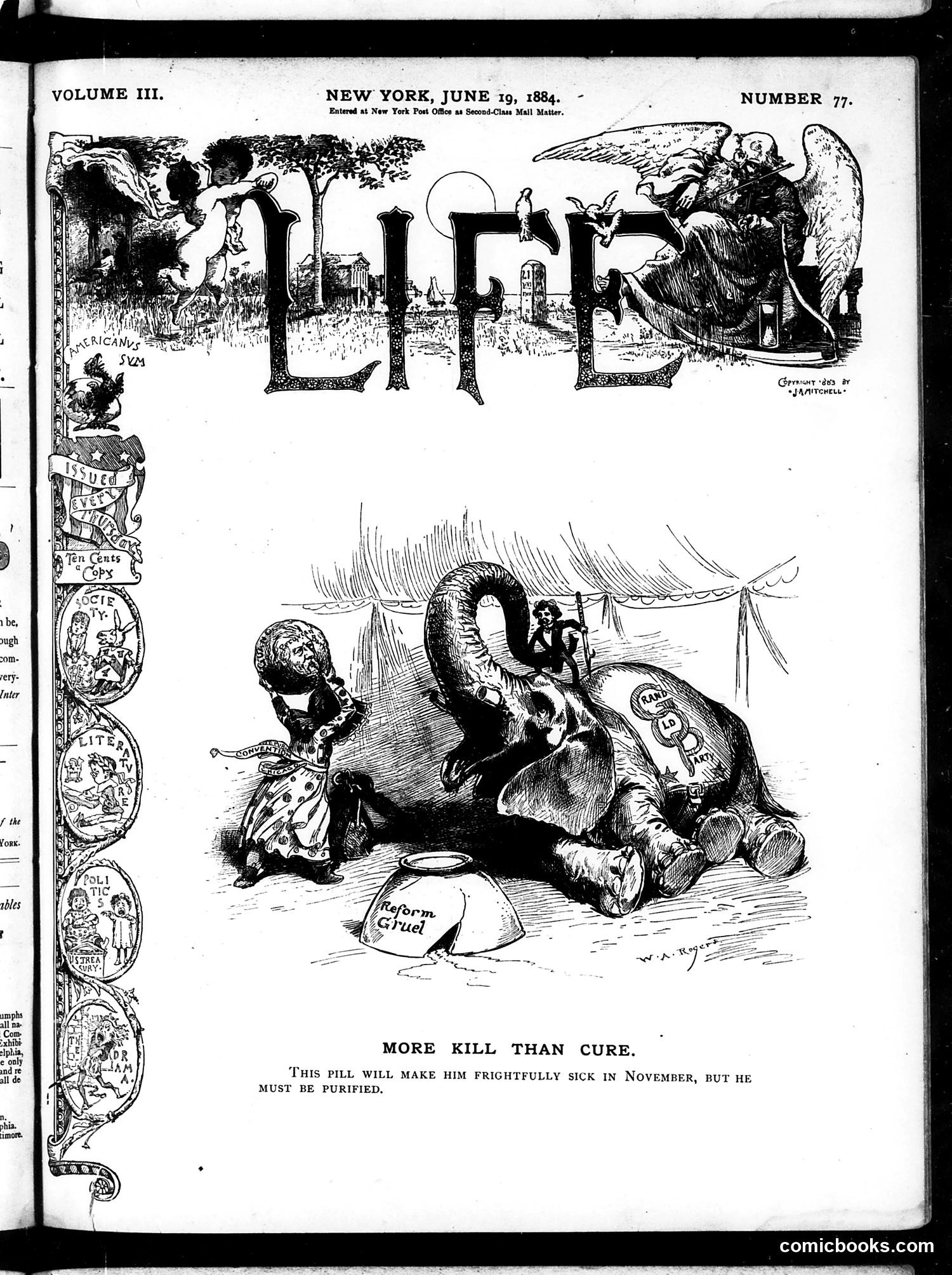
This satirical cartoon titled "More Kill Than Cure" criticizes what appears to be a reform proposal or political movement. The central image depicts an elephant (the Republican Party symbol) being force-fed a pill labeled "Reform Cruel" by small figures. The caption states: "This pill will make him frightfully sick in November, but he must be purified." The satire suggests that proposed reforms, while theoretically beneficial for "purifying" the Republican Party, will actually harm it politically—making Republicans "sick" (losing votes) in the upcoming November election. The cartoonist implies the reforms are more damaging than helpful, hence "more kill than cure." This likely references internal Republican Party divisions during the 1884 election cycle.
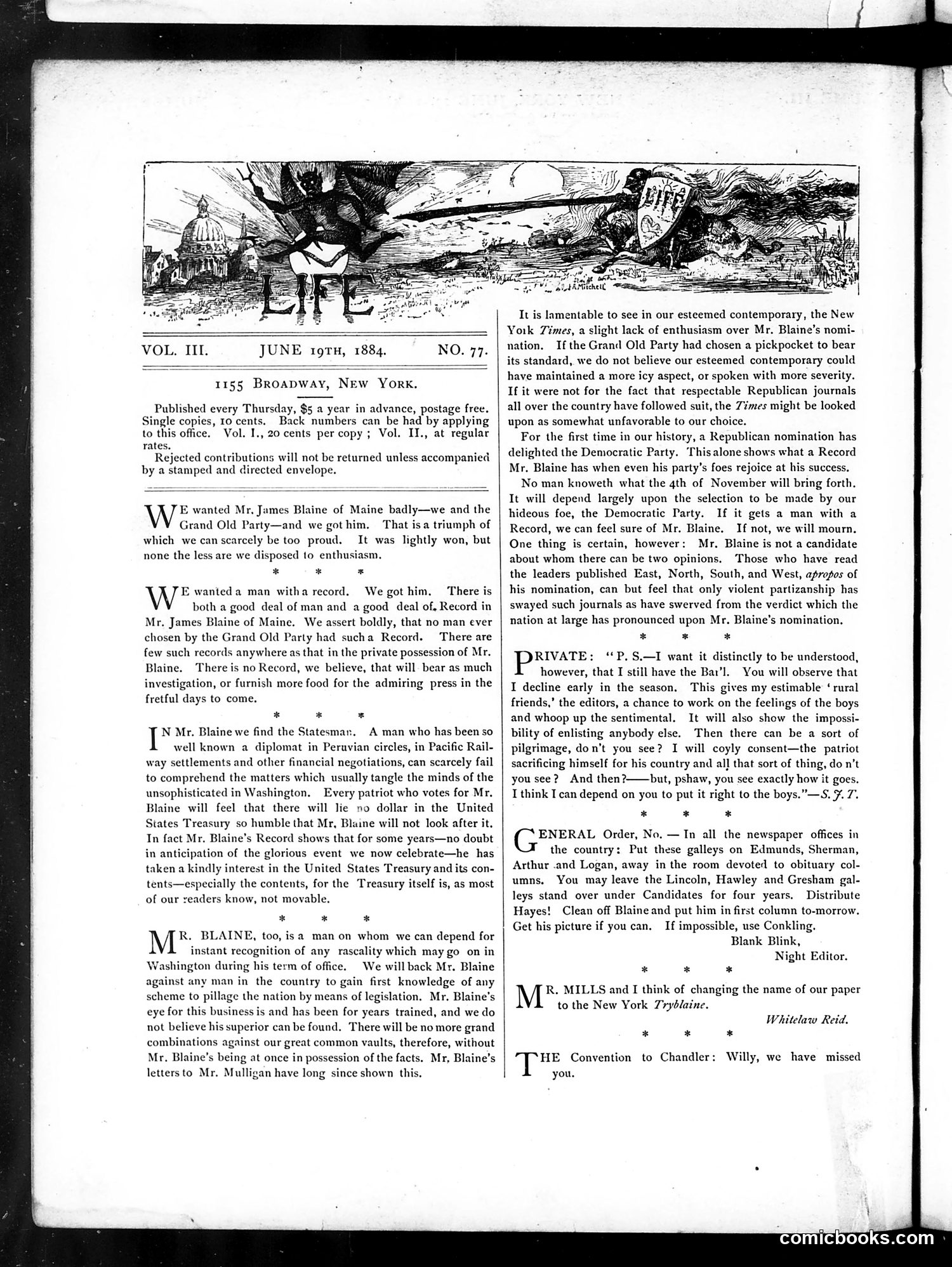
This page contains editorial text rather than a cartoon. The main focus is James Blaine of Maine, the Republican presidential nominee for 1884. The editors express support for Blaine, defending him against criticism in the *New York Times*. They argue that while Blaine's record isn't perfect, he remains "a man on whom we can depend" and possesses superior knowledge and integrity. The text acknowledges Blaine's controversial past but insists his opponents lack grounds for attacks. There are also brief editorial notes, including one about changing the paper's name to the "New York Tryphaine" (appears to be a joke or unclear reference). The overall tone is defensive advocacy for Blaine's candidacy during the 1884 election.
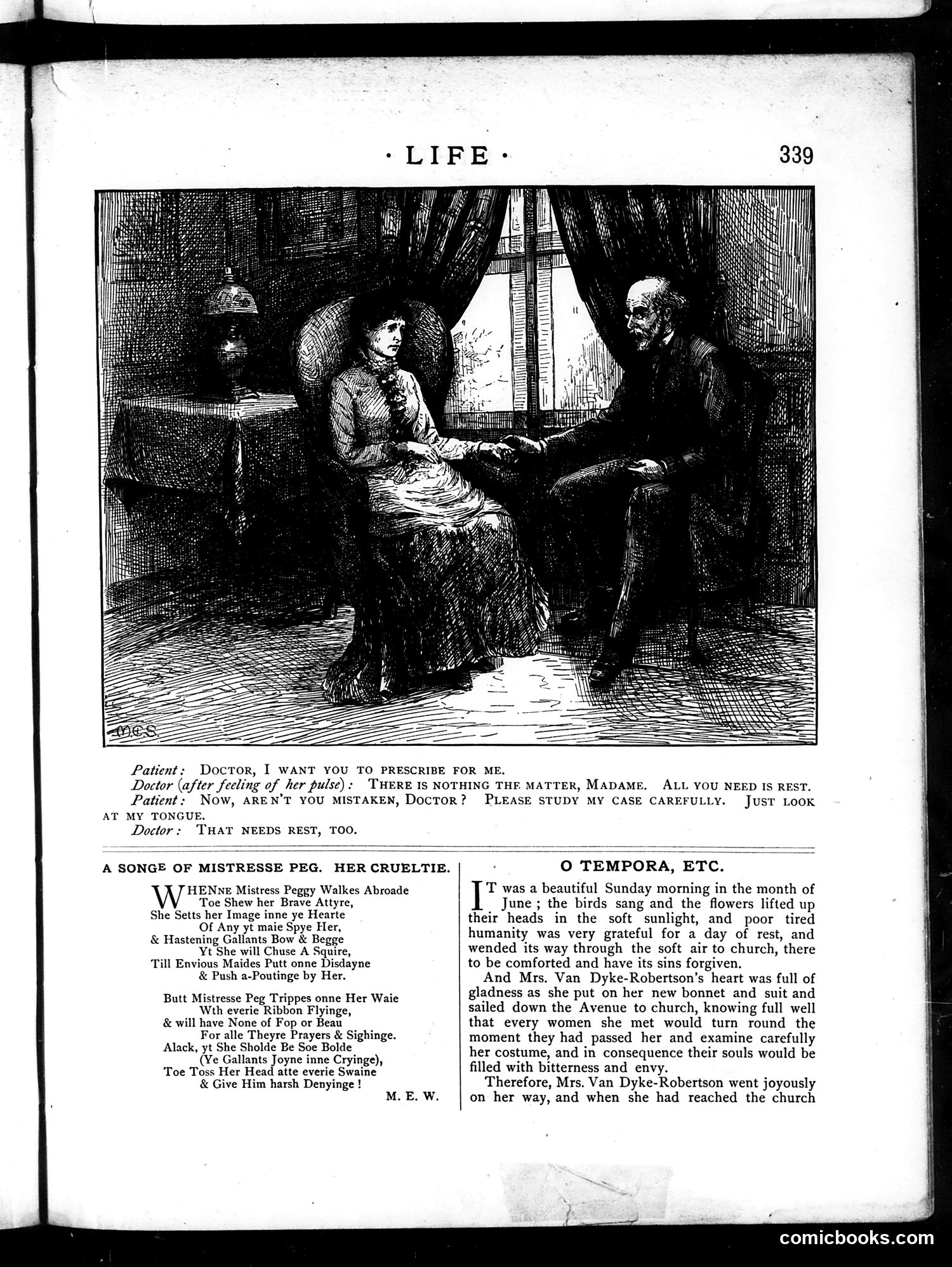
The main illustration depicts a doctor's visit, showing a common medical interaction of the era. The dialogue satirizes the disconnect between patient expectations and medical practice: the patient requests a prescription, the doctor (after examining her pulse) dismisses her concerns, claiming she merely needs rest—while ironically, the doctor himself appears to need rest too. The satire targets the era's casual medical diagnosis, where doctors often attributed women's ailments to vague causes requiring passive "rest" rather than serious treatment. This was a recognized criticism of period medicine. The poem below, "A Songe of Mistresse Peg," appears unrelated—a period verse about a woman named Peg, likely humorous or satirical in nature, though its specific target remains unclear without additional context.
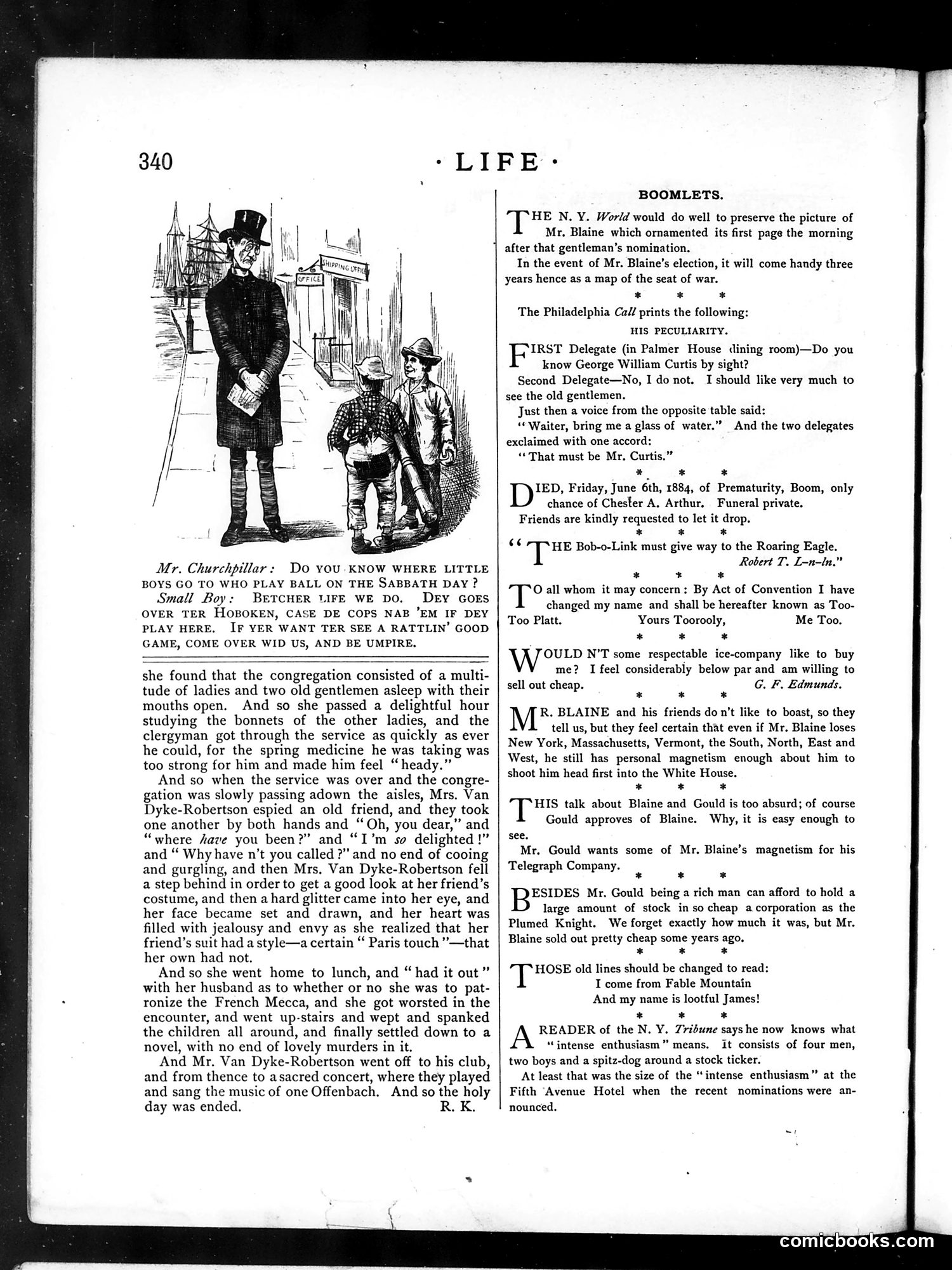
The main cartoon depicts a well-dressed man (labeled "Mr. Churchillar") speaking to two working-class boys. He's asking if they know where boys go on the Sabbath, then instructs them to go to "Butcher Life" instead—a play on words referencing *Life* magazine itself. The humor relies on period-specific class commentary: a pretentious gentleman lecturing street children about proper Sunday activities, with the joke being that he's actually promoting the magazine as entertainment for the working poor. The surrounding "Boomlets" section contains brief satirical gossip items about 1880s political figures like James Blaine, referencing elections and social scandals of that era. These are essentially early "celebrity gossip" columns with political bite.
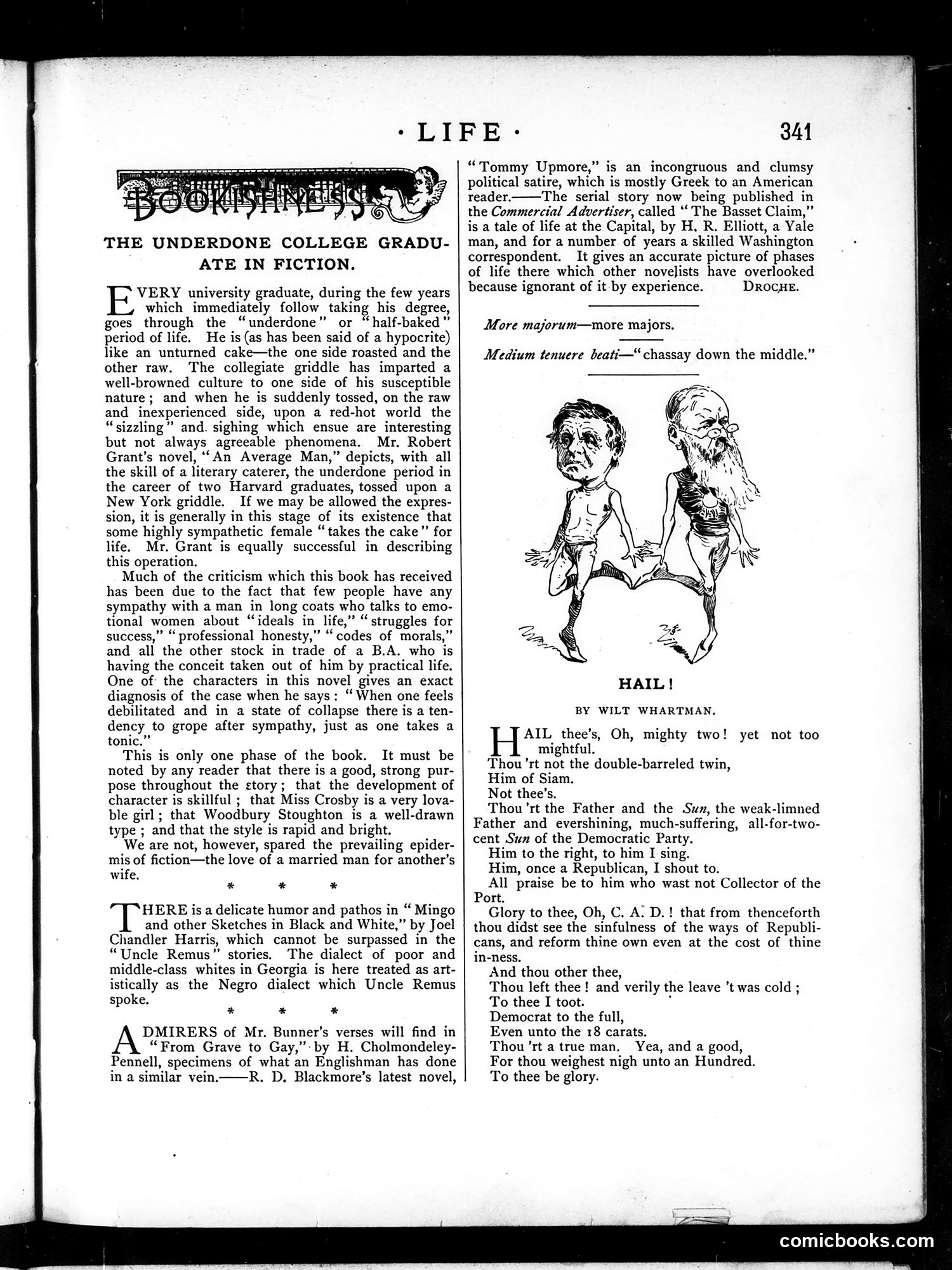
The cartoon depicts two caricatured male figures in a celebratory pose. Based on the accompanying poem, the figures represent **Father and Son**—specifically characterized as a weak-kneed, suffering Father and his overbearing, much-suffering Democratic Son. The satire mocks the relationship between **Republican and Democratic politicians** of the era. The poem's religious language ("Hail," "glory") ironically elevates the Democratic son as a reformer who has overcome his Republican father's influence—even converting him from Republican to Democrat. The joke targets **political hypocrisy and party conversion**, suggesting the son's moral superiority while sarcastically praising him for leaving the "cold" Republican party. The exaggerated physical caricature emphasizes the generational political divide common in early 20th-century American political humor.
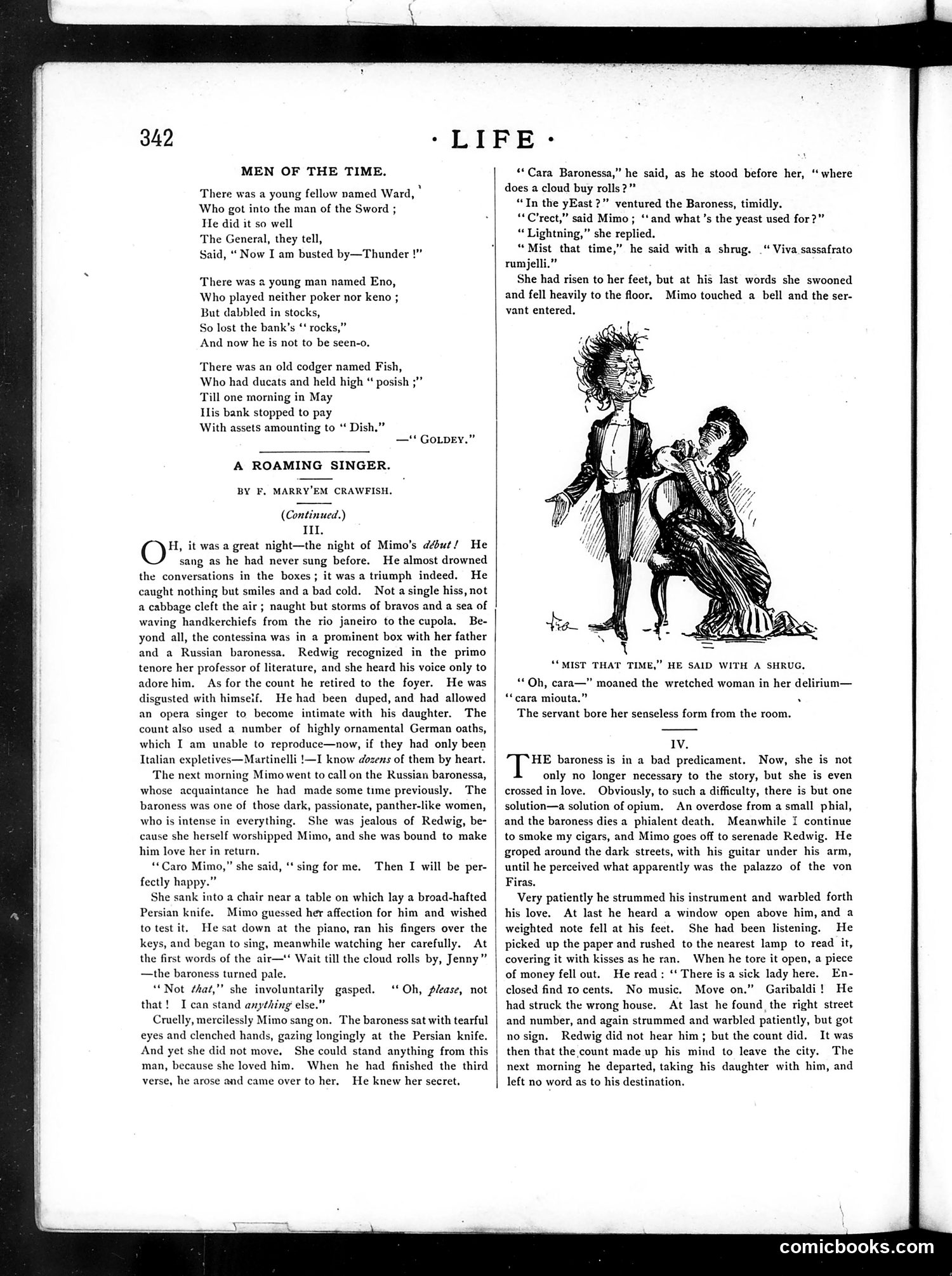
This page contains literary content rather than political satire. The left column presents "Men of the Time," brief satirical verses about various character types (Ward, Eno, Fish—likely referring to actual public figures of the era, though specific identifications aren't clear from the text alone). The main feature is "A Roaming Singer," a serialized story by F. Marry'em Crawfish. The illustration depicts a scene where a well-dressed man (apparently named Redwig) performs music for a baroness, who later swoons. The narrative describes romantic drama involving opera singing and unrequited love. This appears to be humorous fiction rather than political commentary—satire aimed at social pretension, romantic melodrama, and the affectations of artistic performers and aristocrats.
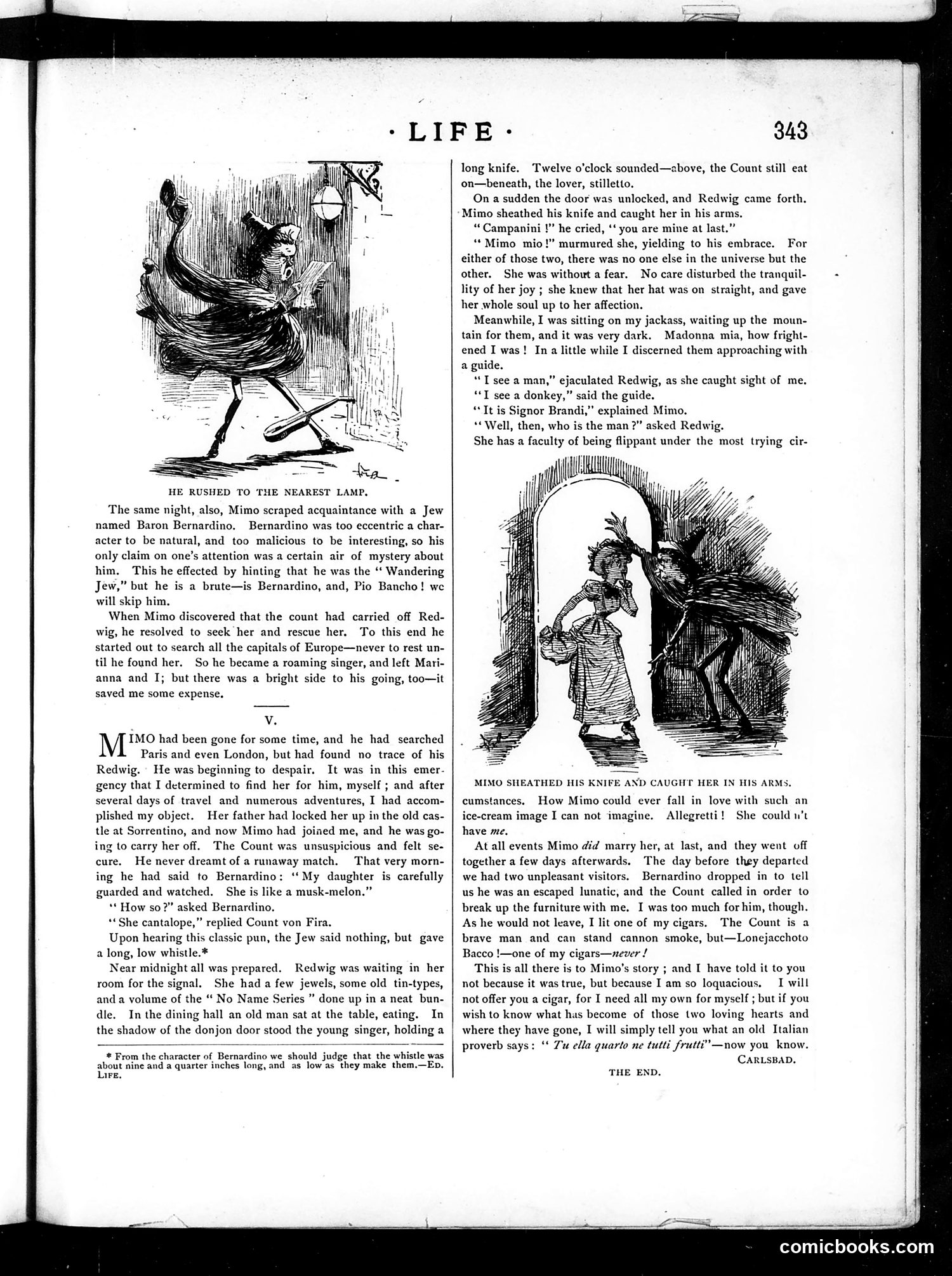
This page contains the conclusion of a serialized fictional narrative rather than political satire. The story involves characters named Mimo, Redwig, Count von Fira, and Bernardino in what appears to be a romantic melodrama set in Europe. The two illustrations show dramatic scenes: one depicts a figure rushing toward a lamp, the other shows characters in an emotional confrontation at a doorway. The narrative describes kidnapping, romantic pursuit across European capitals, and ultimately a wedding. The content is literary fiction—adventure romance—not political commentary. A footnote about Bernardino's whistle suggests the story contains character humor, but this page primarily concludes the serialized tale with the marriage of Mimo and Redwig, marked "THE END."
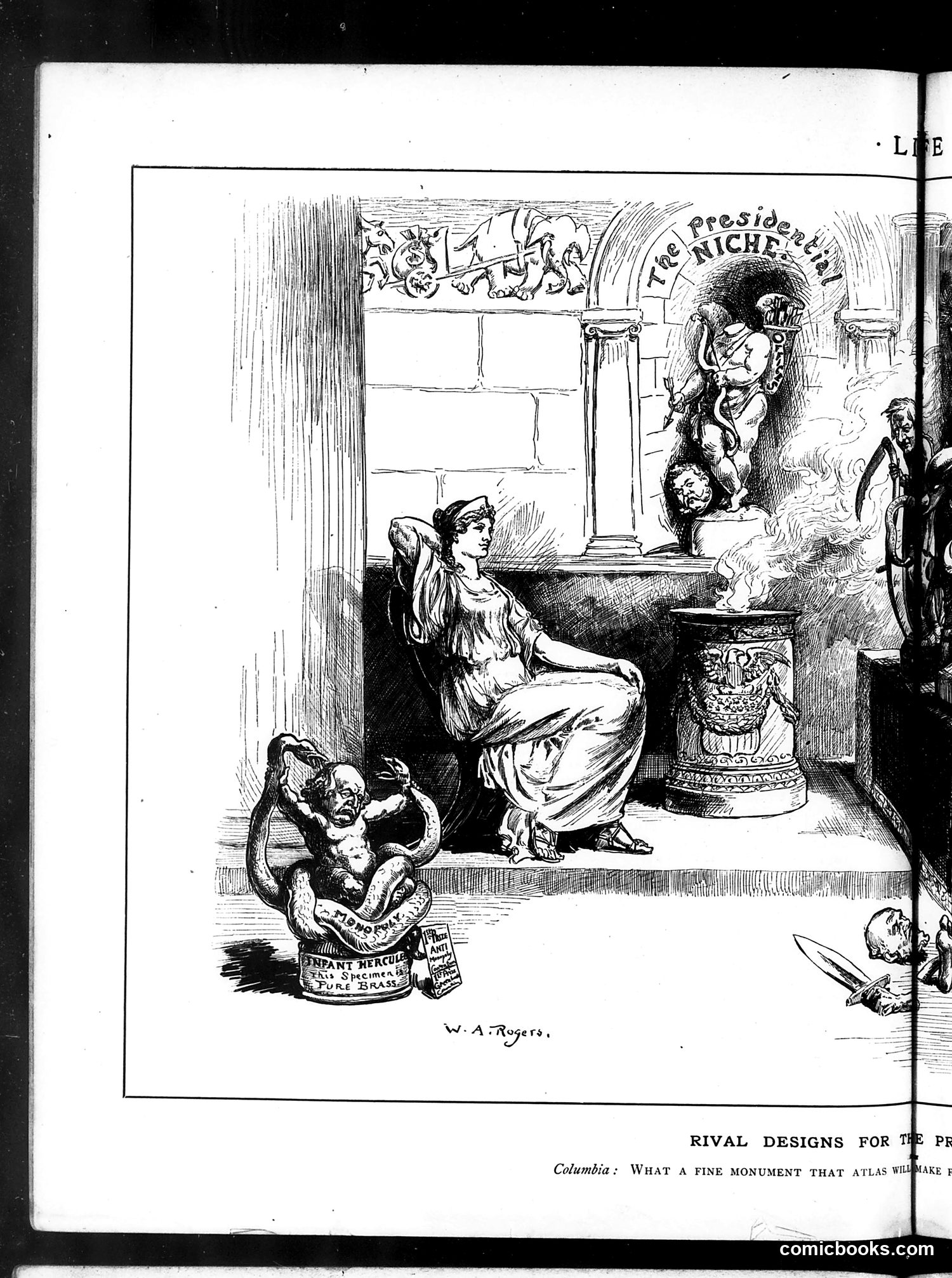
This cartoon by W.A. Rogers depicts a classical female figure (representing Columbia, the personification of America) seated in an elegant neoclassical interior. She gazes at a statue labeled "The President's Niche" while a cherub-like figure below holds what appears to be "Infant Hercules" alongside product containers. The caption reads: "Columbia: What a fine monument that atlas will make!" The satire appears to criticize presidential ambitions or legacy-building. The juxtaposition of commercial products ("Infant Hercules," "Pure Brass") with classical ideals suggests mockery of how American presidents commemorate themselves—replacing genuine heroic achievement with manufactured commercial imagery. The classical setting emphasizes the gap between republican ideals and political reality.
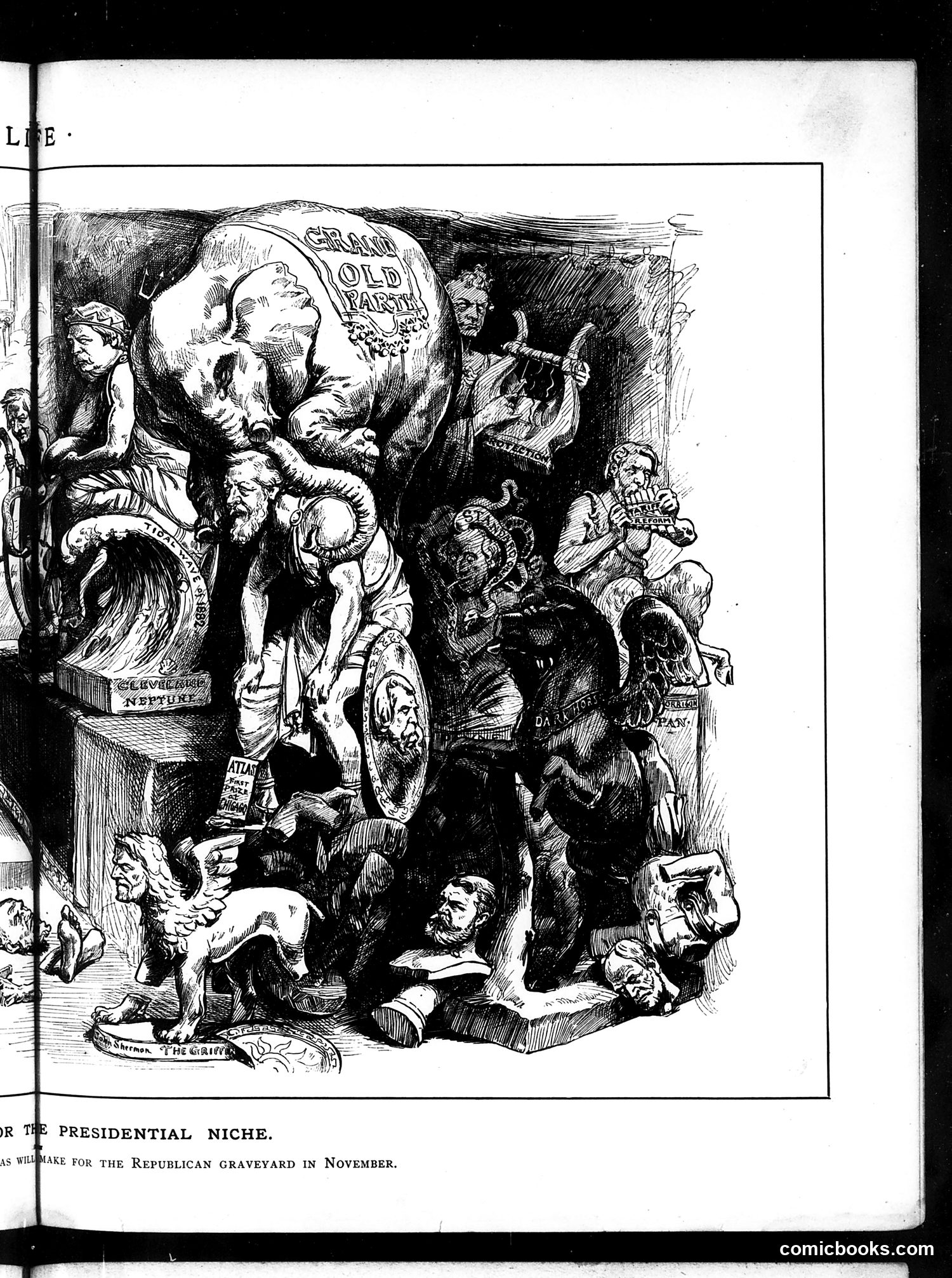
This political cartoon satirizes the 1884 U.S. presidential election. The visible text indicates it concerns "the Republican graveyard in November," suggesting this is anti-Republican satire from *Life* magazine. The central image depicts a large barrel or container labeled "Old Party" surrounded by various figures in chaotic disorder. The composition suggests the Republican Party is in disarray or collapse. Multiple caricatured figures appear to represent different political factions or personalities fighting within the party. The "niche" reference suggests the cartoon mocks Republicans' ability to find a suitable presidential candidate, implying their party is so fractured it resembles a graveyard. The November reference indicates this was published before that month's election, predicting Republican defeat.
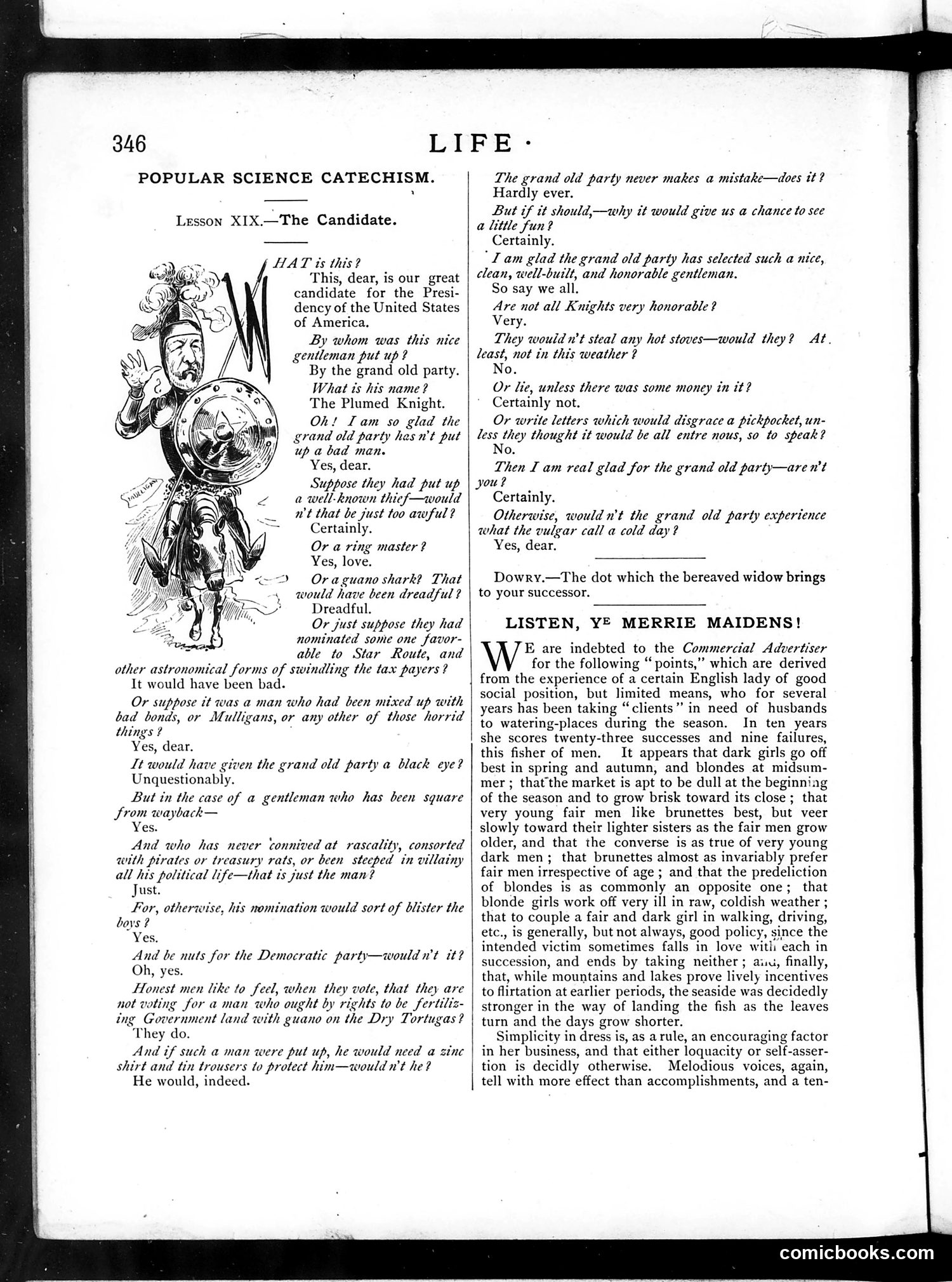
This is a mock catechism (instructional dialogue) satirizing the Republican Party's 1884 presidential nomination of James G. Blaine, nicknamed "the Plumed Knight." The cartoon presents an absurdly idealized candidate while the text ironically catalogs actual Republican scandals: the "Star Route" mail fraud scheme, the "Mulligan Letters" (discrediting Blaine), suspicious bond dealings, and treasury corruption. The satire's genius lies in its setup—the dialogue *celebrates* the candidate's supposed integrity while listing every disqualifying scandal the party had actually been involved with. References like "guano shark" allude to corrupt government contracts and kickback schemes. The phrase "fertilizing Government land with guano on the Dry Tortugas" mocks potential punishment for graft. This is Democratic attack journalism, exposing Republican hypocrisy: they claim moral superiority while their nominee had genuine corruption baggage. The illustration shows Blaine as a cartoonishly decorated figure.
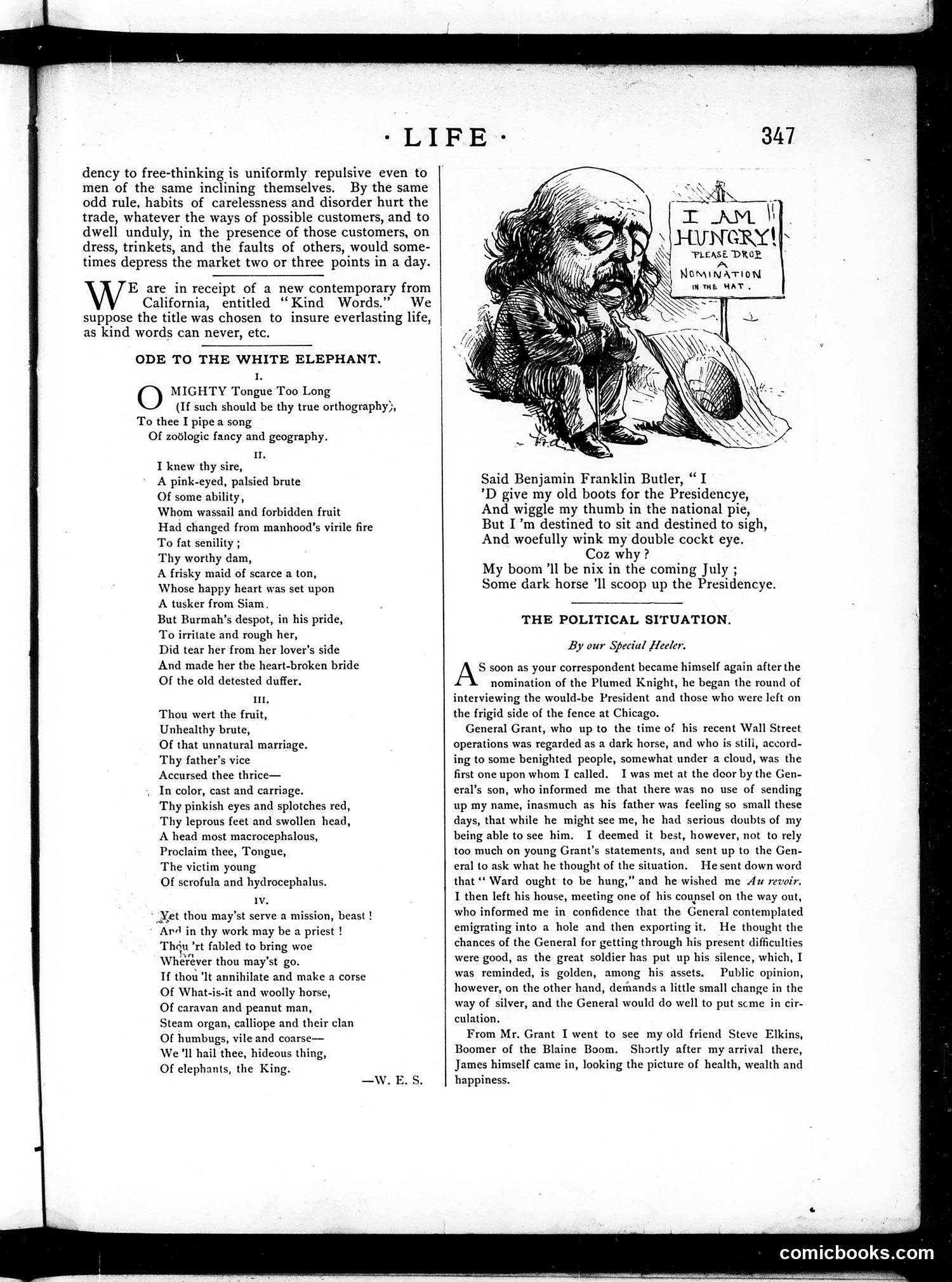
## The Main Cartoon The illustrated figure is a thin, emaciated man holding a sign reading "I AM HUNGRY! PLEASE DROP A NOMINATION IN THE HAT." This caricatures **Benjamin Franklin Butler**, a political figure seeking the presidency. The accompanying verse (attributed to Butler) mocks his electoral ambitions, suggesting he won't succeed in July because "some dark horse 'll scoop up the Presidencye." ## "The Political Situation" Article The article discusses post-convention politics following the nomination of the "Plumed Knight" (likely James G. Blaine, 1884). It describes the author's interviews with potential presidential candidates, particularly **General Grant**, whose recent financial scandals (Wall Street operations) have damaged his reputation. Grant's son supposedly says the General feels "so small these days" he doubts visitors could see him—satirizing Grant's diminished political standing. ## The Satire The humor targets failed presidential aspirants rendered politically destitute and desperate for nomination, with particular scorn toward Grant's disgrace and Butler's hunger for office.
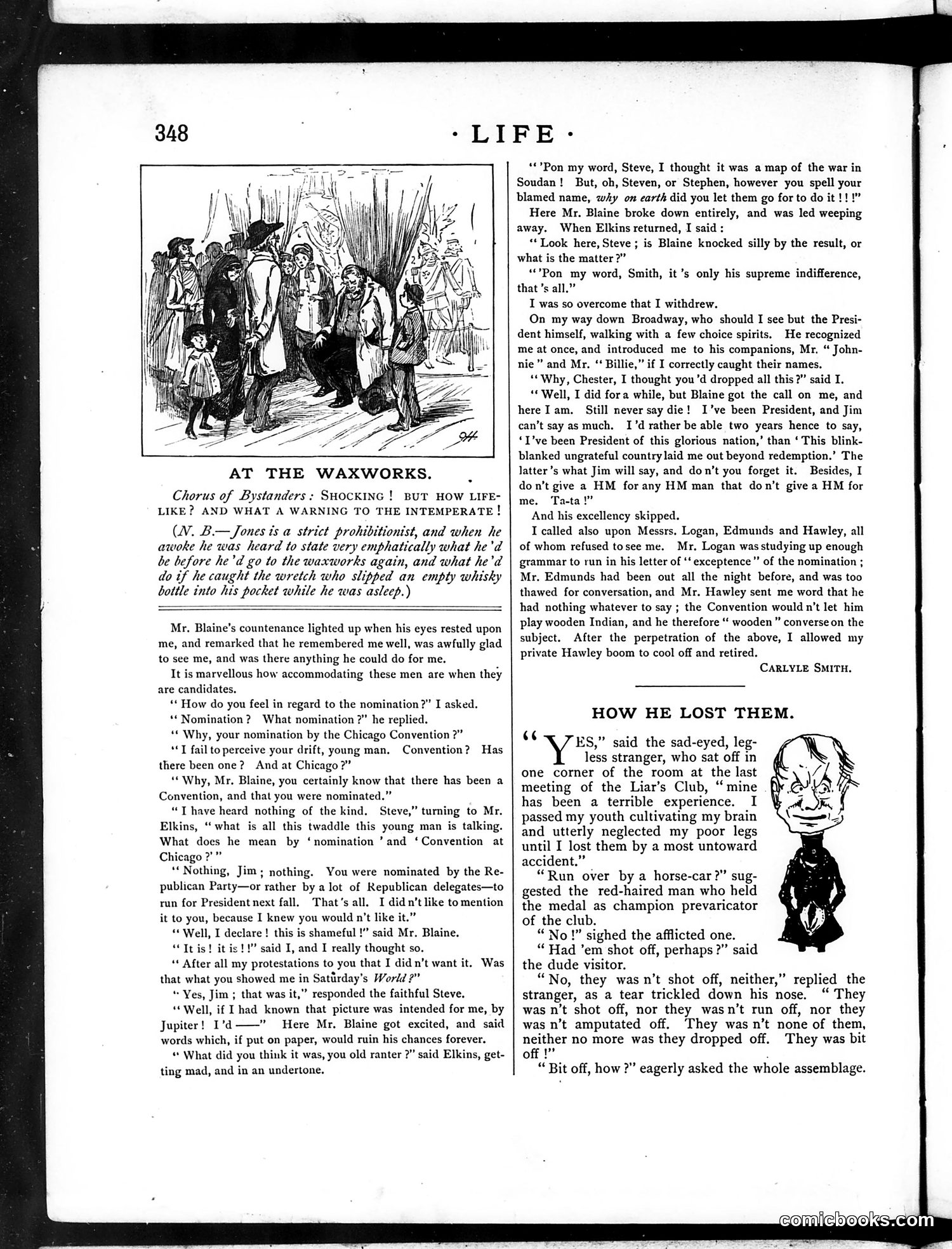
This satirical piece mocks the 1884 Republican presidential nomination process. The cartoon depicts a waxworks (museum of figures), with bystanders commenting on lifelike displays—likely caricatures of political candidates. The text features a conversation with **James G. Blaine**, the Republican nominee, who feigns complete ignorance of his own nomination by the Chicago Convention. This pretense of unwillingness was a common political posture of the era—candidates affected reluctance to appear ambitious rather than power-hungry. The satire attacks Blaine's obvious insincerity: he claims he never wanted the nomination despite clearly having pursued it. The author also mocks other Republican figures (**Chester Arthur**, the incumbent president, and others) for similar political posturing and incompetence. The underlying joke: these men are as stiff and unconvincing as waxwork figures—artificial, rehearsed, and transparently dishonest about their political ambitions.
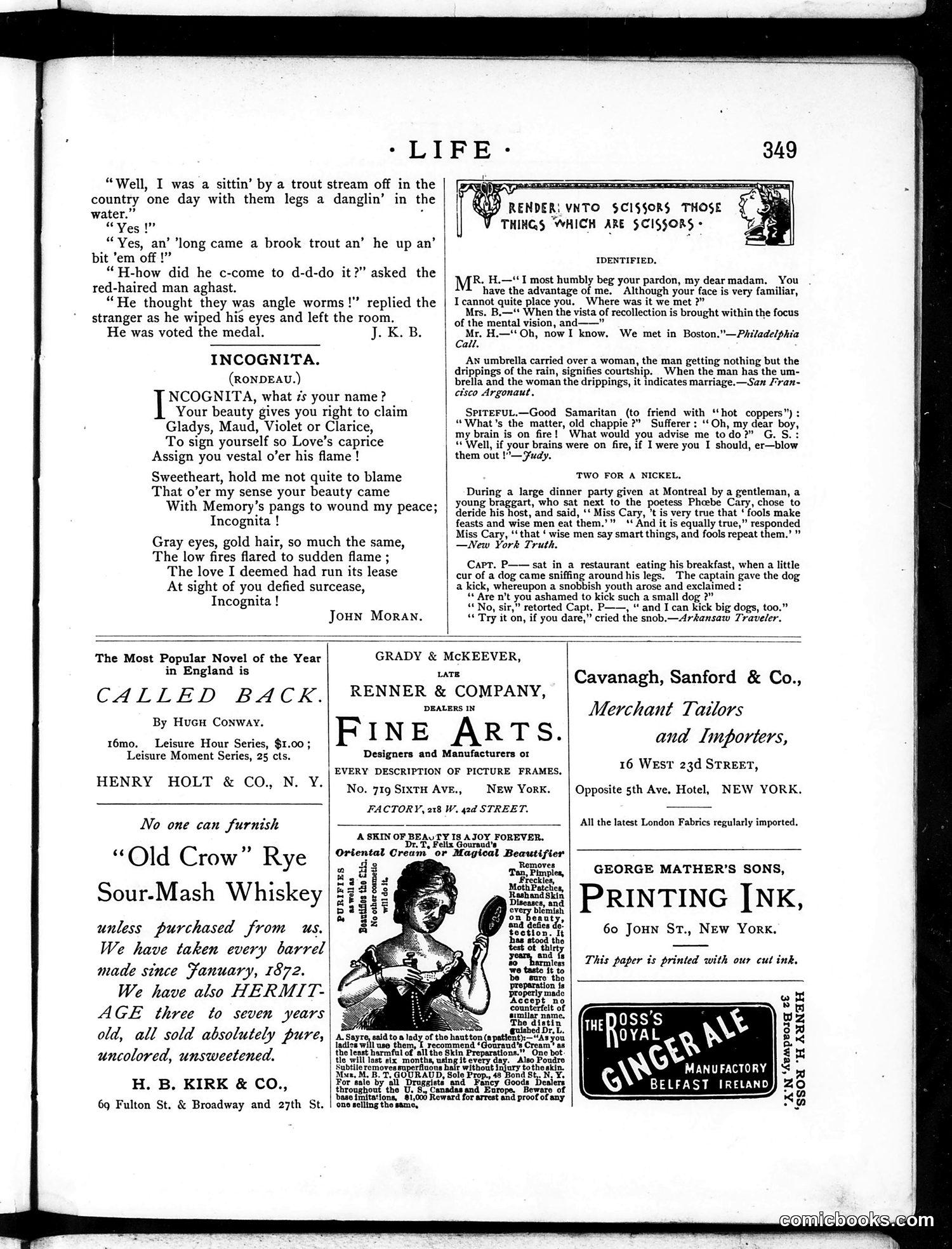
This page is primarily **advertisements and light humor**, not political satire. The main content includes: **The Humor Pieces:** - A folk-style joke about a man whose legs were bitten off by a trout (the trout mistook them for angle worms) - "Incognita," a romantic poem by John Moran about a mysterious woman with gray eyes and gold hair - Several short witty anecdotes about courtship, marriage, and social situations **The Cartoon/Illustration:** The "Render: Unto Scissors" box appears to be a visual puzzle or riddle identifying scissor-like objects. **The Advertisements:** Multiple ads for whiskey, art frames, cosmetics, and printing ink—typical 19th-century magazine content. The page reflects Victorian-era sensibilities regarding courtship, beauty standards, and genteel humor. There is no evident political commentary; this appears to be a standard issue of *Life* magazine from its era as a humor and society publication.
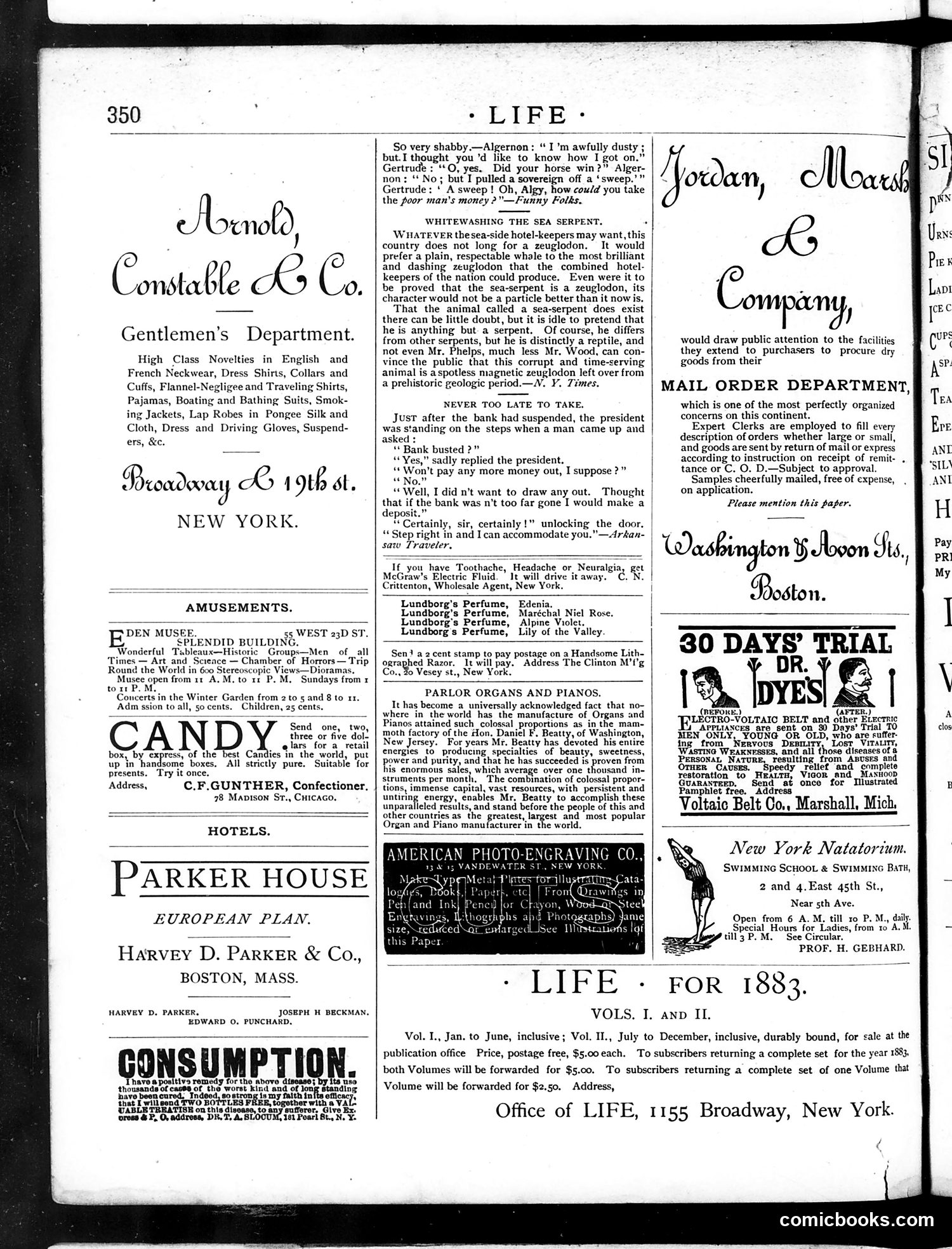
This is primarily an **advertising page** from Life magazine's 1883 issue, not a political cartoon page. The page contains mostly commercial advertisements for gentlemen's clothing (Arnold, Constable & Co.), hotels, candy, and other goods. However, there are **two brief humorous anecdotes** in the middle: 1. **"So Very Shabby"** — A joke about an Algerian who admits he won money not from horse racing but by "pulling a sovereign off a sweep" (stealing from a street sweeper), shocking his companion Gertrude. 2. **"Never Too Late to Take"** — After a bank fails, a man attempts to *deposit* money rather than withdraw it, exploiting the desperate situation. Both anecdotes are gentle, class-conscious humor typical of 1880s comedy — poking fun at social pretense and financial desperation rather than making sharp political statements. The page reflects the magazine's mix of advertising revenue and light satirical content.
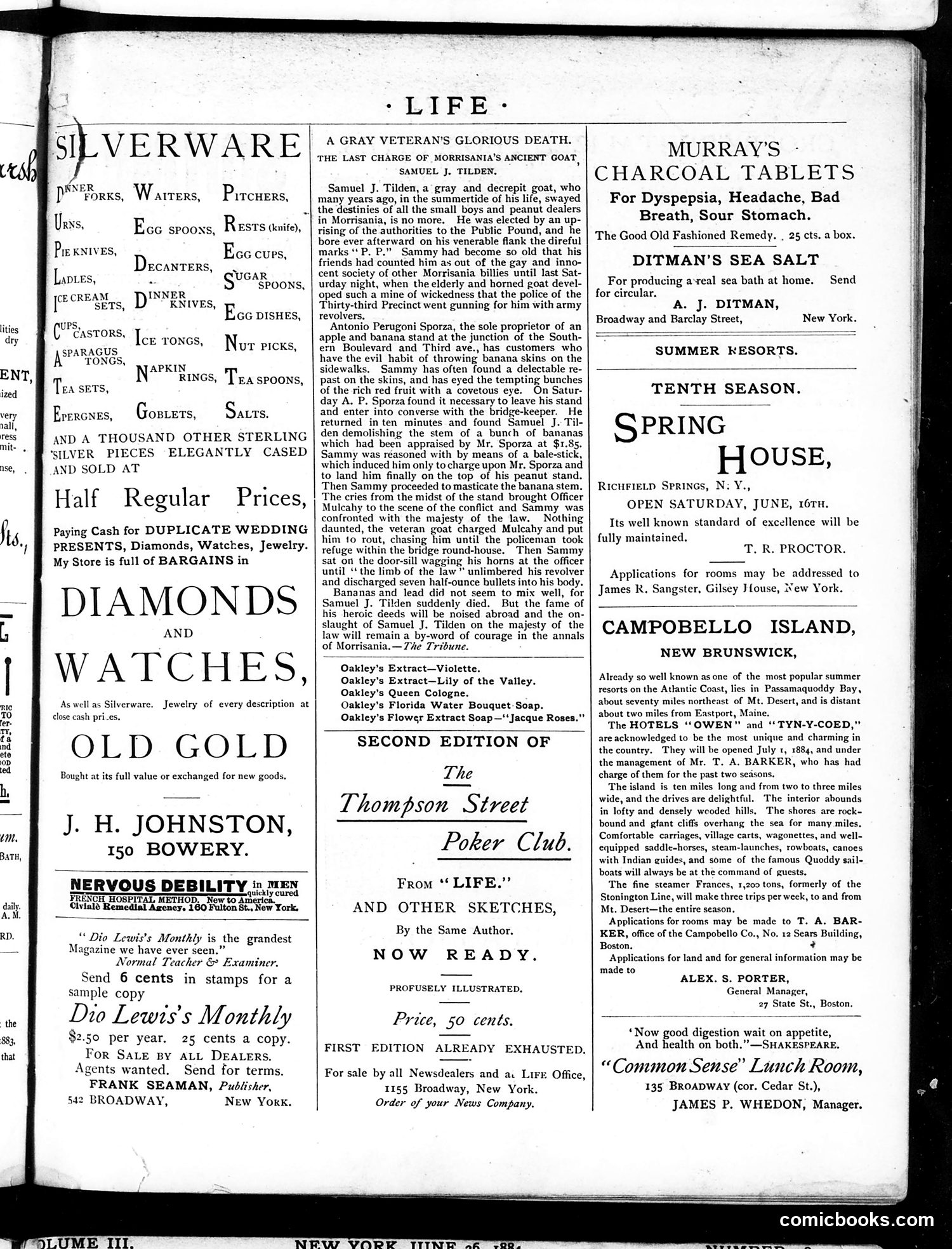
This page is primarily **advertising with one humorous article**, not a political cartoon. The main content is "A Gray Veteran's Glorious Death," a mock-heroic obituary for a goat named Samuel J. Tilden that lived in Morrisania (the Bronx). The satire works on two levels: 1. **The joke**: A real goat's mundane death (shot by police after eating fruit and charging a vendor) is narrated in grandiose, Civil War-style language about a "veteran" making a "glorious" last stand against "the majesty of the law." 2. **The political reference**: The goat is *named* after Samuel J. Tilden, the actual Democratic presidential candidate who lost the disputed 1876 election. By naming the goat after him, *Life* magazine (a Republican publication) mockingly suggests Tilden is senile, stubborn, and ridiculously outdated—fitting given Tilden's advanced age and continued political relevance in the 1880s. The satire ridicules both the goat's absurd bravery and, implicitly, Tilden's lingering political presence through humorous association.
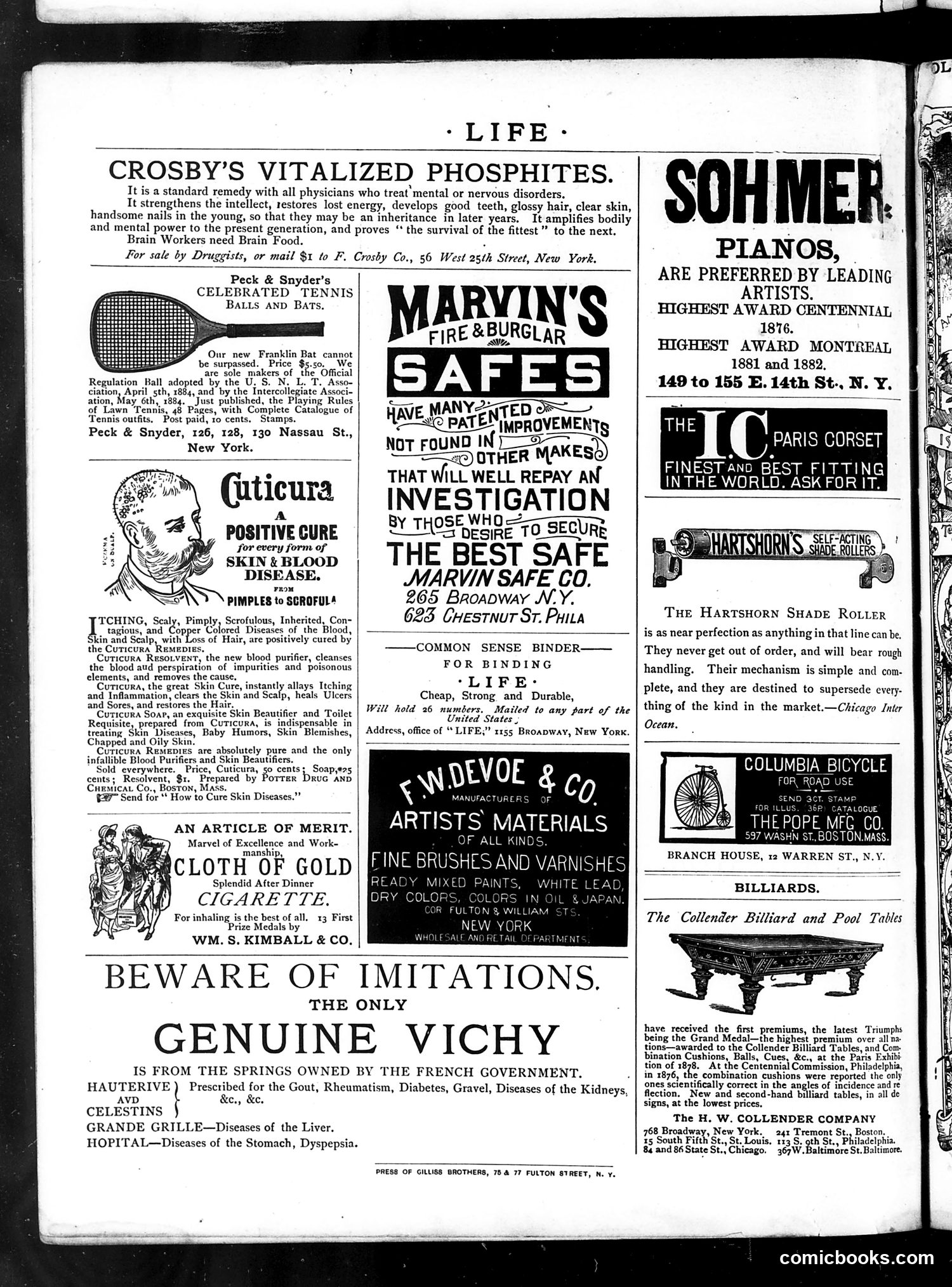
This is predominantly a **Victorian-era advertisements page** with minimal satirical content. The page showcases late 19th-century patent medicines and consumer goods typical of *Life* magazine's revenue model. Notable ads include: - **Crosby's Vitalized Phosphites**: A "brain food" supplement claiming to strengthen intellect and restore energy—reflecting the era's pseudoscientific belief that mental vigor could be purchased as medicine. - **Cuticura**: A blood purifier marketed for skin diseases, employing the period's dubious medical claims about internal remedies curing external conditions. - **Marvin Safes**: Standard commercial advertising emphasizing patented improvements. The **"Cloth of Gold Cigarette"** ad is ironic—promoting cigarettes as "splendid" and "best for inhaling" before tobacco's health dangers were widely acknowledged. The **"Beware of Imitations" Vichy water ad** humorously emphasizes authenticity concerns—even mineral water faced counterfeiting. Overall, this page reflects *Life*'s business model: satirical editorial content subsidized by credulous advertisements for dubious remedies now recognized as fraudulent.