
Life, 1884-06-19 · page 6 of 16
Life — June 19, 1884 — page 6: what you’re looking at
What you’re looking at
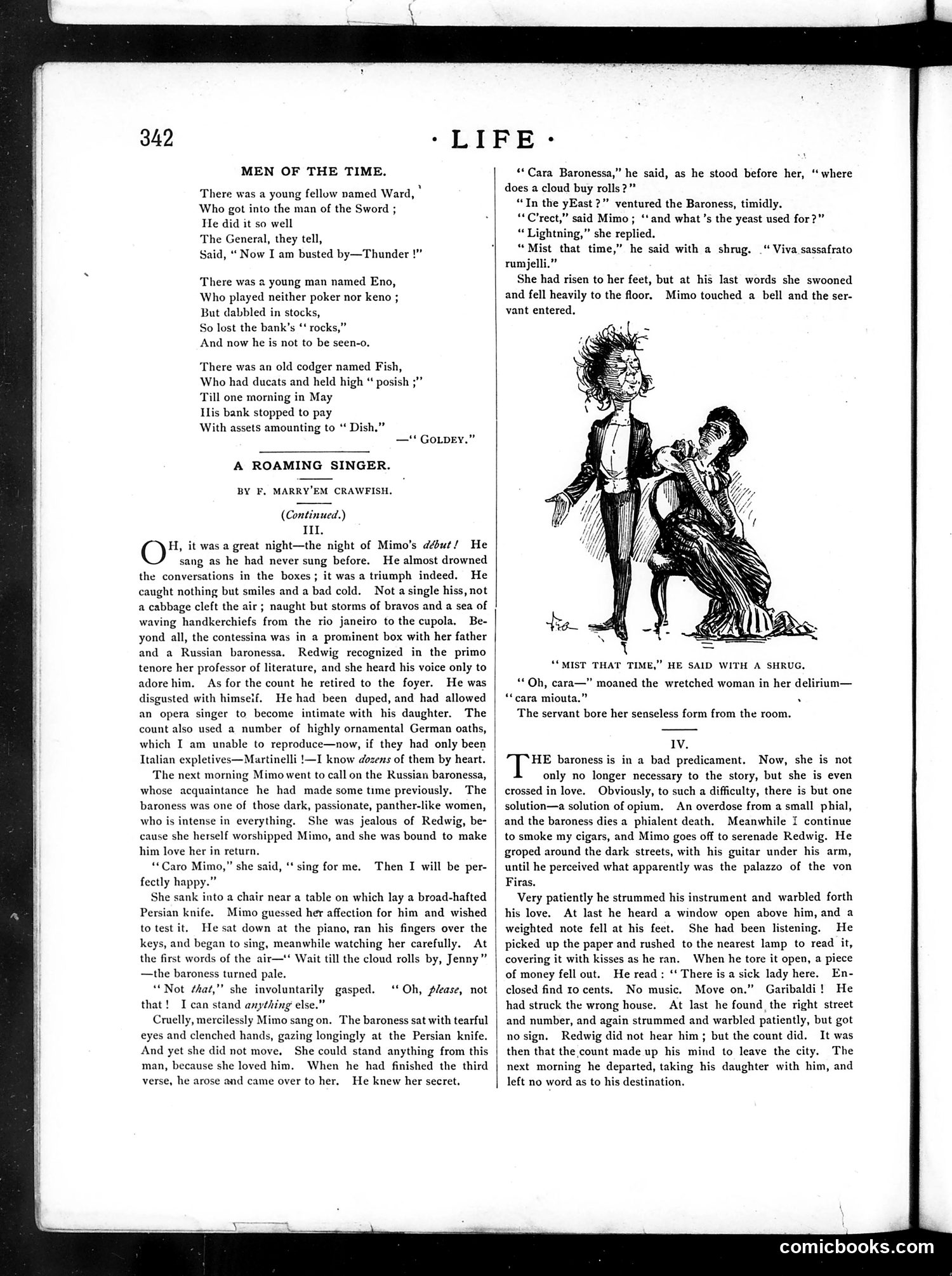
This page contains literary content rather than political satire. The left column presents "Men of the Time," brief satirical verses about various character types (Ward, Eno, Fish—likely referring to actual public figures of the era, though specific identifications aren't clear from the text alone). The main feature is "A Roaming Singer," a serialized story by F. Marry'em Crawfish. The illustration depicts a scene where a well-dressed man (apparently named Redwig) performs music for a baroness, who later swoons. The narrative describes romantic drama involving opera singing and unrequited love. This appears to be humorous fiction rather than political commentary—satire aimed at social pretension, romantic melodrama, and the affectations of artistic performers and aristocrats.
📄 Transcribed text from this page (OCR, searchable)
Machine-transcribed from the original scan — historical spelling and the odd misread are preserved.
- LIFE: MEN OF THE TIME. There was a young fellow named Ward, * Who got into the man of the Sword ; He did it so well The General, they tell, Said, “ Now I am busted by—Thunder !” There was a young man named Eno, Who played neither poker nor keno ; But dabbled in stocks, So lost the bank's ‘* rocks,” And now he is not to be seen-o. There was an old codger named Fish, Who had ducats and held high “ posish ;” Till one morning in May His bank stopped to pay With assets amounting to “‘ Dish.” —‘* GoLDEy.” A ROAMING SINGER. BY F, MARRY’EM CRAWFISH. (Continued.) Ill. H, it was a great night—the night of Mimo’s déut/ He sang as he had never sung before. He almost drowned the conversations in the boxes; it was a triumph indeed. He caught nothing but smiles and a bad cold. Not a single hiss, not a cabbage cleft the air; naught but storms of bravos and a sea of waving handkerchiefs from the rio janeiro to the cupola, Be- yond all, the contessina was in a prominent box with her father and a Russian baronessa. Redwig recognized in the primo tenore her professor of literature, and she heard his voice only to adore him. As for the count he retired to the foyer. He was disgusted with himseif. He had been duped, and had allowed an opera singer to become intimate with his daughter. count also used a number of highly ornamental German oaths, which I am unable to reproduce—now, if they had only been Italian expletives—Martinelli !—I know dozens of them by heart. | The next morning Mimo went to call on the Russian baronessa, whose acquaintance he had made some time previously. The baroness was one of those dark, passionate, panther-like women, who is intense in everything. She was jealous of Redwig, be- cause she herself worshipped Mimo, and she was bound to make him love her in return, “Caro Mimo,” she said, ‘* sing for me. fectly happy.” She sank into a chair near a table on which lay a broad-hafted Persian knife. Mimo guessed her affection for him and wished to test it. Then I will be per- keys, and began to sing, meanwhile watching her carefully. At the first words of the air—“ Wait till the cloud rolls by, Jenny” —the baroness turned pale. “Not ¢hat,” she involuntarily gasped. that! I can stand anything else.” Cruelly, mercilessly Mimo sang on. The baroness sat with tearful eyes and clenched hands, gazing longingly at the Persian knife. And yet she did not move. She could stand anything from this man, because she loved him. When he had finished the third verse, he arose and came over to her. He knew her secret. “Oh, please, not The | He sat down at the piano, ran his fingers over the | “Cara Baronessa,” he said, as he stood before her, ‘‘ where does a cloud buy rolls?” “In the yEast ?” ventured the Baroness, timidly. “‘C’rect,” said Mimo ; ‘‘and what’s the yeast used for?” “ Lightning,” she replied. “Mist that time,” he said with a shrug. rumjelli.”” She had risen to her feet, but at his last words she swooned and fell heavily to the floor. Mimo touched a bell and the ser- vant entered. “ Viva sassafrato “MIST THAT TIME,” HE SAID WITH A SHRUG, “Oh, cara—” moaned the wretched woman in her delirium— “*cara miouta.” . The servant bore her senseless form from the room, Iv. HE baroness is in a bad predicament. Now, she is not only no longer necessary to the story, but she is even crossed in love. Obviously, to such a difficulty, there is but one solution—a solution of opium, An overdose from a small phial, and the baroness dies a phialent death. Meanwhile I continue to smoke my cigars, and Mimo goes off to serenade Redwig. He groped around the dark streets, with his guitar under his arm, until he perceived what apparently was the palazzo of the von Firas. Very patiently he strummed his instrament and warbled forth his love. At last he heard a window open above him, and a weighted note fell at his feet. She had been listening. He picked up the paper and rushed to the nearest lamp to read it, covering it with kisses as he ran. When he tore it open, a piece of money fell out. He read : ‘“‘ There is a sick lady here. En- closed find ro cents. No music. Move on.” Garibaldi! He had struck the wrong house. At last he found the right street and number, and again strummed and warbled patiently, but got no sign, Redwig did not hear him; but the count did. It was then that the count made up his mind to leave the city. The next morning he departed, taking his daughter with him, and left no word as to his destination. comicbooks.com