
Life, 1884-06-19 · page 5 of 16
Life — June 19, 1884 — page 5: what you’re looking at
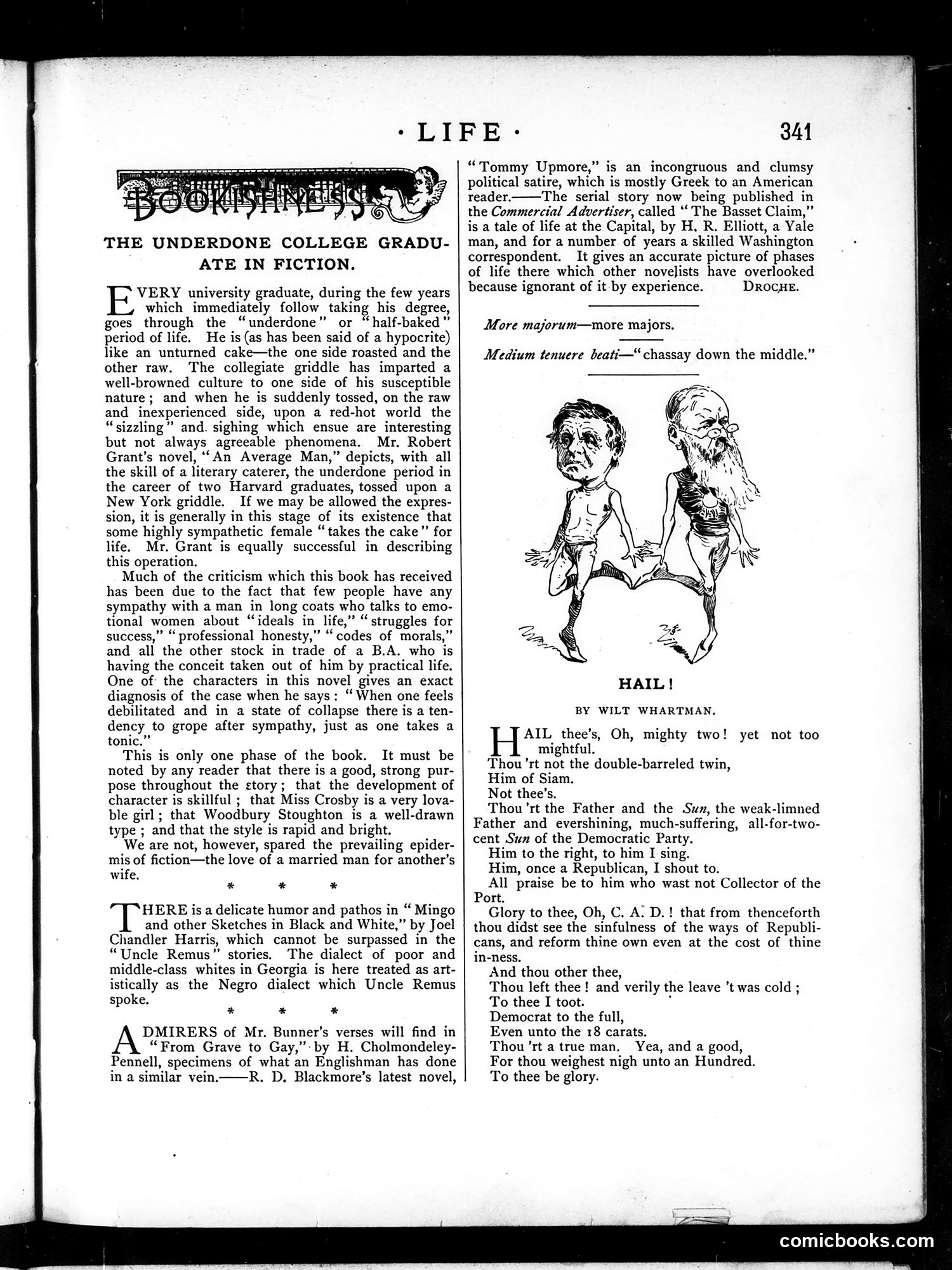
What you’re looking at
The cartoon depicts two caricatured male figures in a celebratory pose. Based on the accompanying poem, the figures represent **Father and Son**—specifically characterized as a weak-kneed, suffering Father and his overbearing, much-suffering Democratic Son. The satire mocks the relationship between **Republican and Democratic politicians** of the era. The poem's religious language ("Hail," "glory") ironically elevates the Democratic son as a reformer who has overcome his Republican father's influence—even converting him from Republican to Democrat. The joke targets **political hypocrisy and party conversion**, suggesting the son's moral superiority while sarcastically praising him for leaving the "cold" Republican party. The exaggerated physical caricature emphasizes the generational political divide common in early 20th-century American political humor.
📄 Transcribed text from this page (OCR, searchable)
Machine-transcribed from the original scan — historical spelling and the odd misread are preserved.
* LIFE: THE UNDERDONE COLLEGE GRADU- ATE IN FICTION. VERY university graduate, during the few years which immediately follow taking his degree, goes through the “underdone” or “half-baked” period of life. He is (as has been said of a hypocrite) like an unturned cake—the one side roasted and the other raw. The collegiate griddle has imparted a well-browned culture to one side of his susceptible nature; and when he is suddenly tossed, on the raw and inexperienced side, upon a red-hot world the “sizzling” and. sighing which ensue are interesting but not always agreeable phenomena. Mr. Robert Grant’s novel, “An Average Man,” depicts, with all the skill of a literary caterer, the underdone period in the career of two Harvard graduates, tossed upon a New York griddle. If we may be allowed the expres- sion, it is generally in this stage of its existence that some highly sympathetic female “takes the cake” for life. Mr. Grant is equally successful in describing this operation. Much of the criticism which this book has received has been due to the fact that few people have any sympathy with a man in long coats who talks to emo- tional women about “ideals in life,” “ struggles for success,” “ professional honesty,” “codes of morals,” and all the other stock in trade of a B.A. who is having the conceit taken out of him by practical life. One of: the characters in this novel gives an exact diagnosis of the case when he says: “When one feels debilitated and in a state of collapse there is a ten- dency to grope after sympathy, just as one takes a tonic.” This is only one phase of the book. It must be noted by any reader that there is a good, strong pur- pose throughout the story; that the development of character is skillful ; that Miss Crosby is a very lova- ble girl; that Woodbury Stoughton is a well-drawn type ; and that the style is rapid and bright. We are not, however, spared the prevailing epider- mis of fiction—the love of a married man for another’s wife. * * * HERE is a delicate humor and pathos in “ Mingo and other Sketches in Black and White,” by Joel Chandler Harris, which cannot be surpassed in the “Uncle Remus” stories. The dialect of poor and middle-class whites in Georgia is here treated as art- istically as the Negro dialect which Uncle Remus spoke. * * * DMIRERS of Mr. Bunner’s verses will find in “From Grave to Gay,”: by H. Cholmondeley- Pennell, specimens of what an Englishman has done in a similar vein——R. D, Blackmore’s latest novel, “Tommy Upmore,” is an incongruous and clumsy political satire, which is mostly Greek to an American reader.. ‘The serial story now being published in the Commercial Advertiser, called ‘‘ The Basset Claim,” is a tale of life at the Capital, by H. R. Elliott, a Yale man, and for a number of years a skilled Washington correspondent. It gives an accurate picture of phases of life there which other novelists have overlooked because ignorant of it by experience. DrocHe. More majorum—more majors. Medium tenuere beati— chassay down the middle.” BY WILT WHARTMAN, AIL thee’s, Oh, mighty two! yet not too mightful. Thou ’rt not the double-barreled twin, Him of Siam. Not thee’s. Thou ’rt the Father and the Sun, the weak-limned Father and evershining, much-suffering, all-for-two- cent Suz of the Democratic Party. Him to the right, to him I sing. Him, once a Republican, I shout to. All praise be to him who wast not Collector of the Port. Glory to thee, Oh, C. A: D.! that from thenceforth thou didst see the sinfulness of the ways of Republi- cans, and reform thine own even at the cost of thine in-ness. And thou other thee, Thou left thee! and verily the leave ’t was cold ; To thee I toot. . Democrat to the full, Even unto the 18 carats. Thou rt atrue man. Yea, and a good, For thou weighest nigh unto an Hundred. To thee be glory. comicbooks.com