
Life, 1884-06-19 · page 12 of 16
Life — June 19, 1884 — page 12: what you’re looking at
What you’re looking at
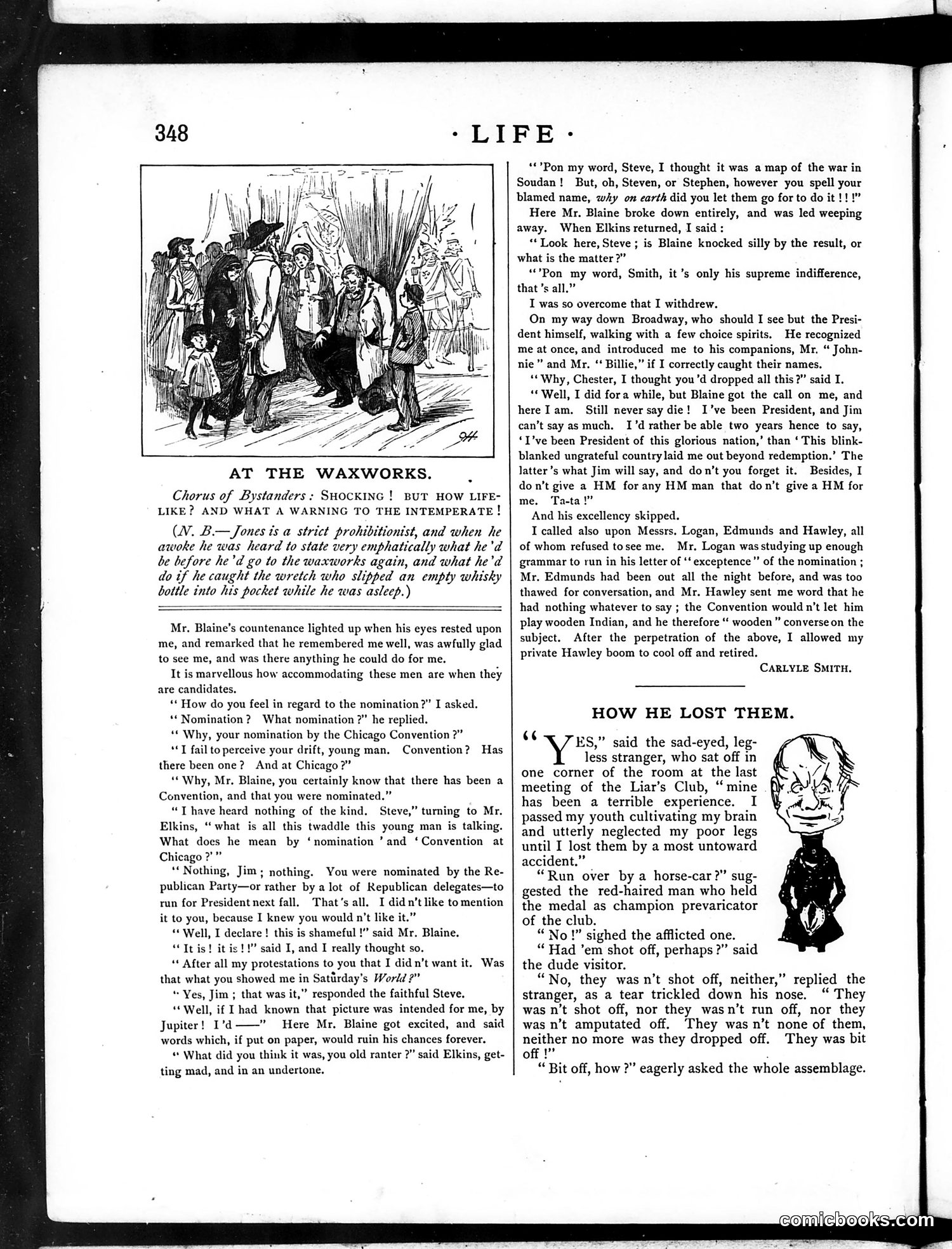
This satirical piece mocks the 1884 Republican presidential nomination process. The cartoon depicts a waxworks (museum of figures), with bystanders commenting on lifelike displays—likely caricatures of political candidates. The text features a conversation with **James G. Blaine**, the Republican nominee, who feigns complete ignorance of his own nomination by the Chicago Convention. This pretense of unwillingness was a common political posture of the era—candidates affected reluctance to appear ambitious rather than power-hungry. The satire attacks Blaine's obvious insincerity: he claims he never wanted the nomination despite clearly having pursued it. The author also mocks other Republican figures (**Chester Arthur**, the incumbent president, and others) for similar political posturing and incompetence. The underlying joke: these men are as stiff and unconvincing as waxwork figures—artificial, rehearsed, and transparently dishonest about their political ambitions.
📄 Transcribed text from this page (OCR, searchable)
Machine-transcribed from the original scan — historical spelling and the odd misread are preserved.
-LIFE- AT THE WAXWORKS. Chorus of Bystanders: SHOCKING ! BUT HOW LIFE- LIKE? AND WHAT A WARNING TO THE INTEMPERATE ! (MW. B—Jones is a strict prohibitionist, and when he awoke he was heard to state very emphatically what he'd be before he'd go to the waxworks again, and what he'd do if he caught the wretch who slipped an empty whisky bottle into his pocket while he was asleep.) Mr. Blaine’s countenance lighted up when his eyes rested upon me, and remarked that he remembered me well, was awfully glad to see me, and was there anything he could do for me. It is marvellous how accommodating these men are when they are candidates. “ How do you feel in regard to the nomination?” I asked. ‘* Nomination? What nomination ?” he replied. “Why, your nomination by the Chicago Convention ?” “«T fail to perceive your drift, young man. Convention? Has there been one? And at Chicago?” “Why, Mr. Blaine, you certainly know that there has been a Convention, and that you were nominated.” “T have heard nothing of the kind. Steve,” turning to Mr. Elkins, “‘ what is all this twaddle this young man is talking. What does he mean by ‘nomination ’ and ‘Convention at Chicago ?"” ‘Nothing, Jim; nothing. You were nominated by the Re- publican Party—or rather by a lot of Republican delegates—to run for President next fall. That's all, I didn’t like to mention it to you, because I knew you would n’t like it.” “Well, I declare! this is shameful !” said Mr. Blaine. “Tt is! it is!!" said I, and I really thought so. “* After all my protestations to you that I didn’t want it. Was that what you showed me in Satiirday’s World ?” “ Yes, Jim ; that was it,” responded the faithful Steve. “Well, if I had known that picture was intended for me, by Jupiter! I1’4 ——” Here Mr. Blaine got excited, and said words which, if put on paper, would ruin his chances forever. “ What did you think it was, you old ranter ?” said Elkins, get- ting mad, and in an undertone. “Pon my word, Steve, I thought it was a map of the war in Soudan! But, oh, Steven, or Stephen, however you spell your blamed name, why on earth did you let them go for to do it!!!" Here Mr. Blaine broke down entirely, and was led weeping away. When Elkins returned, I said: “Look here, Steve ; is Blaine knocked silly by the result, or what is the matter?” “Pon my word, Smith, it’s only his supreme indifference, that’s all.” I was so overcome that I withdrew. On my way down Broadway, who should I see but the Presi- dent himself, walking with a few choice spirits. He recognized me at once, and introduced me to his companions, Mr. “ John- nie” and Mr. “Billie,” if I correctly caught their names. “Why, Chester, I thought you ’d dropped all this ?” said I. ‘* Well, I did fora while, but Blaine got the call on me, and here Iam. Still never say die! I’ve been President, and Jim can’t say as much. I'd rather be able two years hence to say, ‘I’ve been President of this glorious nation,’ than ‘ This blink- blanked ungrateful country laid me out beyond redemption.’ The latter’s what Jim will say, and don’t you forget it. Besides, I don’t give a HM for any HM man that don’t give a HM for me. Ta-ta!” And his excellency skipped. I called also upon Messrs. Logan, Edmunds and Hawley, all of whom refused tosee me. Mr. Logan was studying up enough grammar to run in his letter of ‘‘exceptence” of the nomination ; Mr. Edmunds had been out all the night before, and was too thawed for conversation, and Mr. Hawley sent me word that he had nothing whatever to say ; the Convention would n’t let him play wooden Indian, and he therefore “ wooden” converse on the subject. After the perpetration of the above, I allowed my private Hawley boom to cool off and retired. CARLYLE SMITH. HOW HE LOST THEM. ee ES,” said the sad-eyed, leg- less stranger, who sat off in one corner of the room at the last meeting of the Liar’s Club, “mine has been a terrible experience. I passed my youth cultivating my brain and utterly neglected my poor legs until I lost them by a most untoward accident.” “Run over by a horse-car?” sug- gested the red-haired man who held the medal as champion prevaricator of the club. “No !” sighed the afflicted one. “ Had ’em shot off, perhaps ?” said the dude visitor. “No, they wasn’t shot off, neither,” replied the stranger, as a tear trickled down his nose. “ They was n’t shot off, nor they wasn’t run off, nor they was n’t amputated off. They wasn’t none of them, neither no more was they dropped off. They was bit off !” : “ Bit off, how ?” eagerly asked the whole assemblage.