
A complete issue · 16 pages · 1883
Life — October 18, 1883
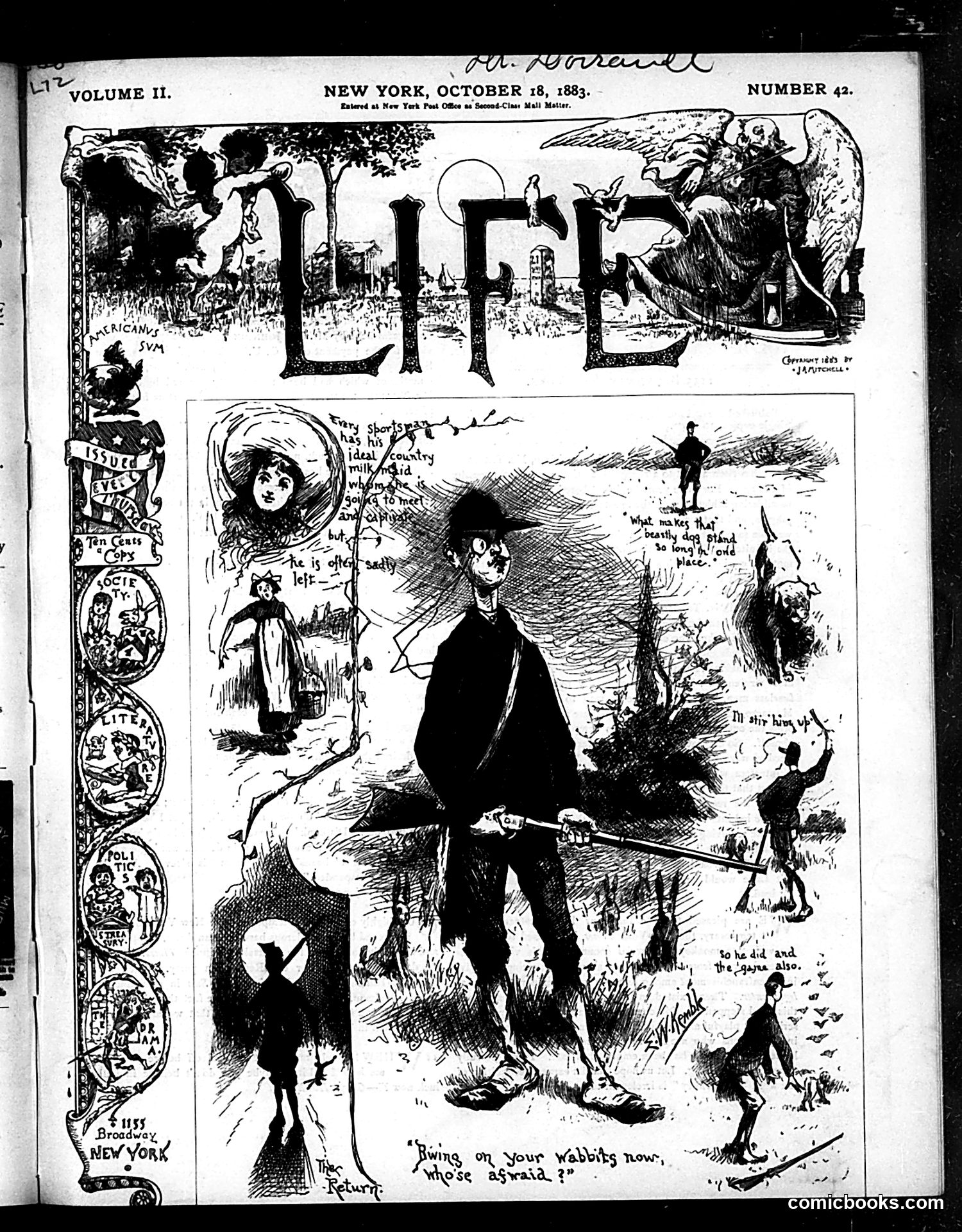
This satirical cartoon depicts a demonic or skeletal figure (personifying Death or some malevolent force) standing in a landscape, holding a rifle and addressing small human figures with the taunt: "Swing on your wabbits now, whose afraid?" The imagery suggests social commentary on violence or danger—the menacing central figure with grotesque features threatens vulnerable people below. The scattered figures and dog in the composition reinforce a sense of threat and vulnerability. The specific reference "wabbits" (rabbits) is unclear without additional context, though it may reference a contemporary event, phrase, or practice. The overall tone is darkly satirical, typical of *Life* magazine's social criticism during this Gilded Age period. The exact political or social target remains difficult to determine from the image alone.
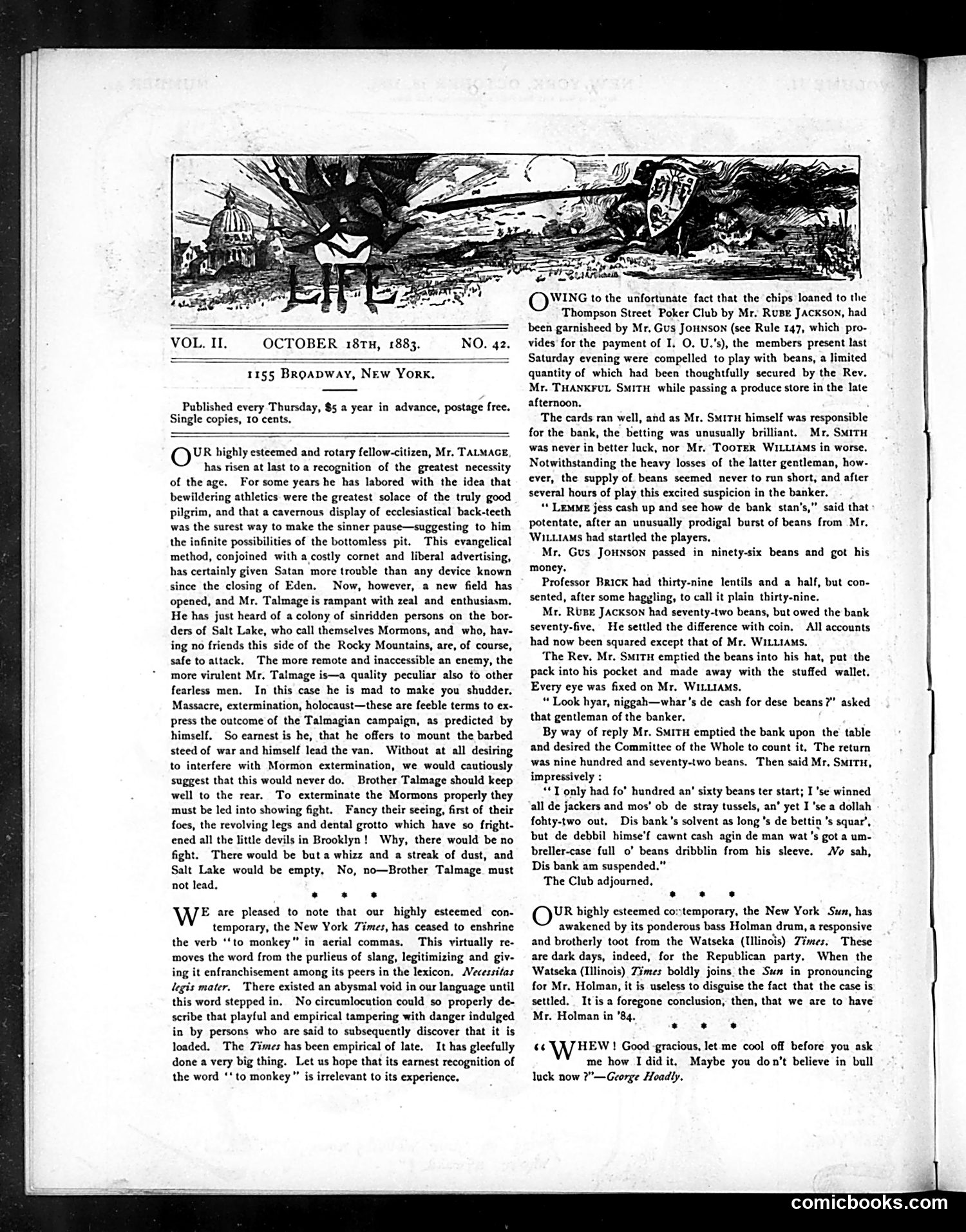
The page contains two distinct articles with no visible cartoons. The first article mocks **Mr. Talmage**, a prominent clergyman, for his recent conversion to Mormonism and his crusade against the religion. Life sarcastically suggests Talmage's evangelical fervor causes more trouble than it solves, comparing his efforts to exterminate Mormonism to the Mormons' own violent history. The satire implies Talmage is hypocritical and self-aggrandizing. The second brief article praises the **New York Times** for removing the word "monkey" from its vocabulary—previously used as slang. Life approves of this linguistic refinement. A separate notice reports the **New York Sun's** endorsement of Republican candidate **Mr. Holman** for an Illinois position, presented as a foregone conclusion.
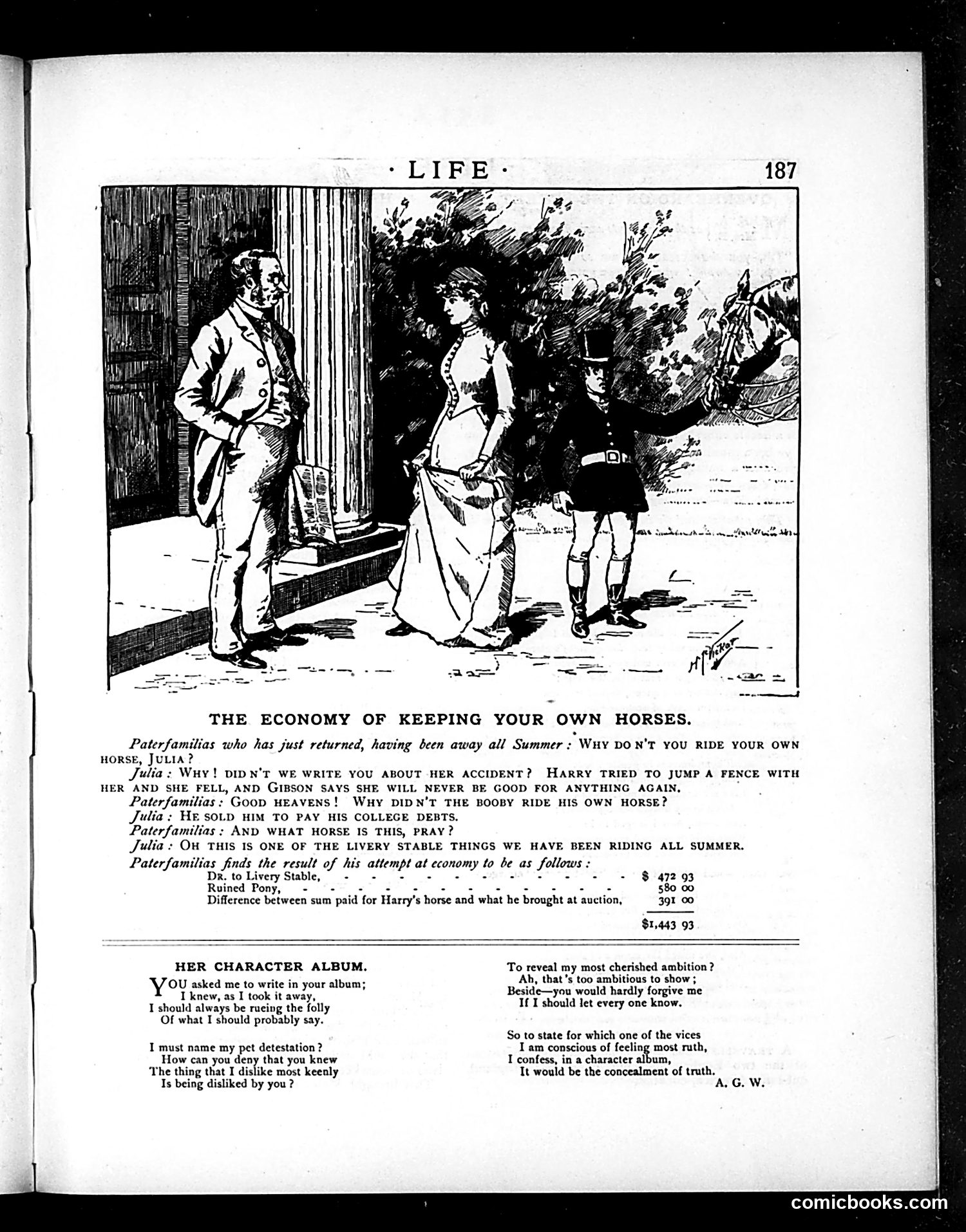
This satirical piece mocks wealthy families' false economy claims. The dialogue shows Paterfamilias (the father) defending his decision to own horses rather than use a livery stable, citing financial prudence. However, the itemized costs reveal the actual expense: $1,443.93 total, with a $391 loss on Harry's injured horse alone. The satire targets upper-class hypocrisy—families convincing themselves that private horse ownership is economical when the arithmetic proves otherwise. The accompanying illustration depicts a gentleman, woman, and young boy with horses, representing this aspirational lifestyle. The piece ridicules the self-deception of the wealthy about their spending habits, a common target of *Life* magazine's social commentary during the Gilded Age.
This page contains three distinct pieces: 1. **"Overheard on the Street"** — A satirical dialogue between two women (Mrs. A and Mrs. B) gossiping about summer activities, fashions, and social life. The humor derives from rapid-fire complaints and social commentary typical of period women's conversation. 2. **"Quoted"** — A poem about a woman's romantic deception, emphasizing concealment and secrecy behind polite social masks. 3. **"Hark from the Tombs!"** — The opening of a serialized novel by W—m D—— II–w–lls about Clara Louise Michel D'Arkness, an eighteen-year-old Boston woman. The narrative establishes her as refined but constrained by Boston society's expectations regarding dress and deportment. The page reflects Gilded Age social satire and serialized fiction typical of Life's editorial mix.
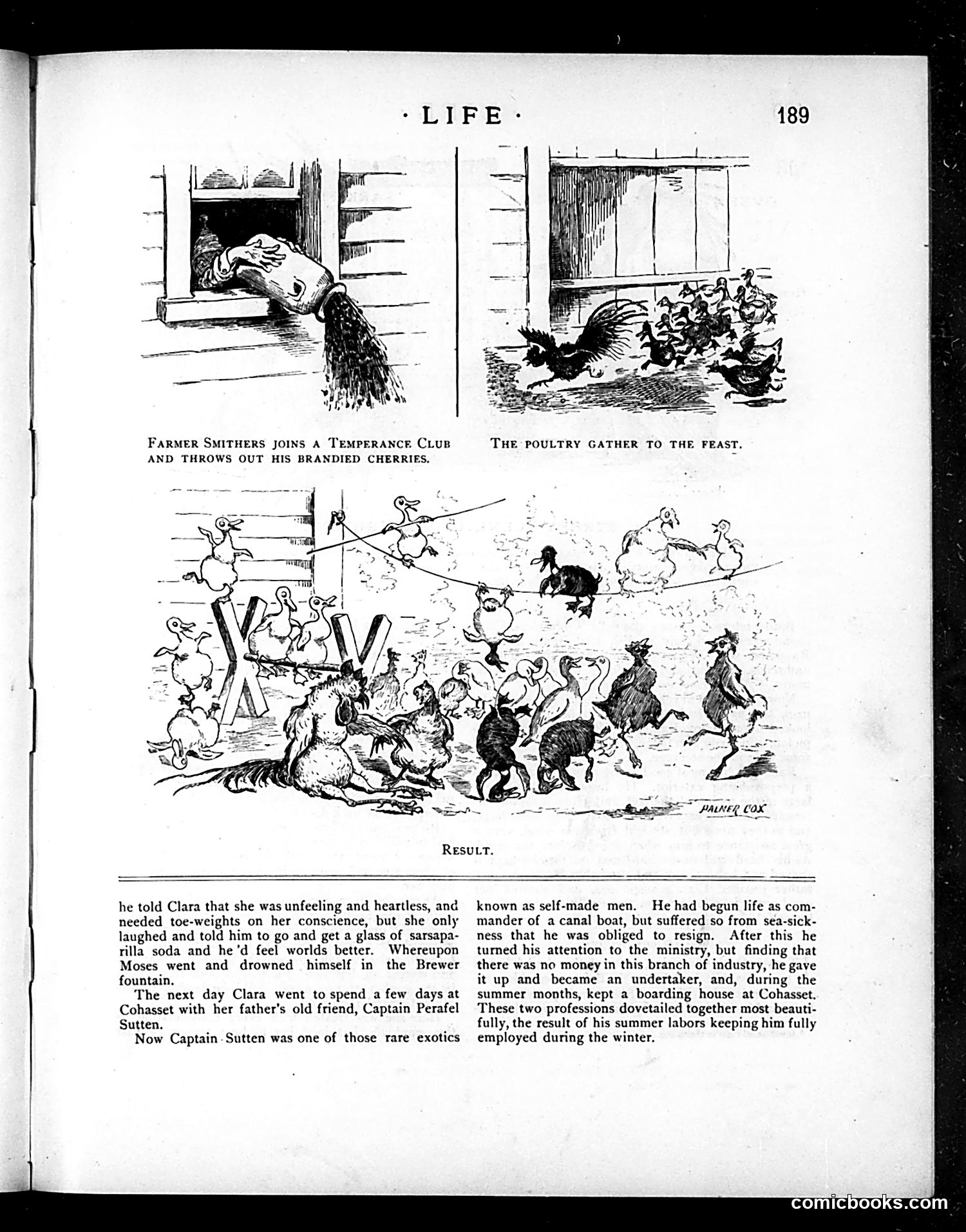
This page contains three illustrations satirizing temperance movements and rural life, likely from the early 1900s. The top two panels mock Farmer Smithers joining a temperance club and discarding alcohol ("brandied cherries"), while poultry gather to feast on the discarded food—a visual joke about unintended consequences. The bottom panel, titled "Result," depicts chaos among the farmer's animals (chickens appearing drunk or intoxicated from consuming the cherries). The satire targets temperance advocates by suggesting their moral crusades create absurd, uncontrollable outcomes. The humor relies on depicting animals behaving wildly, implying that removing alcohol creates disorder rather than improvement. This reflects common anti-temperance sentiment in early 20th-century American satire, mocking reformers as naive idealists whose policies backfire comically.
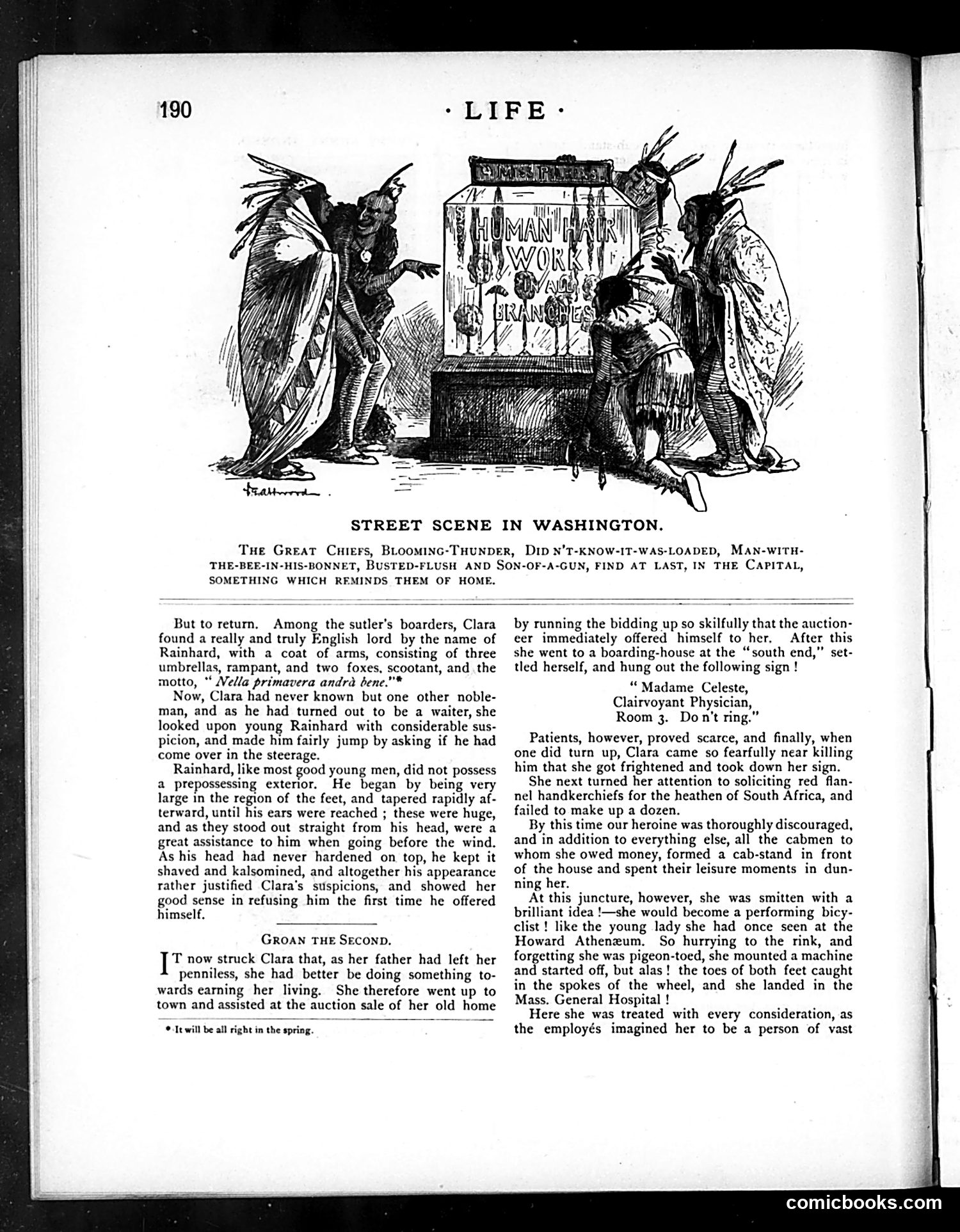
The cartoon titled "Street Scene in Washington" depicts Native American figures (identified by headdresses and traditional dress) examining a sign reading "Human Hair Work and Branches." The caption identifies them humorously as "The Great Chiefs, Blooming-Thunder, Did'n't-know-it-was-loaded, Man-with-the-bee-in-his-bonnet, Busted-flush and Son-of-a-gun." This is 19th-century satirical commentary on Washington D.C. politics, likely mocking contemporary politicians or political factions through the device of Native Americans "discovering" human hair work—suggesting these politicians' schemes were absurd or trivial. The satire uses caricatured Indigenous figures as a vehicle for political ridicule, typical of period humor, though by modern standards such depictions are considered offensive and stereotypical.
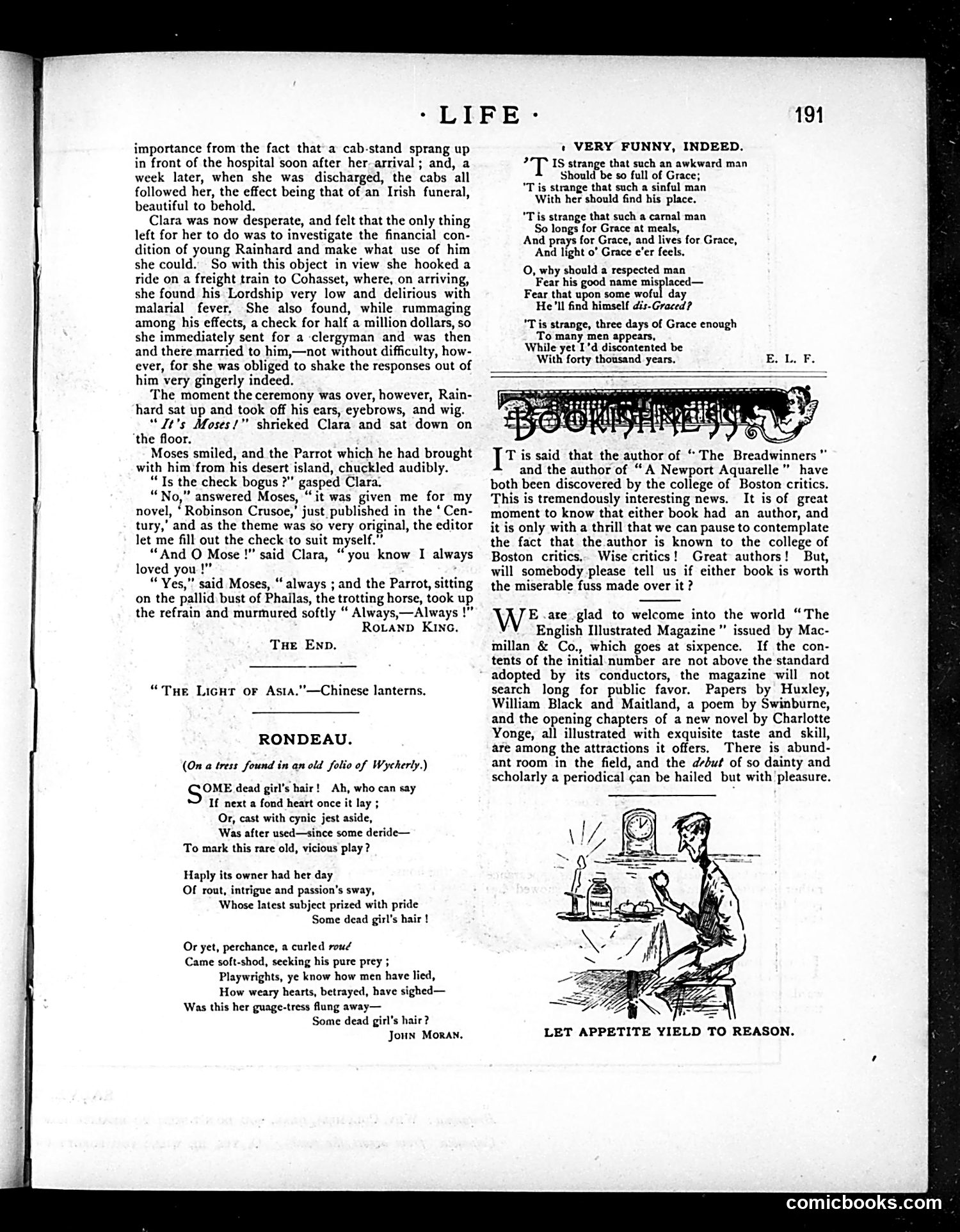
The page contains two distinct items: **"Very Funny, Indeed"** (top right): A poem by E.L.F. mocking a "respectable man" obsessed with "Grace" — appearing to satirize either romantic obsession or possibly a social climber's fixation on status/propriety. The humor relies on the absurdity of his devotion. **"Rondeau"** (bottom left): A poem by John Moran about "some dead girl's hair," exploring themes of vanity, loss, and the fleeting nature of beauty and pride. It's a melancholic meditation rather than satire. **Cartoon** (right side): Shows a man and woman at a table with food and wine, captioned "Let Appetite Yield to Reason." This appears to be a straightforward moral lesson about self-restraint during dining — likely advocating moderation over gluttony, a common Victorian-era message. No specific political figures or current events are clearly referenced on this page.
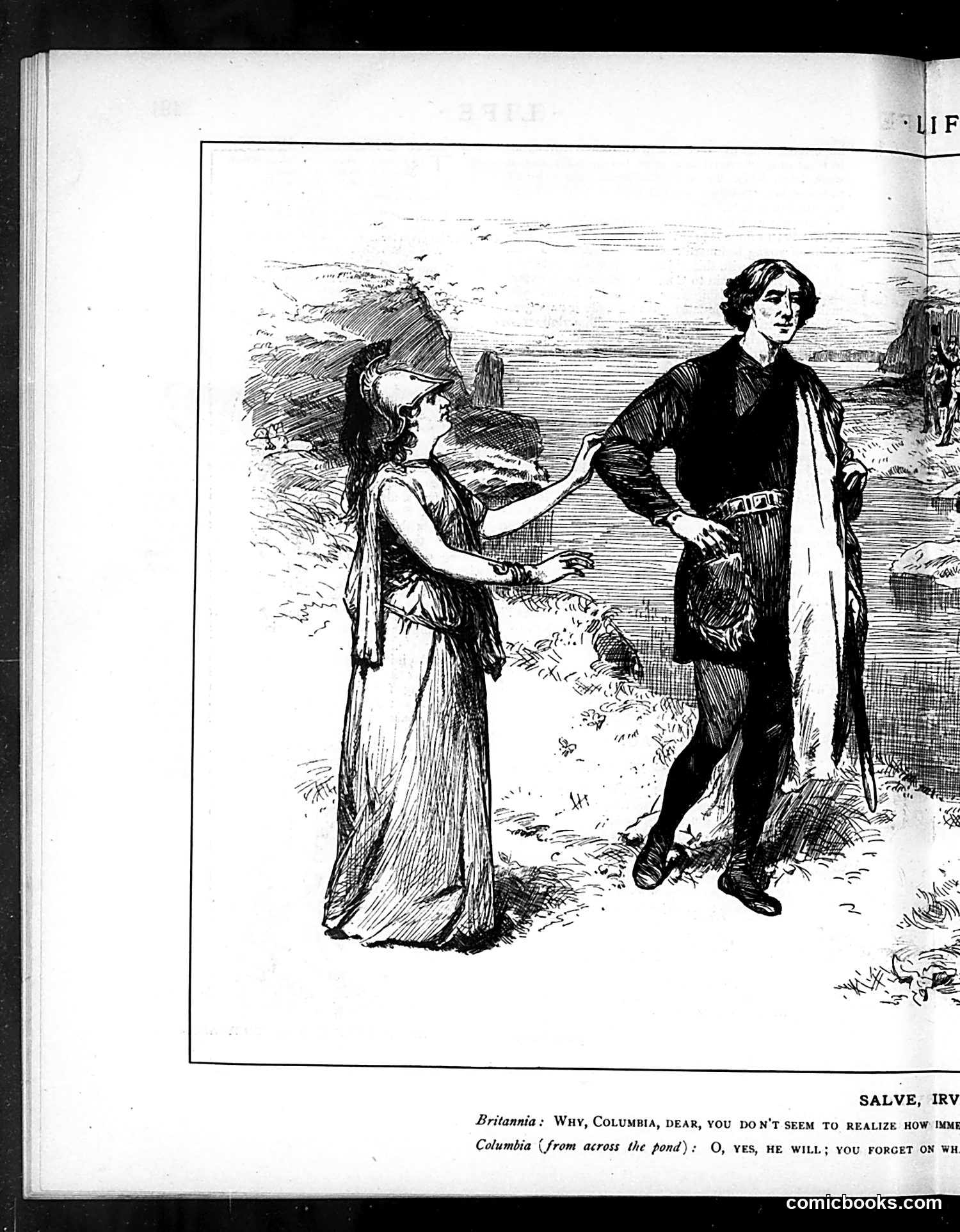
This cartoon depicts **Britannia** (personified Britain, shown in classical dress on the left) addressing a man identified as **Columbia** (personified America, on the right). The dialogue suggests Britannia is warning Columbia about not realizing "how immense" something is, with Columbia responding that "he will" and telling Britannia to "forget on wh[at]." The cartoon appears to satirize Anglo-American relations, likely from the early 20th century. Britannia represents the established British Empire, while Columbia represents American interests. The incomplete OCR text obscures the specific political issue being referenced, but the tone suggests commentary on American underestimation of British power or influence, or possibly disagreement over foreign policy matters between the two nations.
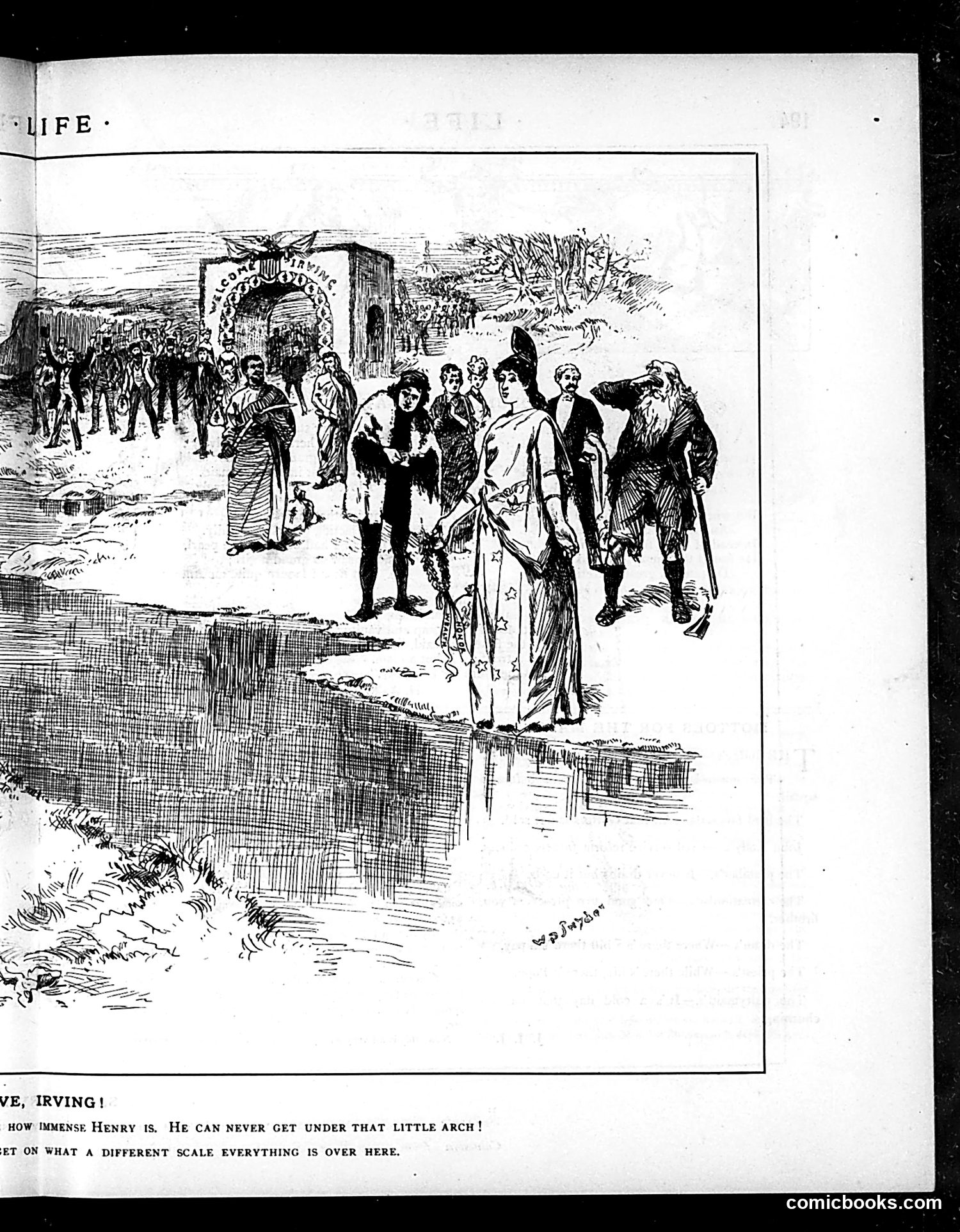
This page from *Life* magazine features a satirical illustration about Henry Irving, a famous British actor. The visible text references "How immense Henry is. He can never get under that little arch!" and comments about everything being "on a different scale." The cartoon depicts Irving as an outsized, towering figure among normal-sized people at what appears to be a historical or architectural site (possibly a castle or fortification entrance). The satire mocks Irving's theatrical grandiosity and ego—suggesting his sense of importance is so inflated that he literally cannot fit through ordinary spaces meant for regular people. This is a visual joke about artistic pretension and celebrity self-importance, using physical scale as metaphor for Irving's outsized theatrical persona and inflated sense of self-worth.
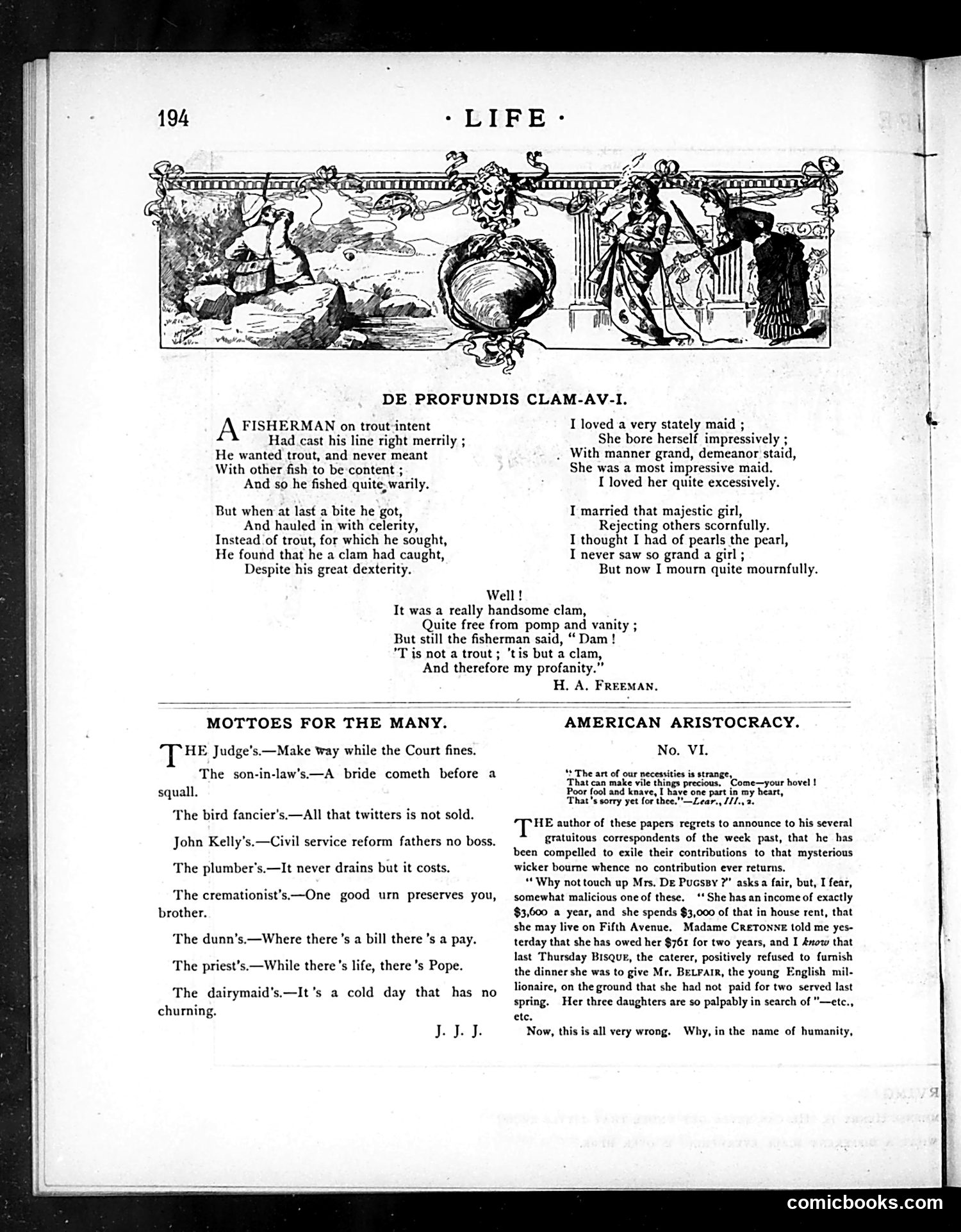
This page contains two satirical pieces from Life magazine: **"De Profundis Clam-Av-I"** is a humorous poem parodying serious Latin literature. A fisherman expecting to catch trout instead catches a clam—a pun on the Latin phrase "de profundis" (from the depths). The poem's title mimics legal/religious formality while mocking disappointed expectations. The secondary poem uses the clam as a metaphor for an unimpressive marriage, where a man married an imposing woman only to regret it. **"Mottoes for the Many"** satirizes various professions through cynical one-liners—judges profit from fines, plumbers charge excessively, priests benefit from death ("While there's life, there's Pope"), etc. These mock corruption and self-interest across social institutions. **"American Aristocracy No. VI"** critiques wealthy New York society women who live beyond their means on Fifth Avenue, spending lavishly on rent while owing tradespeople money and avoiding paying caterers—exposing hypocrisy beneath claims of aristocratic respectability.
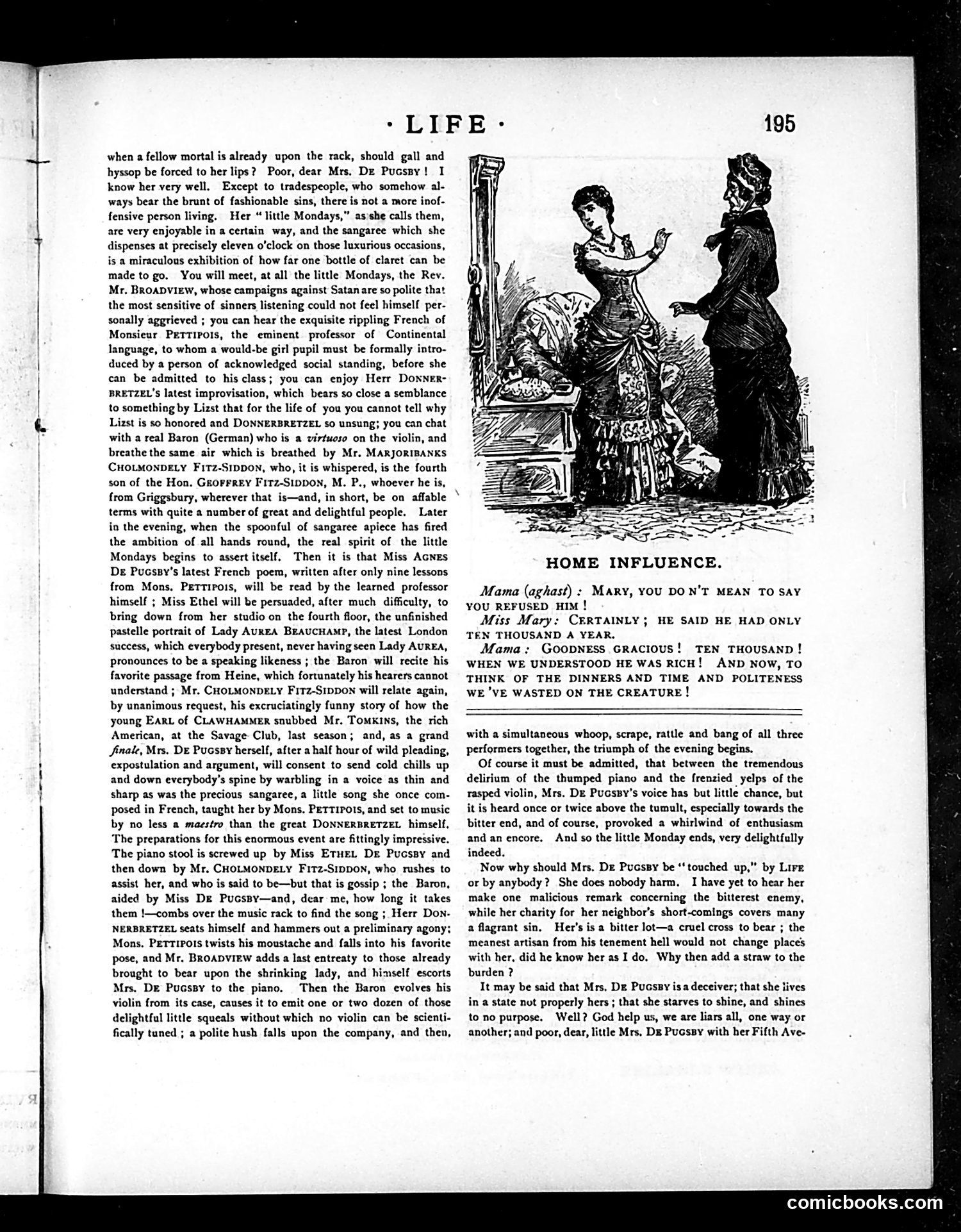
This page satirizes pretentious Victorian salon culture. The illustration shows "Mrs. De Pucsby" hosting her "little Mondays"—gatherings where fashionable but shallow people perform pseudo-intellectual entertainment. The satire targets: **The hostess**: Mrs. De Pucsby, who despite genuine kindness, hosts gatherings that exemplify affected gentility. **The guests**: A parade of dubious cultural authorities—a clergyman with suspiciously polite sermons, a French language professor, a mediocre musician (Herr Donnerbretzel), a "real Baron," and minor aristocrats. All pretend to artistic or social superiority while being fundamentally mediocre. **The entertainment**: Guests endure readings of Mrs. De Pucsby's French poetry (written after only nine lessons), viewing an unfinished portrait, and listening to her thin, unpleasant singing—all presented solemnly as cultural achievement. The joke: refined society is fundamentally ridiculous, sustained by mutual flattery and social desperation. These "delightful people" are merely performing taste rather than possessing it.
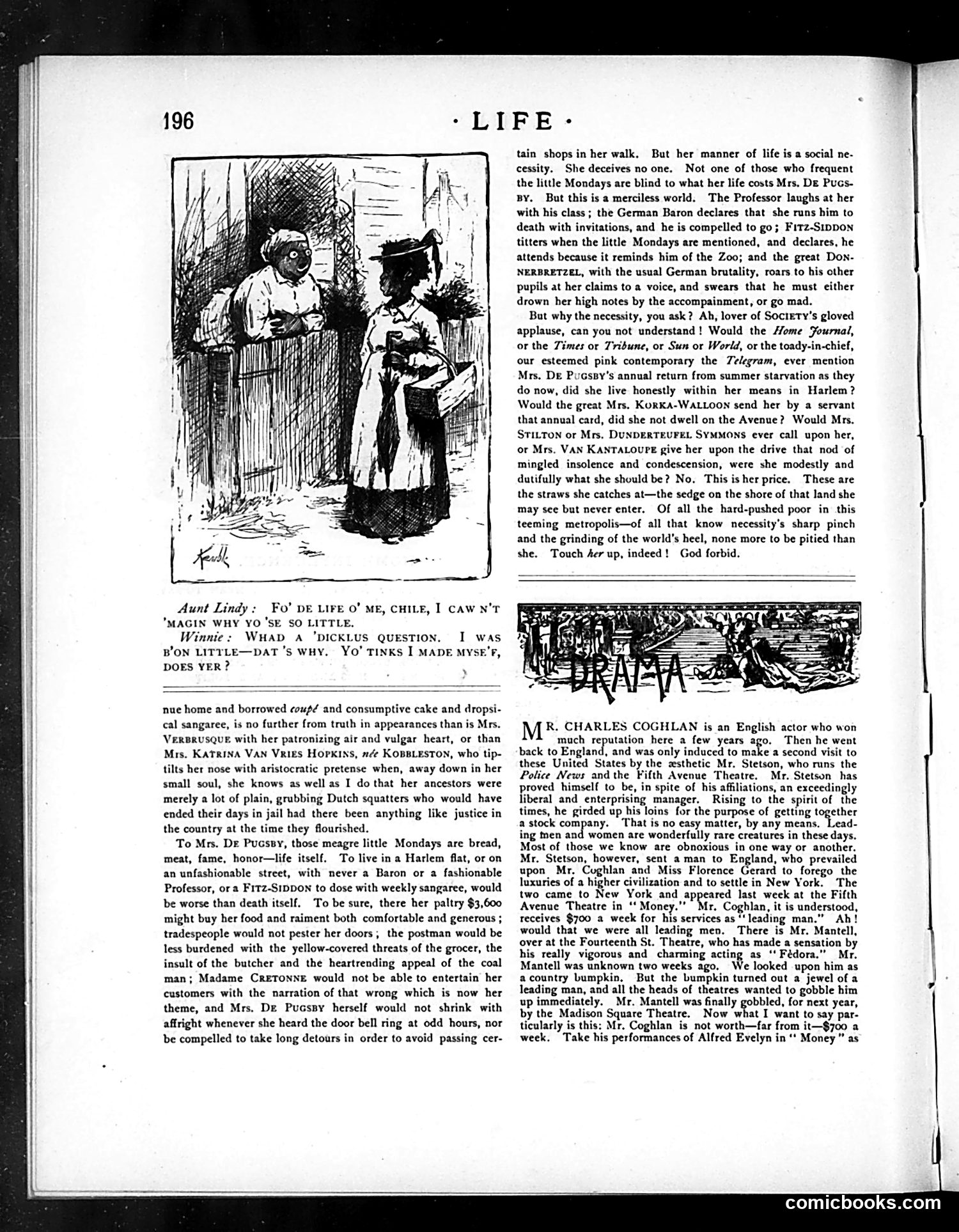
The cartoon depicts "Aunt Lindy" and "Winnie," two Black women in conversation—likely domestic servants discussing their employers' aspirations. The dialogue humorously exposes the absurdity of pretending to be something one isn't born into. The accompanying text critiques "Mrs. De Pucssy," a woman of modest means ($3,600 annually) who maintains an expensive lifestyle in fashionable Manhattan to gain social status. She hosts weekly "little Mondays" salons, borrowing carriages and serving expensive refreshments while avoiding creditors—all to be mentioned in society columns and receive visits from wealthy women. The satire targets the desperation of the aspiring middle class: Mrs. De Pucssy sacrifices financial security purely for social appearance and the hollow "gloved applause" of society. The piece argues she's pitied more than truly poor people, because she experiences both poverty *and* the grinding humiliation of maintaining false respectability. This reflects Gilded Age anxieties about class mobility and the performative nature of social climbing in New York.
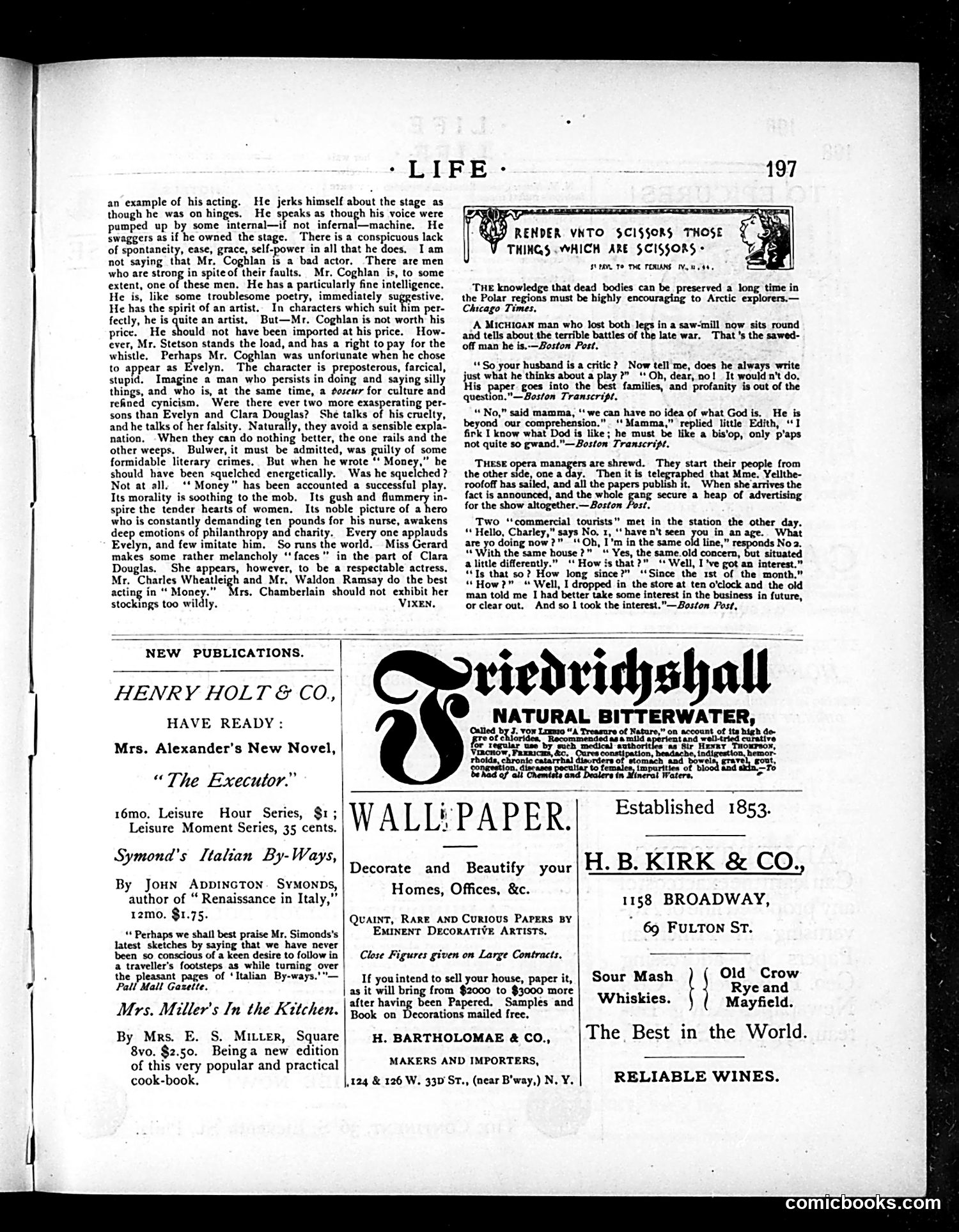
This page contains primarily **theatrical criticism and brief satirical anecdotes** rather than political cartoons. The main content criticizes actor **Charles Coghlan's** performance in the play *"Money,"* claiming he lacks spontaneity and grace despite fine intelligence. The reviewer (signed "Vixen") argues Coghlan was overpaid and that the play itself, while morally soothing to audiences, contains "formidable literary crimes." The page's humor comes from brief, witty jokes about contemporary life: - A Michigan man who lost both legs in a saw-mill now tells war stories (a "sawed-off man") - A critic who cannot write honestly because his paper enters family homes - A child's innocent definition of God as resembling a bishop - Opera companies' publicity tactics for singers The small decorative header with scissors appears to be a visual pun unrelated to the main content. This is primarily a **literary/social commentary page** rather than political satire.
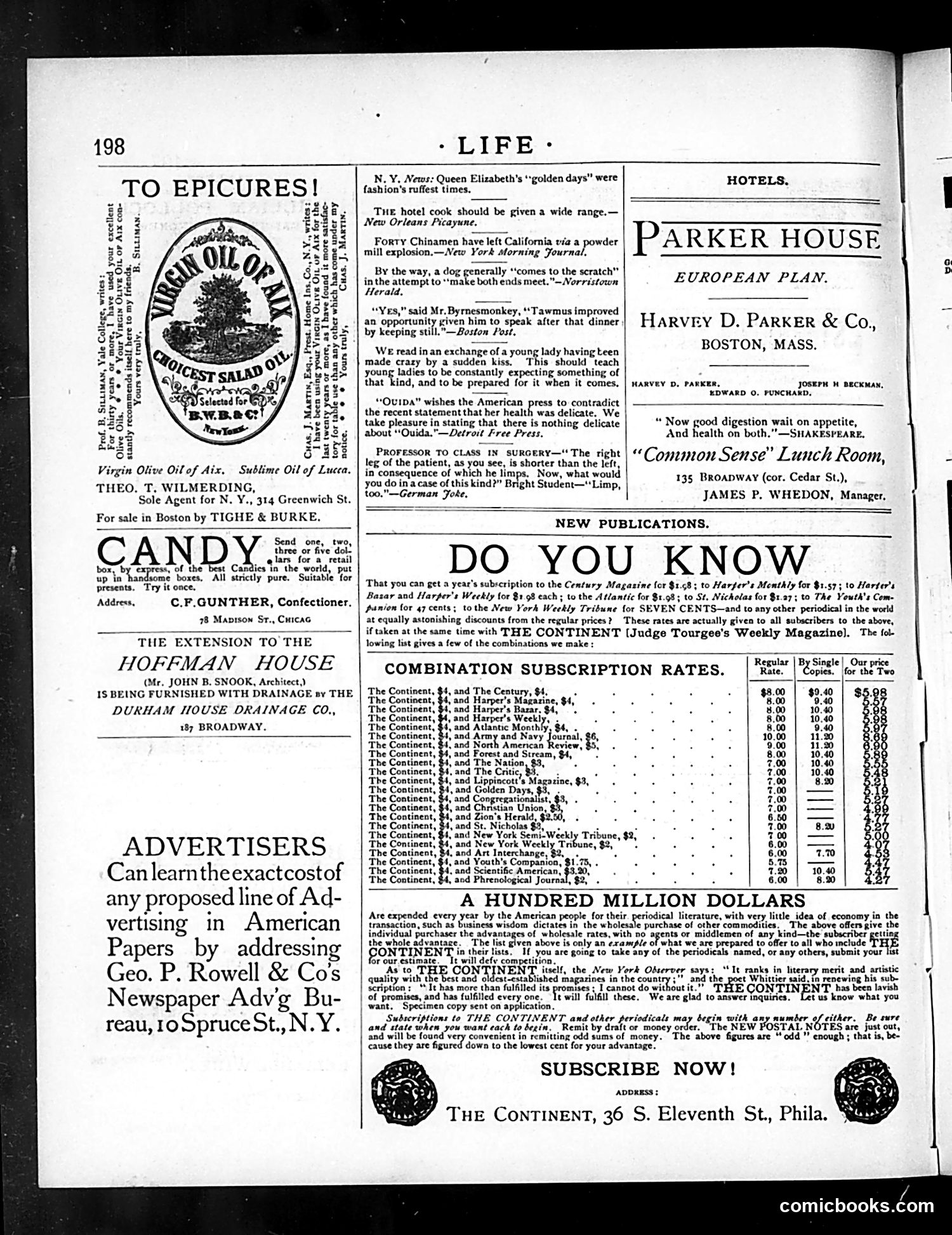
This page is primarily **advertising and magazine subscription promotion**, not political satire. The content consists of: **Main Features:** - Hotel advertisements (Parker House, Boston; Hoffman House extension) - Product ads (Virgin Olive Oil, candy, drainage systems) - A "Common Sense" Lunch Room advertisement - Newspaper advertising bureau promotion **Humorous snippets** appear scattered throughout—brief, unrelated joke items rather than cohesive cartoons. These include absurdist humor: a dog "coming to the scratch" to "make both ends meet"; forty Chinese workers killed in a powder mill explosion treated as a casual news item; a student joking about limping after a surgery lecture. **The primary content** is subscription promotion for *The Continent* magazine, offering bundled rates with other periodicals like *Harper's*, *Century*, and *Atlantic Monthly*. No significant political figures or sustained satirical cartoons are visible. This appears to be a late-19th-century magazine page mixing advertisements with light, disconnected humor rather than editorial commentary.
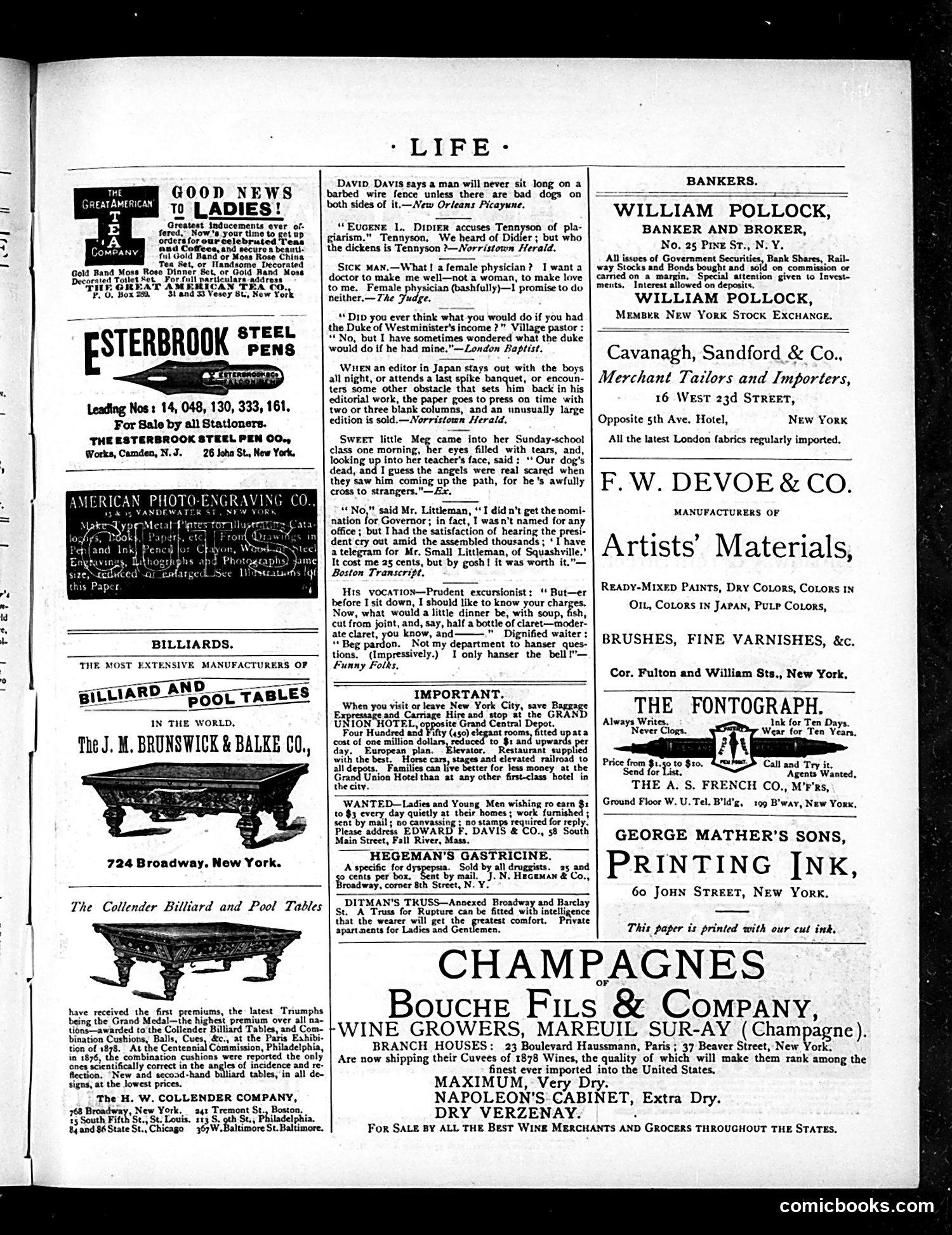
This page is primarily **advertisements and humorous anecdotes** rather than political cartoons. The "Good News to Ladies" section advertises tea and china premiums—a common Victorian marketing tactic offering free decorative items with product purchases. The humor pieces are light social satire typical of the era: - A joke about barbed wire fences mocks rural life - Tennyson plagiarism accusations are literary gossip - A female physician joke reflects period anxieties about women entering medicine - A vicar's comment on wealth pokes mild fun at clergy - Japanese newspaper editing satirizes editorial shortcuts - A child's comment about her dog "scaring angels" is sentimental humor The page also advertises billiard tables, steel pens, and hotels—typical late-19th-century publication content. **No significant political commentary** is present. The satire is gentle, domestic, and focused on character types rather than contemporary events or figures.
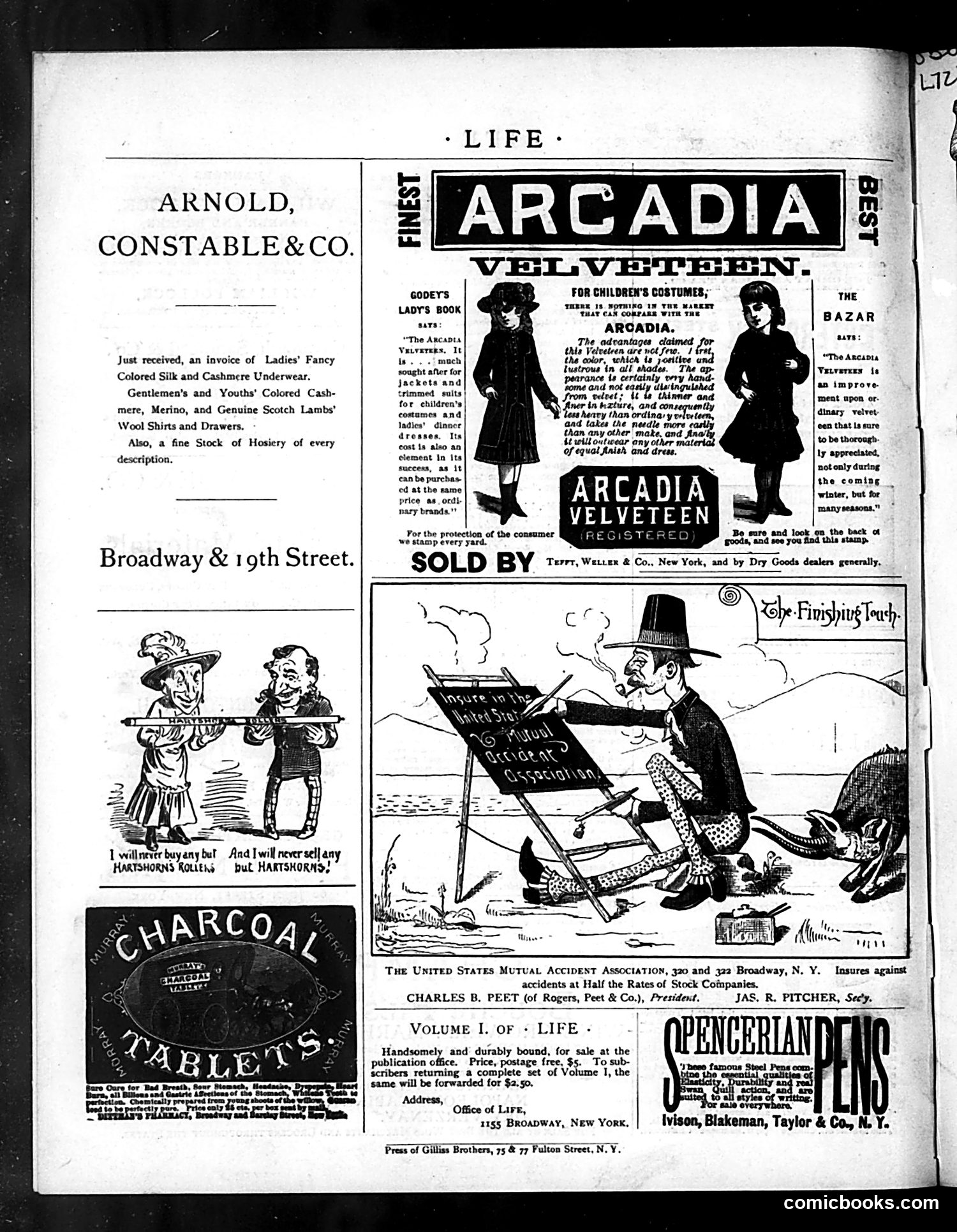
This page is primarily **advertisements and promotional content** rather than satirical cartoons. The main cartoon—"The Finishing Touch"—depicts a man at the beach reading a newspaper labeled "Future Bride of Association," apparently anxious about marital prospects. The joke appears to play on contemporary anxieties about marriage and social standing. Below that, a small comic shows two figures debating hosiery brands—"I will never buy any but HARTSHORNS Rothes" versus "I will never sell any but HARTSHORNS!"—a straightforward advertisement masquerading as humor. The page showcases various **Victorian-era consumer goods**: ladies' undergarments, children's clothing (the "Arcadia Velveteen" fabric), charcoal tablets, and fountain pens. The Arcadia Velveteen section features illustrated children's fashion. The satirical element is minimal; this reads as a typical **late-19th-century magazine mix** of actual advertisements dressed up as editorial content, before modern advertising standards separated the two clearly.