
Life, 1883-10-18 · page 12 of 16
Life — October 18, 1883 — page 12: what you’re looking at
What you’re looking at
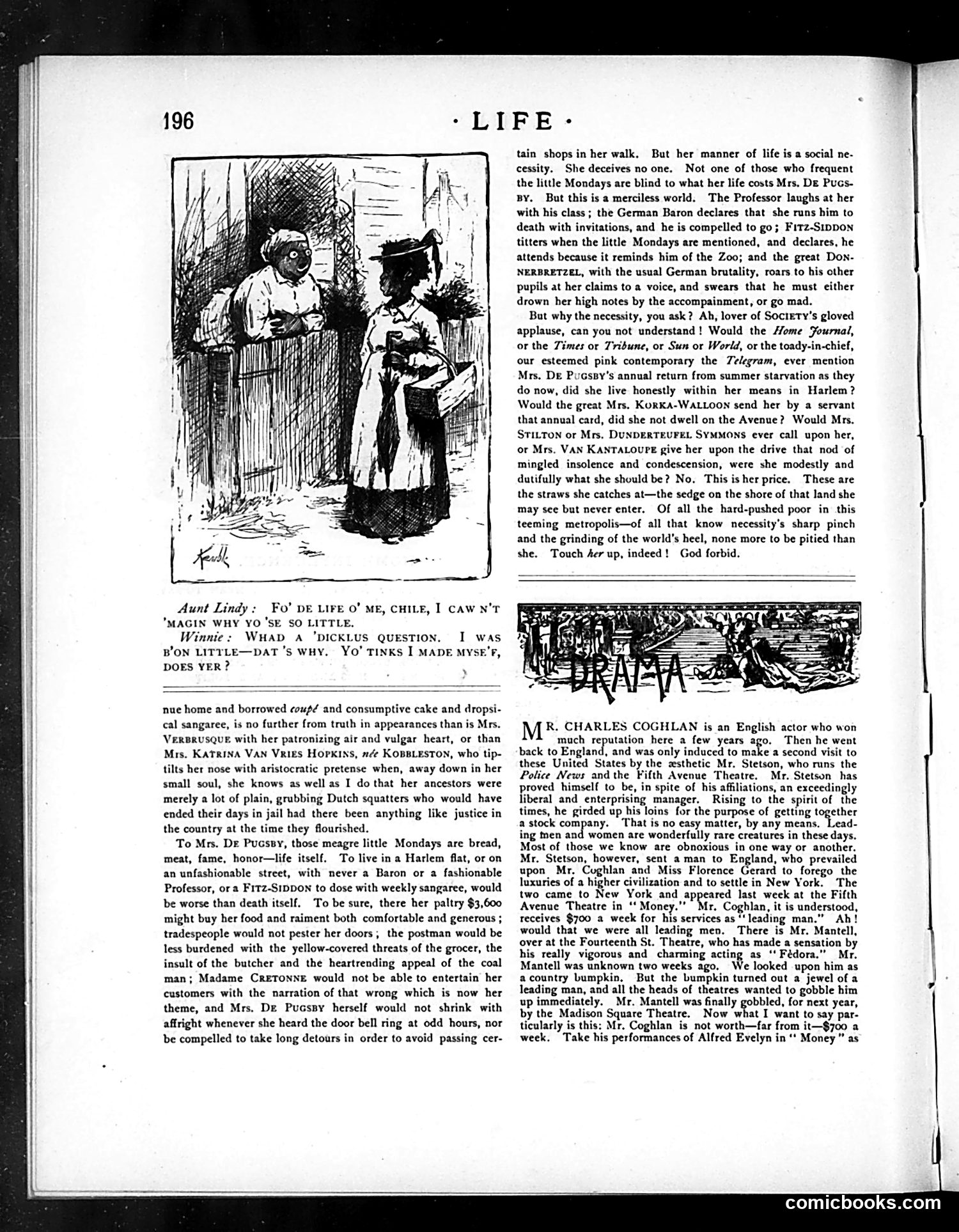
The cartoon depicts "Aunt Lindy" and "Winnie," two Black women in conversation—likely domestic servants discussing their employers' aspirations. The dialogue humorously exposes the absurdity of pretending to be something one isn't born into. The accompanying text critiques "Mrs. De Pucssy," a woman of modest means ($3,600 annually) who maintains an expensive lifestyle in fashionable Manhattan to gain social status. She hosts weekly "little Mondays" salons, borrowing carriages and serving expensive refreshments while avoiding creditors—all to be mentioned in society columns and receive visits from wealthy women. The satire targets the desperation of the aspiring middle class: Mrs. De Pucssy sacrifices financial security purely for social appearance and the hollow "gloved applause" of society. The piece argues she's pitied more than truly poor people, because she experiences both poverty *and* the grinding humiliation of maintaining false respectability. This reflects Gilded Age anxieties about class mobility and the performative nature of social climbing in New York.
📄 Transcribed text from this page (OCR, searchable)
Machine-transcribed from the original scan — historical spelling and the odd misread are preserved.
Aunt Lindy; Fo’ bE LiFe 0° ME, CHILE, I Caw N'T "MAGIN WHY YO 'SE SO LITTLE, Winnie: WHAD A 'DICKLUS QUESTION. I was BON LITTLE—DAT's WHY. Yo' TINKS I MADE MYSE’F, DOES YER? nue home and borrowed coupé and consumptive cake and dropsi- cal sangaree, is no further from truth in appearances than is Mrs. VerprusQue with her patronizing air and vulgar heart, or than Mrs. Katrina VAN Vrigs Hopkins, née Kops.eston, who tip- tilts her nose with aristocratic pretense when, away down in her small soul, she knows as well as I do that her ancestors were merely a lot of plain, grubbing Dutch squatters who would have ended their days in jail had there been anything like justice in the country at the time they flourished. To Mrs. De Pucssy, those meagre little Mondays are bread, meat, fame, honor—life itself. To live in a Harlem flat, or on an unfashionable street, with never a Baron or a fashionable Professor, ora F1Tz-SIDDON to dose with weekly sangaree, would be worse than death itself. To be sure, there her paltry $3,600 might buy her food and raiment both comfortable and generous ; tradespeople would not pester her doors ; the postman would be less burdened with the yellow-covered threats of the grocer, the insult of the butcher and the heartrending appeal of the coal man; Madame CreToNNeE would not be able to entertain her customers with the narration of that wrong which is now her theme, and Mrs, De Pucssy herself would not shrink with affright whenever she heard the door bell ring at odd hours, nor be compelled to take long detours in order to avoid passing cer- - LIFE: tain shops in her walk. But her manner of life is a social ne- cessity. She deceives no one. Not one of those who frequent the little Mondays are blind to what her life costs Mrs. Dz Pucs- By. But this is a merciless world. The Professor laughs at her with his class ; the German Baron declares that she runs him to death with invitations, and he is compelled to go; Fitz-Sippon titters when the little Mondays are mentioned, and declares, he attends because it reminds him of the Zoo; and the great Don- NERBRETZEL, with the usual German brutality, roars to his other pupils at her claims to a voice, and swears that he must either drown her high notes by the accompainment, or go mad. But why the necessity, you ask? Ah, lover of Society's gloved applause, can you not understand! Would the Home Journal, or the 7imes or Tribune, or Sun or World, or the toady-in-chief, our esteemed pink contemporary the Telegram, ever mention Mrs. De Pucssy’s annual return from summer starvation as they do now, did she live honestly within her means in Harlem? Would the great Mrs. KoRKA-WALLOON send her by a servant that annual card, did she not dwell on the Avenue? Would Mrs. STILTON or Mrs. DUNDERTEUFEL SYMMONS ever call upon her, or Mrs. VAN KANTALOUPE give her upon the drive that nod of mingled insolence and condescension, were she modestly and dutifully what she should be? No. This isher price. These are the straws she catches at—the sedge on the shore of that land she may see but never enter. Of all the hard-pushed poor in this teeming metropolis—of all that know necessity's sharp pinch and the grinding of the world’s heel, none more to be pitied than she. Touch Aer up, indeed! God forbid. R. CHARLES COGHLAN is an English actor who won much reputation here a few years ago, Then he went back to England, and was only induced to make a second visit to these United States by the xsthetic Mr. Stetson, who runs the Police News andthe Fifth Avenue Theatre. Mr. Stetson has proved himself to be, in spite of his affiliations, an exceedingly liberal and enterprising manager. Rising to the spirit of the times, he girded up his loins for the purpose of getting together a stock company. That is no easy matter, by any means. Lead- ing men and women are wonderfully rare creatures in these days. Most of those we know are obnoxious in one way or another. Mr. Stetson, however, sent aman to England, who prevailed upon Mr, Coghlan and Miss Florence Gerard to forego the luxuries of a higher civilization and to settle in New York. The two came to New York and appeared last week at the Fifth Avenue Theatre in ‘‘ Money.” Mr, Coghlan, it is understood, receives $700 a week for his services as ‘‘leading man.” Ah! would that we were all leading men. There is Mr. Mantell, over at the Fourteenth St. Theatre, who has made a sensation by his really vigorous and charming acting as ‘‘Fédora.” Mr. Mantell was unknown two weeks ago, We looked upon him as acountry bumpkin, But the bumpkin turned out a jewel of a leading man, and all the heads of theatres wanted to gobble him up immediately. Mr. Mantell was finally gobbled, for next year, by the Madison Square Theatre. Now what I want to say par- ticularly is this: Mr. Coghlan is not worth—far from it—$700 a week, Take his performances of Alfred Evelyn in ‘* Money” as x comicbooks.com