
Life, 1883-10-18 · page 6 of 16
Life — October 18, 1883 — page 6: what you’re looking at
What you’re looking at
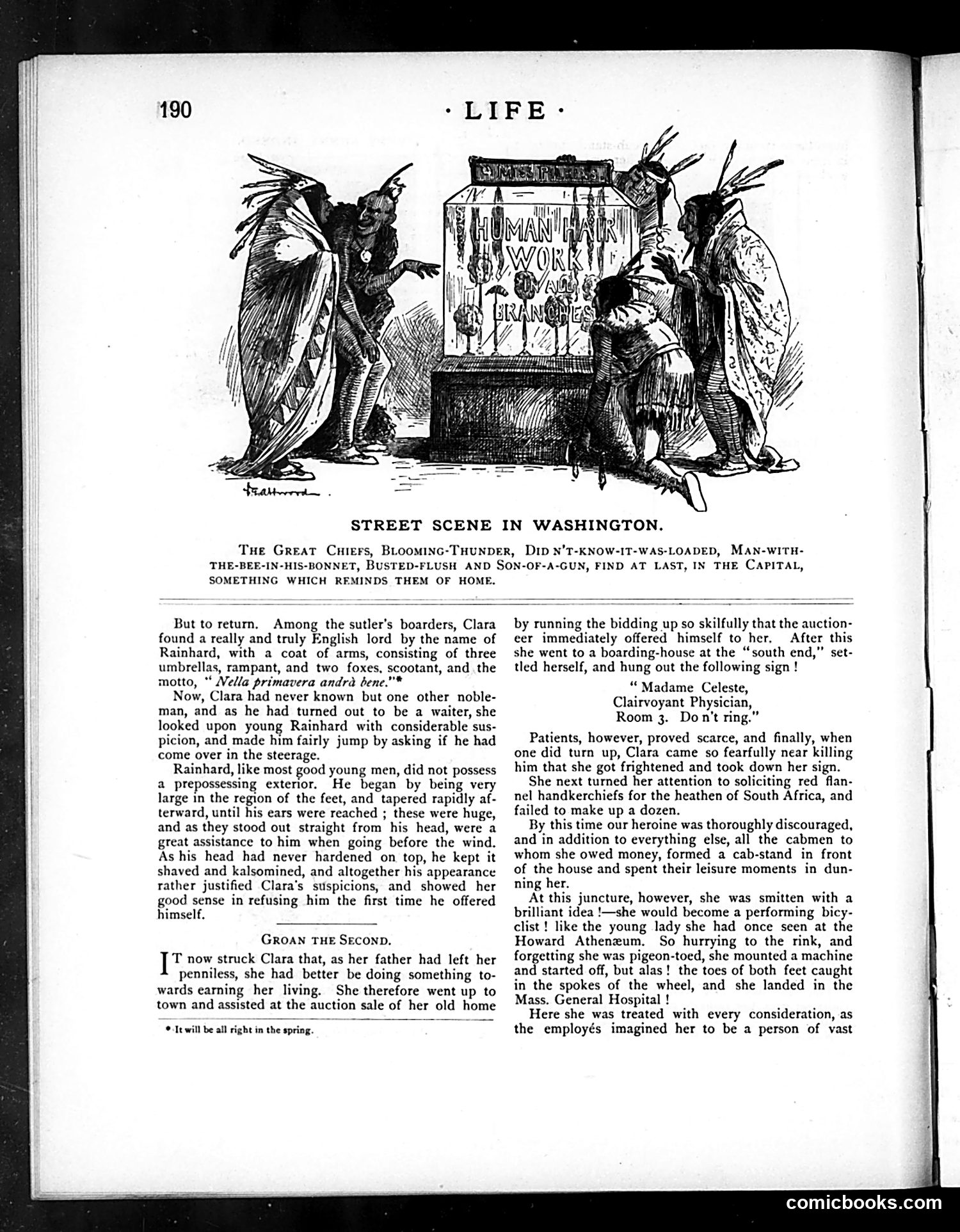
The cartoon titled "Street Scene in Washington" depicts Native American figures (identified by headdresses and traditional dress) examining a sign reading "Human Hair Work and Branches." The caption identifies them humorously as "The Great Chiefs, Blooming-Thunder, Did'n't-know-it-was-loaded, Man-with-the-bee-in-his-bonnet, Busted-flush and Son-of-a-gun." This is 19th-century satirical commentary on Washington D.C. politics, likely mocking contemporary politicians or political factions through the device of Native Americans "discovering" human hair work—suggesting these politicians' schemes were absurd or trivial. The satire uses caricatured Indigenous figures as a vehicle for political ridicule, typical of period humor, though by modern standards such depictions are considered offensive and stereotypical.
📄 Transcribed text from this page (OCR, searchable)
Machine-transcribed from the original scan — historical spelling and the odd misread are preserved.
STREET SCENE IN WASHINGTON. Tue Great Cuters, BLooMING-THUNDER, DID N’T-KNOW-IT-WAS-LOADED, MAN-WITH- THE-BEE-IN-HIS-BONNET, BUSTED-FLUSH AND SON-OF-A-GUN, FIND AT LAST, IN THE CAPITAL, SOMETHING WHICH REMINDS THEM OF HOME. But to return. Among the sutler’s boarders, Clara found a really and truly English lord by the name of Rainhard, with a coat of arms, consisting of three umbrellas, rampant, and two foxes, scootant, and the motto, “ Nella primavera andra bene.”* Now, Clara had never known but one other noble- man, and as he had turned out to be a waiter, she looked upon young Rainhard with considerable sus- picion, and made him fairly jump by asking if he had come over in the steerage. Rainhard, like most good young men, did not possess a prepossessing exterior. He began by being very large in the region of the feet, and tapered rapidly af- terward, until his ears were reached ; these were huge, and as they stood out straight from his head, were a great assistance to him when going before the wind. As his head had never hardened on top, he kept it shaved and kalsomined, and altogether his appearance rather justified Clara's suspicions, and showed her good sense in refusing him the first time he offered himself. GROAN THE SECOND. T now struck Clara that, as her father had left her penniless, she had better be doing something to- wards earning her living. She therefore went up to town and assisted at the auction sale of her old home *-Lewill be all right in the spring. by running the bidding up so skilfully that the auction- eer immediately offered himself to her. After this she went to a boarding-house at the “south end,” set- tled herself, and hung out the following sign ! “Madame Celeste, Clairvoyant Physician, Room 3. Don't ring.” Patients, however, proved scarce, and finally, when one did turn up, Clara came so fearfully near killing him that she got frightened and took down her sign. She next turned her attention to soliciting red flan- nel handkerchiefs for the heathen of South Africa, and failed to make up a dozen. By this time our heroine was thoroughly discouraged, and in addition to everything else, all the cabmen to whom she owed money, formed a cab-stand in front of the house and spent their leisure moments in dun- ning her. At this juncture, however, she was smitten with a brilliant idea !—she would become a performing bicy- clist ! like the young lady she had once seen at the Howard Atheneum. So hurrying to the rink, and forgetting she was pigeon-toed, she mounted a machine and started off, but alas! the toes of both feet caught in the spokes of the wheel, and she landed in the Mass. General Hospital ! Here she was treated with every consideration, as the employés imagined her to be a person of vast comicbooks.com