
Life, 1883-10-18 · page 7 of 16
Life — October 18, 1883 — page 7: what you’re looking at
What you’re looking at
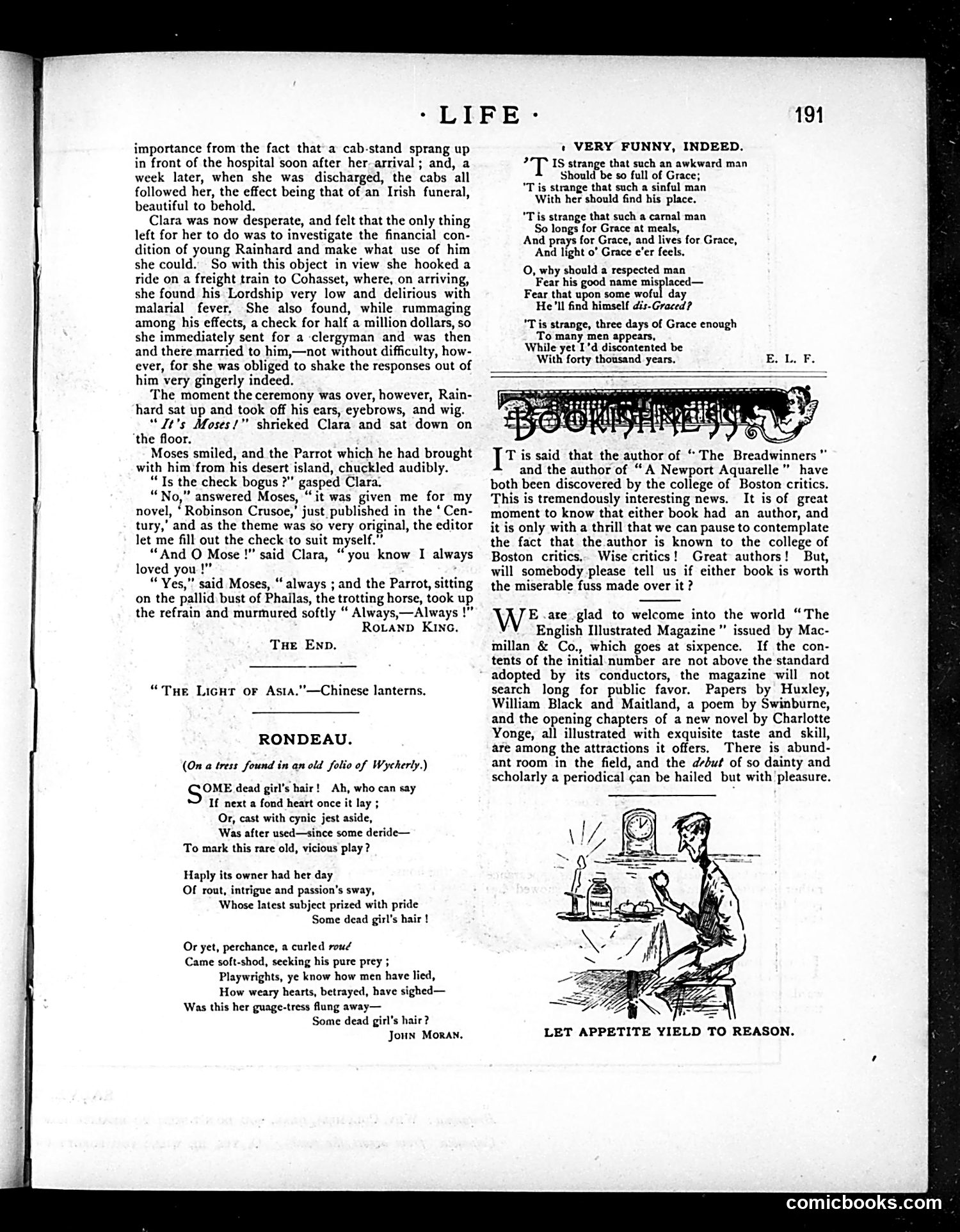
The page contains two distinct items: **"Very Funny, Indeed"** (top right): A poem by E.L.F. mocking a "respectable man" obsessed with "Grace" — appearing to satirize either romantic obsession or possibly a social climber's fixation on status/propriety. The humor relies on the absurdity of his devotion. **"Rondeau"** (bottom left): A poem by John Moran about "some dead girl's hair," exploring themes of vanity, loss, and the fleeting nature of beauty and pride. It's a melancholic meditation rather than satire. **Cartoon** (right side): Shows a man and woman at a table with food and wine, captioned "Let Appetite Yield to Reason." This appears to be a straightforward moral lesson about self-restraint during dining — likely advocating moderation over gluttony, a common Victorian-era message. No specific political figures or current events are clearly referenced on this page.
📄 Transcribed text from this page (OCR, searchable)
Machine-transcribed from the original scan — historical spelling and the odd misread are preserved.
LIFE importance from the fact thata cab-stand sprang up in front of the hospital soon after her arrival ; and, a week later, when she was discharged, the cabs ‘all followed her, the effect being that of an Irish funeral, beautiful to behold. Clara was now desperate, and felt that the only thing left for her to do was to investigate the financial con- dition of young Rainhard and make what use of him she could. So with this object in view she hooked a ride on a freight train to Cohasset, where, on arriving, she found his Lordship very low and delirious with malarial fever, She also found, while rummaging among his effects, a check for half a million dollars, so she immediately sent for a clergyman and was then and there married to him,—not without difficulty, how- ever, for she was obliged to shake the responses out of him very gingerly indeed. The moment the ceremony was over, however, Rain- hard sat up and took off his ears, eyebrows, and wig. “It’s Moses!” shrieked Clara and sat down on the floor. Moses smiled, and the Parrot which he had brought with him from his desert island, chuckled audibly. “Ts the check bogus ?” gasped Clara. “No,” answered Moses, “it was given me for my novel, ‘ Robinson Crusoe,’ just published in the ‘ Cen- tury,’ and as the theme was so very original, the editor let me fill out the check to suit myself.” “And O Mose !” said Clara, “you know I always loved you!” “Yes,” said Moses, “ always ; and the Parrot, sitting on the pallid: bust of Phailas, the trotting horse, took up the refrain and murmured softly “ Always,—Always !" Rotanp Kino. Tue Enp. “Tue Licut oF Asta."—Chinese lanterns, RONDEAU. (On a tress found in an old folio of Wyckerly.) SOME dead girl’s hair! Ah, who can say If next a fond heart once it lay ; Or, cast with cynic jest aside, Was after used—since some deride— To mark this rare old, vicious play? Haply its owner had her day Of rout, intrigue and passion’s sway, Whose latest subject prized with pride Some dead girl's hair ! Or yet, perchance, a curled roué Came soft-shod, seeking his pure prey ; Playwrights, ye know how men have lied, How weary hearts, betrayed, have sighed— Was this her guage-tress flung away— Some dead girl's hair? Joun Moran. « VERY FUNNY, INDEED. 2a]k IS strange that such an awkward man Should be so full of Grace; ‘T is strange that such a sinful man With her should find his place. 'T is strange that such a carnal man So longs for Grace at meals, And prays for Grace, and lives for Grace, And light o’ Grace e’er feels. O, why should a respected man Fear his good name misplaced— Fear that upon some woful da; He'll find himself dis-Graced? "Tis strange, three days of Grace enough To many men appears, While yet I'd discontented be With forty thousand years, T is said that the author of “ The Breadwinners ” and the author of “A Newport Aquarelle” have both been discovered by the college of Boston critics. This is tremendously interesting news. It is of great moment to know that either book had an author, and it is only with a thrill that we can pause to contemplate the fact that the.author is known to the college of Boston critics, Wise critics! Great authors! But, will somebody please tell us if either book is worth the miserable fuss made over it ? WE are glad to welcome into the world “The English Illustrated Magazine * issued by Mac- millan & Co., which goes at sixpence. If the con- tents of the initial number are not above the standard adopted by its conductors, the magazine will not search long for public favor. Papers by Huxley, William Black and Maitland, a poem by Swinburne, and the opening chapters of a new novel by Charlotte Yonge, all illustrated with exquisite taste and skill, are among the attractions it offers. There is abund- ant room in the field, and the dedut of so dainty and scholarly a periodical ¢an be hailed but with pleasure. LET APPETITE YIELD TO REASON. comicbooks.com