
A complete issue · 16 pages · 1883
Life — September 20, 1883
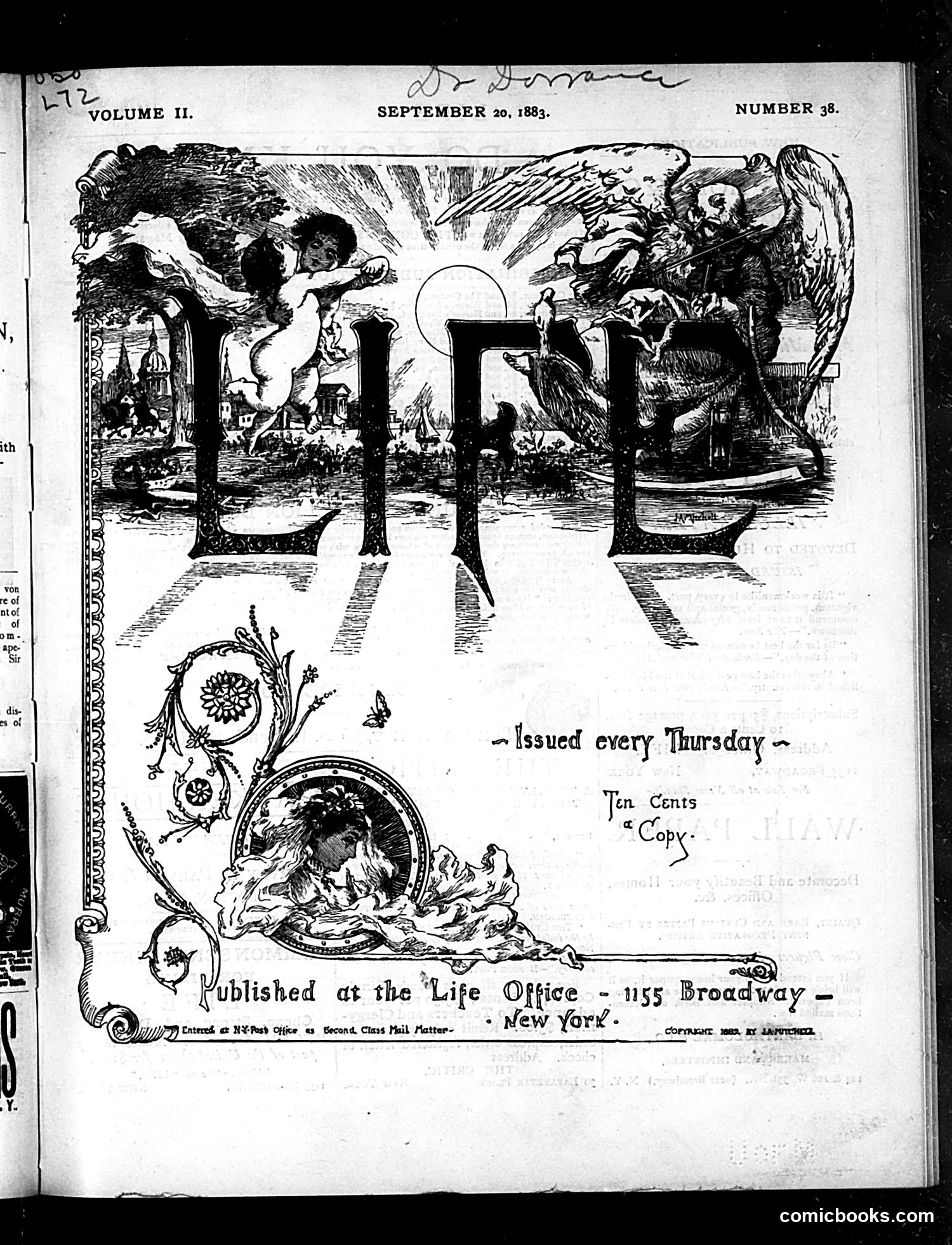
This is the cover of Life magazine's issue from September 20, 1883 (Volume II, Number 38). The large decorative letters "LIFE" dominate the center, framed by an elaborate allegorical illustration featuring cherubs, classical figures, and a cityscape with a sun in the background. The ornamental design includes pastoral and mythological elements typical of 1880s aesthetic design. Below appears a profile portrait medallion, also decorated with classical motifs. The publication information indicates it was issued weekly on Thursdays for ten cents per copy, published at the Life Office at 1155 Broadway, New York. The specific satirical content or political commentary of this particular issue is not clearly legible in the OCR text provided.
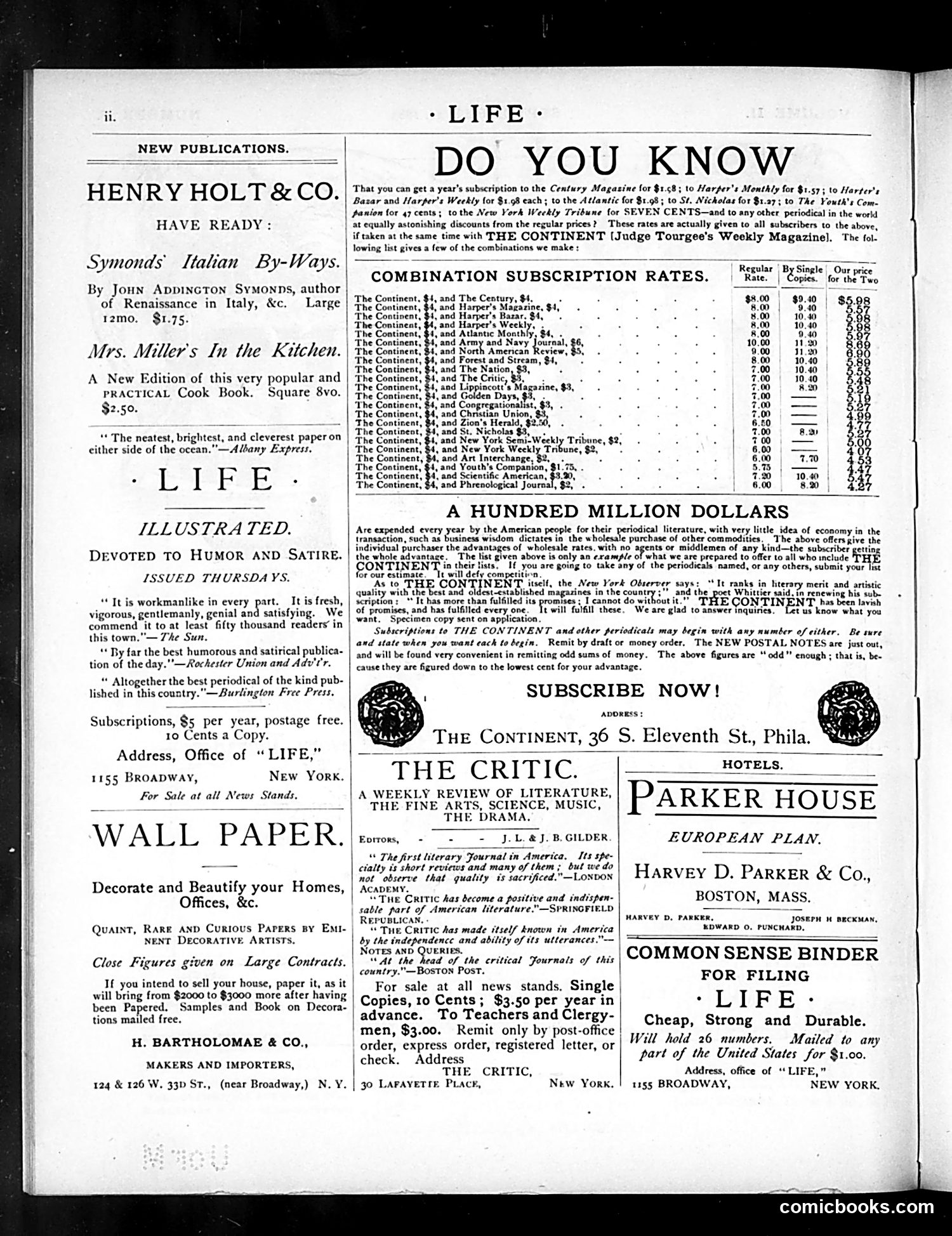
This page is primarily **advertising and editorial content** rather than political cartoons. The layout features: - **Book advertisements** (Symonds' *Italian By-Ways*, *Mrs. Miller's In the Kitchen*) - **Magazine subscription offers** for *Life*, *The Critic*, and other periodicals - **Wallpaper and home decoration ads** - **Hotel advertisement** (Parker House, Boston) The page includes a subscription rates table and promotional copy for *Life* magazine itself, describing it as "the best humorous and satirical publication of the day." There are **no identifiable political cartoons or caricatures** visible on this page. It functions as a typical late 19th/early 20th-century magazine back page mixing classified advertisements with publisher promotions, rather than satirical content requiring historical context to interpret.
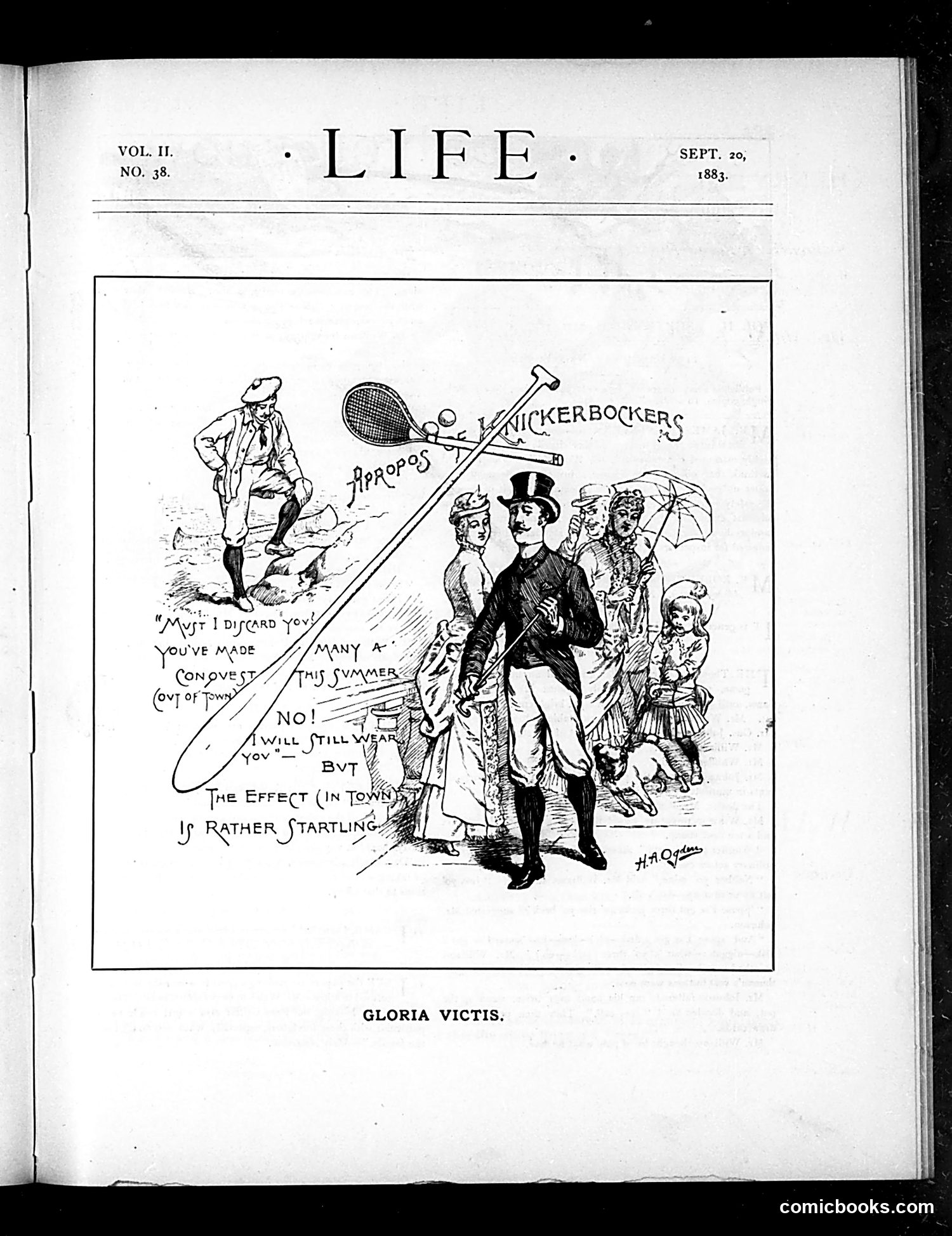
This 1883 *Life* magazine cartoon satirizes a gentleman's fashion dilemma. A man in top hat tells a woman he must discard her—he's made "the conquest out of you" this summer. However, he insists: "No! I will still wear you—but the effect (in town) is rather startling." The joke targets "Nickerbocker" knickerbockers (baggy knee-breeches), labeled atop with a tennis racket. The man fears wearing these fashionable summer sportswear items in the city will make him look ridiculous, despite their social success during the season. This mocks Victorian era anxieties about class status and fashion appropriateness—summer sporting attire was acceptable in resort settings but considered undignified for urban society.
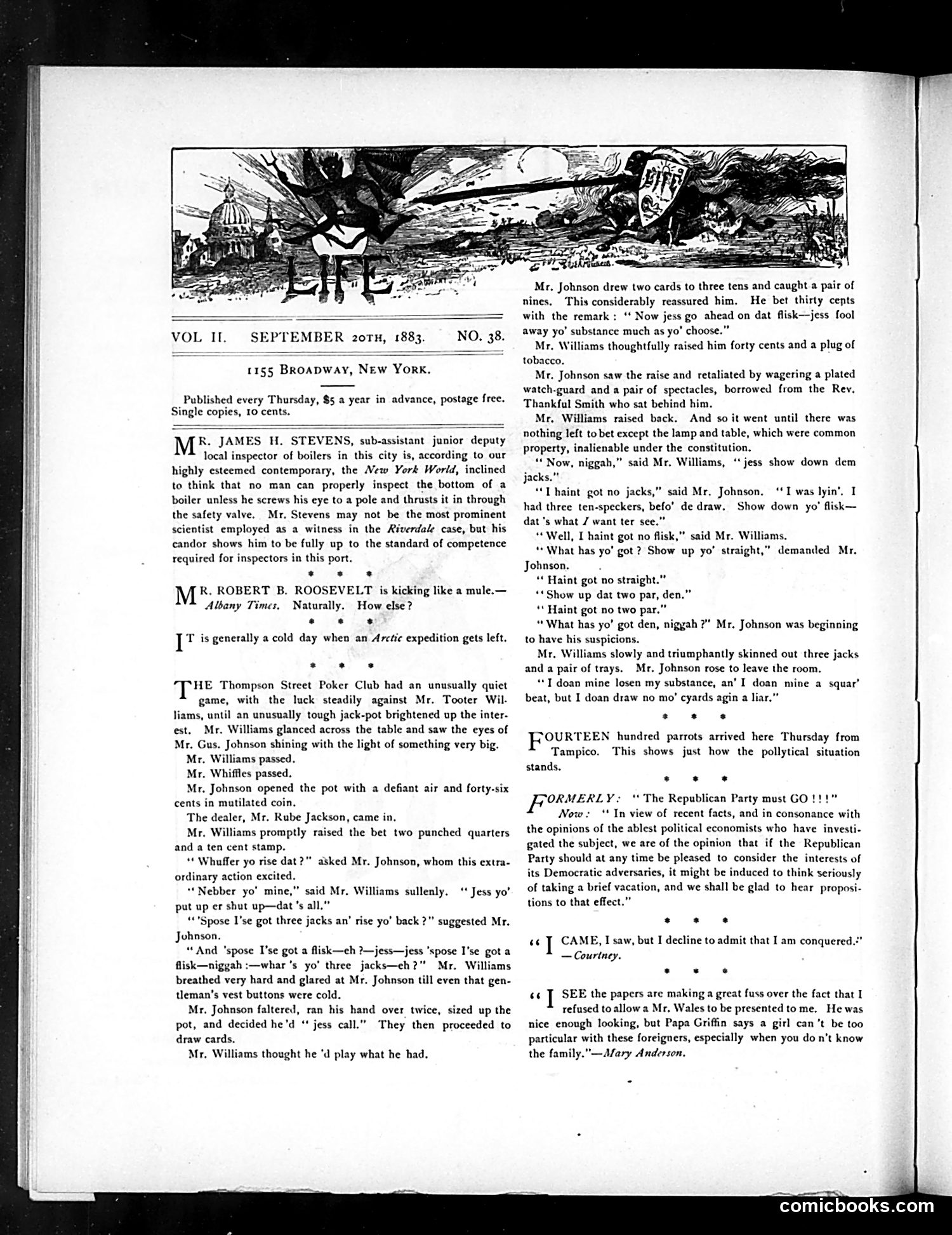
The page contains a satirical story about a poker game at the Thompson Street Poker Club. The narrative describes a game between Mr. Williams and Mr. Johnson that escalates into heated wagering and accusations of cheating. Johnson draws cards and claims victory, while Williams raises the stakes progressively. The dialogue captures period-appropriate dialect and slang ("jess," "niggah"), reflecting 1880s vernacular. The satire appears to mock lower-class gambling culture and the social dynamics of card games—specifically the suspicions, bluffing, and escalating conflicts that emerge during play. The accompanying illustration at the page's top depicts an urban scene, likely referencing the Thompson Street location. The text is primarily humorous social commentary rather than political satire.
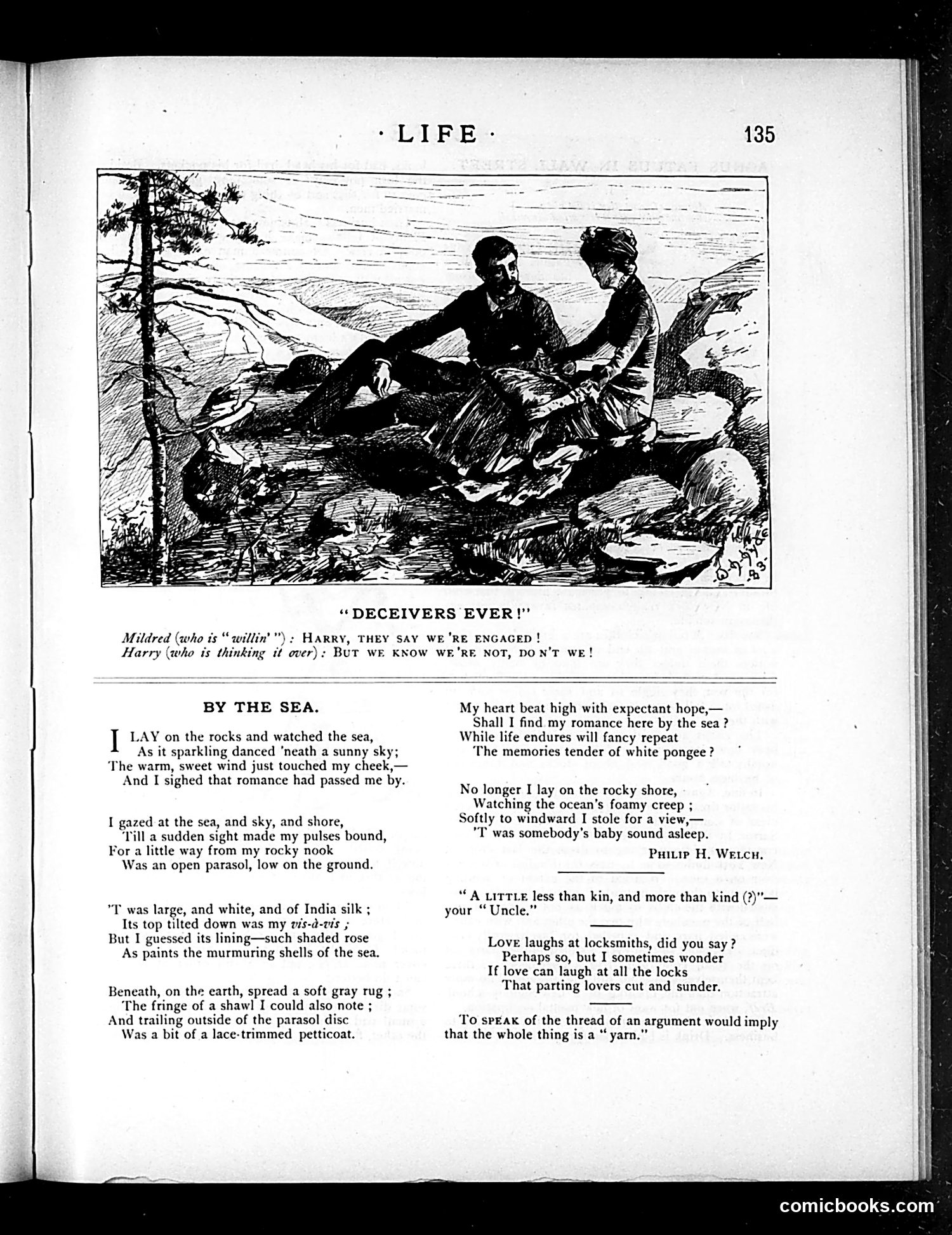
The illustration titled "Deceivers Ever!" depicts a couple on a romantic seaside setting. The caption presents dialogue between Mildred and Harry about their engagement status—Mildred claims they're engaged while Harry insists they're not. This appears to be satirizing romantic misunderstandings or deception between courtship partners, a common comedic theme in early 20th-century magazines. The remainder of the page consists of poetry titled "By the Sea" by Philip H. Welch, along with brief literary quotations and aphorisms about love and relationships. The magazine appears to blend visual satire with literary content, reflecting Life's tradition of mixing humor, social commentary, and cultural pieces. The specific engagement disagreement likely resonated with contemporary readers familiar with courtship conventions and romantic miscommunication.
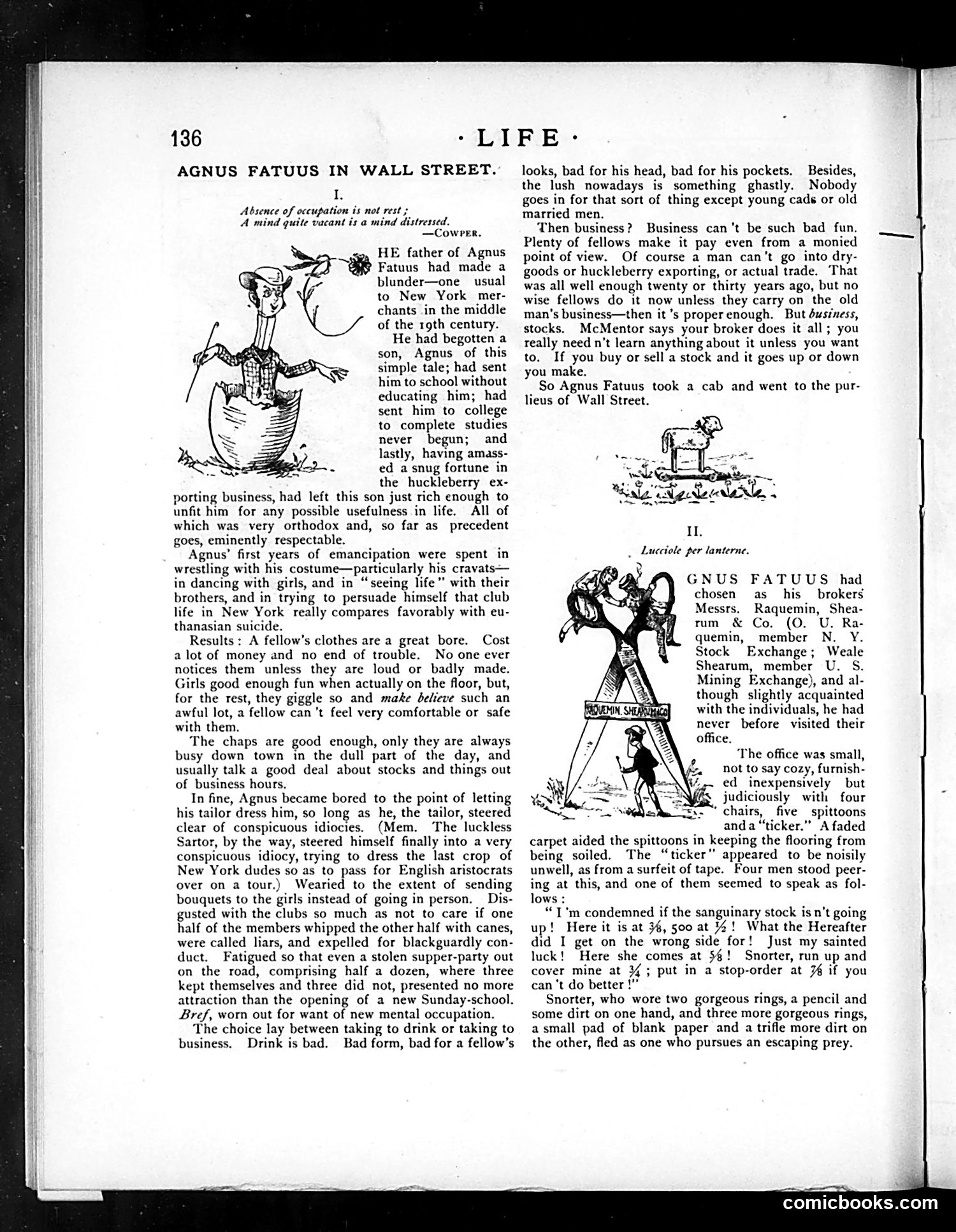
This satirical piece mocks a wealthy but foolish financier named Agnus Fatuus (Latin for "foolish lamb"). The cartoon illustrates his absurd lifestyle: dressed in an oversized suit, he appears comically out of place on Wall Street despite his fortune from the huckleberry export business. The satire targets several vices: his ostentatious clothing that makes him "loud or noticeable," his reliance on expensive brokers (Raquemin, Shearum & Co.), and his frivolous spending on fancy rings and office décor. The text suggests he lacks genuine business acumen—he merely inherited wealth without understanding stocks or commerce. The joke reflects late-19th/early-20th-century anxieties about nouveau riche businessmen whose money outpaces their education or taste.
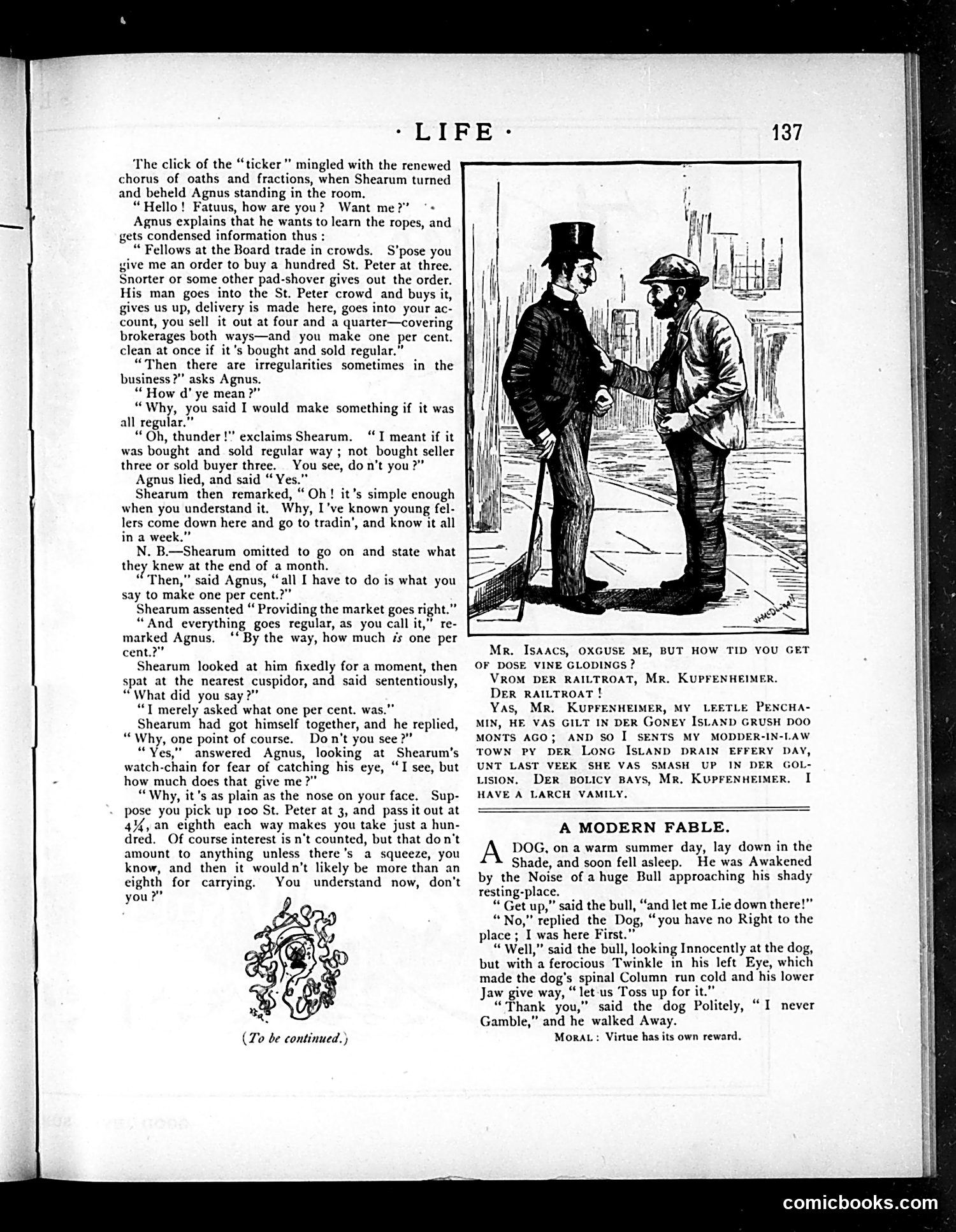
**Main Cartoon:** The illustration depicts two men in top hats having a street conversation. Based on the caption below—referencing "Mr. Isaacs," "Kuppernheimer," a railboat, and mention of "der Long Island"—this appears to satirize German-American immigrant business dealings, likely from the early 20th century. The dialogue discusses stock market transactions and one-percent commissions in ways suggesting either financial manipulation or immigrant entrepreneurship being mocked. **"A Modern Fable":** Below is a short moral tale about a dog and bull disputing territory, concluding with "Virtue has its own reward"—a cynical joke implying virtue provides only hollow satisfaction, not practical benefit. The page reflects period attitudes toward immigrant business practices and American capitalism.
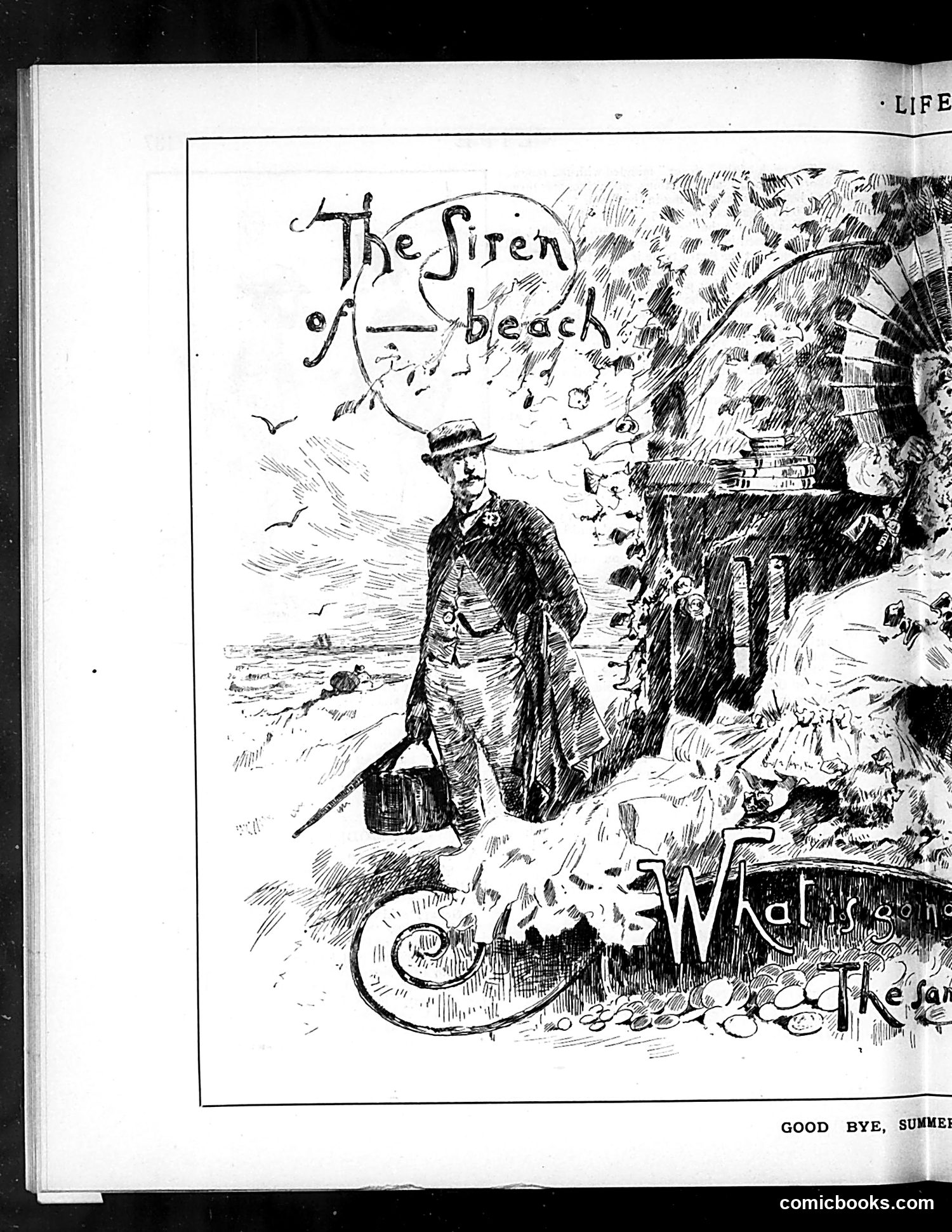
This appears to be a satirical illustration from *Life* magazine showing a well-dressed man at a seaside resort during summer. The man, carrying a bucket and appearing somewhat bemused, stands before a large siren figure emerging from the ocean—representing the mythological temptress. The satire likely mocks the allure of beach vacations and seaside resorts as irresistible temptations for wealthy urbanites. The "siren" metaphor suggests these vacation destinations lure men away from their regular lives with promises of leisure and escape, much like the mythological sirens lured sailors to their doom. The phrase "Good bye, Summer" at the bottom suggests this depicts the reluctant end of the vacation season. The cartoon satirizes both the seductive appeal of resort culture and perhaps the foolishness of surrendering to such temptations.
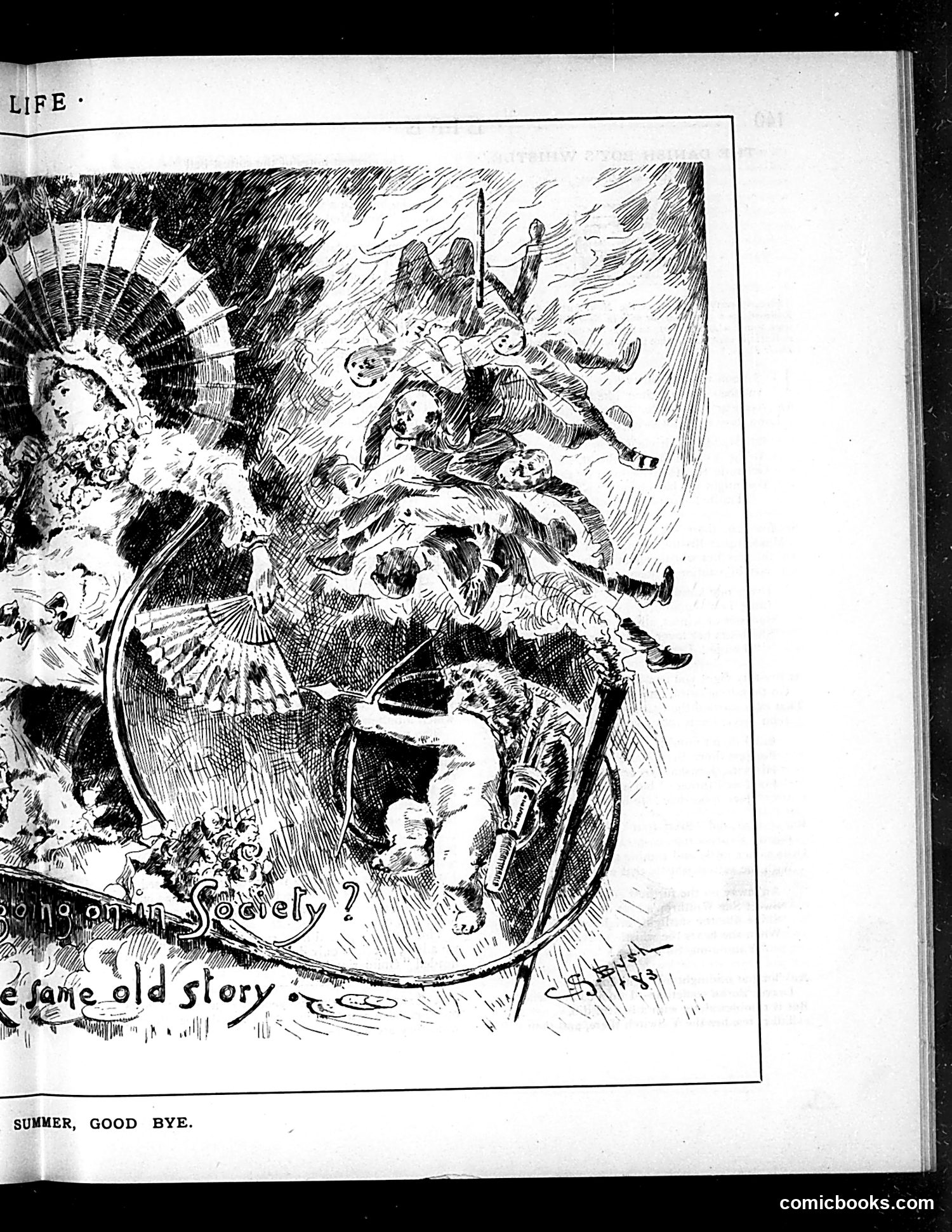
This page contains a single satirical illustration titled "Summer, Good Bye" showing allegorical figures in a chaotic scene. The composition depicts what appears to be personified seasons or summer activities being expelled or departing—likely representing the end of summer social season. The ornate, detailed engraving style depicts elaborately dressed figures in period costume (appearing late 19th century based on the artistic technique) engaged in a swirling, dramatic composition. The "same old story" caption suggests the cartoon comments on recurring seasonal or social patterns. Without additional context about the specific Life issue date or contemporary events, the precise satirical targets remain unclear, though the work appears to mock fashionable society's seasonal rituals and the predictable nature of social calendar transitions.
This page contains two distinct pieces: a humorous poem and a critical note. **"The Danish Boy's Whistle"** (by Robert J. Burdette) is a poem about railroad engineers in New Britain, Connecticut who whistle train signals as romantic communication with their sweethearts. The setup notes that authorities stopped the practice because the noise had become unbearably loud. The poem celebrates this courting custom through multiple vignettes—each engineer whistles a distinctive pattern to reach a specific woman (Gertrude, Little Lou, Jerusha, Sue Winthrop, and Lulu Gray). It's sentimental humor about working-class romance, poking gentle fun at both the engineers' creativity and the disapproving "old folk" who find the noise objectionable. **"That Greek Play"** is a sharp, critical note attacking someone identified as a "pseudo-Harvard man" (possibly "Miss Norman") for a controversial work called a "Greek Play" and related magazine article. The critique suggests this person plagiarized from classical sources ("White flower of Greece") and made shocking personal revelations involving deceased individuals. The tone is biting social satire about literary pretension and scandal-mongering in intellectual circles.
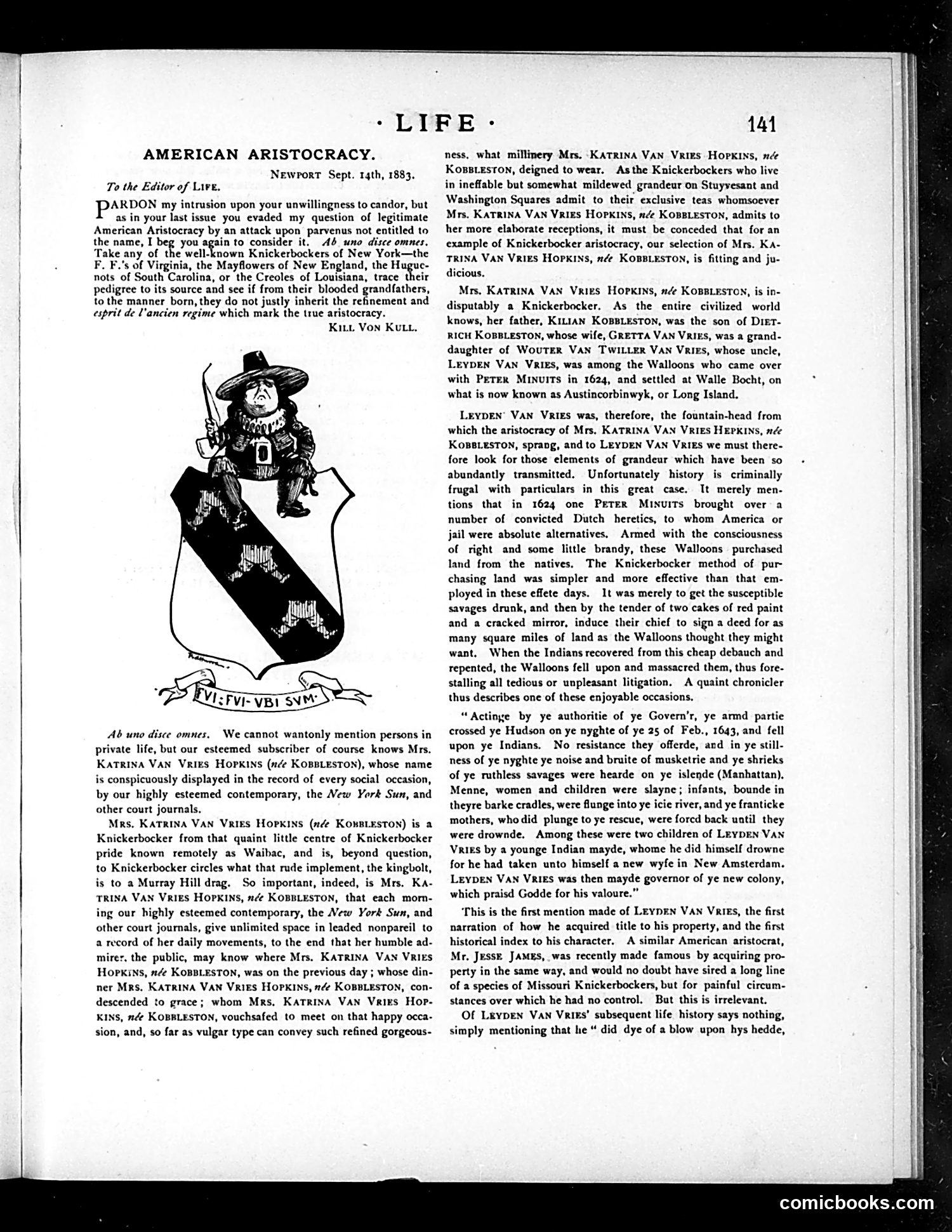
This page satirizes the absurdity of American "aristocracy," particularly the Knickerbocker elite of New York. The letter writer challenges *Life*'s evasion of what constitutes legitimate American aristocracy. The satire centers on **Mrs. Katrina Van Vries Hopkins** (née Kobbleston), a prominent socialite whose daily movements the *New York Sun* breathlessly reports. *Life* mocks how newspapers treat her mundane activities—what she wore, whom she visited—as matters of public interest, elevating her to artificial importance. The coat-of-arms illustration (left) reinforces the joke: the text traces her lineage back to Dutch settlers of 1624, revealing that American "aristocracy" rests on recently arrived colonists, not ancient bloodlines. The irony is biting: her pedigree literally begins with "convicted Dutch heretics" whom the Dutch gave a choice between America or jail. *Life* thus exposes how nouveau-riche Americans manufacture gentility through genealogical claims and media attention, while lacking the actual historical substance real aristocracy possesses.
This satirical piece mocks the pretensions of wealthy New Yorkers obsessed with genealogy and aristocratic lineage. The target appears to be Mrs. **Katrina Van Vries Hopkins**, a society woman who paid $75 per page (an enormous sum at the time) to have a genealogist trace her family tree back to Japhet (biblical ancestry). The satire exposes how the genealogist conveniently omits unflattering facts—like an ancestor confined to debtor's prison—while emphasizing obscure Dutch colonial names (Lispenard, Leyden, Kobbleston) to create an illusion of noble heritage. The joke: her family's "Knickerbocker effulgence" (old New York Dutch prestige) is actually mixed with commercial mediocrity—her father made his fortune in the grocery business. The humor targets **genealogical snobbery** and how wealthy Americans manufactured pedigrees to claim social superiority, particularly the nouveau-riche attempting to establish aristocratic credentials through selective, paid historical revision.
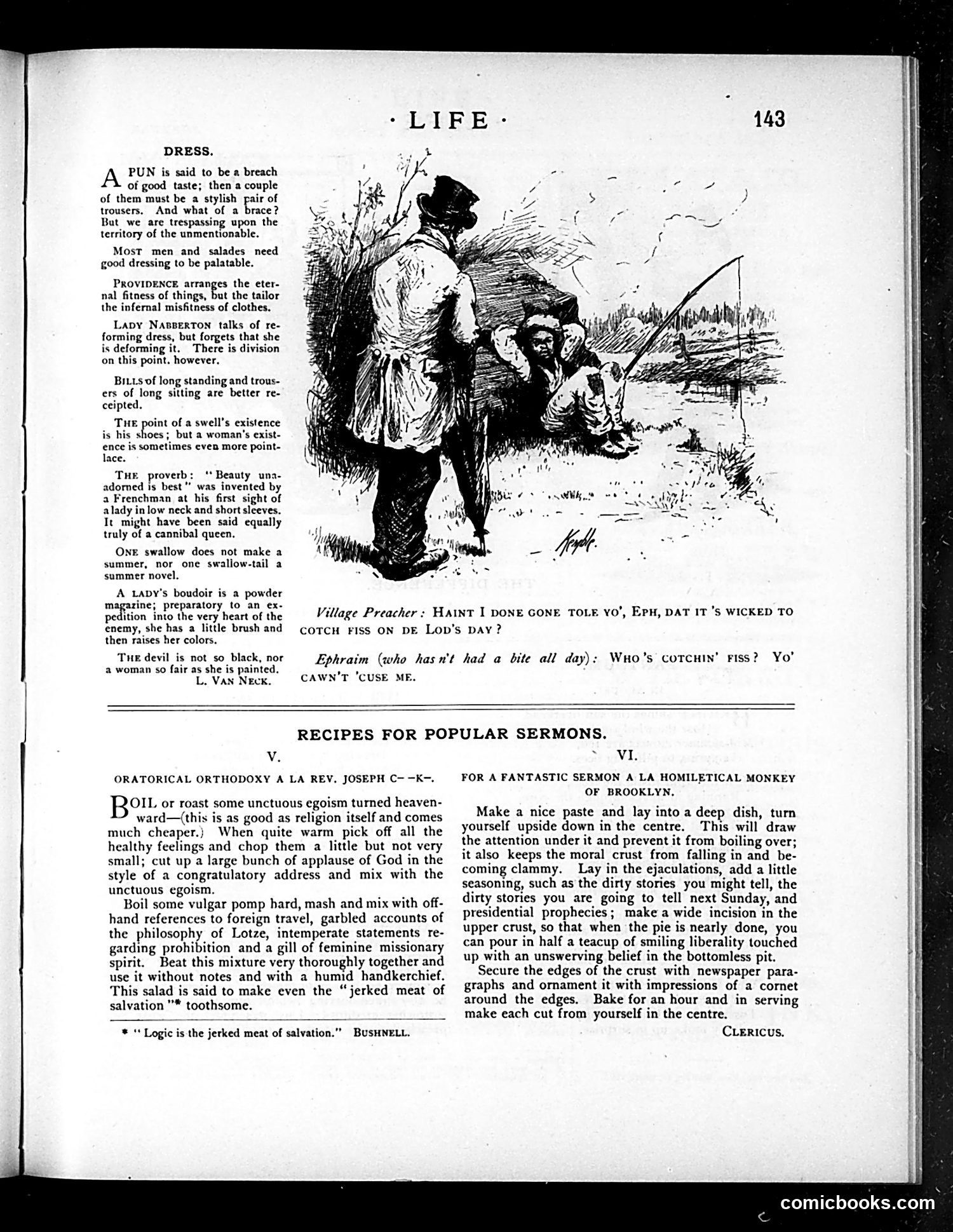
This page combines satirical commentary on fashion, rural dialect humor, and clerical mockery typical of late 19th-century American satire. **The Cartoon:** Shows a village preacher and a poor boy (Ephraim) by a river. The preacher scolds the boy for catching fish on Sunday, while Ephraim cheekily responds he wasn't cursing—establishing a rural, dialect-based joke about class and religious hypocrisy. **"Dress" Section:** Satirizes women's fashion reformers and beauty standards, with puns mocking men's and women's clothing. References "Lady Napperton" (unclear if real figure) who supposedly reforms dress while "deforming it." **"Recipes for Popular Sermons":** Mocks clergy through mock-recipes. Section V ridicules pretentious, emotionally manipulative preaching filled with false piety and plagiarized philosophy. Section VI attacks a "homiletical monkey of Brooklyn" for sensationalist preaching mixing dirty jokes with false piety—suggesting specific Brooklyn clergy engaged in this practice. The overall tone is cynical about both fashion and religious authority.
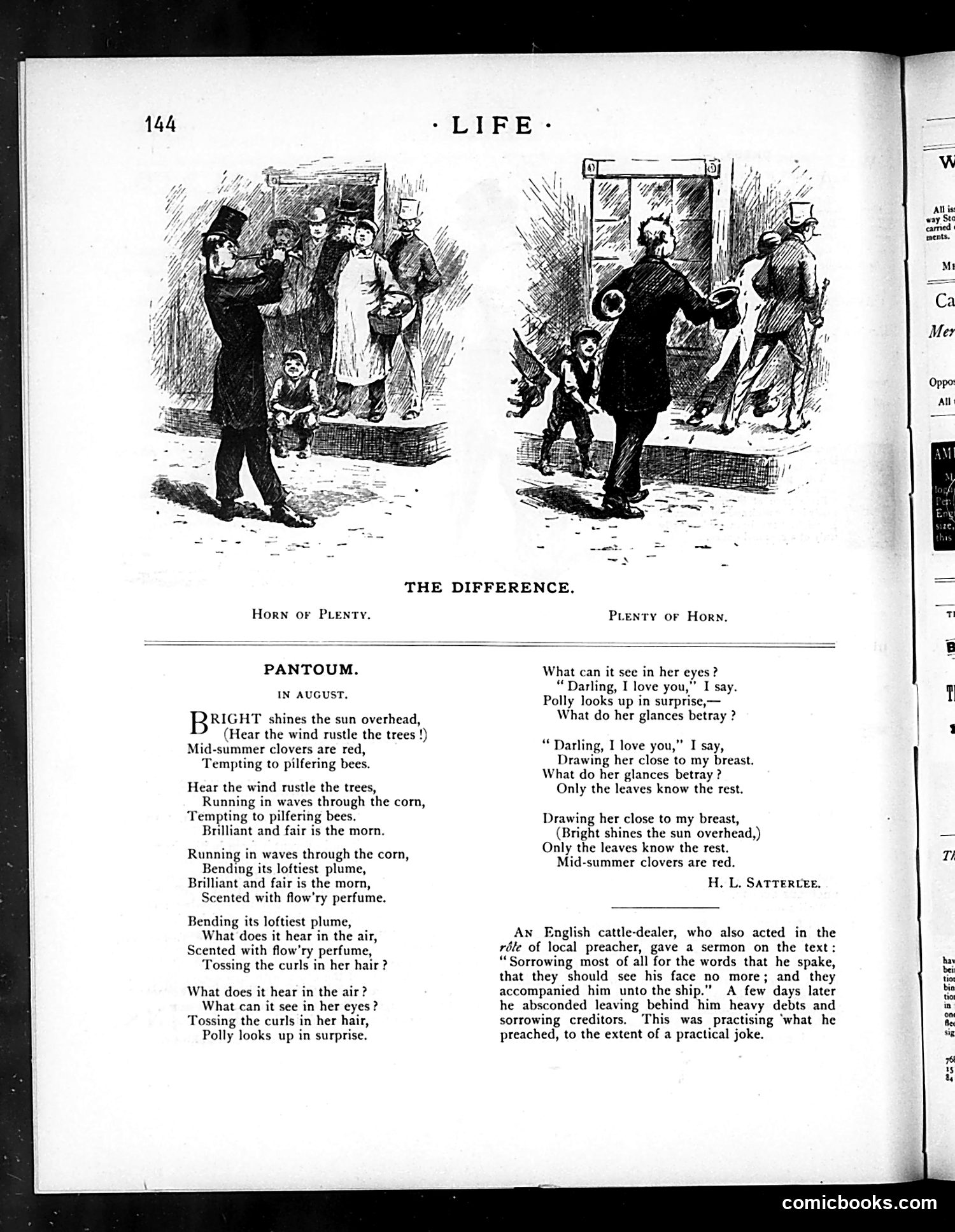
**The Visual Content:** Two parallel sketches labeled "Horn of Plenty" and "Plenty of Horn" depict contrasting domestic scenes—one showing a man generously distributing goods to a gathering of people, the other showing a man with a horn (trumpet) making noise while children and figures react. **The Satire:** "The Difference" plays on the double meaning of "horn"—abundance versus noise/disruption. The juxtaposition mocks how similar situations can have opposite outcomes: genuine plenty versus empty spectacle or annoyance. **The Text:** The poem "Pantoum" by H. L. Satterlee is a romantic August reverie about a young woman ("Polly") and a declaration of love in nature. **The Anecdote:** Below describes an English cattle-dealer who posed as a preacher, delivering sermons about sorrow and separation, then absconded with debts—literally "practicing what he preached" as a cruel joke, ironically embodying the sermon's themes of abandonment. The page combines sentimental poetry with caustic social commentary on hypocrisy and deception.
This page is primarily **advertisements and satirical notes**, not political cartoons. The IMAGE shows commercial ads for billiard tables and other businesses; the text contains brief humorous anecdotes. The "NOTES AND EXTRACTS" section offers satirical quips on contemporary topics: - **Newspaper men's posture**: A joke about journalists being "round-shouldered" because gold weighs little (implying they're always bending over money). - **Ohio campaign**: References Murat Halstead writing poetry about John McLean—mocking the 1880 Ohio political contest as absurdly dramatic. - **George Vanderbilt**: Satirizes young Vanderbilt wanting to be a newspaper reporter, sarcastically claiming this proves his family's "greed for gold" and desire for wealth through "easiest" methods. - **Harriet Martineau statue**: Brief reference to Boston *Herald* opposition to a commemorative statue. These are lightweight social satire typical of *Life* magazine's humor—targeting wealth, journalism, and public figures without deep political engagement.
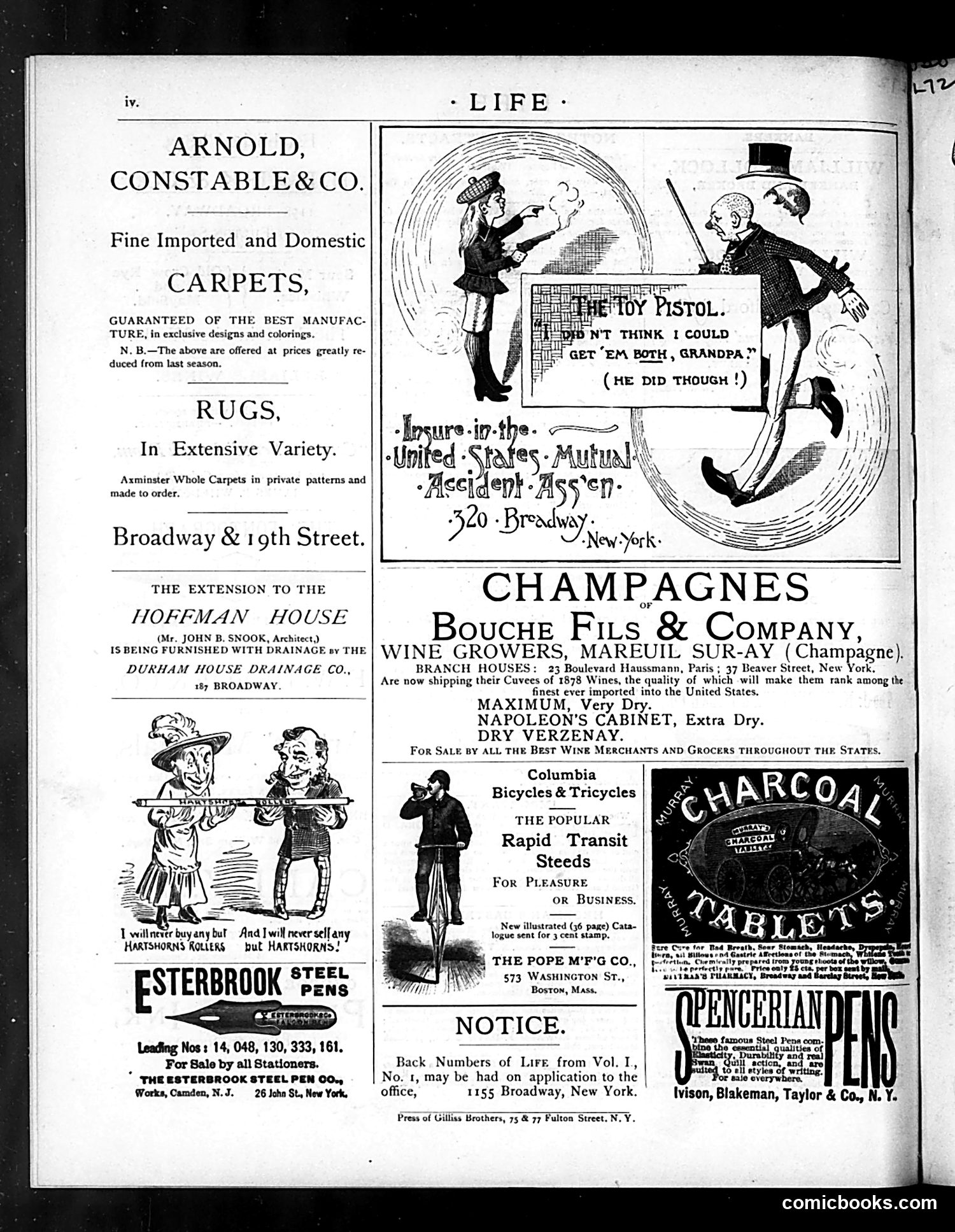
This is primarily a **commercial advertising page** with one small satirical cartoon. The main visual content is a circular vignette showing two well-dressed men—one firing a toy pistol while the other reacts in exaggerated alarm. The caption reads: "THE TOY PISTOL. 'DIDN'T THINK I COULD GET 'EM BOTH, GRANDPA.' (HE DID THOUGH!)" The joke appears to be a gentle domestic humor piece: a grandfather is surprised his toy pistol is effective enough to startle both his grandson and possibly a grandmother simultaneously—playing on the unexpected power of a toy. The page is otherwise filled with period advertisements for carpets, rugs, champagne, bicycles, pens, and other goods typical of late 19th-century American commerce. The "Esterbrook Steel Pens" ad features a brief dialogue joke about brand loyalty ("I will never buy any but Hartshorns Rollers..."). **No major political or social satire is evident.** This appears to be a typical magazine page mixing modest humor with revenue-generating advertisements.