
Life, 1883-09-20 · page 6 of 16
Life — September 20, 1883 — page 6: what you’re looking at
What you’re looking at
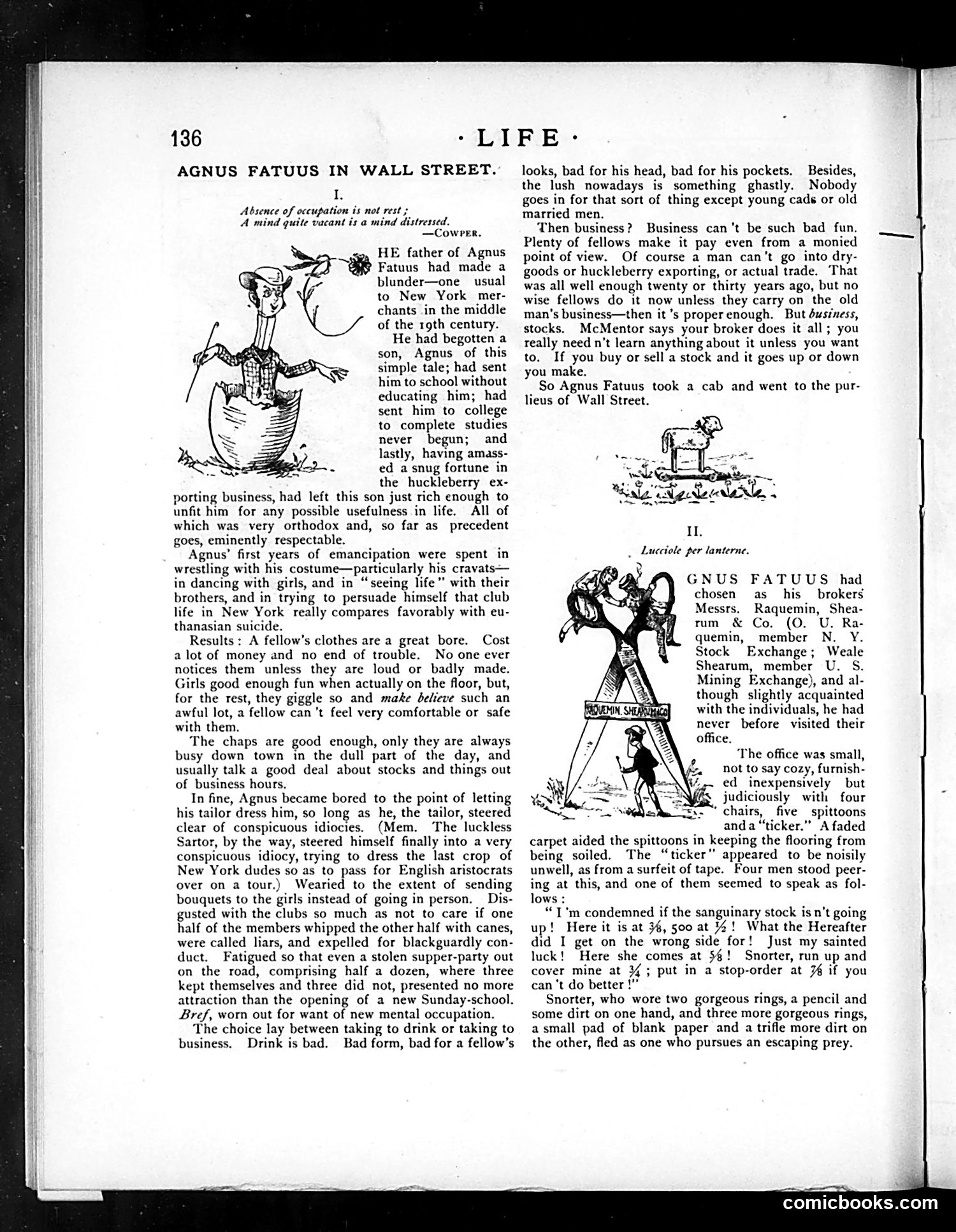
This satirical piece mocks a wealthy but foolish financier named Agnus Fatuus (Latin for "foolish lamb"). The cartoon illustrates his absurd lifestyle: dressed in an oversized suit, he appears comically out of place on Wall Street despite his fortune from the huckleberry export business. The satire targets several vices: his ostentatious clothing that makes him "loud or noticeable," his reliance on expensive brokers (Raquemin, Shearum & Co.), and his frivolous spending on fancy rings and office décor. The text suggests he lacks genuine business acumen—he merely inherited wealth without understanding stocks or commerce. The joke reflects late-19th/early-20th-century anxieties about nouveau riche businessmen whose money outpaces their education or taste.
📄 Transcribed text from this page (OCR, searchable)
Machine-transcribed from the original scan — historical spelling and the odd misread are preserved.
136 AGNUS FATUUS IN WALL STREET. I. Absence of occupation is not rest ; A mind quite vacant is a mind distressed. —Cowrer. ~ HE father of Agnus Fatuus had made a blunder—one__ usual to New York mer- chants .in the middle of the 19th century. He had begotten a son, Agnus of this simple tale; had sent him to school without educating him; had sent him to college to complete studies never begun; and lastly, having amass- ed a snug fortune in the huckleberry ex- porting business, had left this son just rich enough to unfit him for any possible usefulness in life. All of which was very orthodox and, so far as precedent goes, eminently respectable. Agnus’ first years of emancipation were spent in wrestling with his costume—particularly his cravats— in dancing with girls, and in “seeing life” with their brothers, and in trying to persuade himself that club life in New York really compares favorably with eu- thanasian suicide. Results : A fellow’s clothes are a great bore. Cost a lot of money and no end of trouble. No one ever notices them unless they are loud or badly made. Girls good enough fun when actually on the floor, but, for the rest, they giggle so and make believe such an awful lot, a fellow can't feel very comfortable or safe with them. The chaps are good enough, only they are always busy down town in the dull part of the day, and usually talk a good deal about stocks and things out of business hours. In fine, Agnus became bored to the point of letting his tailor dress him, so long as he, the tailor, steered clear of conspicuous idiocies. (Mem. The luckless Sartor, by the way, steered himself finally into a very conspicuous idiocy, trying to dress the last crop of New York dudes so as to pass for English aristocrats over on a tour.) Wearied to the extent of sending bouquets to the girls instead of going in person. _Dis- gusted with the clubs so much as not to care if one half of the members whipped the other half with canes, were called liars, and expelled for blackguardly con- duct. Fatigued so that even a stolen supper-party out on the road, comprising half a dozen, where three kept themselves and three did not, presented no more attraction than the opening of a new Sunday-school. Bref, worn out for want of new mental occupation. The choice lay between taking to drink or taking to business. Drink is bad. Bad form, bad for a fellow’s -LIFE- looks, bad for his head, bad for his pockets. Besides, the lush nowadays is something ghastly. Nobody goes in for that sort of thing except young cadés or old married men. Then business? Business can't be such bad fun. Plenty of fellows make it pay even from a monied point of view. Of course a man can’t go into dry- goods or huckleberry exporting, or actual trade. That was all well enough twenty or thirty years ago, but no wise fellows do it now unless they carry on the old man’s business—then it’s proper enough. But business, stocks. McMentor says your broker does it all; you really need n’t learn anything about it unless you want to. If you buy or sell a stock and it goes up or down you make. So Agnus Fatuus took a cab and went to the pur- lieus of Wall Street. Whee . eee Il. _ Lucciole per lanterne. GNUS FATUUS had chosen as his brokers Messrs. Raquemin, Shea- tum & Co. (O. U. Ra- quemin, member N. Y. Stock Exchange; Weale Shearum, member U. S. Mining Exchange), and al- though slightly acquainted with the individuals, he had never before visited their office. The office was small, not to say cozy, furnish- ed inexpensively but S judiciously with four * chairs, five spittoons anda “ticker.” A faded carpet aided the spittoons in keeping the flooring from being soiled. The “ticker” appeared to be noisily unwell, as from a surfeit of tape. Four men stood peer- ing at this, and one of them seemed to speak as fol- lows : “T'm condemned if the sanguinary stock is n't going up! Here it is at 34, 500 at %4! What the Hereafter did I get on the wrong side for! Just my sainted luck! Here she comes at $@! Snorter, run up and cover mine at 34; put in a stop-order at % if you can't do better !"” Snorter, who wore two gorgeous rings, a pencil and some dirt on one hand, and three more gorgeous rings, a small pad of blank paper and a trifle more dirt on the other, fled as one who pursues an escaping prey. comicbooks.com