
Life, 1883-09-20 · page 10 of 16
Life — September 20, 1883 — page 10: what you’re looking at
What you’re looking at
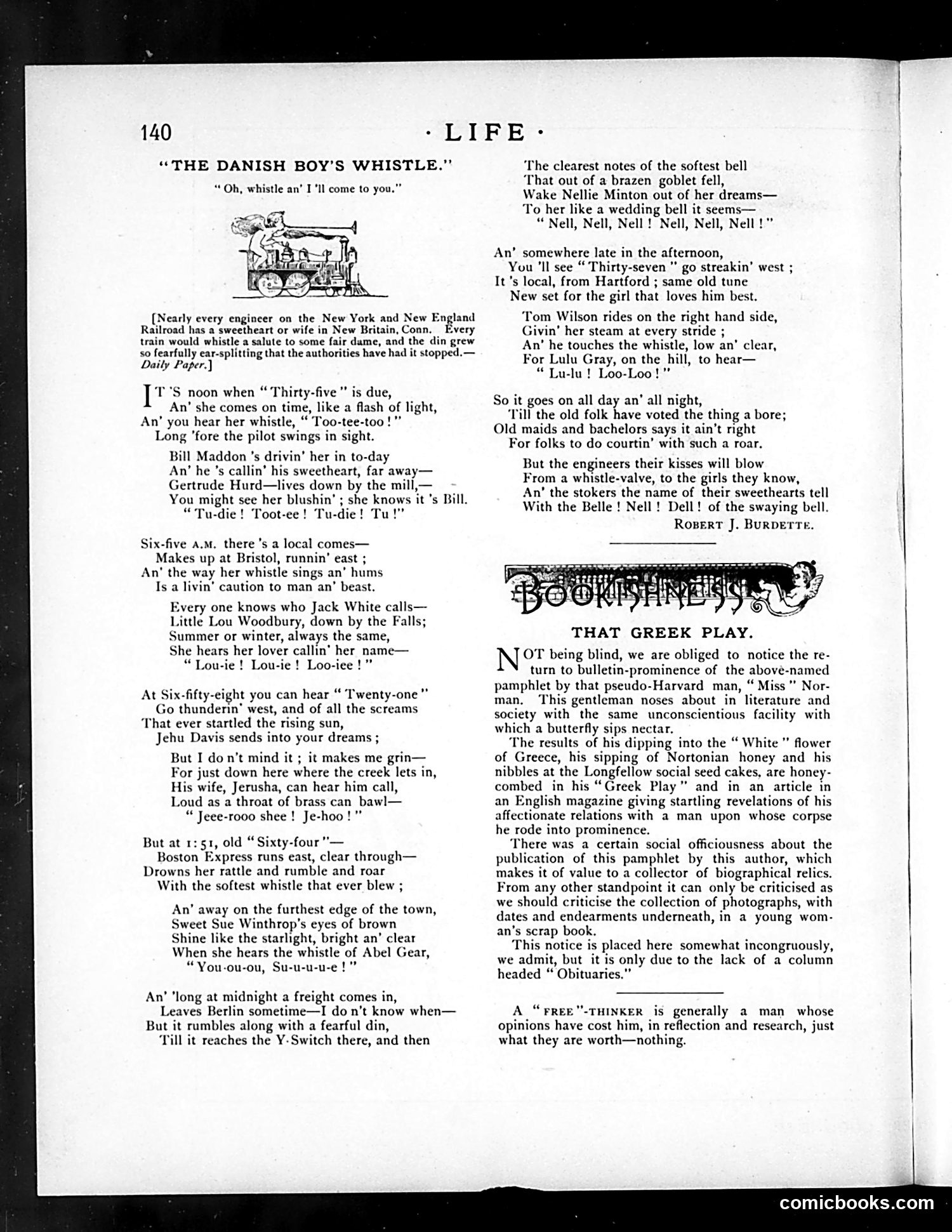
This page contains two distinct pieces: a humorous poem and a critical note. **"The Danish Boy's Whistle"** (by Robert J. Burdette) is a poem about railroad engineers in New Britain, Connecticut who whistle train signals as romantic communication with their sweethearts. The setup notes that authorities stopped the practice because the noise had become unbearably loud. The poem celebrates this courting custom through multiple vignettes—each engineer whistles a distinctive pattern to reach a specific woman (Gertrude, Little Lou, Jerusha, Sue Winthrop, and Lulu Gray). It's sentimental humor about working-class romance, poking gentle fun at both the engineers' creativity and the disapproving "old folk" who find the noise objectionable. **"That Greek Play"** is a sharp, critical note attacking someone identified as a "pseudo-Harvard man" (possibly "Miss Norman") for a controversial work called a "Greek Play" and related magazine article. The critique suggests this person plagiarized from classical sources ("White flower of Greece") and made shocking personal revelations involving deceased individuals. The tone is biting social satire about literary pretension and scandal-mongering in intellectual circles.
📄 Transcribed text from this page (OCR, searchable)
Machine-transcribed from the original scan — historical spelling and the odd misread are preserved.
140 ‘“‘THE DANISH BOY’S WHISTLE.” “Oh, whistle an’ I'll come to you.”” (Nearly every engineer on the New York and New England Railroad has a sweetheart or wife in New Britain, Conn. Every train would whistle a salute to some fair dame, and the din grew so fearfully ear-splitting that the authorities have had it stopped. — Daily Paper.) T'S noon when “ Thirty-five” is due, An’ she comes on time, like a flash of light, An’ you hear her whistle, “‘ Too-tee-too!"” Long 'fore the pilot swings in sight. Bill Maddon 's drivin’ her in to-day An’ he’s callin’ his sweetheart, far away— Gertrude Hurd—lives down by the mill,— You might see her blushin’ ; she knows it 's Bill. “Tu-die! Toot-ee! Tu-die! Tu!” Six-five a.m, there ’s a local comes— Makes up at Bristol, runnin’ east ; An’ the way her whistle sings an’ hums Is a livin’ caution to man an’ beast. Every one knows who Jack White calls— Little Lou Woodbury, down by the Falls; Summer or winter, always the same, She hears her lover callin’ her name— “Lou-ie ! Lou-ie ! Loo-iee !” At Six-fifty-eight you can hear “‘ Twenty-one” Go thunderin’ west, and of all the screams ‘That ever startled the rising sun, Jehu Davis sends into your dreams ; But I don’t mind it ; it makes me grin— For just down here where the creek lets in, His wife, Jerusha, can hear him call, Loud as a throat of brass can bawl— “ Jeee-rooo shee! Je-hoo!"” But at 1:51, old “Sixty-four "— Boston Express runs east, clear through— Drowns her rattle and rumble and roar With the softest whistle that ever blew ; An’ away on the furthest edge of the town, Sweet Sue Winthrop’s eyes of brown Shine like the starlight, bright an’ clear When she hears the whistle of Abel Gear, “You-ou-ou, Su-u-u-u-e!"” An’ ‘long at midnight a freight comes in, Leaves Berlin sometime—I do n't know when— But it rumbles along with a fearful din, ‘Till it reaches the Y-Switch there, and then - LIFE: ‘The clearest notes of the softest bell That out of a brazen goblet fell, Wake Nellie Minton out of her dreams— To her like a wedding bell it seems— “ Nell, Nell, Nell! Nell, Nell, Nell!” An’ somewhere late in the afternoon, You ‘Il see “ Thirty-seven " go streakin’ west ; It’s local, from Hartford ; same old tune New set for the girl that loves him best. Tom Wilson rides on the right hand side, Givin’ her steam at every stride ; An’ he touches the whistle, low an’ clear, For Lulu Gray, on the hill, to hear— “ Lu-lu ! Loo-Loo!"" So it goes on all day an’ all night, ‘Till the old folk have voted the thing a bore; | Old maids and bachelors says it ain’t right For folks to do courtin’ with such a roar, But the engineers their kisses will blow From a whistle-valve, to the girls they know, An’ the stokers the name of their sweethearts tell With the Belle ! Nell! Dell! of the swaying bell. Ropert J. BuRDETTE. THAT GREEK PLAY. OT being blind, we are obliged to notice the re- turn to bulletin-prominence of the above-named pamphlet by that pseudo-Harvard man, “ Miss Nor- man, is gentleman noses about in literature and society with the same unconscientious facility with which a butterfly sips nectar. The results of his dipping into the “ White ” flower of Greece, his sipping of Nortonian honey and his nibbles at the Longfellow social seed cakes, are honey- combed in his “Greek Play” and in an article in an English magazine giving startling revelations of his affectionate relations with a man upon whose corpse he rode into prominence. There was a certain social officiousness about the publication of this pamphlet by this author, which makes it of value to a collector of biographical relics. From any other standpoint it can only be criticised as we should criticise the collection of photographs, with dates and endearments underneath, in a young wom- an’s scrap book. This notice is placed here somewhat incongruously, we admit, but it is only due to the lack of a column headed “ Obituaries.” A “FREE"-THINKER is generally a man_ whose opinions have cost him, in reflection and research, just what they are worth—nothing. comicbooks.com