
A complete issue · 16 pages · 1883
Life — January 25, 1883
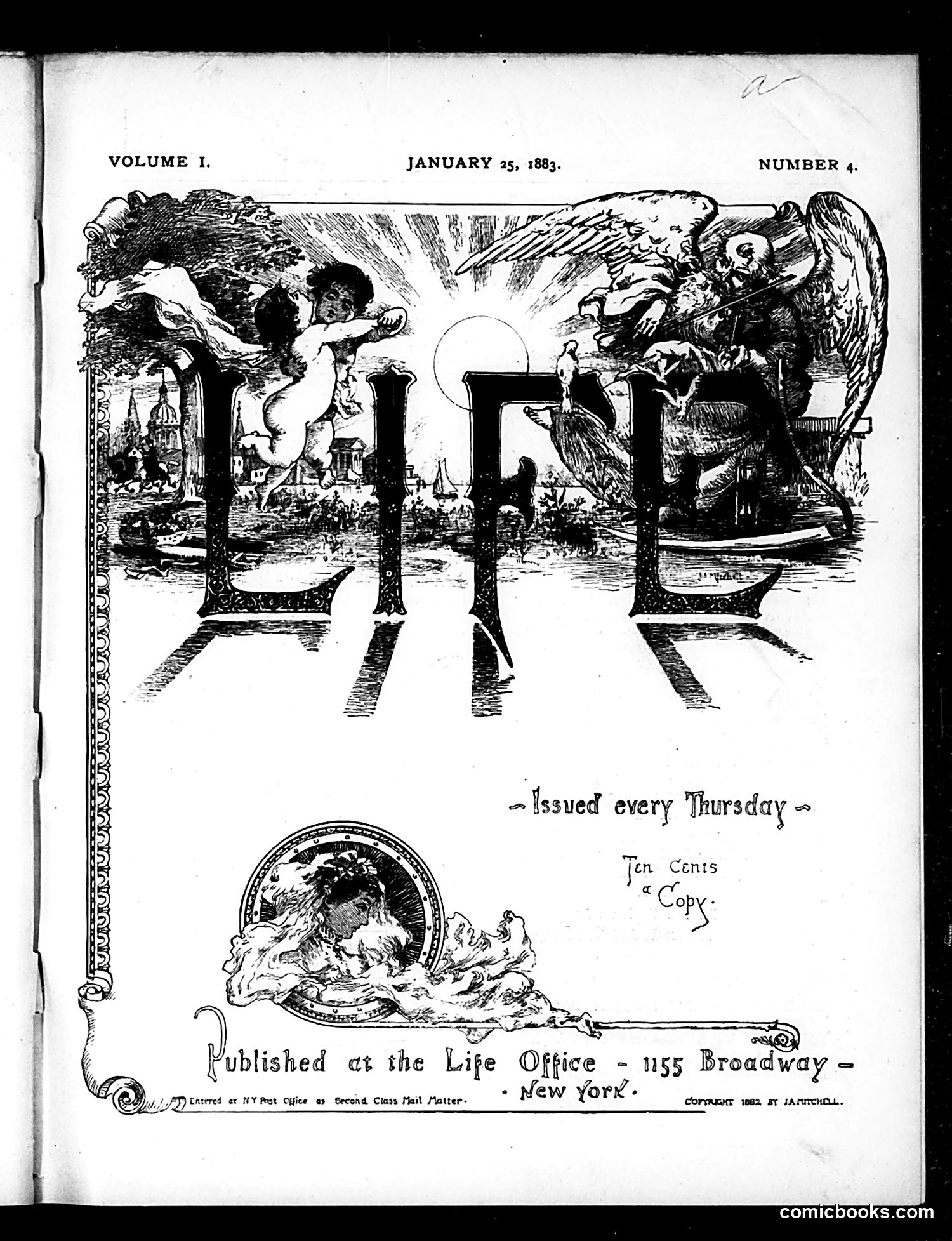
This is the cover/title page for Life magazine's first volume, number 4. The large illustration features fantastical figures—winged demons or devils—flanking the word "LIFE" displayed prominently in the center. A cityscape with a moon appears in the background. The imagery appears satirical and allegorical rather than referencing a specific political event. The demonic figures likely represent forces of chaos, vice, or social ills that Life magazine claimed to satirize and expose. The theatrical, grotesque style was typical of 19th-century satirical illustration. Published at 1155 Broadway in New York, the magazine cost ten cents per copy and was issued weekly on Thursdays. The copyright holder is listed as J. A. Mitchell.
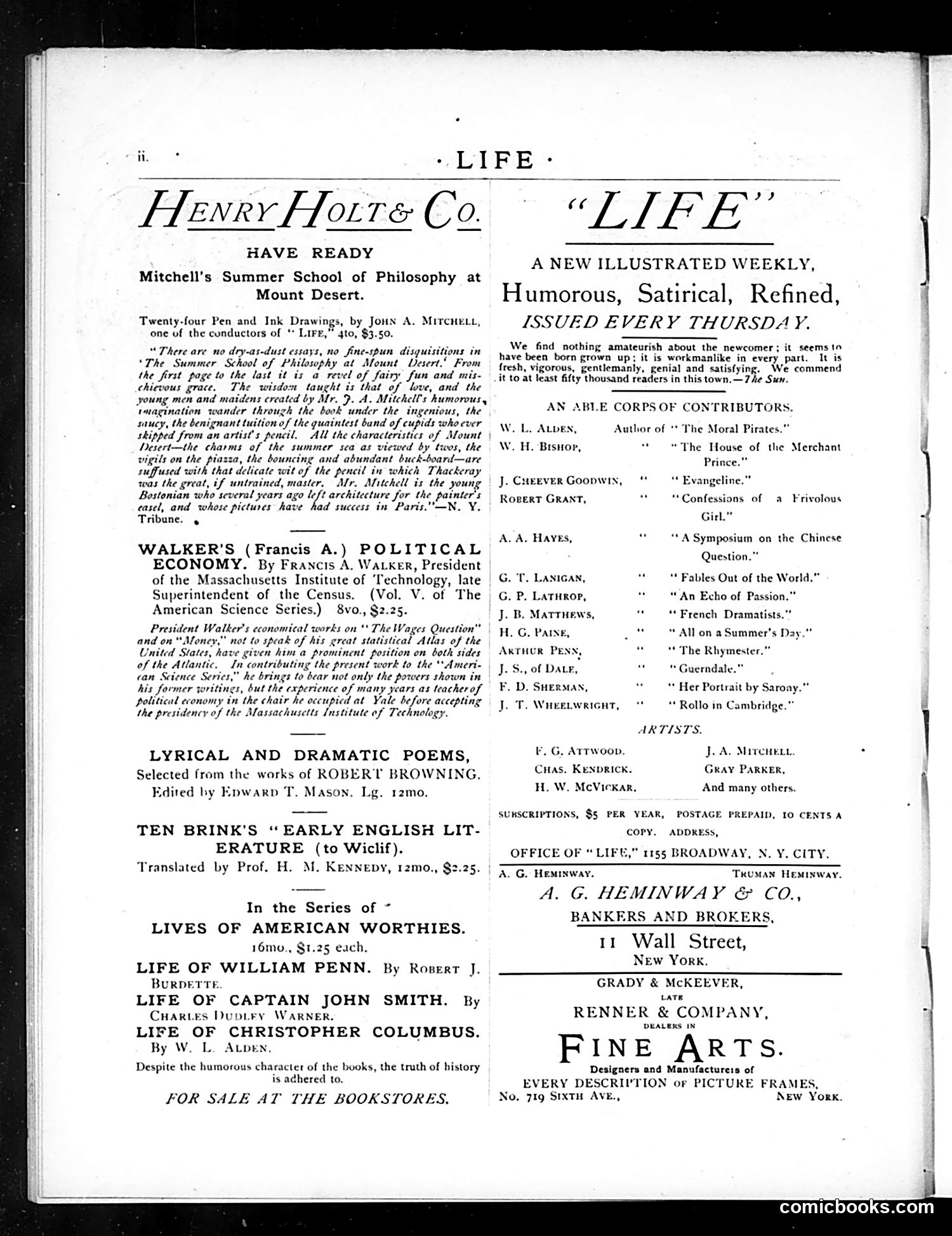
This appears to be a page from Life magazine consisting almost entirely of advertisements and publisher information rather than editorial cartoon content. The page promotes "Life" as a "new illustrated weekly" that is "Humorous, Satirical, Refined" and issued every Thursday. It lists the magazine's able corps of contributors, including writers like W.L. Alden and artists like Gray Parker. Additional advertisements promote books from Henry Holt & Co., Walter's Political Economy, and other literary works. The bottom features ads for A.G. Heminway & Co. (bankers and brokers) and Grady & McKeever (fine arts dealers). Without visible cartoons or satirical illustrations on this particular page, the political or social commentary content is unclear.
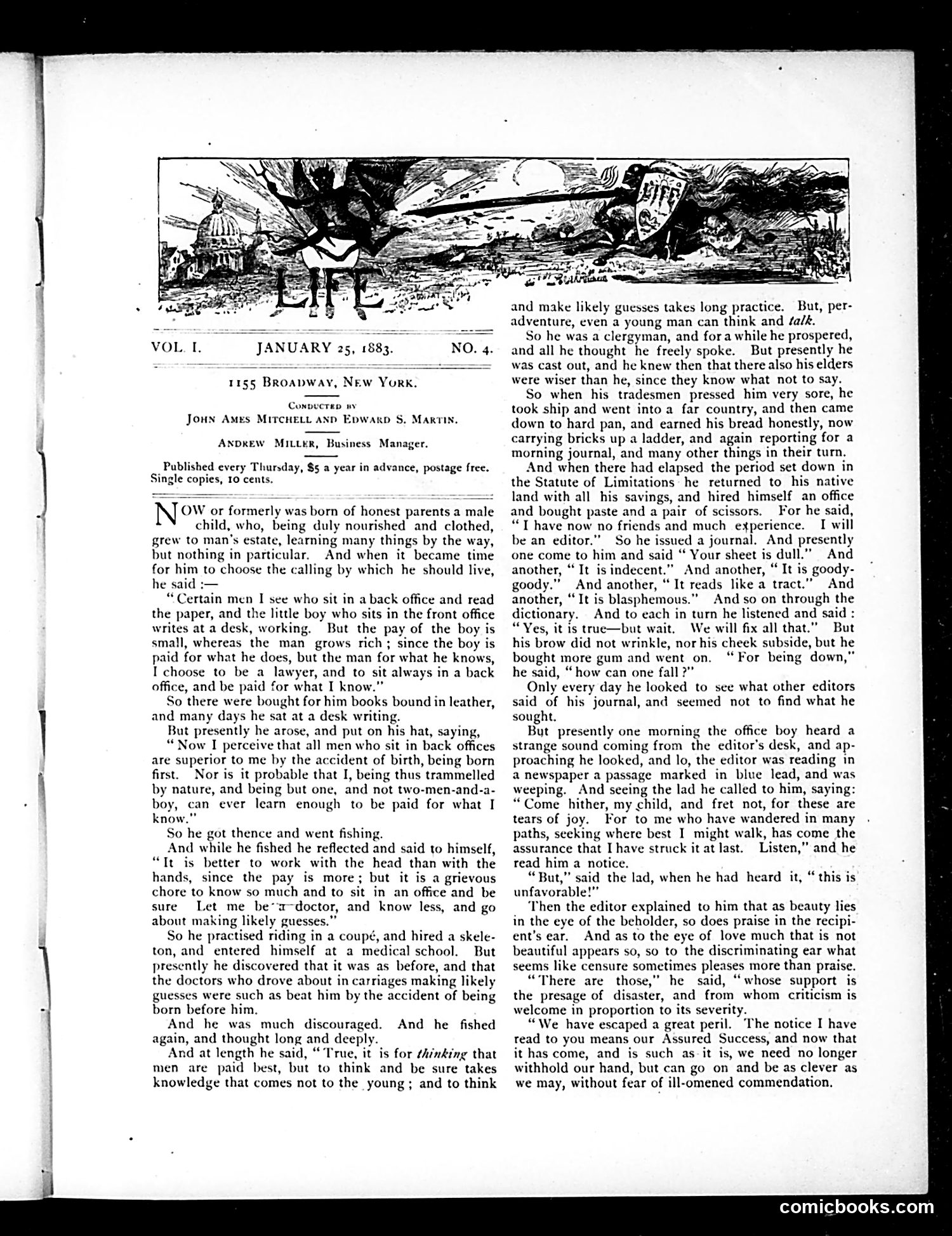
This page from *Life* (January 25, 1883) contains a serialized story titled "Andrew Miller, Business Manager," not a political cartoon. The narrative describes a young man of humble origins who struggles to find his calling. After attempting various professions—lawyer, doctor—he eventually becomes a newspaper editor and publishes a journal. The story illustrates 19th-century themes of ambition, self-improvement, and social mobility through honest work. It celebrates the newspaper industry as an accessible path to success for enterprising young men. The tale appears to be gentle social commentary on vocational choices and perseverance rather than political satire. The illustration at the top simply depicts the protagonist.
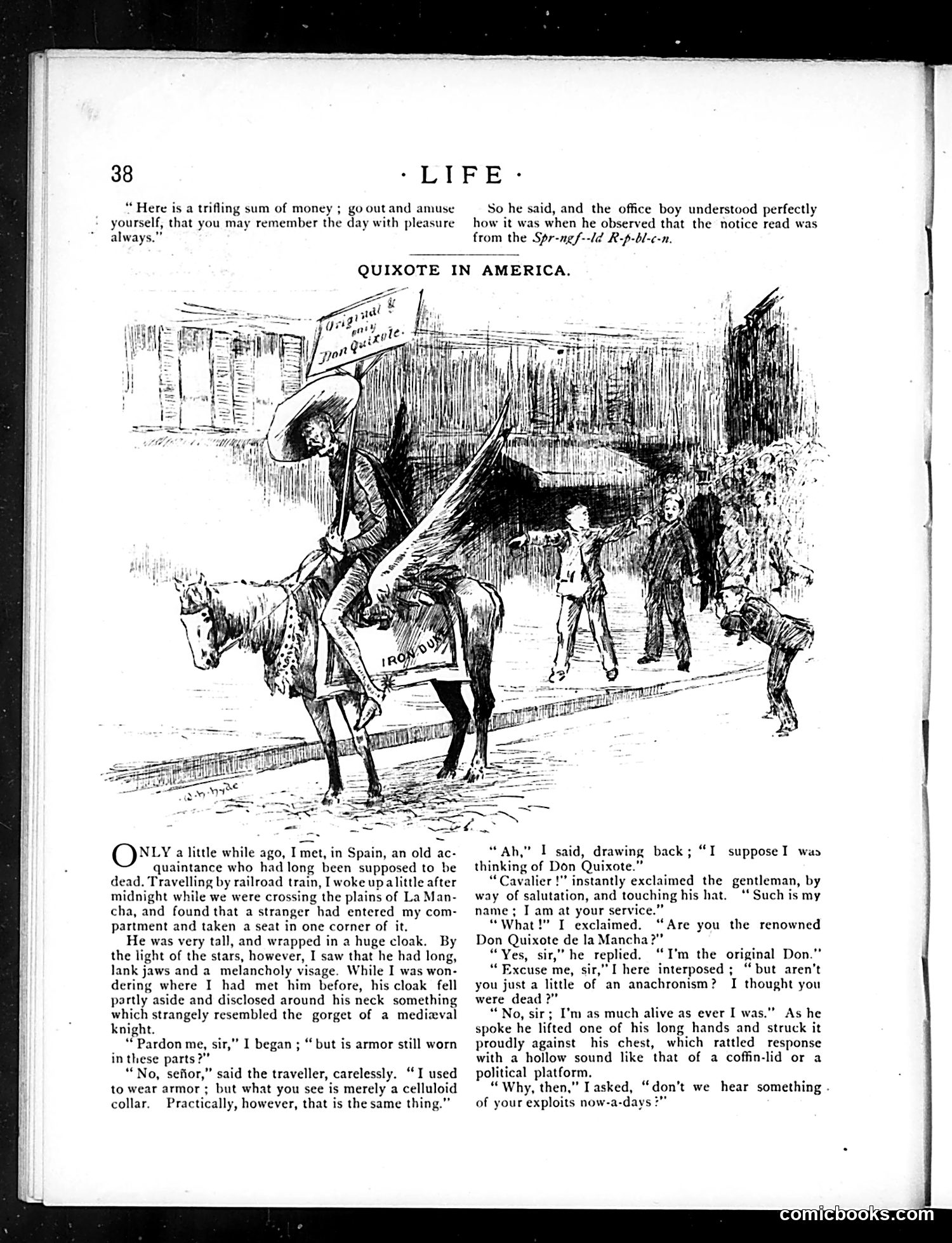
This satirical piece compares a modern American to Don Quixote, Cervantes's delusional knight-errant. The illustration shows a man mounted on a horse labeled "Iron Don," carrying a banner reading "Original & Only Don Quixote," parading through an American street while onlookers react with bemusement. The satire works on multiple levels: the figure claims to be "the original Don" and boasts of his exploits, yet clearly represents someone either genuinely confused about his importance or fraudulently trafficking in false credentials—a common American con. The conversation reveals the pretender hasn't been heard from in years, suggesting he's either an obscure failed businessman or a charlatan reviving an abandoned scheme to fleece a credulous public. The "Iron Don" horse label likely mocks his claims to knightly authenticity.
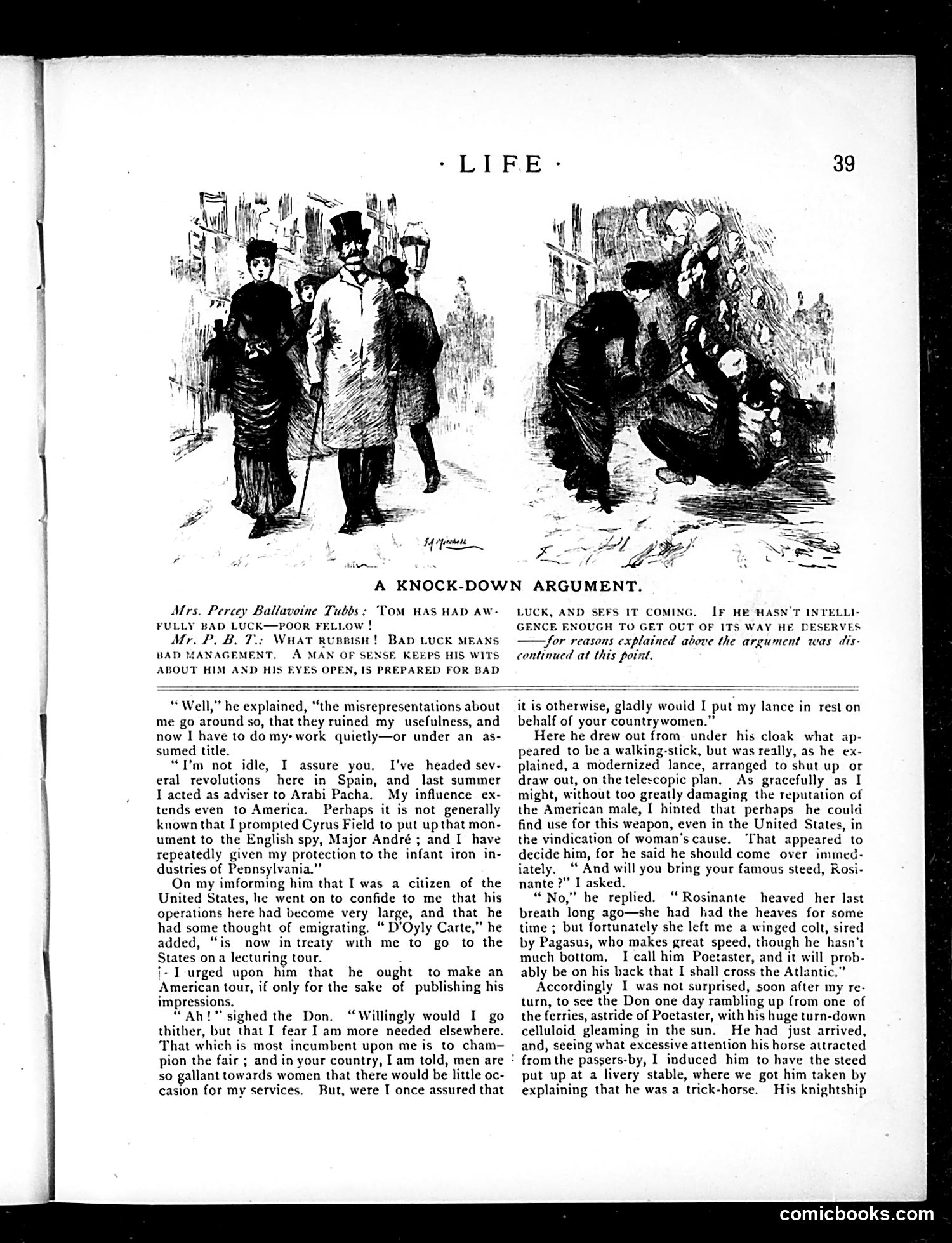
This satirical cartoon illustrates a social class conflict common in Gilded Age America. The left panel shows well-dressed, upper-class figures on a city street, while the right depicts working-class people huddled together, apparently homeless or impoverished. The caption presents a callous argument: a wealthy woman (Mrs. Percy Ballavoine Tubbs) dismisses poverty as the fault of the poor themselves, claiming bad luck results from lack of intelligence. The accompanying text—a gentleman's response—sarcastically refutes this, noting that prepared people survive misfortune while the unprepared suffer. The cartoon critiques both the wealthy's indifference to systematic poverty and the myth that poverty results from personal failing rather than circumstance. It's a pointed commentary on Gilded Age inequality and class attitudes toward the poor.
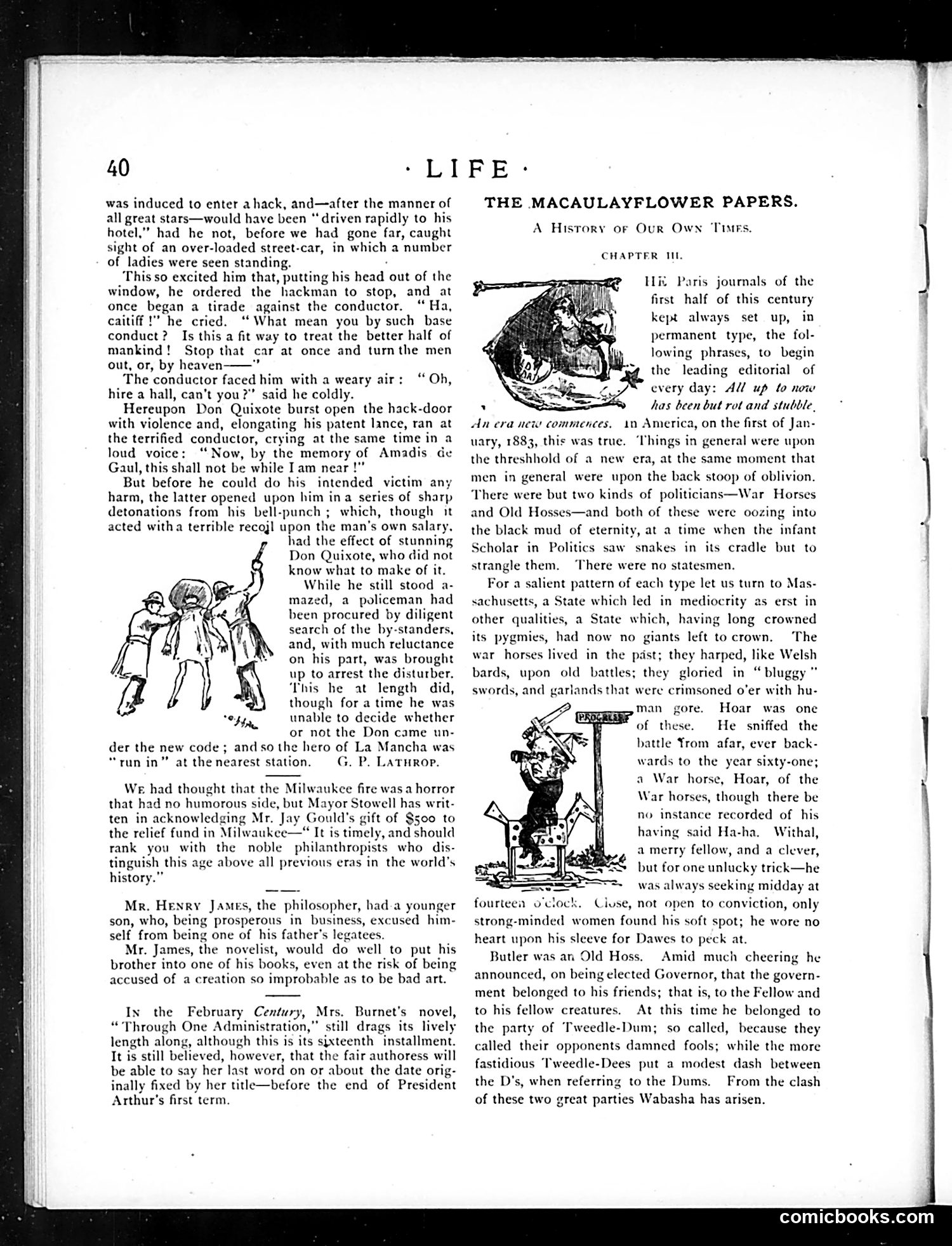
This page contains two distinct illustrations accompanying literary and social commentary. The **left illustration** depicts a violent street scene with a conductor being attacked by a group—likely satirizing urban disorder or labor disputes common in the 1880s. The accompanying text recounts an incident involving a hackney carriage conductor's misconduct. The **right illustration** shows a figure (possibly a horse or animal) in a grotesque or exaggerated pose, accompanying "The Macaulay Flower Papers" column discussing American politics. The text references Massachusetts politics and historical figures like "Old Hosses," using equine metaphors to mock political parties and their aging leadership. The overall page uses satirical humor to critique contemporary political factionalism and urban social problems. The specific political figures referenced remain unclear without additional historical context.
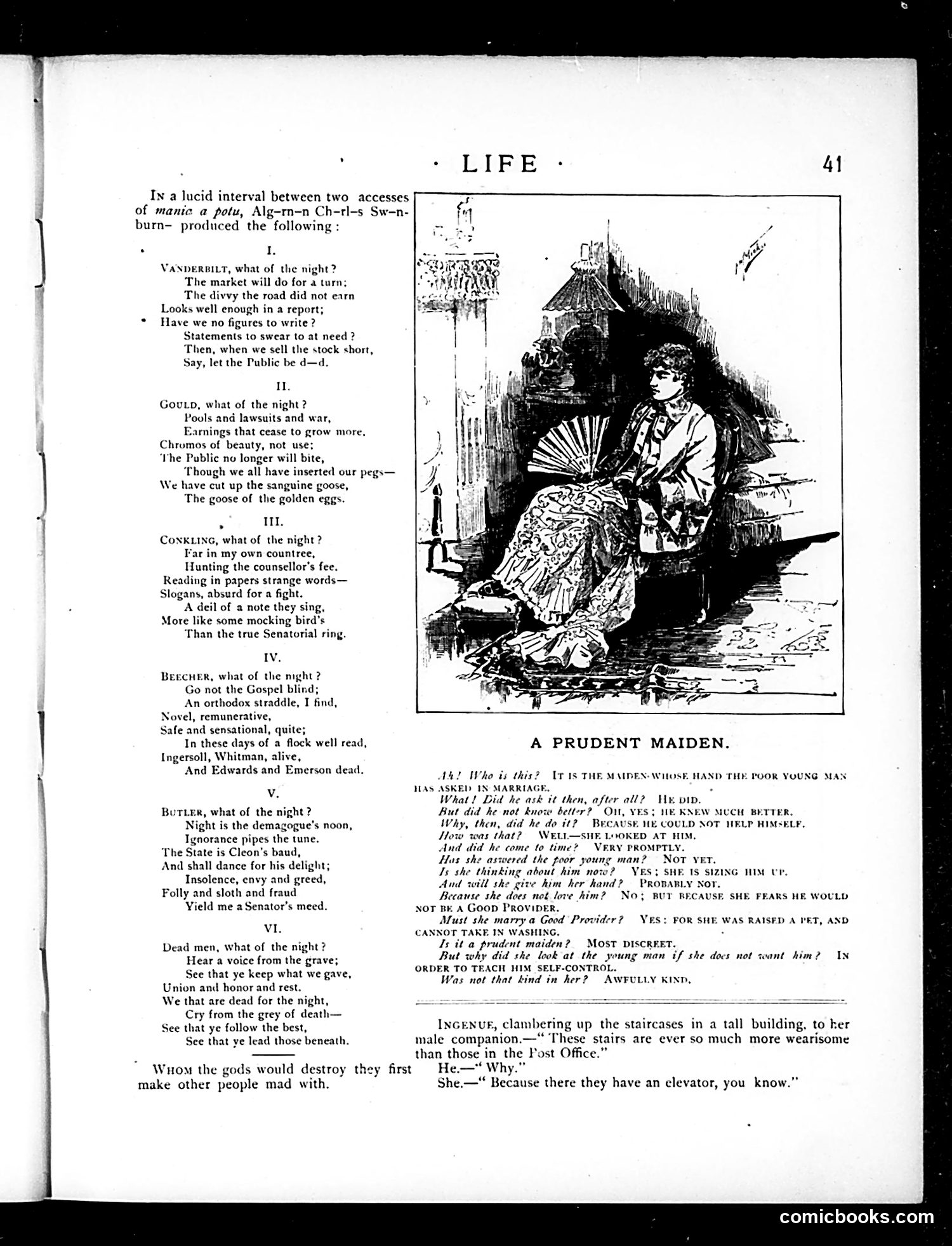
This illustration and accompanying dialogue satirize courtship conventions of the Gilded Age. The sketch depicts a young woman rejecting a suitor's marriage proposal, not from lack of affection but from practical financial concerns—a sharp social commentary. The woman lists pragmatic reasons for refusal: the man lacks adequate income, cannot support a household, and has no savings. She fears becoming a "Good Provider's" dependent, unable to afford washing services. The satire targets both rigid gender roles and class anxieties of the period. The "prudent maiden" represents a shift in female agency—she refuses romantic sentiment for economic security. The dialogue mocks both sentimental courtship ideals and the harsh financial realities facing working and middle-class couples in early 20th-century America.
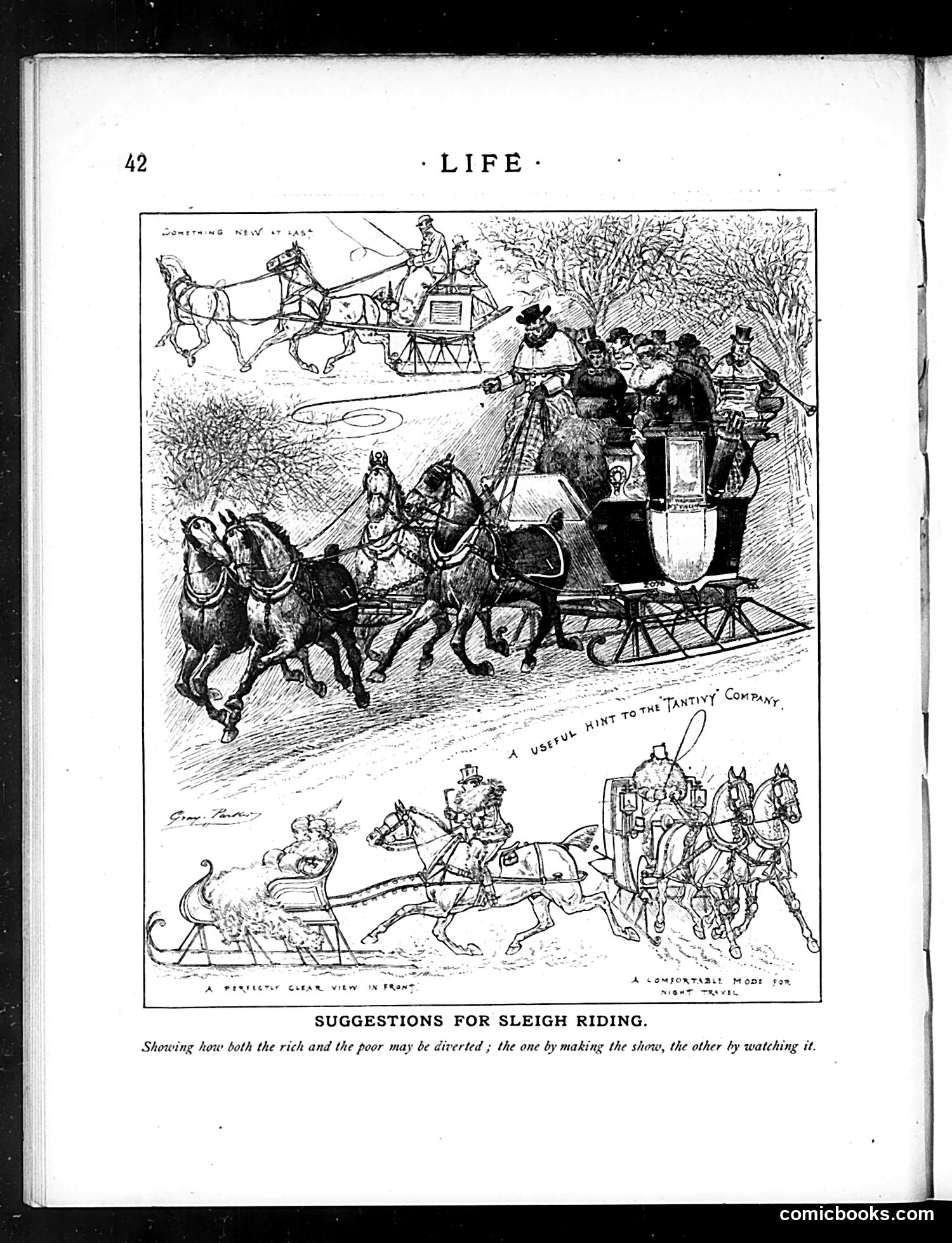
This satirical illustration from *Life* magazine uses winter sleigh riding as social commentary. The main panel shows contrasting scenarios: wealthy people in an elaborate, ornate sleigh drawn by multiple horses, while poor people watch from the roadside or ride in a simple conveyance. The subtitle—"Showing how both the rich and the poor may be directed; the one by making the show, the other by watching it"—makes explicit the satire's point: wealth creates spectacle that entertains the poor, keeping class divisions intact. The lower vignettes offer absurdist alternatives (a lobster-drawn sleigh, animals in harness), reinforcing how ludicrous and artificial these class distinctions are. The cartoon critiques conspicuous consumption and social inequality during America's Gilded Age.
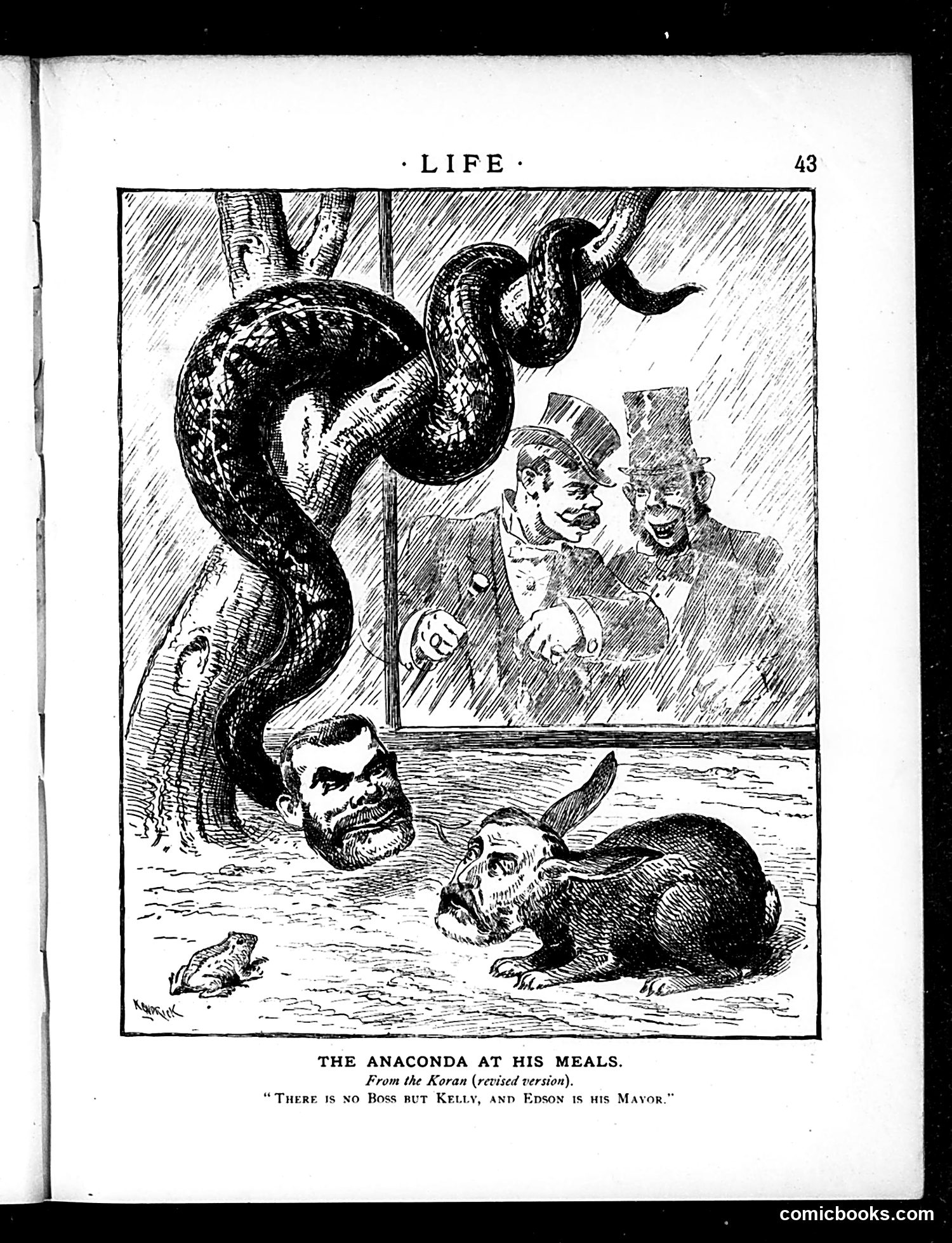
This cartoon satirizes political corruption in early 20th-century America. The large anaconda represents political corruption or a criminal enterprise controlling meals (resources/power). Two caricatured figures in top hats observe from a window—likely political bosses or corrupt officials. The caption attributes the joke to "the Koran (revised version)" and quotes: "There is no Boss but Kelly, and Edson is his Mayor." This mocks the relationship between a political boss (appears to reference someone named Kelly) and a mayor (Edson), suggesting the mayor is merely a puppet of the real power broker. The small animals below (frog, rabbit) may represent ordinary citizens or victims of this corrupt system. The satire criticizes how hidden power structures control public affairs.
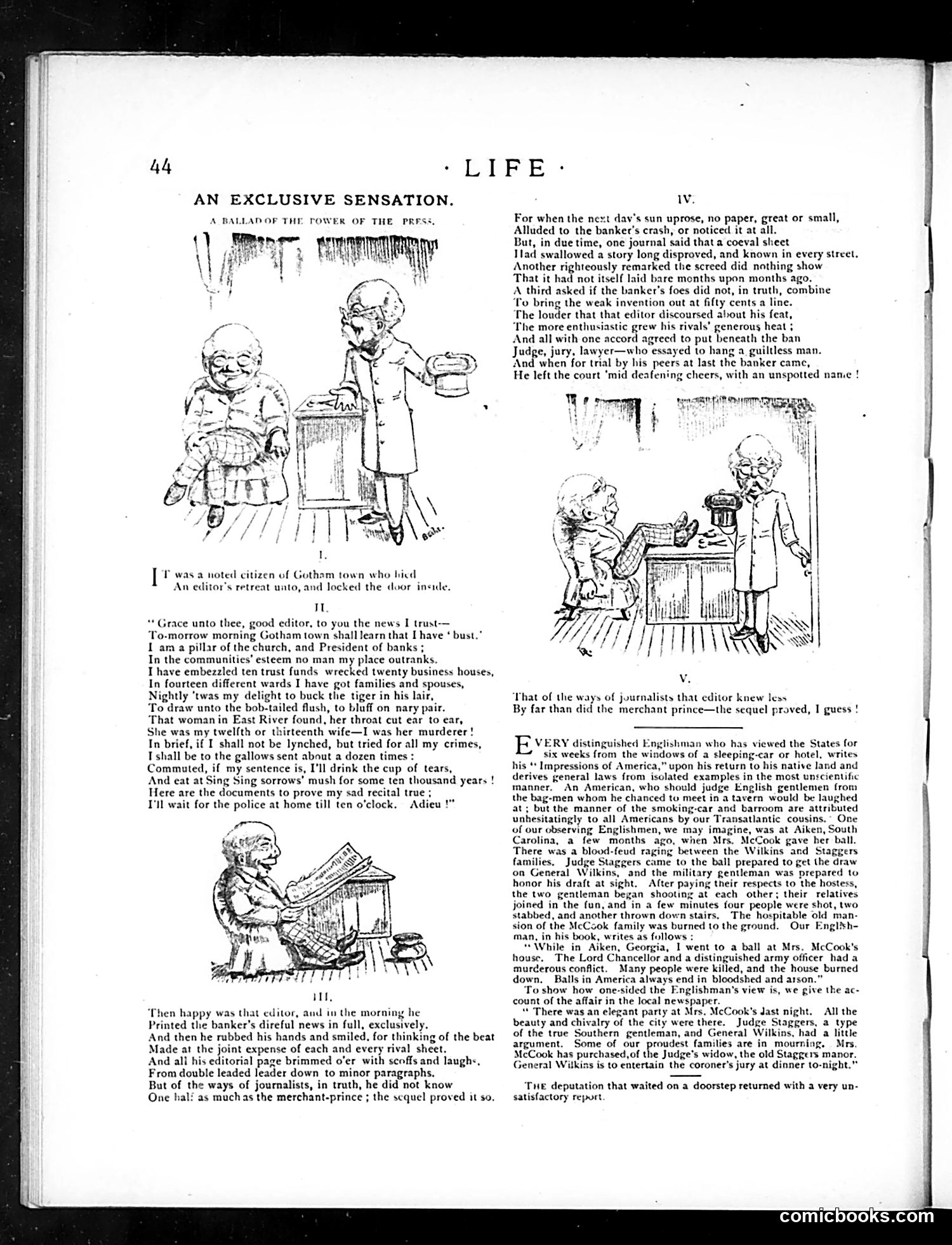
This satirical ballad mocks newspaper editors' willingness to prioritize sensational exclusives over truth and social responsibility. **The Setup:** A wealthy banker—described as embezzler, murderer, and criminal—confesses everything to an editor, who publishes the story as an exclusive "beat." The editor celebrates scooping rival papers. **The Punchline:** The next day, no other papers mention the story. When they finally speak, they collectively discredit it as old news or dismiss it as a fabrication by the banker's enemies. Rival journalists unite to suppress the story, ensuring the banker faces no consequences and leaves court with his reputation intact. **The Satire:** The joke's on the editor. His competitors didn't ignore the story because it was false—they suppressed it to punish him for getting the exclusive. Journalistic rivalry trumps both truth and justice. The "merchant-prince" (banker) manipulated the system better than the editor understood. **The Critique:** American newspapers prioritize competitive advantage over accuracy and ethics.
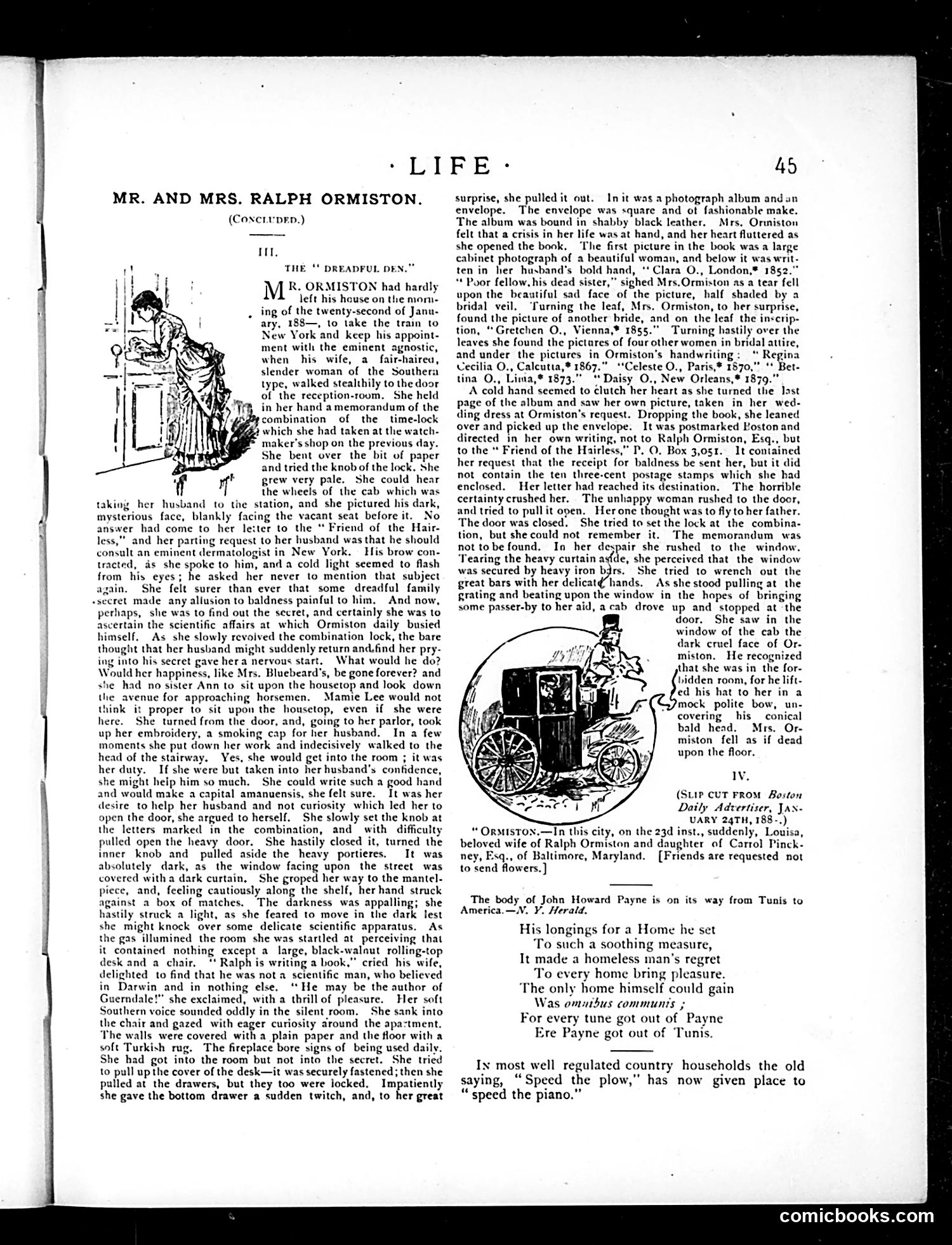
This serialized story satirizes Victorian anxieties about marriage, secrets, and gender roles. The narrative follows Mrs. Ormiston discovering her husband's locked "reception room"—a space he has kept from her. The joke plays on contemporary fears: readers initially expect sinister secrets (the Bluebeard allusion suggests infidelity or worse), but the punchline is mundane—he's merely writing a book. The satire targets both spouses: Mr. Ormiston's obsessive privacy and sensitivity about baldness appear ridiculous, while Mrs. Ormiston's curiosity and justification for snooping ("help him," "amanuensis") mock women's patronizing rationalizations for violating boundaries. The illustration shows her discovering the locked room, capturing the melodramatic tension the text undermines. The piece gently ridicules bourgeois domestic dynamics and the artificial mysteries couples maintain.
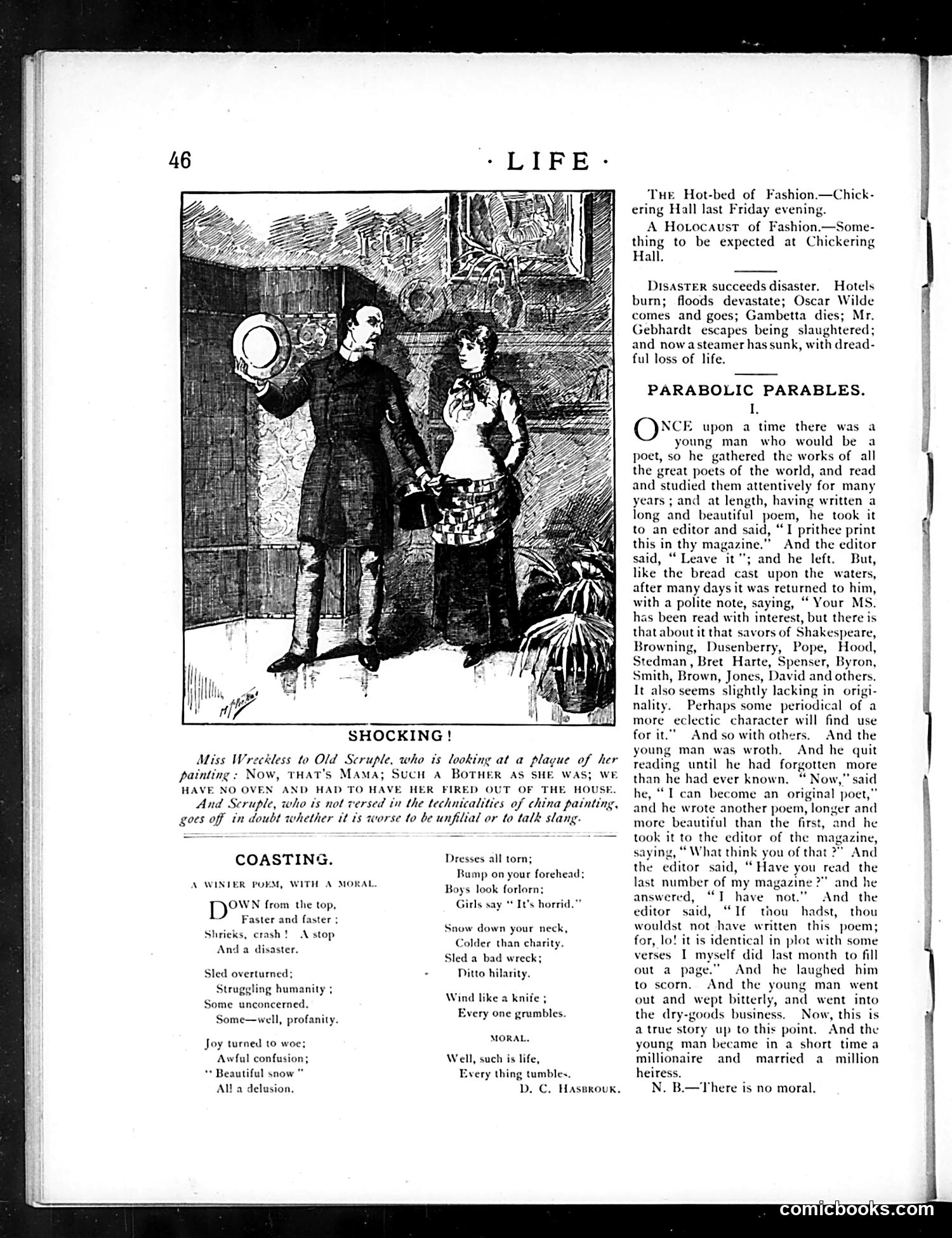
This page contains three satirical pieces typical of late 19th-century American humor: **"Coasting"** is a winter poem mocking the romanticized notion of sledding. It describes the reality—crashes, injuries, cold, and chaos—contradicting the popular sentiment about "beautiful snow," ending with the cynical moral that life is disappointingly unstable. **"Shocking!"** cartoon satirizes a conversation between "Miss Wreckless" (a careless young woman showing off a painted plaque) and "Old Scruple" (conservative elder). The joke targets both the young woman's casual rudeness ("slang") and the elder's outdated concern about propriety versus artistic incompetence. **"Parabolic Parables"** is a longer satirical fable about an aspiring poet. It mocks literary pretension: the young man studies great poets obsessively, gets rejected for derivative work, tries becoming "original," fails again, abandons literature for retail, and accidentally becomes wealthy—subverting expectations that talent or effort guarantee success. The concluding "N.B.—There is no moral" undercuts the fable form itself, suggesting life is meaninglessly random.
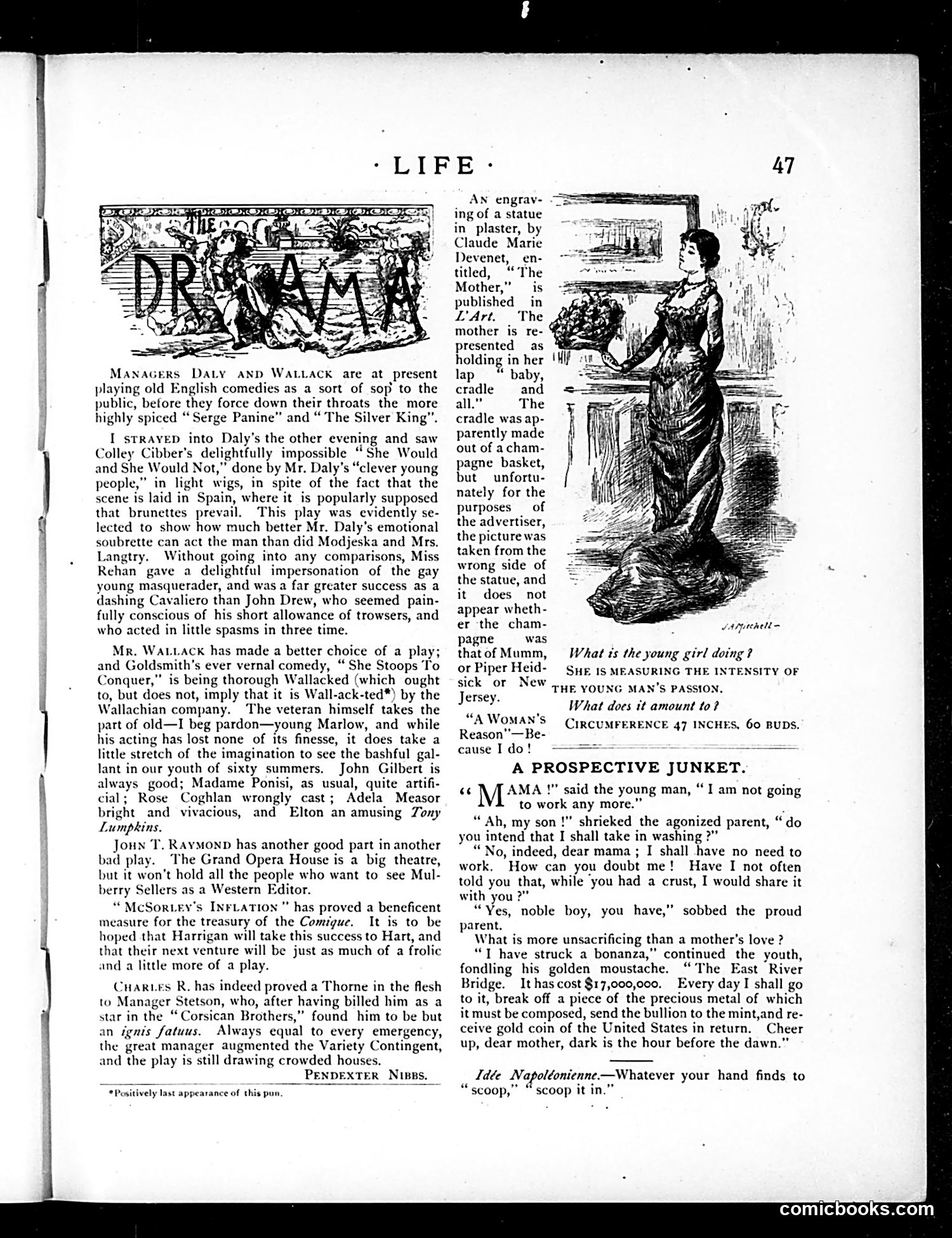
This page from *Life* contains theater reviews and satirical vignettes typical of the magazine's humorous commentary. ## Theater Reviews Critic Pendexter Nibbs reviews contemporary productions. He praises Ada Rehan's cross-dressing performance in Colley Cibber's "She Would and She Would Not" at Daly's Theatre, comparing her favorably to Modjeska and Langtry. He also covers Wallack's company performing Goldsmith's "She Stoops to Conquer," noting actor John Gilbert's competence but questioning whether the elderly Wallack can convincingly play the young Marlow. ## Cartoon Vignettes The illustrated section shows a young woman measuring a man's chest/passion intensity (captioned "circumference 47 inches, 60 buds"), a Victorian-era joke about romantic ardor quantified absurdly. "A Prospective Junket" satirizes a delusional youth claiming he's struck a bonanza and won't need to work, while his anxious mother fears poverty. The satire targets get-rich-quick schemes and youthful irresponsibility—likely relevant to 1880s economic speculation. The humor relies on theatrical in-jokes and domestic melodrama familiar to *Life's* educated readership.
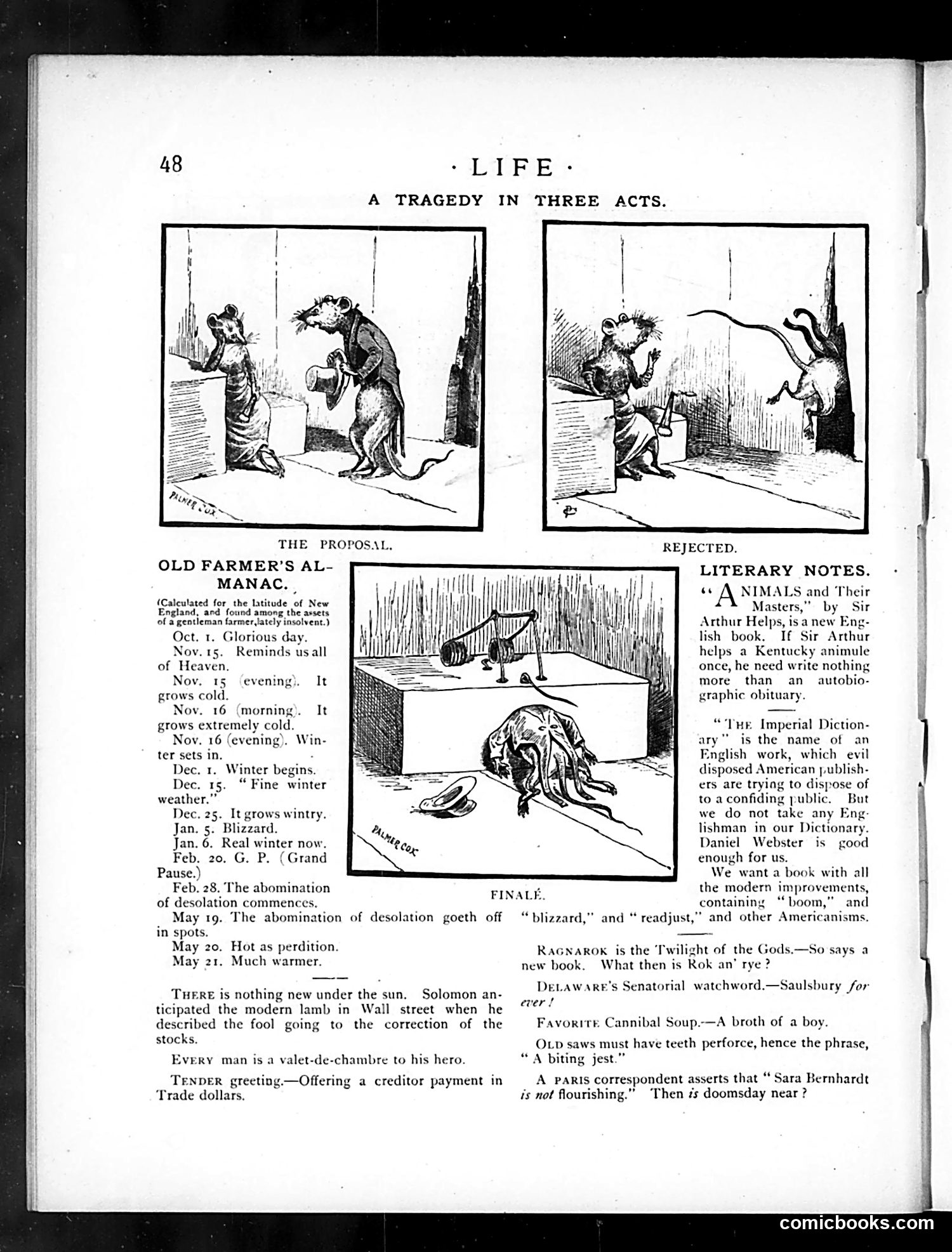
This three-panel satirical cartoon depicts a romantic proposal's arc: "The Proposal" (left), "Rejected" (right), and "Finale" (bottom). The figures appear to be anthropomorphic animals—likely a male suitor approaching a female, then being spurned, and finally shown prostrate in despair. The humor lies in the melodramatic treatment of romantic rejection as high tragedy. The accompanying "Old Farmer's Almanac" parody mocks predictable seasonal patterns and economic hardship (the farmer is "lately insolvent"), while the literary notes satirize contemporary pretensions—criticizing imported English dictionaries while championing "American" words like "boom" and "blizzard," and making jokes about minor literary figures and celebrity gossip (Sara Bernhardt). The overall effect ridicules both sentimental romance narratives and American cultural vanities of the period.
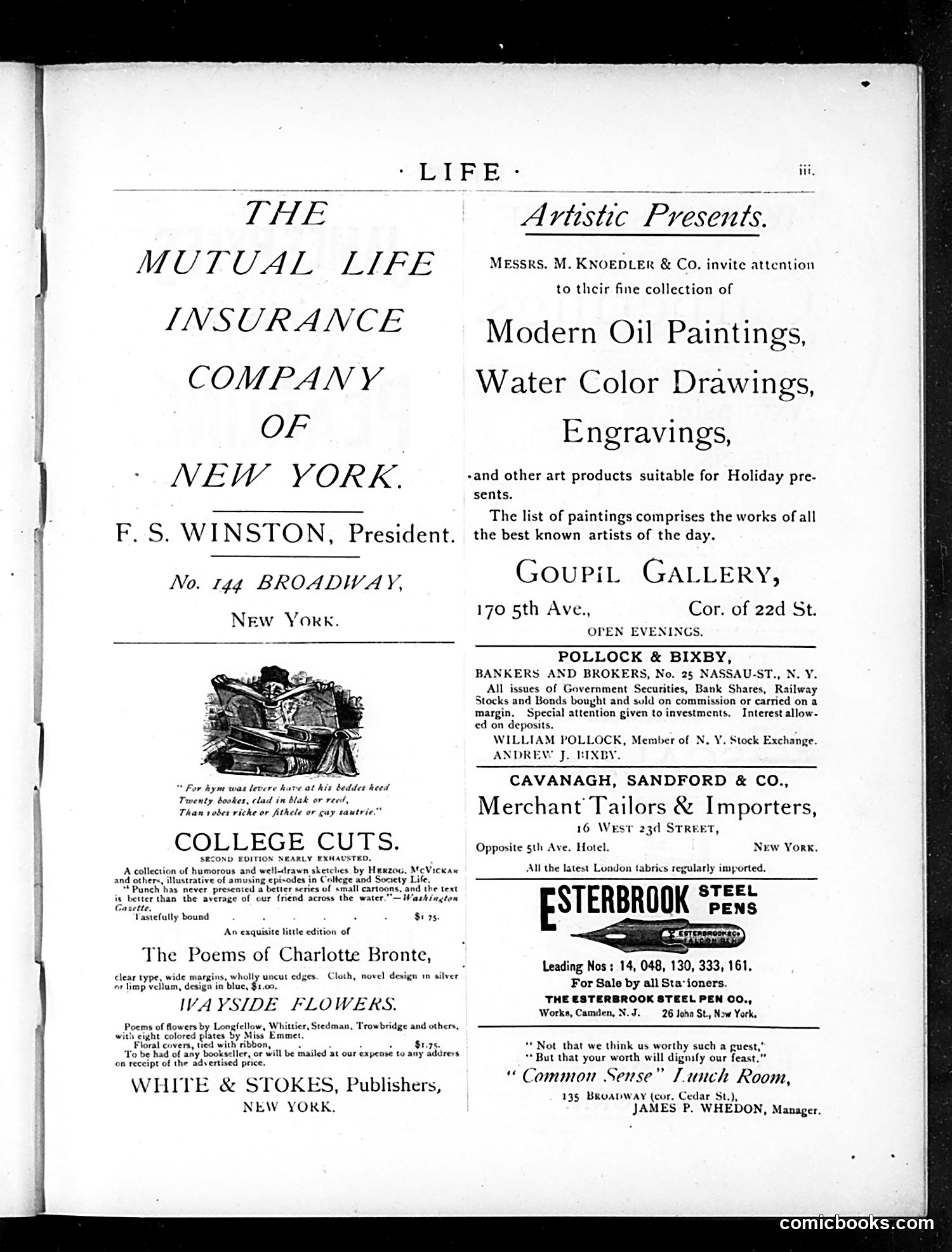
This is primarily an **advertising page** from Life magazine, not a political cartoon page. The page consists almost entirely of commercial advertisements and notices. The only illustrated content is a small **woodcut-style vignette** near the top left showing books stacked on a shelf, accompanying an advertisement for "College Cuts"—a humor book collection. The image supports the literary theme with a Chaucer quotation about preferring books to material possessions. The page advertises various products and services typical of late 19th-century New York: insurance, art galleries, merchant tailors, banking services, and pen manufacturers. There is **no political satire or social commentary** visible—this is a straightforward commercial page designed to generate revenue for the publication through paid advertisements.
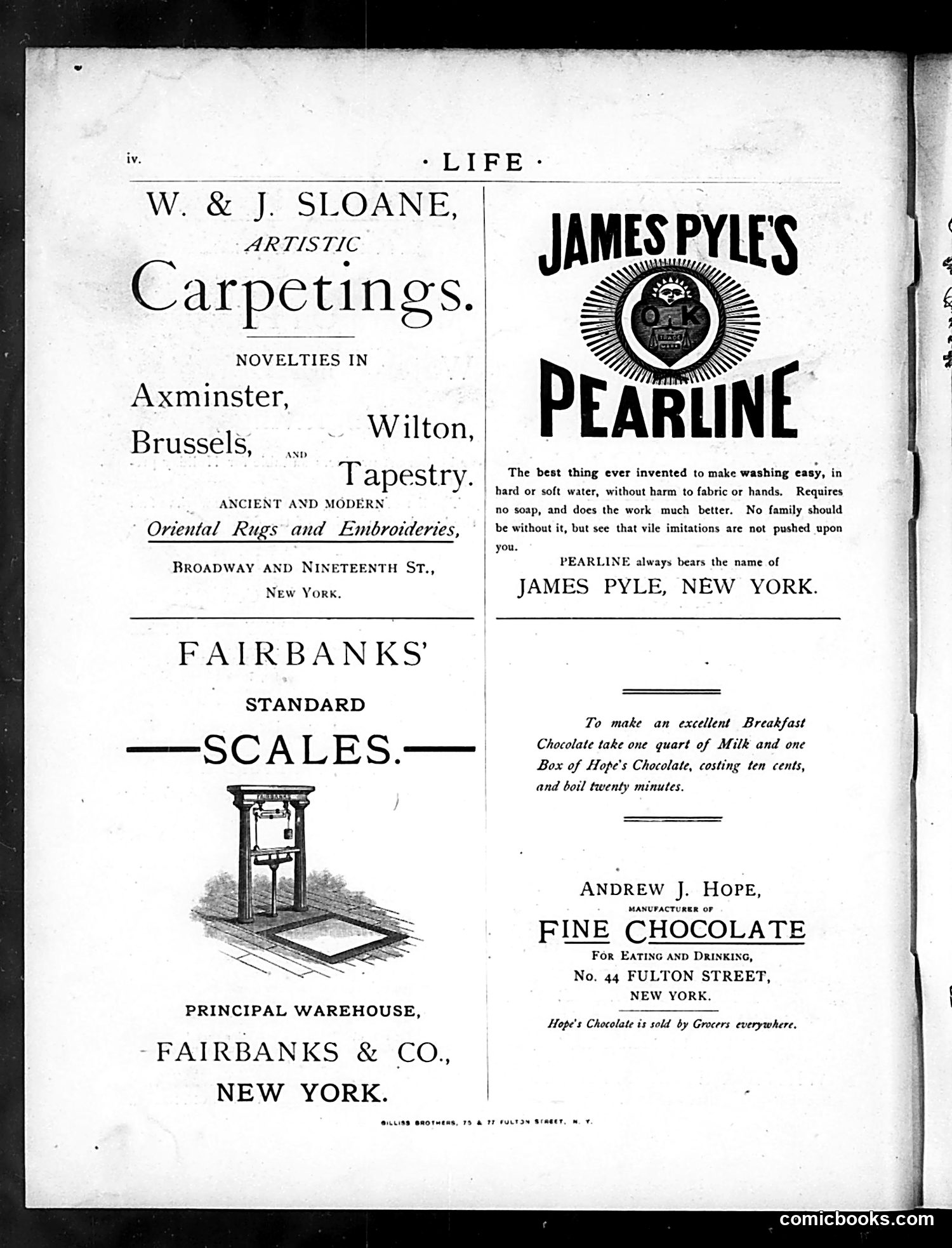
This is primarily an **advertising page**, not a cartoon or satirical content page. It contains four commercial advertisements from late 19th-century New York businesses: 1. **W. & J. Sloane** — carpet and rug merchant on Broadway 2. **James Pyle's Pearline** — a laundry/cleaning product claiming superiority over soap 3. **Fairbanks' Standard Scales** — weighing equipment for commercial use 4. **Andrew J. Hope's Fine Chocolate** — with a recipe suggestion The page reflects period advertising practices: product claims (Pearline's effectiveness without soap), price points (Hope's chocolate box costs ten cents), and distribution networks (sold "by Grocers everywhere"). There are no political references, caricatures, or satirical commentary visible—it's straightforward commercial promotion typical of Life magazine's revenue model during this era.