
Life, 1883-01-25 · page 10 of 16
Life — January 25, 1883 — page 10: what you’re looking at
What you’re looking at
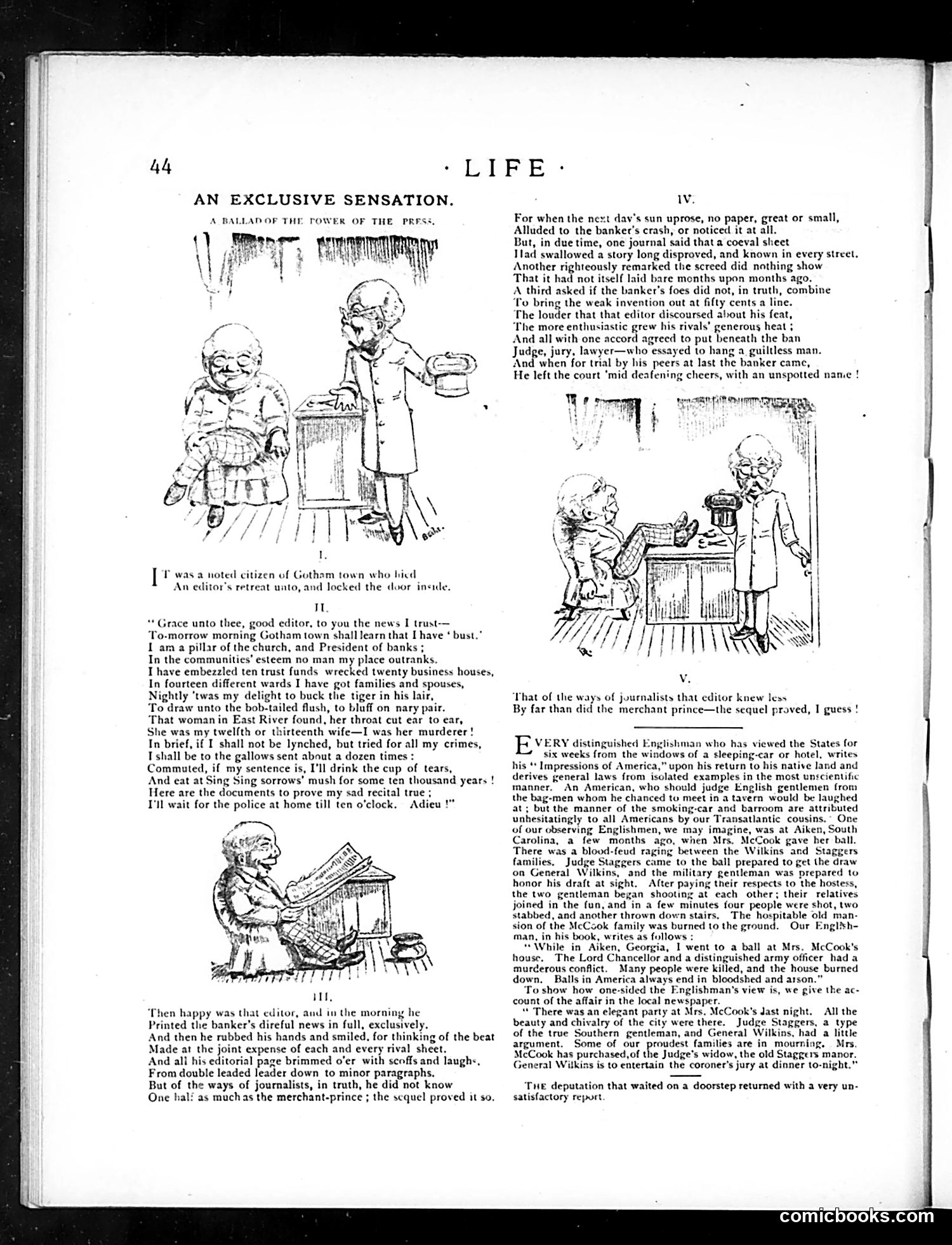
This satirical ballad mocks newspaper editors' willingness to prioritize sensational exclusives over truth and social responsibility. **The Setup:** A wealthy banker—described as embezzler, murderer, and criminal—confesses everything to an editor, who publishes the story as an exclusive "beat." The editor celebrates scooping rival papers. **The Punchline:** The next day, no other papers mention the story. When they finally speak, they collectively discredit it as old news or dismiss it as a fabrication by the banker's enemies. Rival journalists unite to suppress the story, ensuring the banker faces no consequences and leaves court with his reputation intact. **The Satire:** The joke's on the editor. His competitors didn't ignore the story because it was false—they suppressed it to punish him for getting the exclusive. Journalistic rivalry trumps both truth and justice. The "merchant-prince" (banker) manipulated the system better than the editor understood. **The Critique:** American newspapers prioritize competitive advantage over accuracy and ethics.
📄 Transcribed text from this page (OCR, searchable)
Machine-transcribed from the original scan — historical spelling and the odd misread are preserved.
44 AN EXCLUSIVE SENSATION. A BALLAD OF THE TOWER OF THE PRESS. T was a noted citizen of Gotham town who hicd An editor's retreat unto, and locked the door inside. IT “Grace unto thee, good editor, to you the news I trust— ‘To-morrow morning Gotham town shall learn that I have ‘ bust.” 1 ama pillar of the church, and President of banks ; In the communities’ esteem no man my place outranks, Thave embezzled ten trust funds wrecked twenty business houses, In fourteen different wards I have got families and spouses, Nightly ‘twas my delight to buck the tiger in his lair, To draw unto the bob-tailed flush, to bluff on nary pair. That woman in East River found, her throat cut ear to ear, She was my twelfth or thirteenth wife—I was her murderer! In brief, if I shall not be lynched, but tried for all my crimes, T shall be to the gallows sent about a dozen times : Commuted, if my sentence is, I'll drink the cup of tears, And eat at Sing Sing sorrows’ mush for some ten thousand years ! Here are the documents to prove my sad recital true ; I'll wait for the police at home till ten o'clock. Adieu !” ‘Then happy was that editor, aud in the morning he Printed the banker's direful news in full, exclusively, And then he rubbed his hands and smiled, for thinking of the beat Made at the joint expense of each and every rival sheet. And all his editorial page brimmed o'er with scoffs and laughs, From double leaded leader down to minor paragraphs. But of the ways of journalists, in truth, he did not know One half as muchas the merchant-prince ; the scquel proved it so. ‘LIFE: lv. For when the next day's sun uprose, no paper, great or small, Alluded to the banker's crash, or noticed it at all. But, in due time, one journal said that a coeval sheet Iad swallowed a story long disproved, and known in every street. Another righteously remarked the screed did nothing show That it had not itself laid bare months upon months ago. A third asked if the banker's foes did not, in truth, combine ‘To bring the weak invention out at fifty cents a line. The louder that that editor discoursed about his feat, The more enthusiastic grew his rivals’ generous heat } And all with one accord agreed to put beneath the ban Judge, jury, lawyer—who essayed to hang a guiltless man. ‘And when for trial by his peers at last the banker came, He left the court ‘mid deafening cheers, with an unspotted name ! AABN TP CITI SS That of the ways of journalists that editor knew less By far than did the merchant prince—the sequel proved, I guess ! VERY distinguished Englishman who has viewed the States for six weeks from the windows of a sleeping-car or hotel, writes his “ Impressions of America,” upon his return to his native land and derives general laws from isolated examples in the most unscientific manner. An American, who should judge English gentlemen from the bag-men whom he chanced to meet ina tavern would be laughed at; but the manner of the smoking-car and barroom are attributed unhesitatingly to all Americans by our Transatlantic cousins. ° One of our observing Englishmen, we may imagine, was at Aiken, South Carolina, a few months ago, when Mrs, McCook gave her ball. There was a blood-feud raging between the Wilkins and Staggers fi aggers came to the ball prepared to get the draw on General Wilkins, and the military gentleman was prepared to honor his draft at sight. After paying their respects to the hostess, the two gentleman began shooting at each other; their relatives joined in the fun, and in a few minutes four people were shot, two stabbed, and another thrown down stairs, The hospitable old man- sion of the McCcok family was burned to the ground. Our Englsh- man, in his book, writes as follows : “While in Aiken, Georgia, I went to a ball at Mrs. McCook’s house, The Lord Chancellor and a distinguished army officer had a murderous conflict. Many people were killed, and the house burned down, Balls in America always end in bloodshed and arson.” To show how one-sided the Englishman's view is, we give the ac- count of the affair in the local newspaper. “ There was an elegant party at Mrs. McCook's Jast night. All the beauty and chivalry of the city were there. Judge Staggers, a type of the true Southern gentleman, and General Wilkins, had a little argument. Some of our proudest families are in mourning. Mrs MeCook has purchased, of the Judge's widow, the old Staggers manor, General Wilkins is to entertain the coroner's jury at dinner to-night,” ‘Tne deputation that waited on a doorstep returned with a very un- satisfactory report.