
Life, 1883-01-25 · page 4 of 16
Life — January 25, 1883 — page 4: what you’re looking at
What you’re looking at
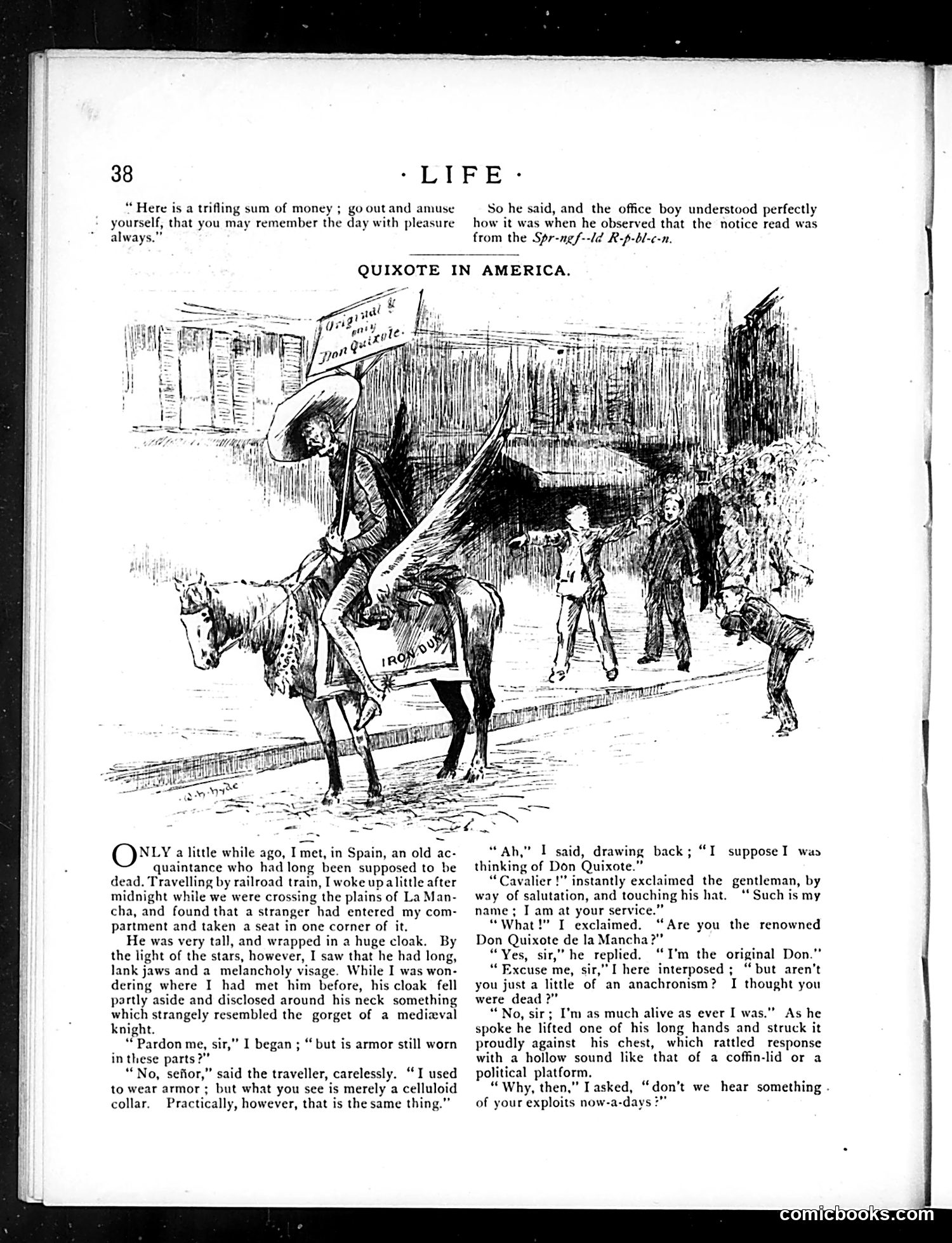
This satirical piece compares a modern American to Don Quixote, Cervantes's delusional knight-errant. The illustration shows a man mounted on a horse labeled "Iron Don," carrying a banner reading "Original & Only Don Quixote," parading through an American street while onlookers react with bemusement. The satire works on multiple levels: the figure claims to be "the original Don" and boasts of his exploits, yet clearly represents someone either genuinely confused about his importance or fraudulently trafficking in false credentials—a common American con. The conversation reveals the pretender hasn't been heard from in years, suggesting he's either an obscure failed businessman or a charlatan reviving an abandoned scheme to fleece a credulous public. The "Iron Don" horse label likely mocks his claims to knightly authenticity.
📄 Transcribed text from this page (OCR, searchable)
Machine-transcribed from the original scan — historical spelling and the odd misread are preserved.
38 “ Here is a trifling sum of money ; go out and amuse yourself, that you may remember the day with pleasure always.” So he said, and the office boy understood perfectly how it was when he observed that the notice read was from the Spr-ng/--ld R-p-bl-c-n. QUIXOTE IN AMERICA. NLY a little while ago, I met, in Spain, an old ac- quaintance who had long been supposed to be dead. Travelling by railroad train, [woke upalittle after midnight while we were crossing the plains of La Man- cha, and found that a stranger had entered my com- partment and taken a seat in one corner of it. He was very tall, and wrapped in a huge cloak. By the light of the stars, however, I saw that he had long, lank jaws and a melancholy visage. While I was won- dering where I had met him before, his cloak fell partly aside and disclosed around his neck something which strangely resembled the gorget of a medizval knight. “Pardon me, sir,” I began ; “ but is armor still worn in these parts?” “No, sefior,” said the traveller, carelessly. “I used to wear armor ; but what you see is merely a celluloid collar. Practically, however, that is the same thing.” “Ah,” I said, drawing back; “I thinking of Don Quixote.” “Cavalier! instantly exclaimed the gentleman, by way of salutation, and touching his hat. ‘* Such is my name; I am at your service.” “What!” I exclaimed. “Are you the renowned Don Quixote de la Mancha?” “Yes, sir,” he replied. “I’m the original Don.” “Excuse me, sir,” I here interposed ; “but aren’t you just a little of an anachronism? I thought you were dead ?” “No, sir; I’m as much alive as ever I was.” As he spoke he lifted one of his long hands and struck it proudly against his chest, which rattled response with a hollow sound like that of a coffin-lid or a political platform, “Why, then,” Iasked, “don’t we hear something . of your exploits now-a-days ?” suppose I was