
Life, 1883-01-25 · page 5 of 16
Life — January 25, 1883 — page 5: what you’re looking at
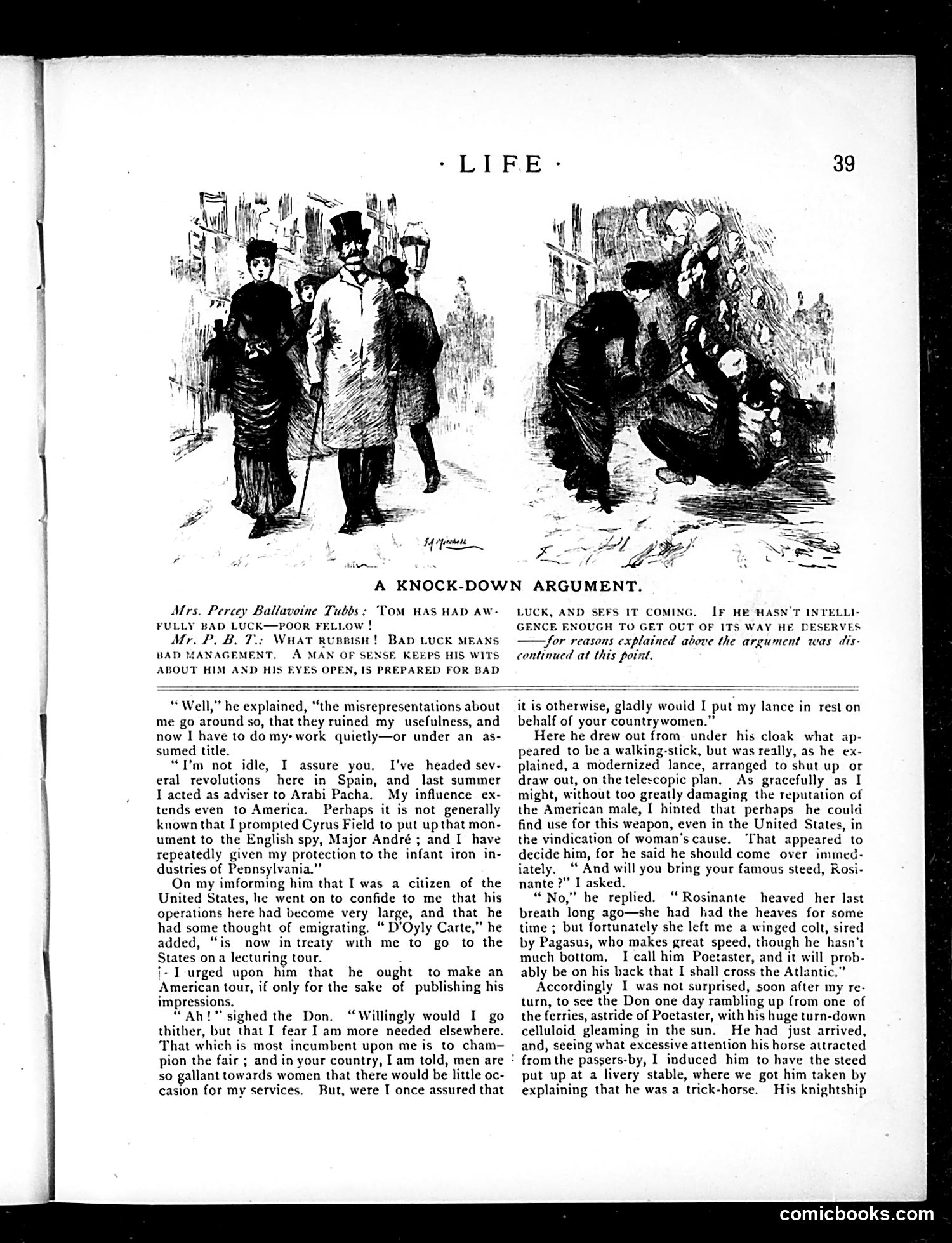
What you’re looking at
This satirical cartoon illustrates a social class conflict common in Gilded Age America. The left panel shows well-dressed, upper-class figures on a city street, while the right depicts working-class people huddled together, apparently homeless or impoverished. The caption presents a callous argument: a wealthy woman (Mrs. Percy Ballavoine Tubbs) dismisses poverty as the fault of the poor themselves, claiming bad luck results from lack of intelligence. The accompanying text—a gentleman's response—sarcastically refutes this, noting that prepared people survive misfortune while the unprepared suffer. The cartoon critiques both the wealthy's indifference to systematic poverty and the myth that poverty results from personal failing rather than circumstance. It's a pointed commentary on Gilded Age inequality and class attitudes toward the poor.
📄 Transcribed text from this page (OCR, searchable)
Machine-transcribed from the original scan — historical spelling and the odd misread are preserved.
nN “ LALEE * 39 cA ayeccbaete ae Lin Mrs. Percey Ballavoine Tubbs: Tom HAS HAD AW- FULLY BAD LUCK—POOR FELLOW ! Mr. P. B. 7.;: WHat Ruppish! BAD LUCK MEANS BAD MANAGEMENT. A MAN OF E KEEPS HIS WITS ABOUT HIM AND HIS EYES OPEN, IS PREPARED FOR BAD A KNOCK-DOWN ARGUMENT. LUCK, AND SIT COMI If HE HASN'T INTELLI- GENCE ENOUGH TO GET OUT OF ITS WAY HE DESERVES for reasons explained above the argument was dis- continued at this pont. “ Well,” he explained, “the misrepresentations about me go around so, that they ruined my usefulness, and now I have to do my- work quietly—or under an as- sumed title. “I'm not idle, I assure you. I’ve headed sev- eral revolutions here in Spain, and last summer I acted as adviser to Arabi Pacha. My influence ex- tends even to America. Perhaps it is not generally known that I prompted Cyrus Field to put up that mon- ument to the English spy, Major André ; and I have repeatedly given my protection to the infant iron in- dustries of Pennsylvania.” On my imforming him that I was a citizen of the United States, he went on to confide to me that his operations here had become very large, and that he had some thought of emigrating. “ D'Oyly Carte,” he added, “is now in treaty with me to go to the States ona lecturing tour. . ij- I urged upon him that he ought to make an American tour, if only for the sake of publishing his impressions. “Ab!” sighed the Don. “Willingly would I go thither, but that I fear I am more needed elsewhere. That which is most incumbent upon me is to cham— pion the fair ; and in your country, I am told, men are * so gallant towards women that there would be little oc- casion for my services. Rut, were [ once assured that it is otherwise, gladly would I put my lance in rest on behalf of your countrywomen.” Here he drew out from under his cloak what ap- peared to bea walking-stick, but was really, as he ex- plained, a modernized lance, arranged to shut up or draw out, on thetelescopic plan. As gracefully as I might, without too greatly damaging the reputation of the American male, I hinted that perhaps he could find use for this weapon, even in the United States, in the vindication of woman's cause. That appeared to decide him, for he said he should come over immed- iately, “ And will you bring your famous steed, Rosi- nante ?”’ I asked. “No,” he replied. ‘“ Rosinante heaved her last breath long ago—she had had the heaves for some time ; but fortunately she left me a winged colt, sired by Pagasus, who makes great speed, though he hasn’t much bottom, I call him Poetaster, and it will prob- ably be on his back that I shall cross the Atlantic.” Accordingly I was not surprised, soon after my re- turn, to sce the Don one day rambling up from one of the ferries, astride of Poetaster, with his huge turn-down celluloid gleaming in the sun. He had just arrived, and, seeing what excessive attention his horse attracted from the passers-by, I induced him to have the steed put up at a livery stable, where we got him taken by explaining that he was a trick-horse. His knightship comicbooks.com