
Life, 1883-01-25 · page 11 of 16
Life — January 25, 1883 — page 11: what you’re looking at
What you’re looking at
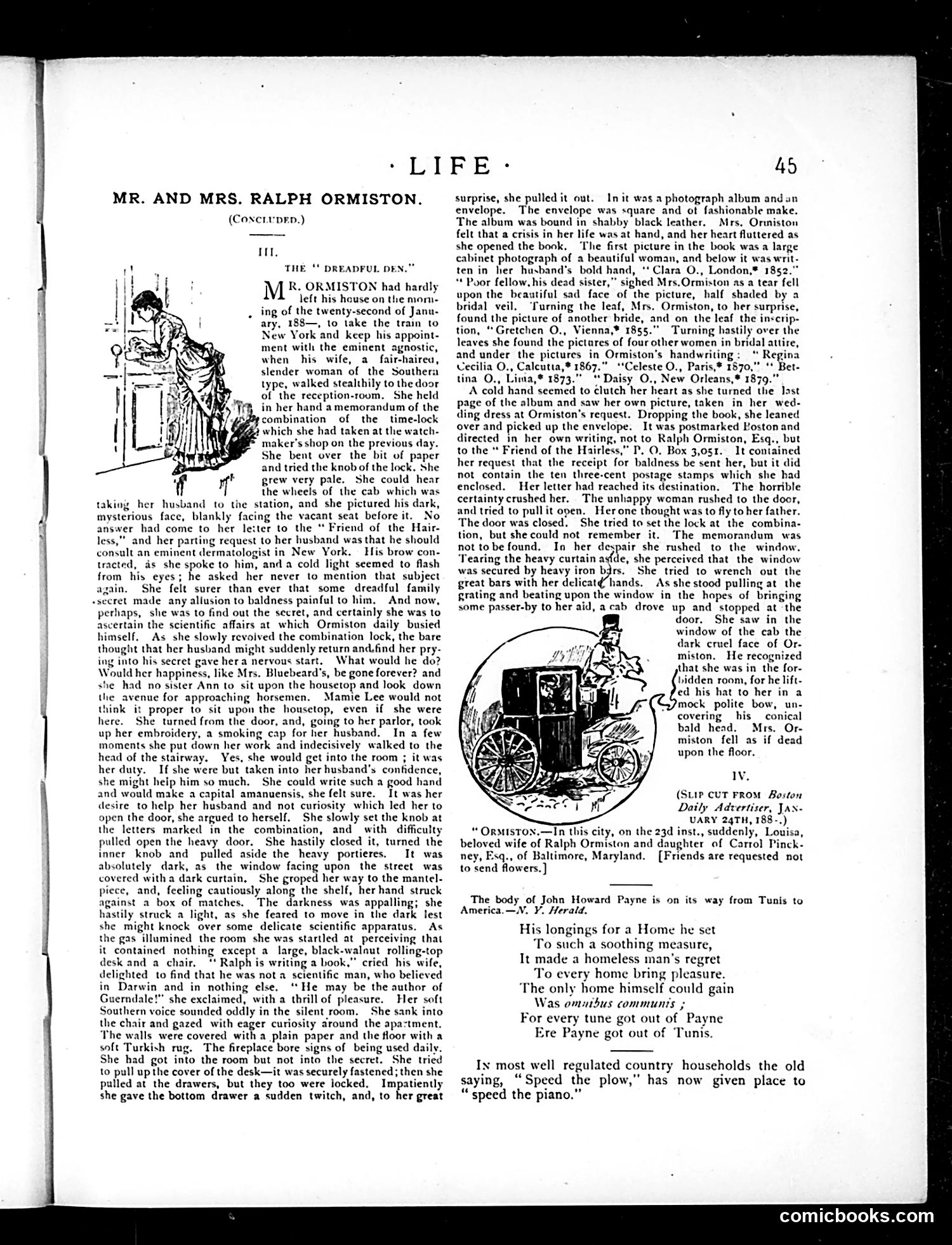
This serialized story satirizes Victorian anxieties about marriage, secrets, and gender roles. The narrative follows Mrs. Ormiston discovering her husband's locked "reception room"—a space he has kept from her. The joke plays on contemporary fears: readers initially expect sinister secrets (the Bluebeard allusion suggests infidelity or worse), but the punchline is mundane—he's merely writing a book. The satire targets both spouses: Mr. Ormiston's obsessive privacy and sensitivity about baldness appear ridiculous, while Mrs. Ormiston's curiosity and justification for snooping ("help him," "amanuensis") mock women's patronizing rationalizations for violating boundaries. The illustration shows her discovering the locked room, capturing the melodramatic tension the text undermines. The piece gently ridicules bourgeois domestic dynamics and the artificial mysteries couples maintain.
📄 Transcribed text from this page (OCR, searchable)
Machine-transcribed from the original scan — historical spelling and the odd misread are preserved.
cna i THE ‘ DREADFUL DE | { 4 ME, ORMISTON had hardly * LIFE: 45 MR. AND MRS. RALPH ORMISTON. (Coxciupep.) left his house on the mom- ing of the twenty-second of Janu- ary, 188—, to take the train to New York and keep his appoint- ment with the eminent agnost when his wife, a fair-hairea, slender woman of the Southera type, walked stealthily to the door of the reception-room, She held in her hand a memorandum of the Bycombination of the time-lock which she had taken at the watch- maker's shop on the previous day. She bent over the bit of paper and tried the knob of the lock. She grew very pale. She could hear the wheels of the cab which was taking her husband to the station, and she pictured his dark, mysterious face, blankly facing the vacant seat before it. No answer had come to her letter to the * Friend of the Hair- less," and her parting request to her husband was that he should consult an eminent dermatologist in New York, His brow con- tracted, as she spoke to him, anda cold light seemed to flash from his eyes; he asked her never to mention that subject again. She felt surer than ever that some dreadful family t made any allusion to baldness painful to him. And now, perhaps, she was to find out the secret, and certainly she was to ascertain the scientific affairs at which Ormiston daily busied himself. As she slowly revoived the combination lock, the bare thought that her husband might suddenly return and.find her pry- ing into his secret gave hera nervous start, What would he do? Would her happiness, like Mrs. Bluebeard’s, be gone forever? and she had no sister Ann to sit upon the housetop and look down the avenue for approaching horsemen. Mamie Lee would not think it proper to sit upon the housetop, even if she were here. She turned from the door, and, going to her parlor, took up her embroidery, a smoking cap for her husband. In a few moments she put down her work and indecisively walked to the head of the stairway, Yes, she would get into the room ; it was her du If she were but taken into her husband's confidence, she might help him so much. She could write such a good hand and would make a capital amanuensis, she felt sure. It was her desire to help her husband and not curiosity which led her to open the door, she argued to herself, She slowly set the knob at the letters marked in the combination, and with difficulty pulled open the heavy door. She hastily closed it, turned the inner knob and pulled aside the heavy portieres. It was absolutely dark, as the window facing upon the street was covered witha dark curtain, She groped her way to the mantel- piece, and, feeling cautiously along the shelf, her hand struck against a box of matches. The darkness was appalling; she hastily struck a light, as she feared to move in the dark lest she might knock over some delicate scientific apparatus. As the gas illumined the room she was startled at perceiving that it contained nothing except a ge, black-walnut rolling-top desk and a chair, ‘* Ralph is writing a book,” cried his wife, delighted to find that he was nota scientific man, who believed in Darwin and in nothing else. ‘He may be the author of Guerndale!” she exclaimed, with a thrill of pleasure. Her soft Southern voice sounded oddly in the silent room. She sank into the chair and gazed with eager curiosity around the apa-tment. ‘The walls were covered with a plain paper and the floor with a soft Turkish rug. The fireplace bore signs of being used daily. She had got into the room but not into the secret. She tried to pull up the cover of the desk—it was securely fastened; then she pulled at the drawers, but they too were locked. Impatiently she gave the bottom drawer a sudden twitch, and, to her great surprise, she pulled it out. In it was a photograph album and an envelope. The envelope was square and ot fashionable make. The album bound in shabby black leather. Mrs. Ormiston felt that a crisis in her life was at hand, and her heart fluttered as she opened the book. ‘The first picture in the book was a large cabinet photograph of a beautiful woman, and below it was writ- nin her hasband's bold hand, ‘* Clara O., London,* 1852. Poor fellow, his dead sister,” sighed Mrs.Ormiston as a tear fell upon the beautiful sad face of the picture, half shaded by a bridal veil. ‘Turning the leaf, Mrs. Ormiston, to her surprise, found the picture of another bride, and on the leaf the inscrip. tion, “Gretchen O., Vienna,® 1855." Turning hastily over the leaves she found the pictares of four other women in brid inder the pictures in Ormiston’s handwriting : “Celeste O., Paris,* 1570, “Daisy O., New Orleans,® 1879.” A cold hand seemed to clutch her heart as she turned the last page of the album and saw her own picture, taken in her wed- ding dress at Ormiston’s request. Dropping the book, she leaned over and picked up the envelope. It was postmarked Eoston and directed in her own writing, not to Ralph Ormiston, Esq., but to the “ Friend of the Hairless,” P, O, Box 3,051. It contained her request that the receipt for baldness be sent her, but it did not contain the ten three-cent postage stamps which she had enclosed. Her letter had reached its destination. The horrible certainty crushed her. The unhappy woman rushed to the door, and tried to pullit open. Herone thought was to fly to her father. The door was closed. She tried to set the lock at the combina- tion, but she could not remember it. The memorandum was not tobe found. In her deypair she rushed to the window. ‘Tearing the heavy curtain Pi je, she perceived that the window was secured by heavy iron b; She tried to wrench out the great bars with her delicat¢/hands. As she stood pulling at the grating and beating upon the window in the hopes of bringing some passer-by to her aid, acab drove up and stopped at the door, She saw in the window of the cab the dark cruel face of Or- miston. He recognized that she was in the for- hidden room, for he lift- ed his hat to her in a mock polite bow, un- covering his conical bald head. Mrs. Or- miston fell as if dead upon the floor. Iv, (SLIP CUT FROM Boston Daily Advertiser, Jax- UARY 24TH, 188 Orsistox.—In this city, on the 23d inst., suddenly, Louisa, beloved wife of Ralph Ormiston and daughter of Carrol Pinck- ney, Esq., of Baltimore, Maryland. [Friends are requested not to send flowers. ] The body of John Howard Payne is on its way from Tunis to America.—N. ¥. Herald. His longings for a Home he set To such a soothing measure, It made a homeless man’s regret To every home bring pleasure. The only home himself could gain Was omuthus communis ; For every tune got out of Payne Ere Payne got out of Tunis. Ix most well regulated country households the old saying, “Speed the plow,” has now given place to “speed the piano.” comicbooks.com