
Life, 1883-01-25 · page 12 of 16
Life — January 25, 1883 — page 12: what you’re looking at
What you’re looking at
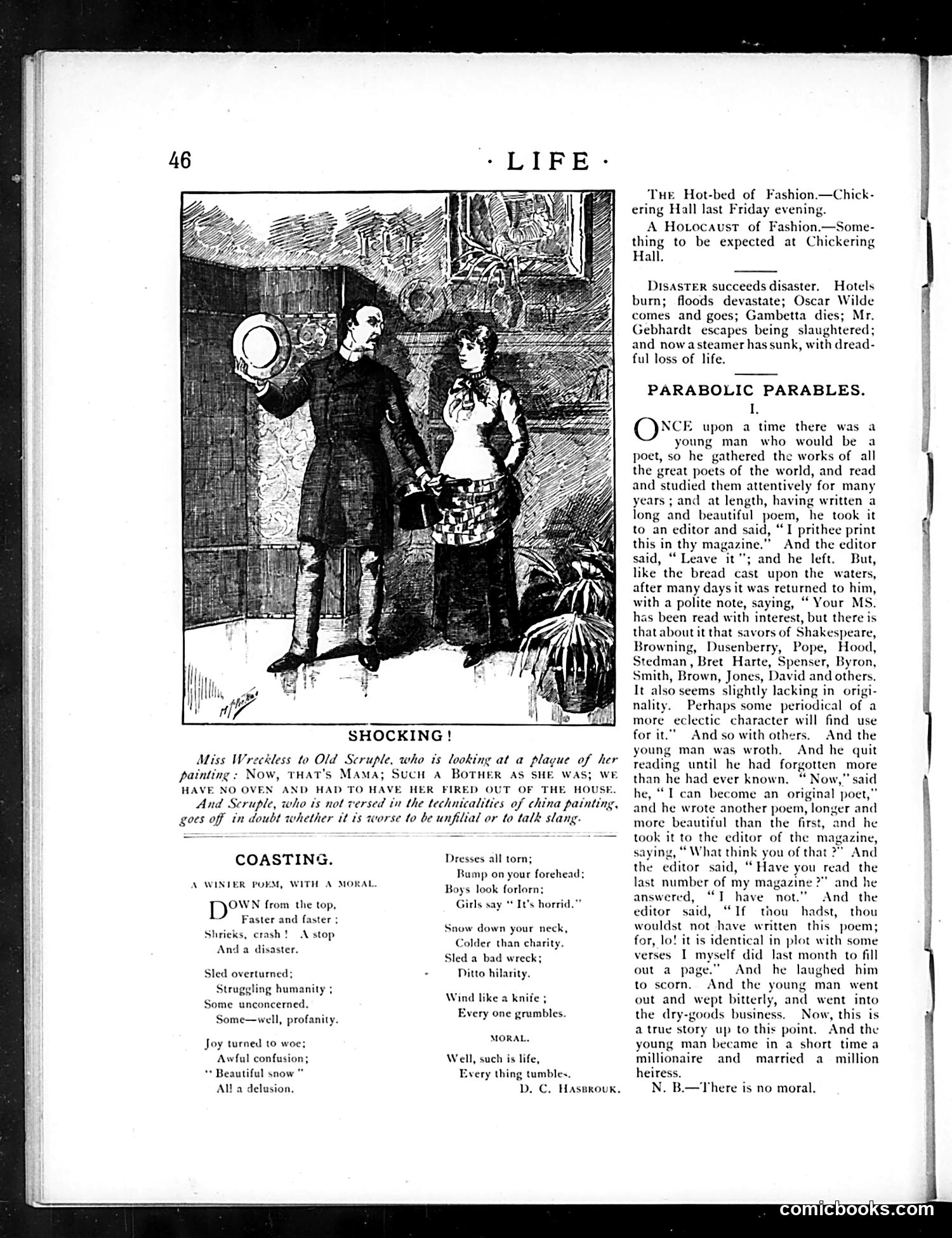
This page contains three satirical pieces typical of late 19th-century American humor: **"Coasting"** is a winter poem mocking the romanticized notion of sledding. It describes the reality—crashes, injuries, cold, and chaos—contradicting the popular sentiment about "beautiful snow," ending with the cynical moral that life is disappointingly unstable. **"Shocking!"** cartoon satirizes a conversation between "Miss Wreckless" (a careless young woman showing off a painted plaque) and "Old Scruple" (conservative elder). The joke targets both the young woman's casual rudeness ("slang") and the elder's outdated concern about propriety versus artistic incompetence. **"Parabolic Parables"** is a longer satirical fable about an aspiring poet. It mocks literary pretension: the young man studies great poets obsessively, gets rejected for derivative work, tries becoming "original," fails again, abandons literature for retail, and accidentally becomes wealthy—subverting expectations that talent or effort guarantee success. The concluding "N.B.—There is no moral" undercuts the fable form itself, suggesting life is meaninglessly random.
📄 Transcribed text from this page (OCR, searchable)
Machine-transcribed from the original scan — historical spelling and the odd misread are preserved.
HAVE COASTING. \ WINTER POEM, WITH A MORAL OWN from the top, aster and faster ; Shrieks, crash! A stop And a disaster. Sled overturned; Struggling humanity ; Some unconcerned. Some—well, profanity. Joy turned to woe: Awful confusion; “+ Beautiful snow " All a delusion, O OVEN AND HAD TO HAVE SHOCKING! Miss Wreckless to Old Scruple, who is looking at a plague of her painting: Now, THAT'S MaMa; Such A BOTHER AS SHE WAS; WE HER FIRED OUT OF THE HOU And Scruple, who is not versed in the technicalities of china painting, goes off in doubt whether it is worse to be unfilial or to talk slang. Dresses all torn; Rump on your forehead: Boys look forlorn: Girls say “It's horrid.” Snow down your neck, Colder than charity. Sled a bad wreck; Ditto hilarity. Wind like a kniée ; Every one grumbles. MORAL, Well, such is life, very thing tumbles. D, C, Hassroux, Tue Hot-bed of Fashion.—Chick- ering Hall last Friday evening. A Hotocavust of Fashion.—Some- thing to be expected at Chickering Hall, Disaster succeeds disaster. Hotels burn; floods devastate; Oscar Wilde comes and goes; Gambetta dies; Mr. Gebhardt escapes being slaughtered; and now asteamer has sunk, with dread- ful loss of life. PARABOLIC PARABLES. I, O "E upon a time there was a young man who would be a poet, so he gathered the works of all the great poets of the world, and read and studied them attentively for many years ; and at length, having written a long and beautiful poem, he took it to an editor and said, “I prithee print th thy magazine.” And the editor said, “ Leave it; and he left. But, like the bread cast upon the waters, after many days it was returned to him, with a polite note, saying, “ Your MS. has been read with interest, but there is that about it that savors of Shakespeare, Browning, Dusenberry, Pope, Hood, Stedman, Bret Harte, Spenser, Byron, Smith, Brown, Jones, David and others. It also seems slightly lacking in origi- i s some periodical of a clectic character will find use for it.” And so with others. And the young man was wroth. And he quit reading until he had forgotten more than he had ever known. “ Now,” said he, “I can become an original poct,” and he wrote another poem, longer and more beautiful than the first, and he took it to the editor of the magazine, saying, “ What think you of that ?” And the editor said, “Have you read the last number of my magazi and he answered, “JT have not.” And the editor said, “If thou hadst, thou wouldst not have written this poem; for, lo! it is identical in plot with some verses I myself did last month to fill out a page.” And he laughed him to scorn. And the young man went out and wept bitterly, and went into the dry-goods business. Now, this is a true story up to this point. And the young man became in a short time a millionaire and = married a_ million heiress. N. B.—There is no moral. > ane = a