
Life, 1883-01-25 · page 3 of 16
Life — January 25, 1883 — page 3: what you’re looking at
What you’re looking at
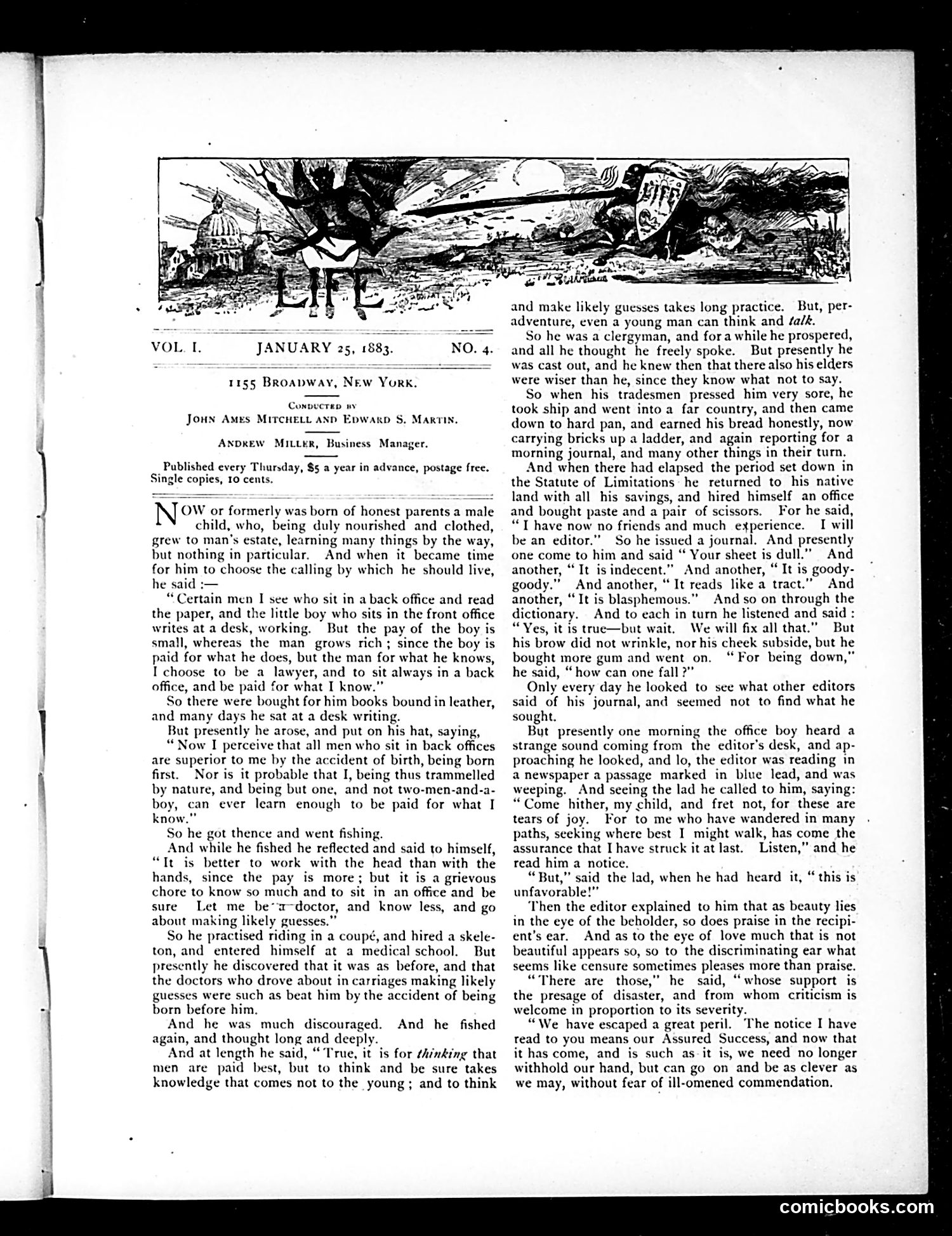
This page from *Life* (January 25, 1883) contains a serialized story titled "Andrew Miller, Business Manager," not a political cartoon. The narrative describes a young man of humble origins who struggles to find his calling. After attempting various professions—lawyer, doctor—he eventually becomes a newspaper editor and publishes a journal. The story illustrates 19th-century themes of ambition, self-improvement, and social mobility through honest work. It celebrates the newspaper industry as an accessible path to success for enterprising young men. The tale appears to be gentle social commentary on vocational choices and perseverance rather than political satire. The illustration at the top simply depicts the protagonist.
📄 Transcribed text from this page (OCR, searchable)
Machine-transcribed from the original scan — historical spelling and the odd misread are preserved.
A - Conpucrep ny JOHN Ames MITcHELL AND Epwaxp S, MARTIN, ANDREW MILLER, Business Manager. Published every Thursday, $5 a year in advance, postage free. Single copies, 10 cents. Now or formerly was born of honest parents a male child, who, being duly nourished and clothed, grew to man’s estate, learning many things by the way, but nothing in particular. And when it became time for him to choose the calling by which he should live, he said :— “Certain men I see who sit in a back office and read the paper, and the little boy who sits in the front office writes at a desk, working. But the pay of the boy is small, whereas the man grows rich ; since the boy is paid for what he does, but the man for what he knows, I choose to be a lawyer, and to sit always in a back office, and be paid for what I know.” So there were bought for him books bound in leather, and many days he sat at a desk writing. But presently he arose, and put on his hat, saying, “Now I perceive that all men who sit in back offices are superior to me by the accident of birth, being born first. Nor is it probable that I, being thus trammelled by nature, and being but one, and not two-men-and-a- boy, can ever learn enough to be paid for what I know.” So he got thence and went fishing. And while he fished he reflected and said to himself, “Tt is better to work with the head than with the hands, since the pay is more; but it is a grievous chore to know so much and to sit in an office and be sure Let me be*a-doctor, and know less, and go about making likely guesses,” So he practised riding in a coupé, and hired a skele- ton, and entered himself at a medical school. But presently he discovered that it was as before, and that the doctors who drove about in carriages making likely guesses were such as beat him by the accident of being born before him. And he was much discouraged. And he fished again, and thought long and deeply. And at length he said, “ True, it is for ¢hinking that men are paid best, but to think and be sure takes knowledge that comes not to the young; and to think and make likely guesses takes long practice. But, per- adventure, even a young man can think and ¢éa/&. So he was a clergyman, and fora while he prospered, and all he thought he freely spoke. But presently he was cast out, and he knew then that there also his elders were wiser than he, since they know what not to say. So when his tradesmen pressed him very sore, he took ship and went into a far country, and then came down to hard pan, and earned his bread honestly, now carrying bricks up a ladder, and again reporting for a morning journal, and many other things in their turn. And when there had elapsed the period set down in the Statute of Limitations he returned to his native land with all his savings, and hired himself an office and bought paste and a pair of scissors. For he said, “T have now no friends and much experience. I will be an editor.” So he issued a journal. And presently one come to him and said “ Your sheet is dull.” And another, “It is indecent.” And another, “ It is goody- goody.” And another, “It reads like a tract.” And another, “It is blasphemous.” And so on through the dictionary. And to each in turn he listened and said : “Yes, it is true—but wait. We will fix all that.” But his brow did not wrinkle, nor his cheek subside, but he bought more gum and went on. “For being down,” he said, “ how can one fall ?” Only every day he looked to see what other editors said of his journal, and seemed not to find what he sought. But presently one morning the office boy heard a strange sound coming from the editor's desk, and ap- proaching he looked, and lo, the editor was reading in a newspaper a passage marked in blue lead, and was weeping. And seeing the lad he called to him, saying: “Come hither, my child, and fret not, for these are tears of joy. For to me who have wandered in many paths, seeking where best I might walk, has come the assurance that I have struck itat last. Listen,” and he read him a notice. “But,” said the lad, when he had heard it, “ this is unfavorable!” Then the editor explained to him that as beauty lies in the eye of the beholder, so does praise in the recipi- ent’s ear. And as to the eye of love much that is not beautiful appears so, so to the discriminating ear what seems like censure sometimes pleases more than praise. “There are those,” he said, “whose support is the presage of disaster, and from whom criticism is welcome in proportion to its severity. “We have escaped a great peril. The notice I have tead to you means our Assured Success, and now that it has come, and is such as-it is, we need no longer withhold our hand, but can go on and be as clever as we may, without fear of ill-omened commendation. comicbooks.com