
Life, 1883-01-25 · page 6 of 16
Life — January 25, 1883 — page 6: what you’re looking at
What you’re looking at
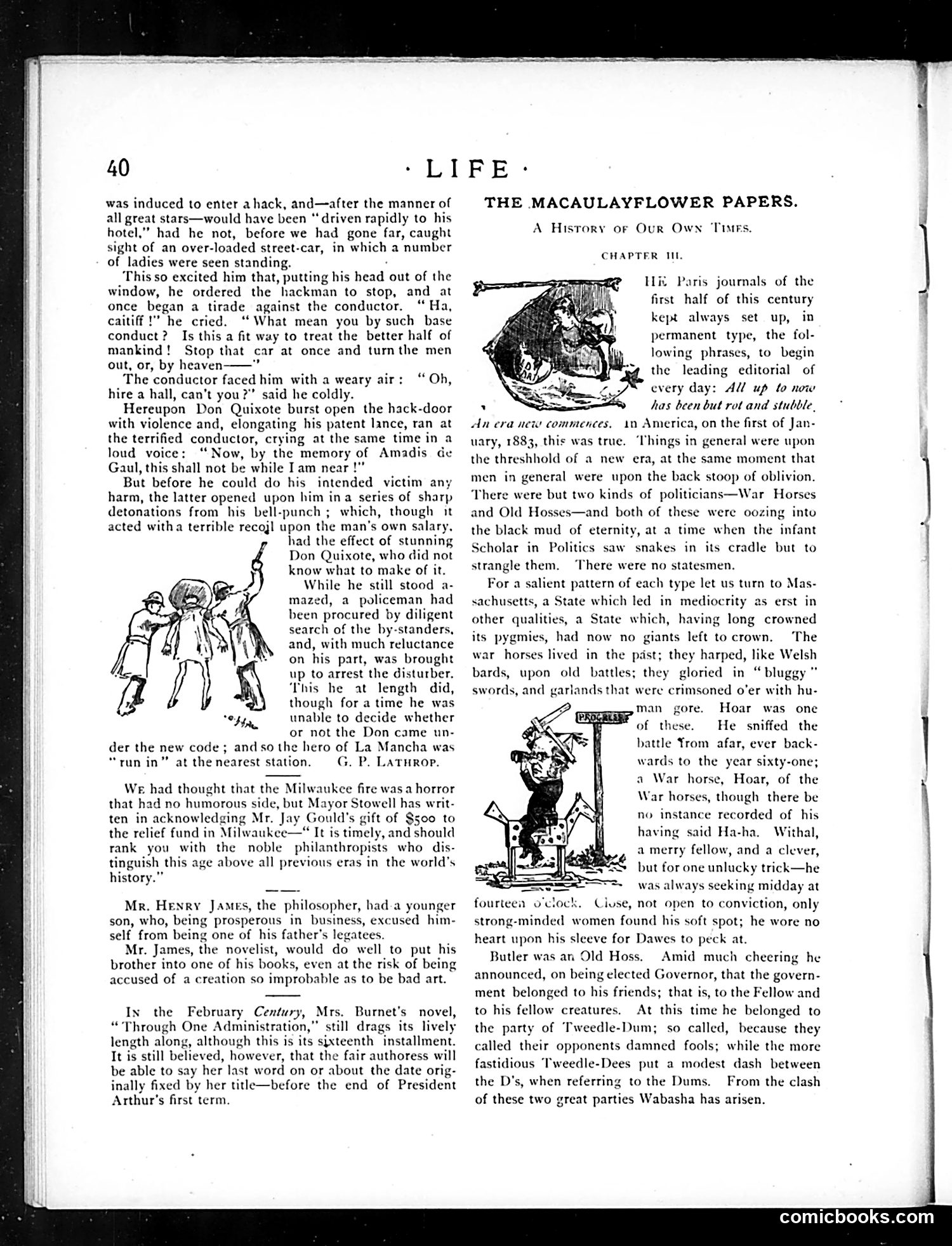
This page contains two distinct illustrations accompanying literary and social commentary. The **left illustration** depicts a violent street scene with a conductor being attacked by a group—likely satirizing urban disorder or labor disputes common in the 1880s. The accompanying text recounts an incident involving a hackney carriage conductor's misconduct. The **right illustration** shows a figure (possibly a horse or animal) in a grotesque or exaggerated pose, accompanying "The Macaulay Flower Papers" column discussing American politics. The text references Massachusetts politics and historical figures like "Old Hosses," using equine metaphors to mock political parties and their aging leadership. The overall page uses satirical humor to critique contemporary political factionalism and urban social problems. The specific political figures referenced remain unclear without additional historical context.
📄 Transcribed text from this page (OCR, searchable)
Machine-transcribed from the original scan — historical spelling and the odd misread are preserved.
40 was induced to enter ahack, and—after the manner of all great stars—would have been “driven rapidly to his hotel,” had he not, before we had gone far, caught sight of an over-loaded street-car, in which a number of ladies were seen standing. . This so excited him that, putting his head out of the window, he ordered the hackman to stop, and at once began a tirade against the conductor. “ Ha, caitiff !" he cried. ‘What mean you by such base conduct? Is this a fit way to treat the better half of mankind! Stop that car at once and turn the men out, or, by heaven ni The conductor faced him with a weary air: “Oh, hire a hall, can't you?” said he coldly. Hereupon Don Quixote burst open the hack-door with violence and, elongating his patent lance, ran at the terrified conductor, crying at the same time in a loud voice: ow, by the memory of Amadis de Gaul, this shall not be while Iam near !” But before he could do his intended victim any harm, the latter opened upon him ina series of sharp detonations from his bell-punch ; which, though it acted witha terrible recojl upon the man’s own salary, had the effect of stunning Don Quixote, who did not know what to make of it. While he still stood a- mazed, a policeman had been procured by diligent search of the by-standers, and, with much reluctance on his part, was brought up to arrest the disturber. ‘This he at length did, though for a time he was unable to decide whether or not the Don came un- der the new code; and so the hero of La Mancha was “run in” at the nearest station. P. Laturop. WE had thought that the Milwaukee fire was a horror that had no humorous side, but Mayor Stowell has writ- ten in acknowledging Mr. Jay Gould's gift of $500 to the relief fund in Milwaukee—“ It is timely, and should rank you with the noble philanthropists who dis- tinguish this age above all previous eras in the world’s history.” Mr. Henry James, the philosopher, hada younger son, who, being prosperous in business, excused him- self from being one of his father's legatees. Mr. James, the novelist, would do well to put his brother into one of his books, even at the risk of being accused of a creation so improbable as to be bad art. In the February Century, Mrs. Burnet’s novel, “Through One Administration,” still drags its lively length along, although this is its sixteenth installment. It is still believed, however, that the fair authoress will be able to say her last word on or about the date orig- inally fixed by her title—before the end of President Arthur's first term. - LIFE: THE MACAULAYFLOWER PAPERS. A History of Our Own TIME, CHAPTER II. Hit Paris journals of the first half of this century kept always set up, in permanent type, the fol- lowing phrases, to begin the leading editorial of every day: All up to now has been but rot and stubble, An era new commences, 1m America, on the first of Jan- uary, 1883, this was true. ‘lhings in general were upon the threshhold of a new era, at the same moment that men in general were upon the back stoop of oblivion. There were but two kinds of politicians—War Horses and Old Hosses—and both of these were oozing into the black mud of eternit Scholar in Politic at a time when the infant saw snakes in its cradle but to strangle them. There were no statesmen. For a salient pattern of each type let us turn to Mas- sachusetts, a State which led in mediocrity as erst in other qualities, a State which, having long crowned had now no giants left tocrown, The war horses lived in the past; they harped, like Welsh bards, upon old battles; they gloried in “ bluggy ” swords, and garlands that were crimsoned o'er with hu- its pygmies man gore. Hoar was one of these. He sniffed the battle Yrom afar, ever back- wards to the year sixty-one; a War horse, Hoar, of the War horses, though there be no instance recorded of his having said Ha-ha. Withal, a merry fellow, and a clever, but for one unlucky trick—he was always seeking midday at fourteen o'ctock, Ciuse, not open to conviction, only strong-minded women found his soft spot; he wore no heart upon his sleeve for Dawes to peck at. Butler was an Old Hoss. Amid much cheering he announced, on being elected Governor, that the govern- ment belonged to his friends; that is, to the Fellow and to his fellow creatures. At this time he belonged to the party of Tweedle-Dum; so called, because they called their opponents damned fools; while the more fastidious T'weedle-Dees put a modest dash between the D's, when referring to the Dums. From the clash of these two great parties Wabasha has arisen. comicbooks.com