
A complete issue · 18 pages · 1883
Life — January 11, 1883
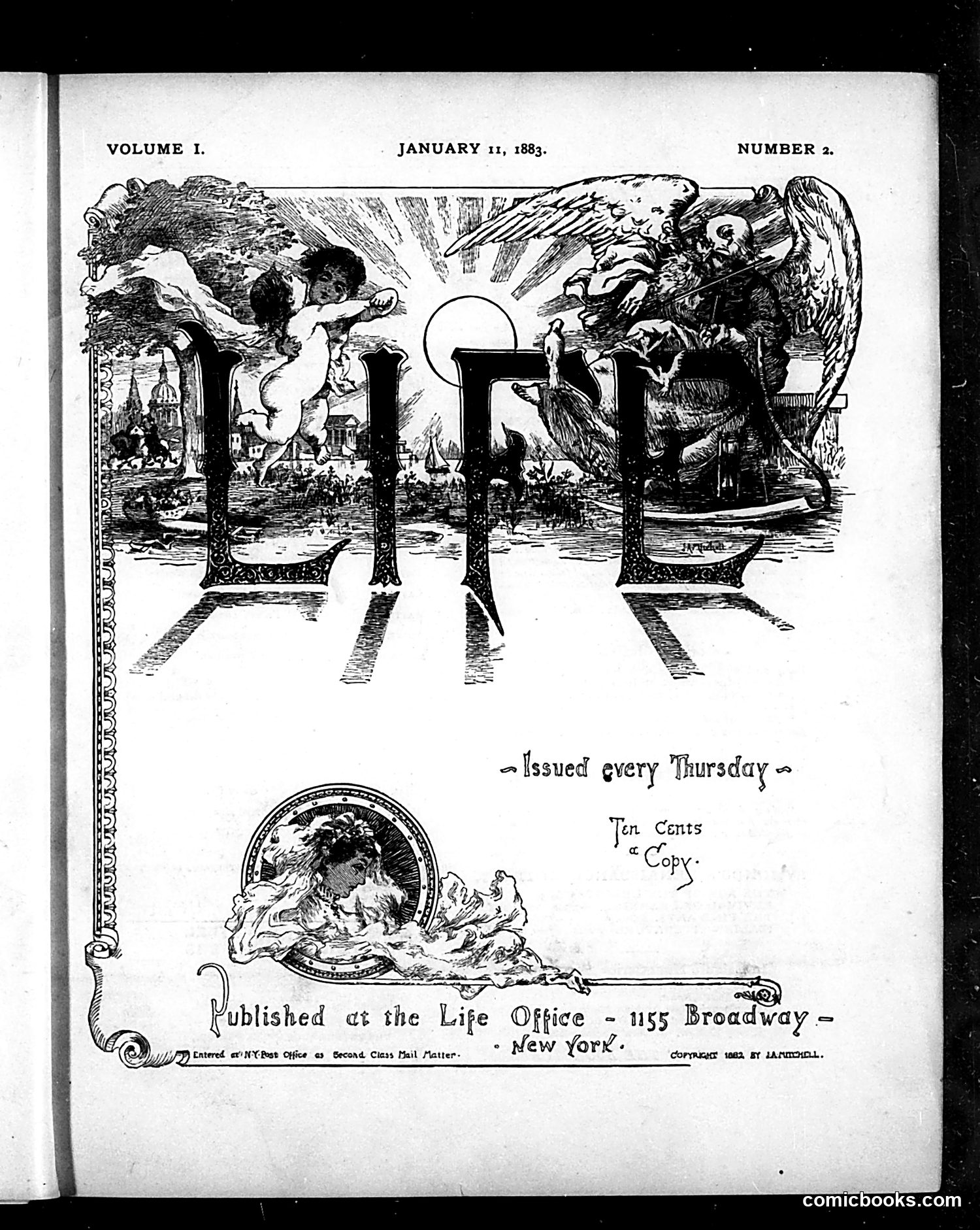
This is the cover/masthead for *Life* magazine's second issue. The large decorative letters "LIFE" dominate the center, framed by ornate Victorian typography. Above and around the letters sits an elaborate allegorical illustration featuring classical and mythological figures—including what appears to be cherubs, winged beings, and a cityscape in the background. The imagery suggests *Life*'s aspirations as a publication: grand, artistic, and culturally sophisticated. The classical artistic style and ornamental design reflect 1880s aesthetics for high-end periodicals. Published at 1155 Broadway in New York for ten cents per copy, *Life* positioned itself as an upscale satirical and artistic weekly for educated readers. The specific satirical content of this issue is not visible on this masthead page.
This appears to be a **contents/advertising page** from *Life* magazine rather than a cartoon or satirical content page. The page announces upcoming articles and features, including pieces on philosophy, horseback riding, and Christian doctrine. It advertises books from Henry Holt & Co. and lists contributors to the magazine—writers like Robert Grant and Arthur Penn. The only visual element is an **Esterbrook Steel Pens advertisement** at the bottom, featuring the company's logo and product information. There are no political cartoons, caricatures, or satirical illustrations visible on this page to analyze. It functions primarily as an index of editorial content and advertising for a late 19th/early 20th-century publication.
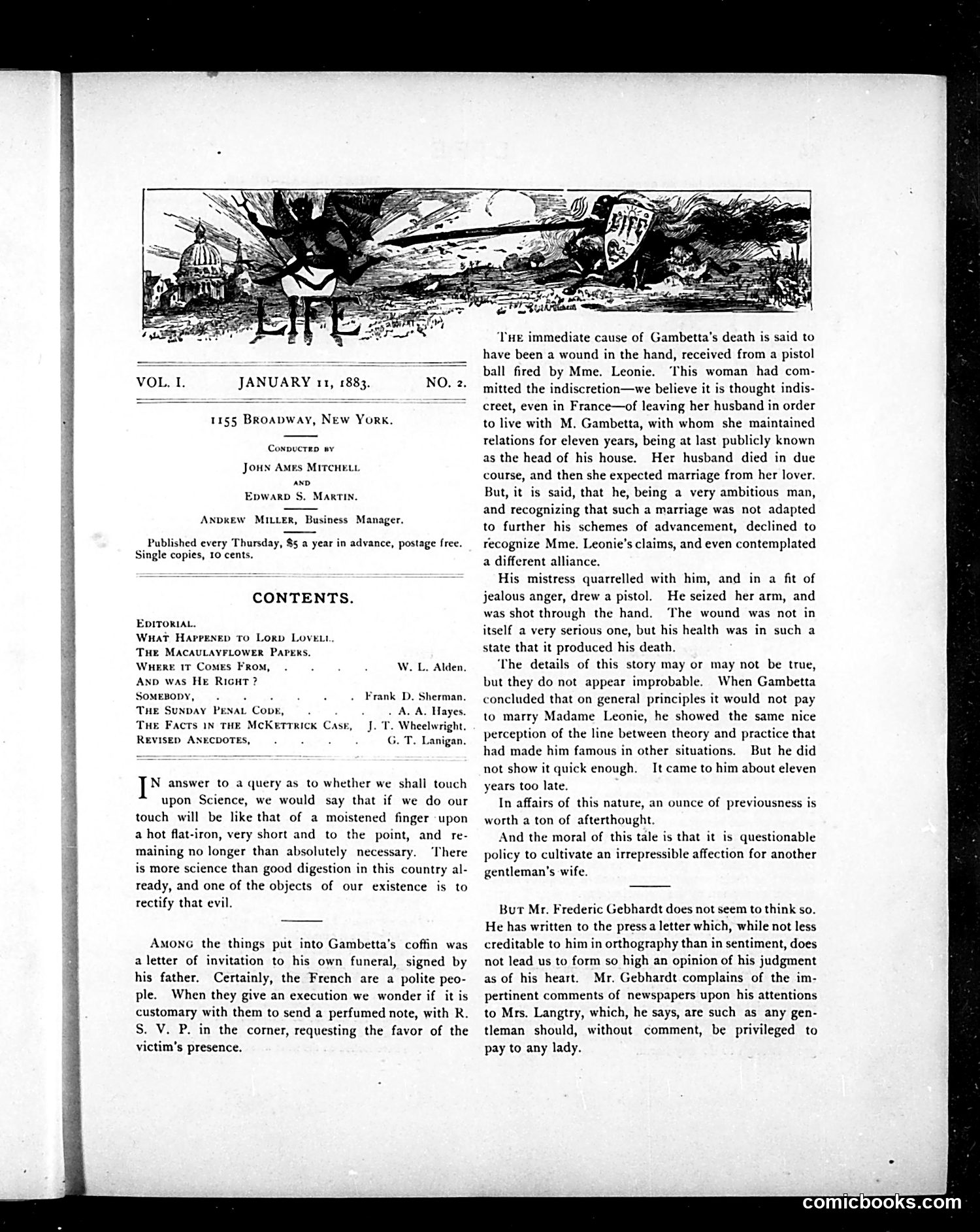
The header illustration appears to be a decorative masthead typical of 19th-century publications, showing allegorical or satirical figures in a landscape scene, though specific identities are unclear from the image. The main text discusses the death of Gambetta (a prominent French politician), describing a scandal: his mistress Mme. Leonie shot him during a quarrel over his refusal to marry her after his legitimate husband died. The editorial uses this as social commentary on the dangers of cultivated "irrepressible affection" outside marriage. A secondary item responds to criticism from Frederic Gebhardt about newspaper coverage of his attention to a Mrs. Langtry, asserting newspapers have the right to comment on public figures' conduct. This is primarily news commentary rather than visual satire.
This page contains literary and social commentary rather than political cartoons. The main content includes: **"What Is Said of Us"** - A section praising *Life* magazine itself as "fresh, vigorous, gentlemanly, genial, and satisfying," noting it appeals to thoughtful readers. **"What Happened to Lord Lovell"** - A narrative poem (likely a traditional ballad) about a man who abandons his fiancée Lady Jane without explanation. When she confronts him at his door, he offers increasingly implausible excuses—a wound, a clock malfunction, salmon poisoning, and wine consumption—for his mysterious absence. The satire appears directed at male irresponsibility and unconvincing excuses in romantic relationships rather than at specific political figures. It's humorous social commentary on courtship and deception, using historical/literary subject matter.
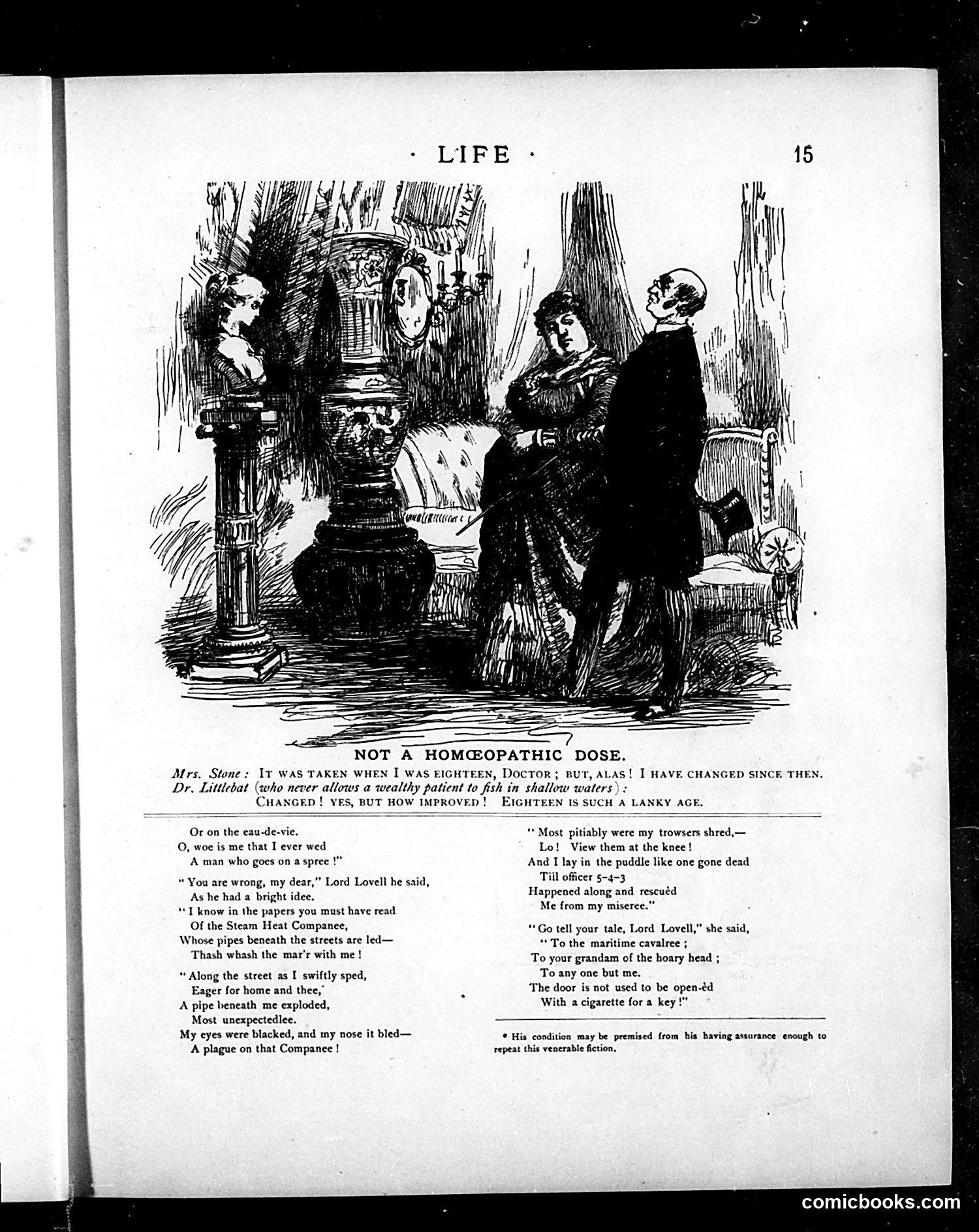
This satirical cartoon depicts a medical consultation. Mrs. Stone tells Dr. Littlehat that she was "eighteen" when she last took his prescribed treatment, but "alas! I have changed since then." The doctor responds that eighteen is "such a lanky age." The satire targets homeopathy—a medical practice using extremely diluted substances. The title "Not a Homeopathic Dose" jokes that whatever treatment Mrs. Stone received was ineffective or insufficient, implying she has aged considerably in the interim. The accompanying poem by Lord Lovell humorously recounts a mishap involving steam heat pipes and ruined trousers, further mocking incompetent medical practitioners and suggesting dubious remedies of the era. This reflects Victorian skepticism toward homeopathic medicine as ineffective quackery.
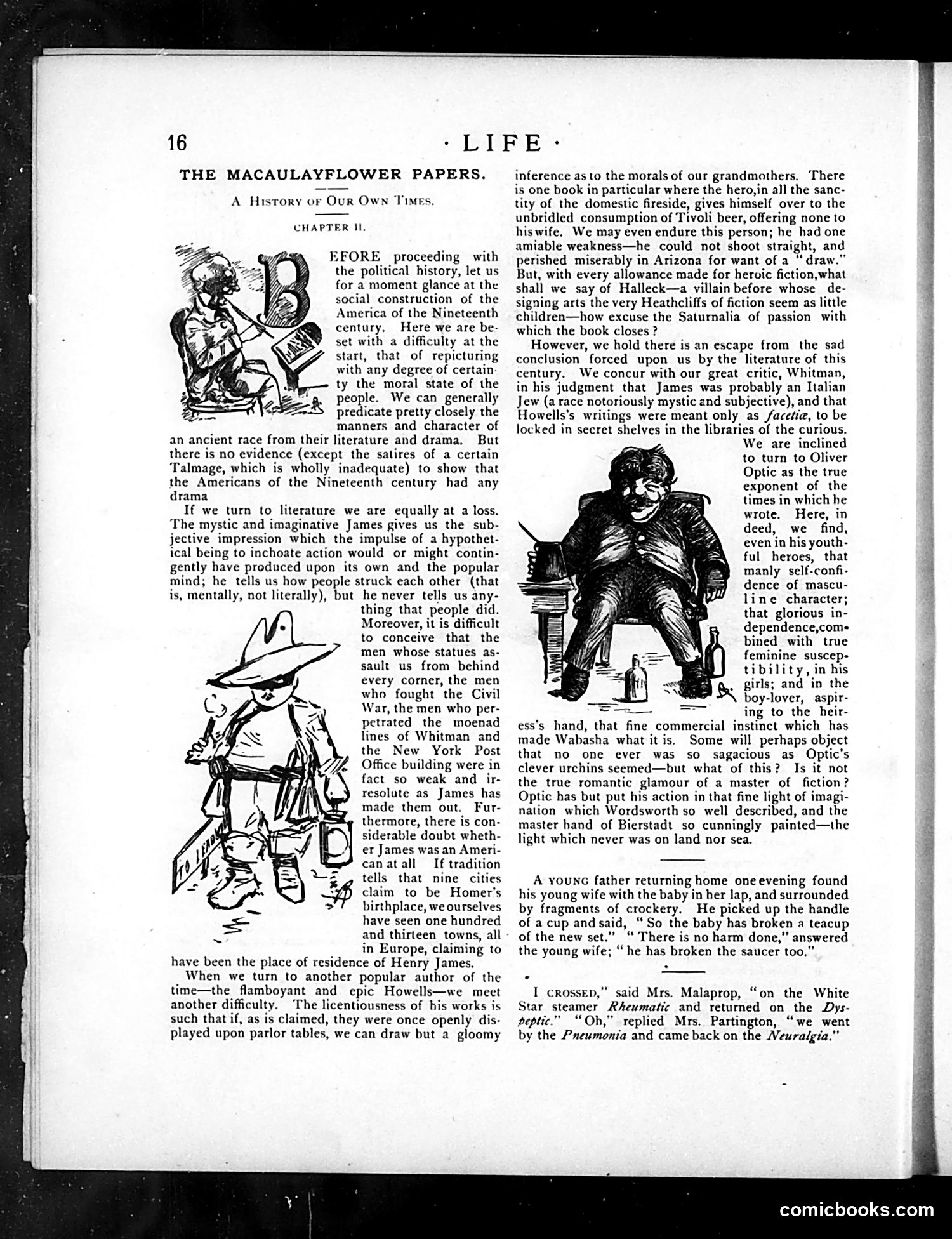
This page from Life magazine's "Macaulay Flower Papers" section contains two satirical illustrations accompanying literary criticism. The upper cartoon depicts a disheveled figure representing **James Fenimore Cooper**, the 19th-century American novelist. The satire mocks Cooper's writing style and the gap between his literary pretensions and actual literary merit. The lower cartoon shows a similarly unkempt character, likely **Oliver Optic** (the pseudonym of William T. Adams), another popular 19th-century writer. The text criticizes Optic's works as commercially successful but lacking genuine romantic or literary substance. Both illustrations use exaggerated caricature to ridicule these authors' reputations among educated critics of the time, even as their works remained popular with the general reading public. The page exemplifies Life's satirical attacks on American literary culture.
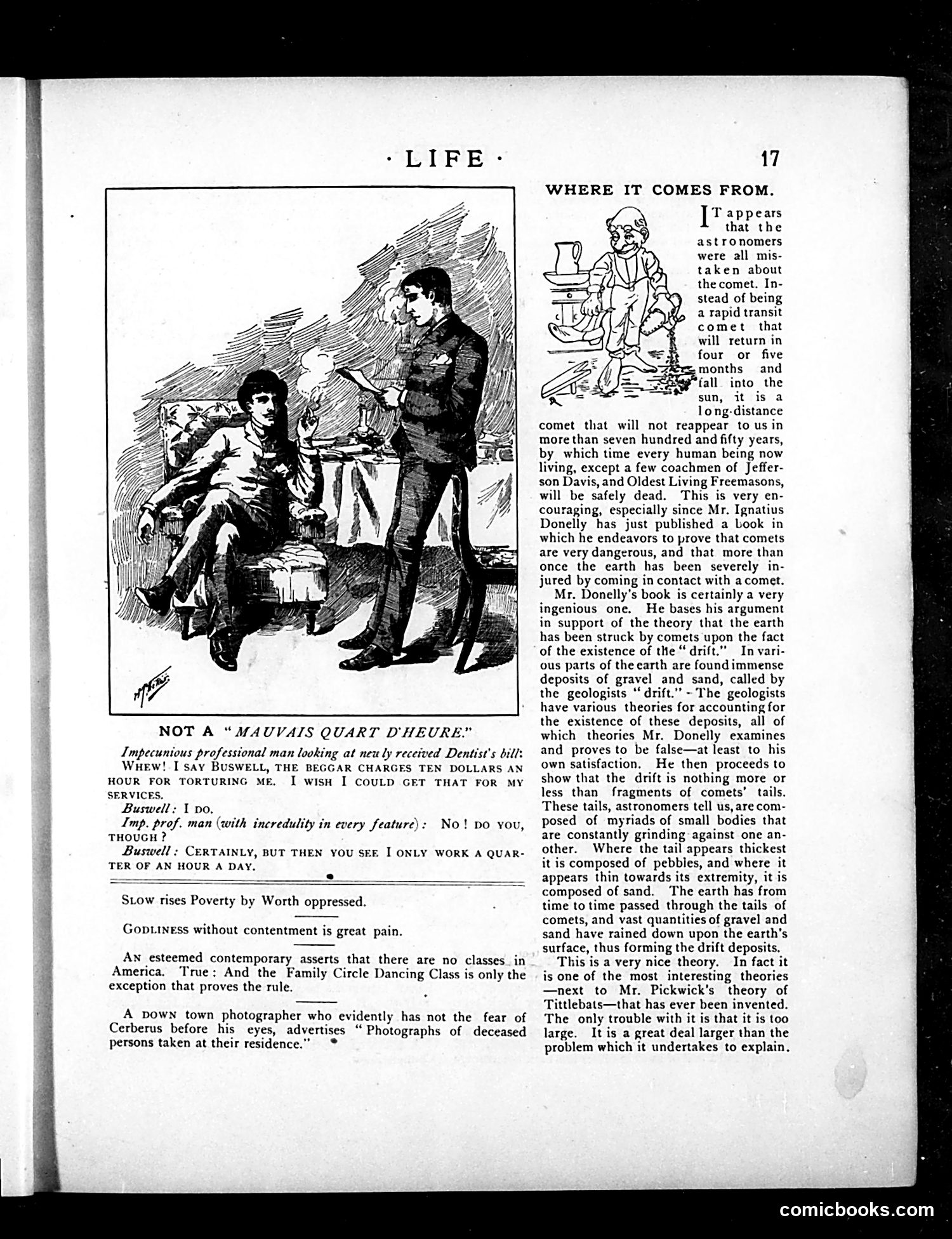
**Main Cartoon: "Not a 'Mauvais Quart d'Heure'"** This dialogue cartoon depicts a beggar approaching a well-dressed gentleman (likely representing a wealthy person or professional). The beggar claims he's been tortured and demands ten dollars for "services," while the gentleman responds that he only works a quarter-hour daily. The humor relies on a play on the French phrase "mauvais quart d'heure" (a bad quarter-hour/brief unpleasant moment). The cartoon satirizes class tensions and the absurdity of a beggar's demand for payment, contrasting the beggar's claim of suffering against the gentleman's admitted minimal work. **Right Column: "Where It Comes From"** This discusses astronomical theories about comets, particularly referencing Mr. Ignatius Donelly's recent book claiming comets are dangerous and may have struck Earth. The text examines geological "drift" deposits as evidence supporting this theory.
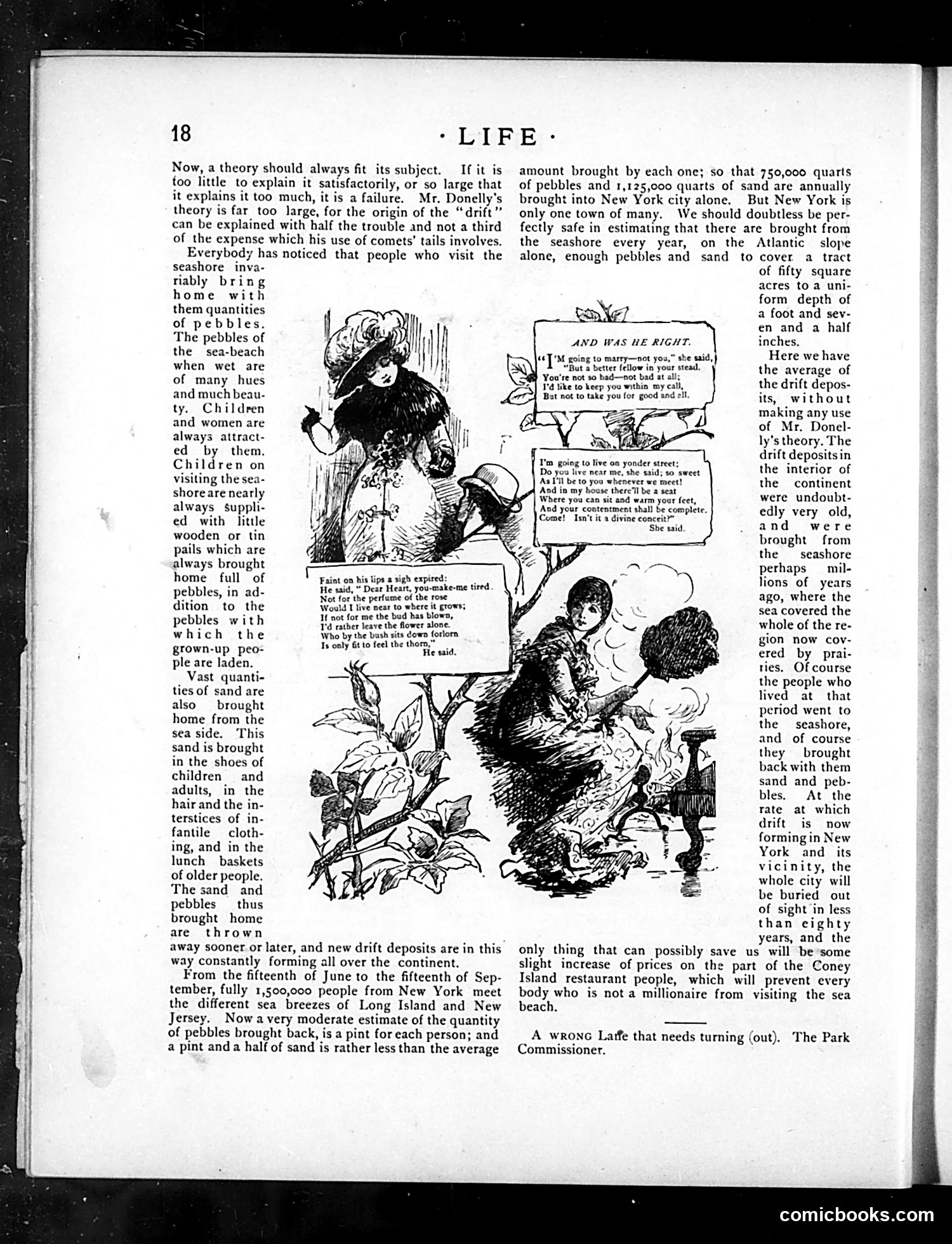
This page satirizes New York City's accumulating problem with sand and pebbles brought home from beaches by visitors. The illustration shows a couple discussing marriage plans while surrounded by decorative pebbles and sand—visual evidence of the article's complaint. The text argues Mr. Donnelly's geological theory inadequately explains the "drift" depositing massive quantities of beach material throughout the city. The author estimates 1.5 million quarts of sand enter New York annually from Coney Island and other shores. The satire highlights an absurd civic nuisance: beach-goers habitually collect souvenirs (pebbles, sand in clothing/hair), gradually burying the city under accumulated debris. The piece warns that within eighty years, Manhattan will become unrecognizable—buried beneath centuries of accumulated seashore deposits.
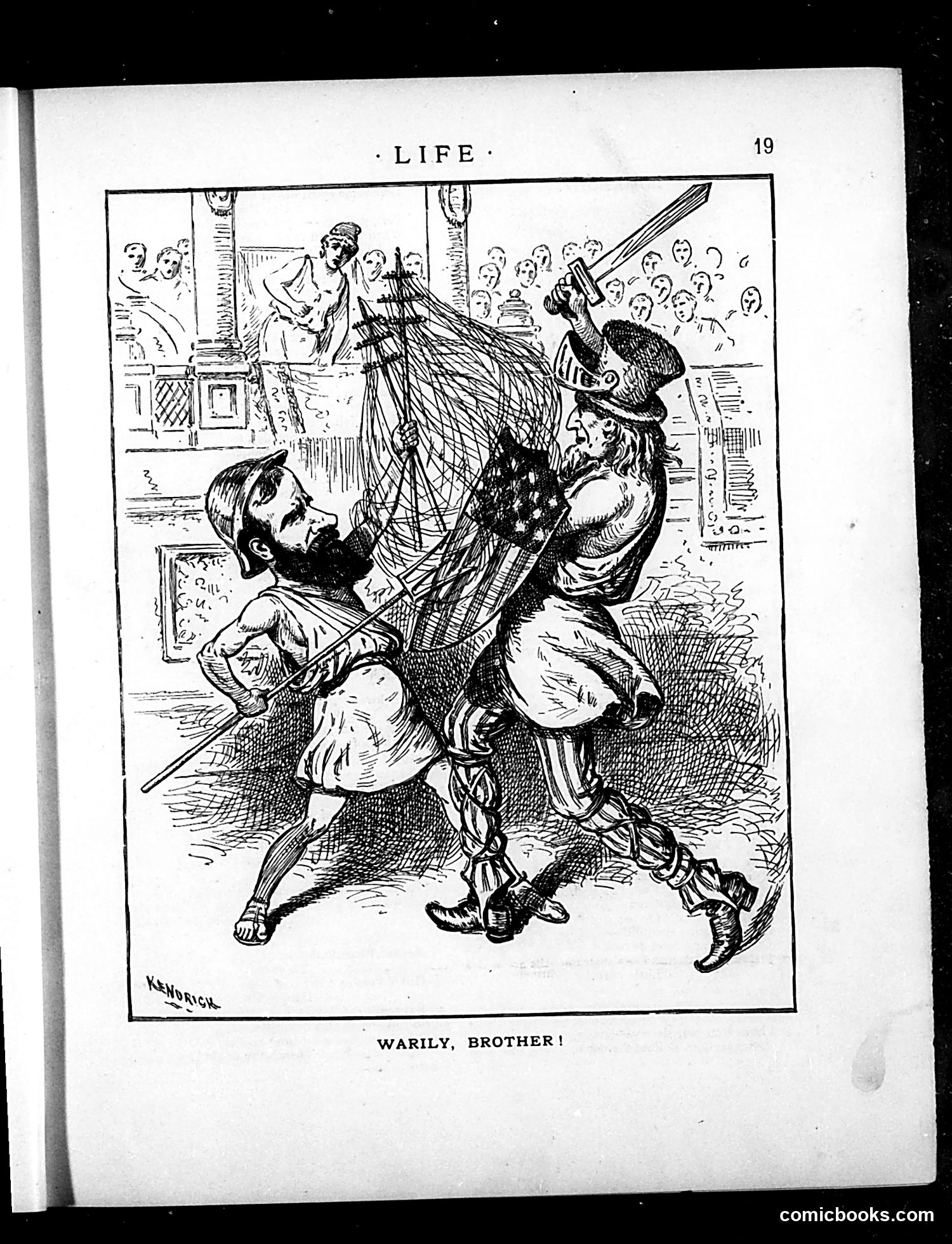
This cartoon depicts two exaggerated male figures engaged in a cautious confrontation, each wielding a sword. The artistic style and caricature suggest they represent political or social antagonists of the era. The title "Warily, Brother!" implies they are nominal allies (brothers) who nonetheless approach each other with suspicion and defensive posture. The crowd visible in the background appears to be witnessing this tense standoff. Without additional context identifying the specific figures or their labels, the cartoon likely comments on political tensions between groups nominally aligned but mutually distrustful—a common theme in satirical commentary. The "warily" framing suggests wariness despite claimed brotherhood, possibly addressing labor disputes, political factions, or international relations of the period.
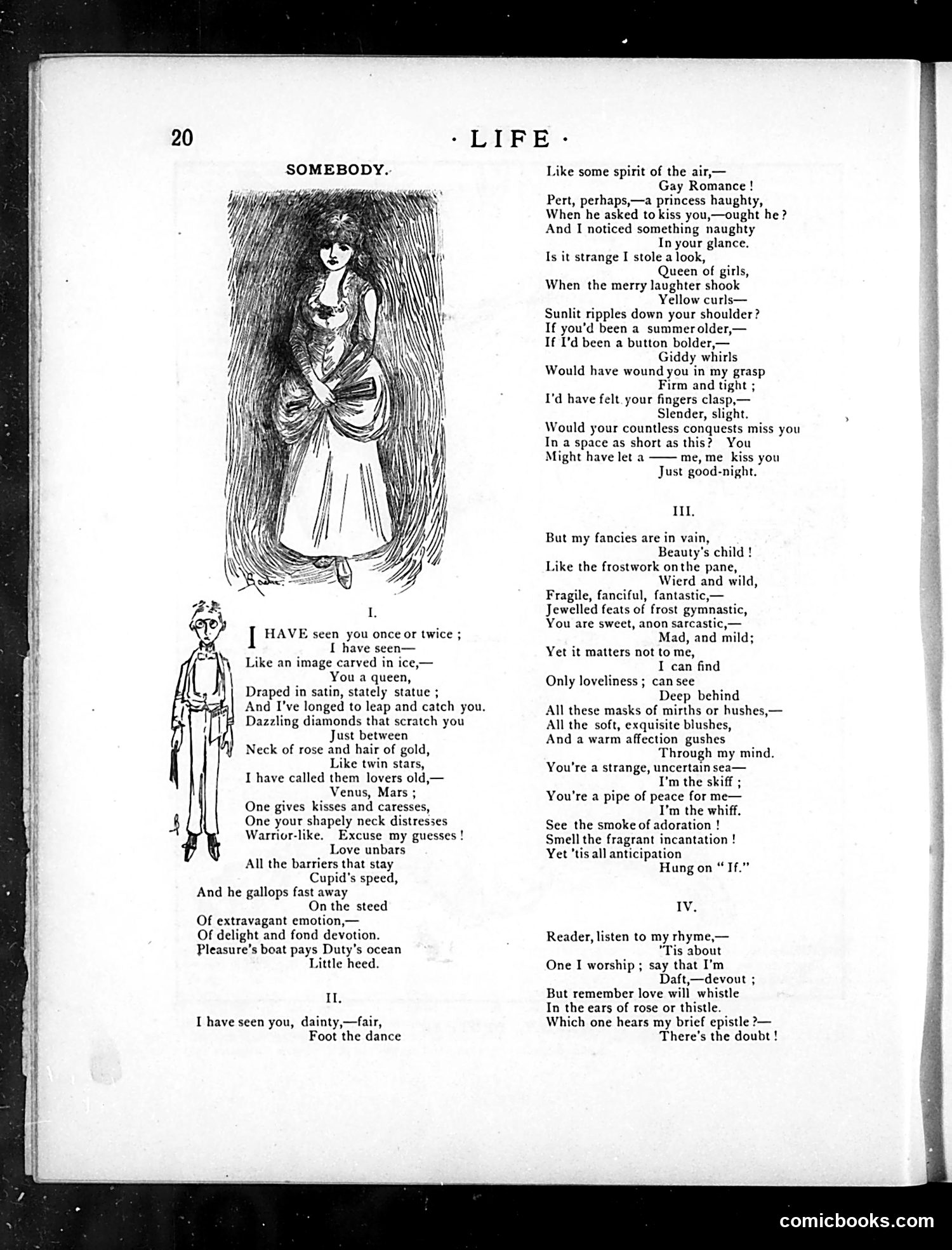
This is a romantic poem titled "Somebody," not political satire. It depicts a male speaker's infatuation with an unnamed woman he's glimpsed only once or twice. The accompanying sketches show a fashionably dressed woman in profile and a standing figure in period dress, illustrating the idealized subject of his admiration. The poem progresses through four sections expressing increasingly elaborate romantic fantasies: initial attraction, imagined physical intimacy, frustrated longing, and final uncertainty about whether his feelings are reciprocated. The speaker romanticizes her as ethereal ("spirit of the air," "carved in ice") while acknowledging the futility of his "fancies" and describing himself as "daft" and "devout." The concluding stanza questions whether she'll ever hear his "brief epistle"—the poem itself—leaving the outcome uncertain. This reflects late-19th-century *Life* magazine's frequent publication of light, sentimental verse about courtship and unrequited love.
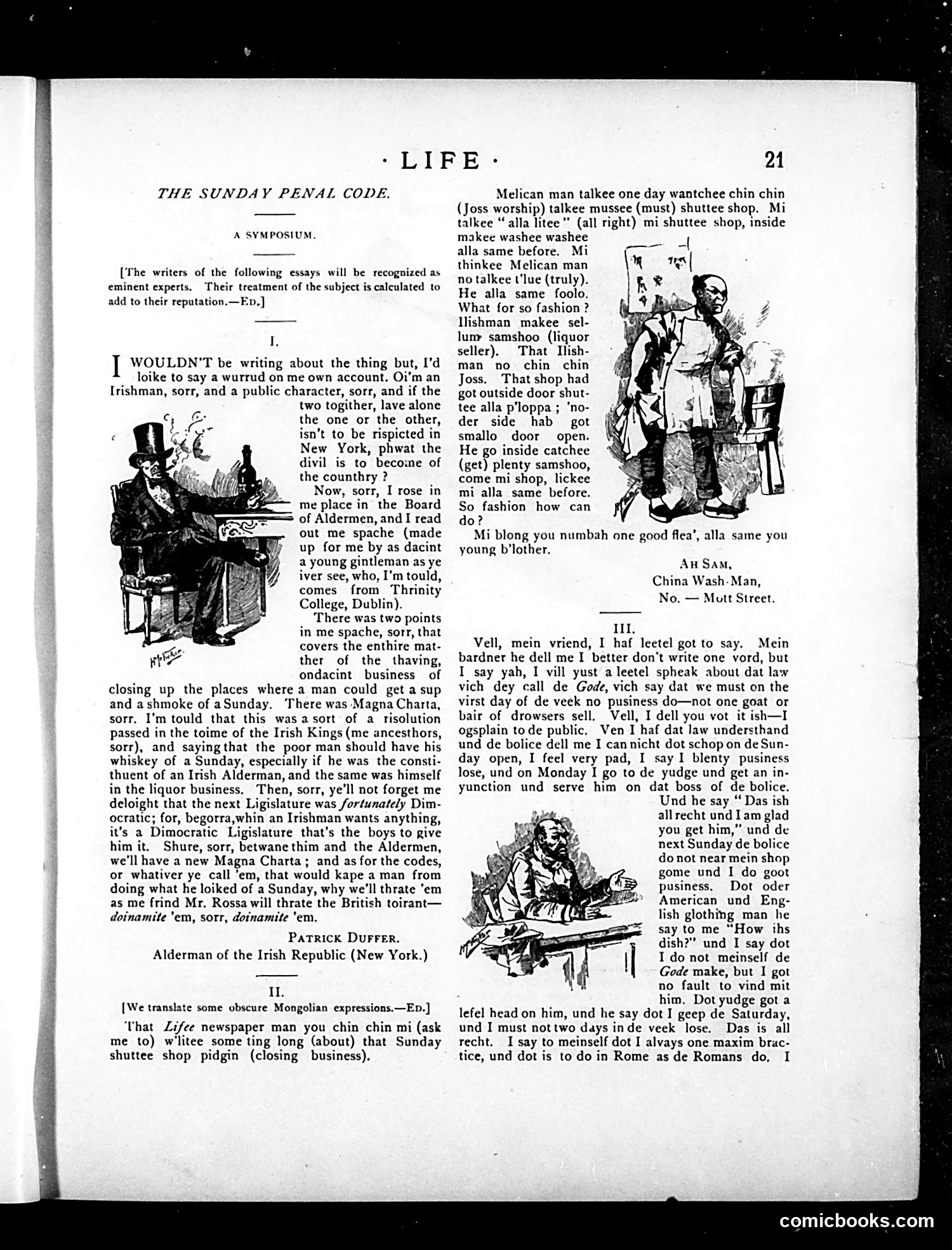
This page satirizes opposition to Sunday closing laws (which required businesses to shut on Sundays). Three speakers with exaggerated ethnic dialects represent different New York constituencies resisting the law: 1. **Patrick Duffer** (Irish alderman): Uses heavy brogue to argue that closing bars violates "Magna Charta" and Democratic principles. His self-interest is transparent—he profits from the liquor business. 2. **Au Sam** (Chinese laundry owner): Speaks pidgin English, explaining he simply moves operations inside to evade the law, making enforcement pointless. 3. **The German speaker** (likely a tailor or clothier): Describes using legal injunctions against police to keep his shop open, showing how wealthy merchants exploit the justice system. The satire targets both ethnic stereotypes and hypocrisy: the law is unenforceable because business owners find loopholes, while politicians who profit from vice cynically defend it through pseudo-constitutional rhetoric.
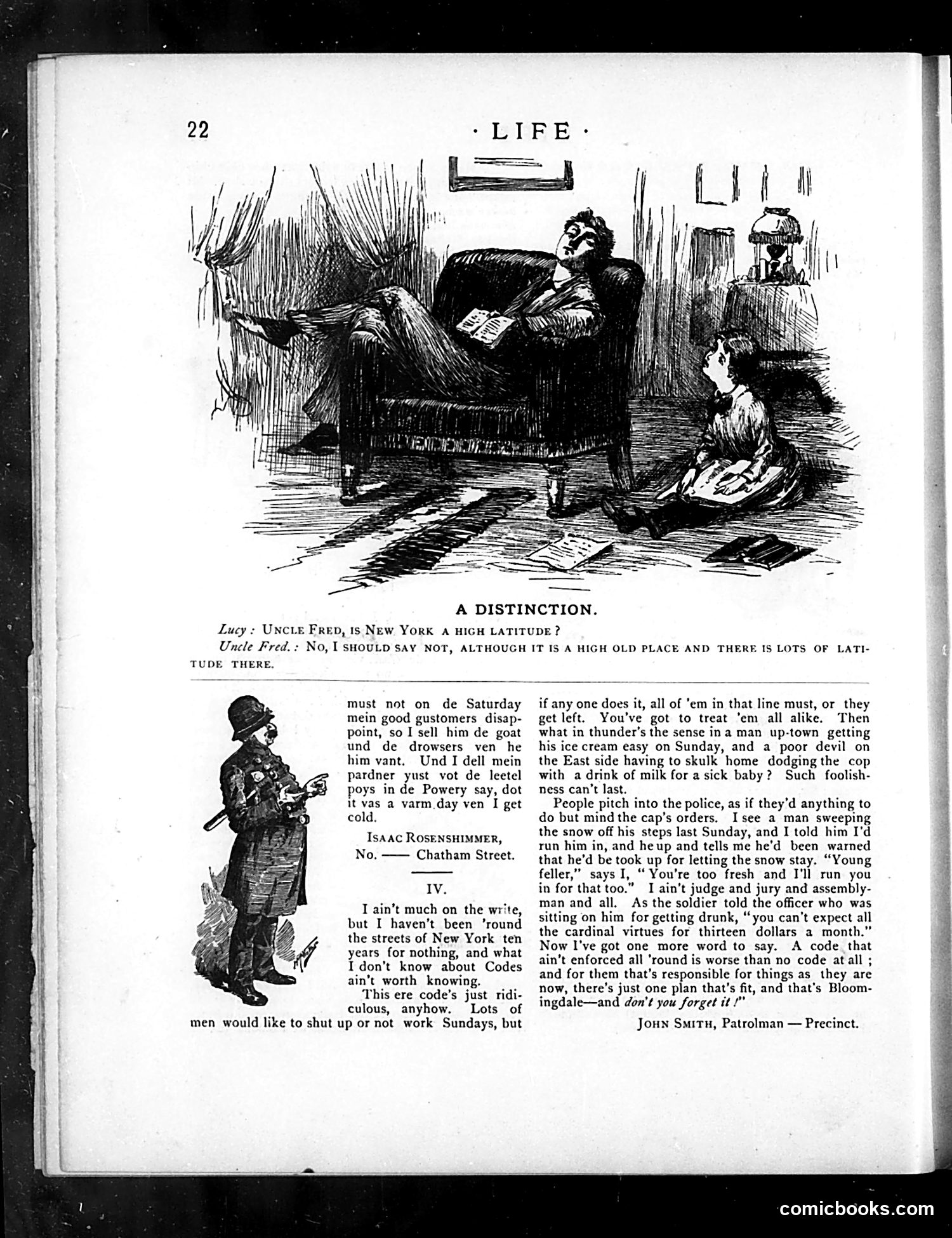
This page from *Life* magazine satirizes New York City's Sunday laws (codes regulating commercial activity on Sundays). The top cartoon shows a child asking Uncle Fred whether New York has "high latitude"—a pun: he means geographical latitude, but Uncle Fred responds with "latitude" meaning leniency/freedom, suggesting New York allows rule-breaking. Below are two monologues from working-class New Yorkers criticizing the inconsistent enforcement of Sunday codes. Isaac Rosenshimmer (a German-Jewish immigrant, indicated by dialect) complains he must follow rules strictly while customers evade them. Patrolman John Smith argues that selective enforcement is worse than useless—the wealthy uptown can buy ice cream on Sunday while poor East Siders risk arrest for letting snow sit on steps or carrying milk. He sarcastically suggests corrupt officials should be sent to Bloomingdale (an asylum). The satire targets class hypocrisy: laws enforced selectively against the poor while the wealthy ignore them with impunity.
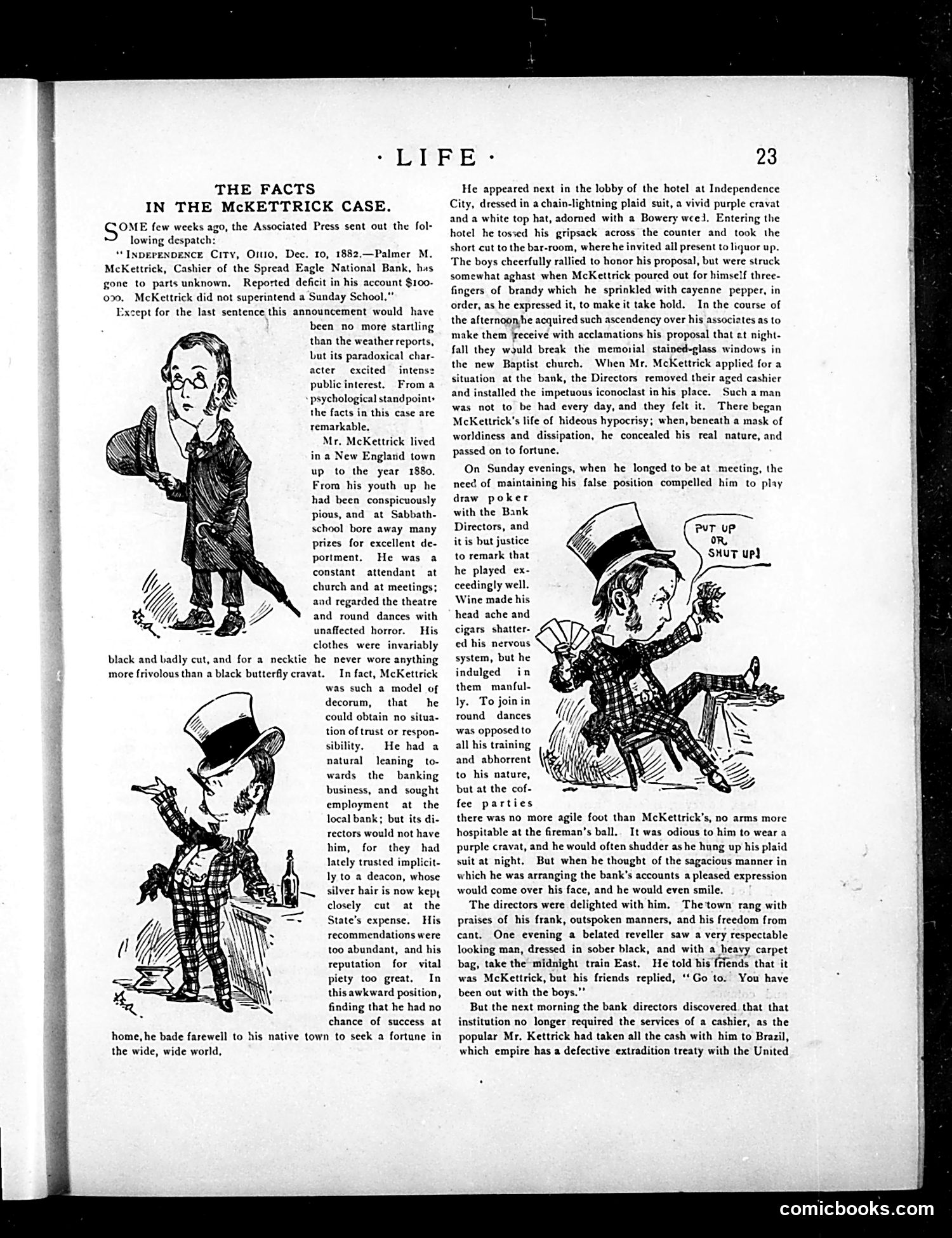
This satirical piece mocks the hypocrisy of Victorian respectability through the story of Palmer M. McKettrick, a bank cashier who embezzles $100,000. **The Setup:** McKettrick begins as an absurdly pious New England man—obsessively religious, wearing only black clothes and conservative neckties, so virtuous that banks won't hire him because his piety seems suspicious. **The Satire:** Upon moving to Independence City, he transforms into a caricature of vice: loud, drinking heavily with cayenne pepper, wearing garish plaid suits and purple cravats, vandalizing churches, playing poker, and frequenting dances. Paradoxically, this *exact* behavior makes him successful—the bank directors immediately promote him to cashier, believing only such a "modern man" can be trusted with real responsibility. **The Joke:** The cartoon exposes how late-19th-century Americans valued *appearance* of toughness and worldliness over actual moral character. McKettrick's exaggerated corruption proves more appealing to businessmen than genuine virtue. The irony: his real self—secretly still pious—remains hidden beneath the false persona, suggesting that American capitalism rewarded performance over principle.
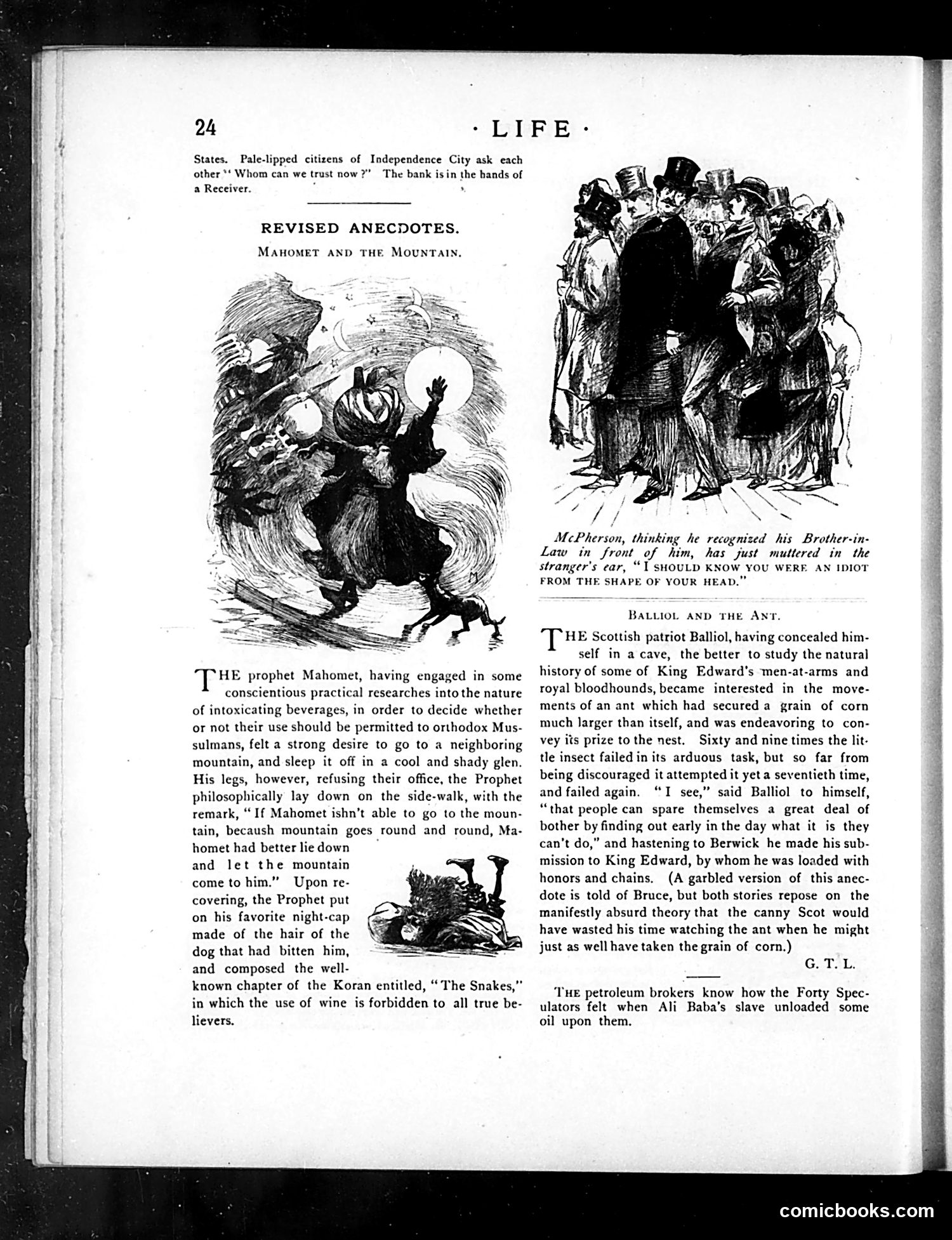
This page contains three separate satirical pieces: **"Mahomet and the Mountain"** mocks religious hypocrisy. The prophet Muhammad gets drunk researching alcohol's permissibility, then lies on the sidewalk. Upon sobering up, he claims divine inspiration and forbids wine in the Koran—a joke about convenient religious justifications for one's own behavior. **"Balliol and the Ant"** satirizes Scottish pragmatism. John Balliol watches an ant fail repeatedly at moving grain, concludes "don't waste time on impossible tasks," then immediately surrenders to King Edward rather than fight. The narrator notes this supposedly clever surrender actually wasted his resistance. **The opening bank line** references a contemporary banking crisis (likely the 1907 panic), where a "Receiver" manages a failed bank—citizens ask who they can trust anymore. **"McPherson" cartoon** shows a man insulting someone he mistook for his brother-in-law, illustrating awkward social embarrassment. These pieces use historical anecdotes and everyday scenarios to mock human irrationality, cowardice, and foolishness.
This is primarily an **advertising page** with minimal editorial content. The left column features a small cartoon labeled "College Cuts"—a humorous sketch appearing to show a scholarly figure surrounded by books (the epigraph quotes Chaucer about preferring books to wealth). The cartoon illustrates amusing college and society life episodes. The page is dominated by advertisements for New York businesses: insurance, book publishers, art galleries, brokers, tailors, and restaurants. The "College Cuts" book advertisement itself is the closest thing to satirical content, poking gentle fun at academic pretension. **For modern readers:** This represents 19th-century *Life* magazine's business model—mixing light humor with paid advertising. The references to Chaucer and Charlotte Brontë indicate the literary, educated audience targeted. The "Common Sense" Lunch Room's quote about worthy guests suggests aspirational marketing to a genteel clientele. No specific political satire appears on this particular page.
This page is primarily **advertising and announcements**, not editorial content with cartoons. The left side lists books for sale by Henry Holt & Co., including Mitchell's illustrated *Summer School of Philosophy* and Walker's *Political Economy*. The right side contains **press comments** about a new publication: *Life*, a weekly satirical magazine edited by John A. Mitchell and Edward S. Martin. Multiple newspapers praised it as witty, well-designed, and professionally executed—notably "not amateurish" despite being new. Reviewers highlighted its clever illustrations, reasonable humor, and sensible commentary on current events. The citations reference *The Sun*, *N.Y. World*, *The Graphic*, *Mail and Express*, *Buffalo Express*, *Rochester Union and Advertiser*, *Syracuse Herald*, and *Brooklyn Daily Times*—suggesting this was *Life's* launch period, with established press validating the newcomer's quality and promising appeal to educated readers.
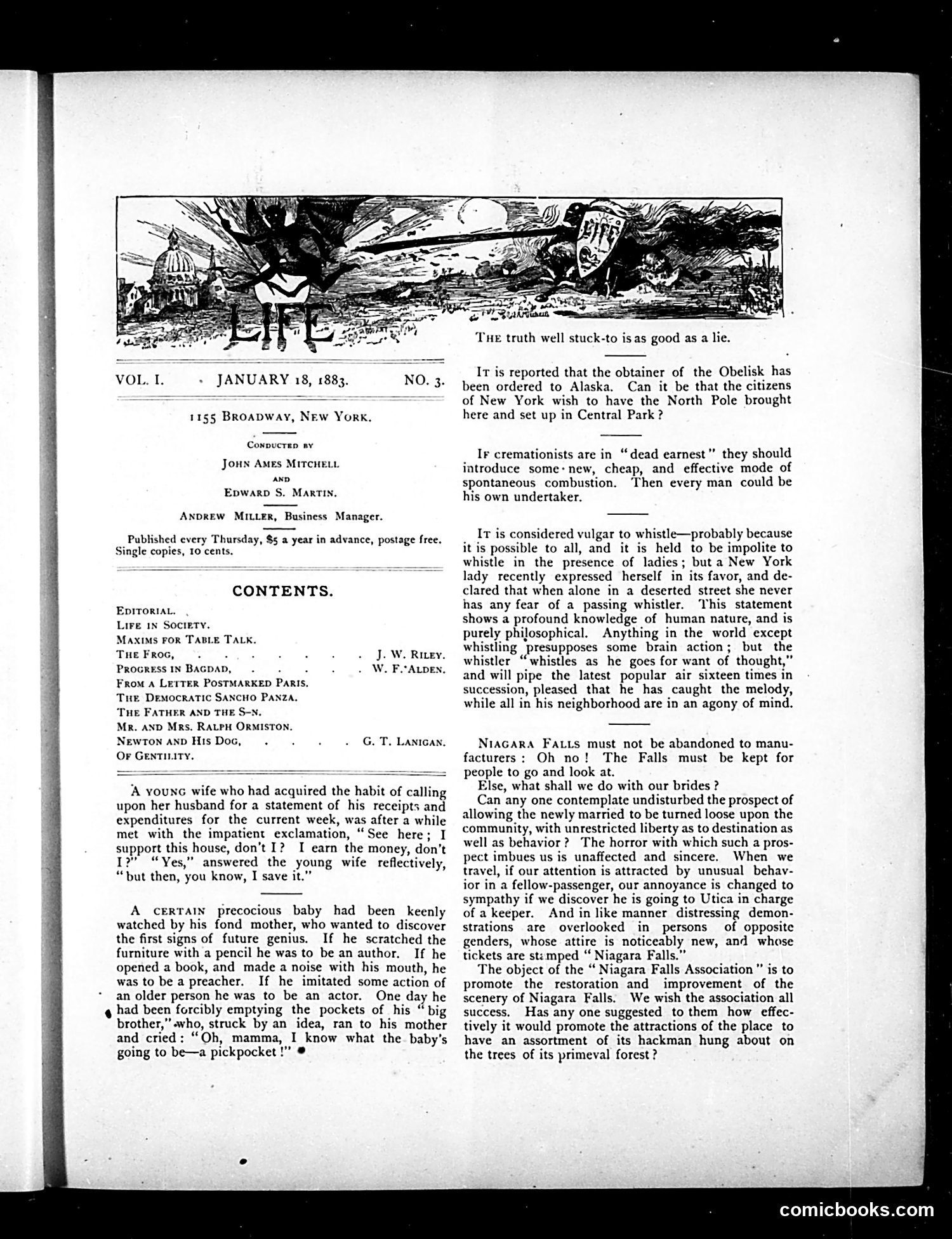
This is the contents page and opening editorial section of *Life*, a satirical weekly. The page contains no political cartoons, but rather short humorous pieces and editorial commentary on contemporary American life. **Key targets of satire:** 1. **Marital finances**: A joke mocking a wife who demands accounting of household spending, countering that she "saves" the money her husband earns—satirizing emerging questions about women's economic roles. 2. **Precocious children**: Mock observations about parents reading genius into children's behavior, ending with a joke about a child stealing from his brother. 3. **Whistling etiquette**: Social commentary on the class implications of whistling in public (deemed vulgar), with ironic praise for a woman unafraid of male whistlers. 4. **Niagara Falls preservation**: Criticism of industrial exploitation of the Falls, with tongue-in-cheek observations about honeymoon destinations and their moral complications. The tone is consistently ironic and gently satirical about Victorian social conventions and emerging modern anxieties about class, gender, and progress.
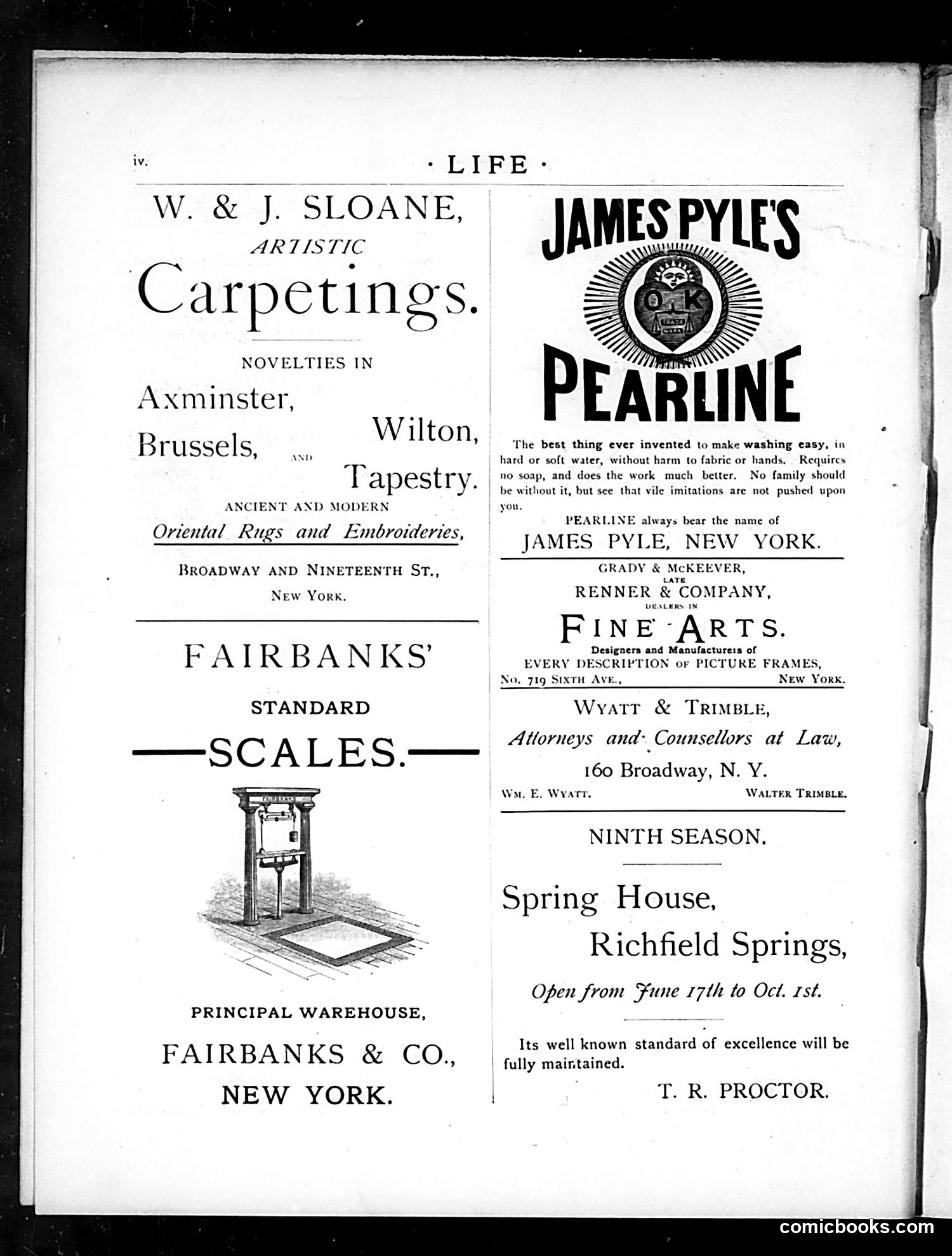
This is primarily an **advertising page** from Life magazine, not a political cartoon. It contains six distinct advertisements for New York businesses and services: 1. **W. & J. Sloane** — carpet and rug merchant 2. **Fairbanks Standard Scales** — industrial weighing equipment 3. **James Pyle's Pearline** — a laundry cleaning product (with period logo) 4. **Grady & McKever/Renner & Company** — picture frame manufacturers 5. **Wyatt & Trimble** — law firm 6. **Spring House, Richfield Springs** — seasonal resort hotel The only visual element is an engraved illustration of a **Fairbanks scale**. The Pearline ad includes a skull-like decorative emblem typical of Victorian-era product branding. These ads reflect late 19th-century American consumer goods and services. There is **no satirical content or political commentary** visible on this page—it represents standard commercial advertising from Life's era.