
Life, 1883-01-11 · page 7 of 18
Life — January 11, 1883 — page 7: what you’re looking at
What you’re looking at
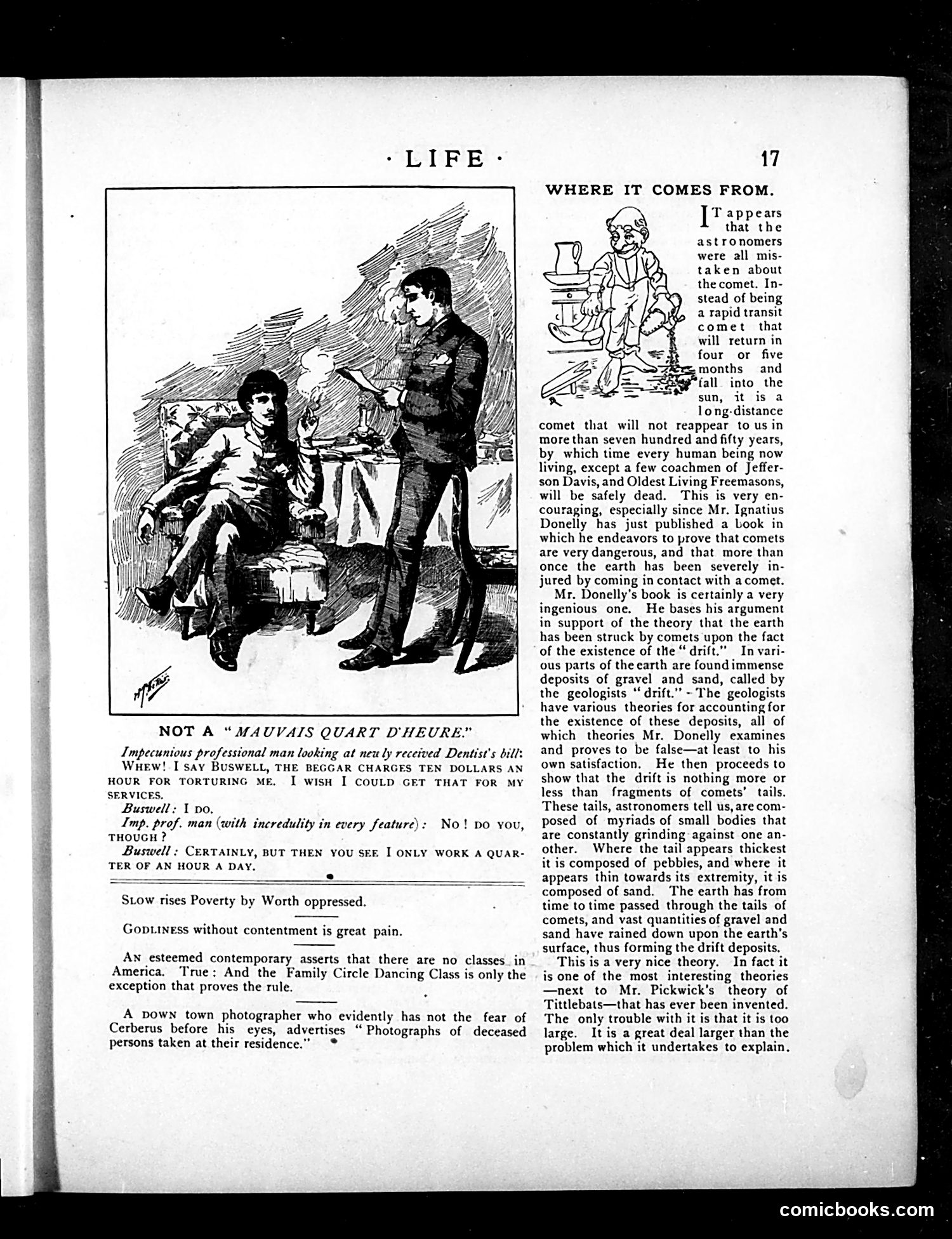
**Main Cartoon: "Not a 'Mauvais Quart d'Heure'"** This dialogue cartoon depicts a beggar approaching a well-dressed gentleman (likely representing a wealthy person or professional). The beggar claims he's been tortured and demands ten dollars for "services," while the gentleman responds that he only works a quarter-hour daily. The humor relies on a play on the French phrase "mauvais quart d'heure" (a bad quarter-hour/brief unpleasant moment). The cartoon satirizes class tensions and the absurdity of a beggar's demand for payment, contrasting the beggar's claim of suffering against the gentleman's admitted minimal work. **Right Column: "Where It Comes From"** This discusses astronomical theories about comets, particularly referencing Mr. Ignatius Donelly's recent book claiming comets are dangerous and may have struck Earth. The text examines geological "drift" deposits as evidence supporting this theory.
📄 Transcribed text from this page (OCR, searchable)
Machine-transcribed from the original scan — historical spelling and the odd misread are preserved.
NOT A “MAUVAIS QUART D'HEURE.” Impecunious professional man looking at neu ly received Dentist's bill: Wuew! I say BUSWELL, THE BEGGAR CHARGES TEN DOLLARS AN HOUR FOR TORTURING ME. I wish I COULD GET THAT FOR MY SERVICES, Buswell: 1 po, Imp. prof. man (with incredulity in every feature): THOUGH ? Buswell : CERTAINLY, BUT THEN YOU SEE I ONLY WORK A QUAR- TER OF AN HOUR A DAY. No! po you, Stow rises Poverty by Worth oppressed. Gop iness without contentment is great pain. AN esteemed contemporary asserts that there are no classes_in America. True: And the Family Circle Dancing Class is only the exception that proves the rule. A Down town photographer who evidently has not the fear of Cerberus before his eyes, advertises “Photographs of deceased persons taken at their residence.” * 17 WHERE IT COMES FROM. I" appears that the astronomers were all mis- taken about the comet. In- stead of being a rapid transit comet that will return in four or five months and fall into the sun, it is a long-distance comet that will not reappear to us in more than seven hundred and fifty years, by which time every human being now living, except a few coachmen of Jeffer- son Davis, and Oldest Living Freemasons, will be safely dead. This is very en- couraging, especially since Mr. Ignatius Donelly has just published a book in which he endeavors to prove that comets are very dangerous, and that more than once the earth has been severely in- jured by coming in contact with a comet. Mr. Donelly’s book is certainly a very ingenious one. He bases his argument in support of the theory that the earth has been struck by comets upon the fact of the existence of tHe “ drift.” In vari- ous parts of the earth are found immense deposits of gravel and sand, called by the geologists “ drift." - The geologists have various theories for accounting for the existence of these deposits, all of which theories Mr. Donelly examines and proves to be false—at least to his own satisfaction, He then proceeds to show that the drift is nothing more or less than fragments of comets’ tails. These tails, astronomers tell us, are com- posed of myriads of small bodies that are constantly grinding against one an- other. Where the tail appears thickest it is composed of pebbies, and where it appears thin towards its extremity, it is composed of sand. The earth has from time to time passed through the tails of comets, and vast quantities of gravel and sand have rained down upon the earth’s surface, thus forming the drift deposits. This is a very nice theory. In fact it is one of the most interesting theories —next to Mr. Pickwick’s theory of Tittlebats—that has ever been invented. The only trouble with it is that it is too large. It is a great deal larger than the problem which it undertakes to explain. comicbooks.com