
Life, 1883-01-11 · page 4 of 18
Life — January 11, 1883 — page 4: what you’re looking at
What you’re looking at
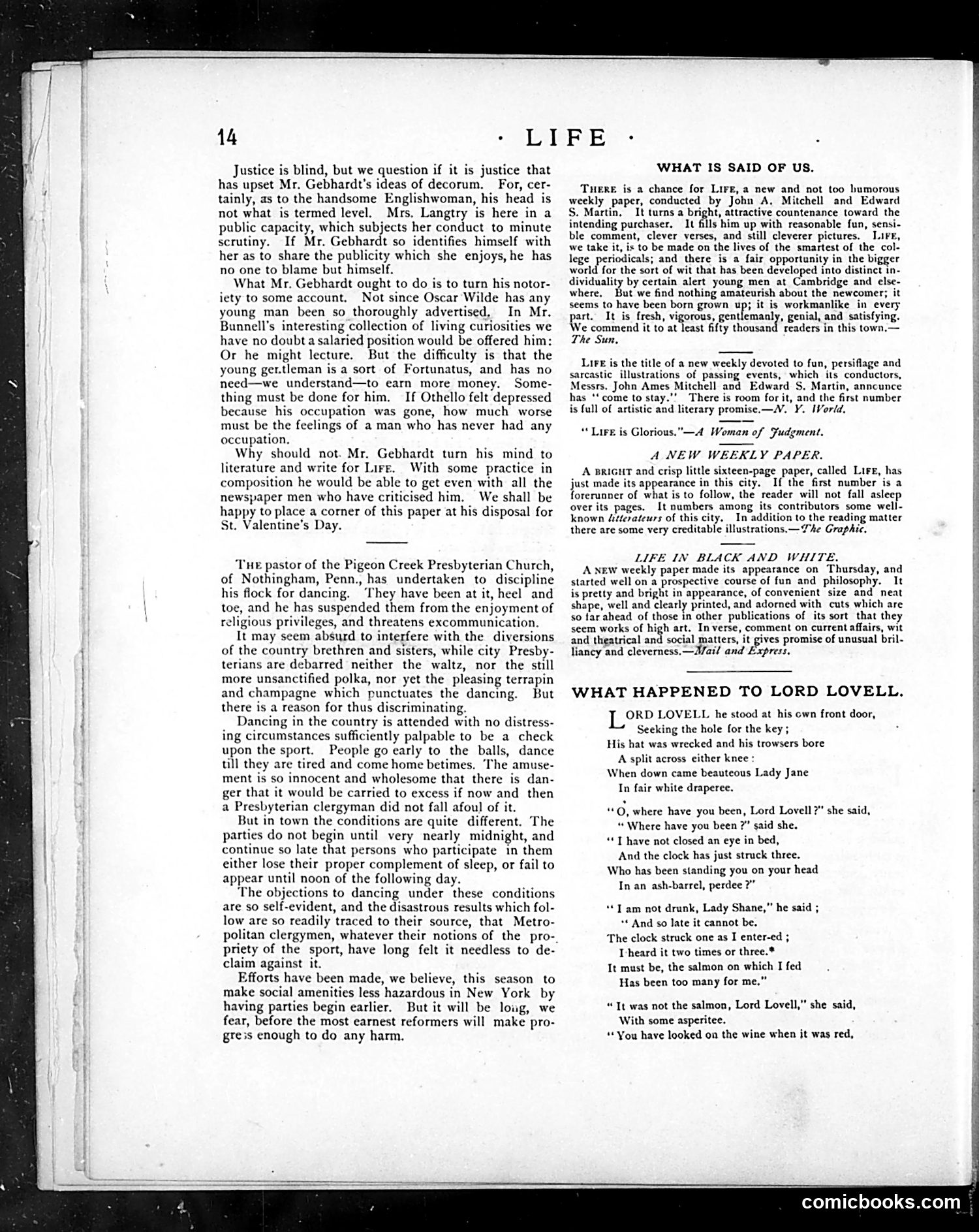
This page contains literary and social commentary rather than political cartoons. The main content includes: **"What Is Said of Us"** - A section praising *Life* magazine itself as "fresh, vigorous, gentlemanly, genial, and satisfying," noting it appeals to thoughtful readers. **"What Happened to Lord Lovell"** - A narrative poem (likely a traditional ballad) about a man who abandons his fiancée Lady Jane without explanation. When she confronts him at his door, he offers increasingly implausible excuses—a wound, a clock malfunction, salmon poisoning, and wine consumption—for his mysterious absence. The satire appears directed at male irresponsibility and unconvincing excuses in romantic relationships rather than at specific political figures. It's humorous social commentary on courtship and deception, using historical/literary subject matter.
📄 Transcribed text from this page (OCR, searchable)
Machine-transcribed from the original scan — historical spelling and the odd misread are preserved.
14 Justice is blind, but we question if it is justice that has upset Mr. Gebhardt’s ideas of decorum. For, cer- tainly, as to the handsome Englishwoman, his head is not what is termed level. Mrs. Langtry is here in a public capacity, which subjects her conduct to minute scrutiny. If Mr. Gebhardt so identifies himself with her as to share the publicity which she enjoys, he has no one to blame but himself. What Mr. Gebhardt ought to do is to turn his notor- iety to some account. Not since Oscar Wilde has any young man been so thoroughly advertised, In Mr. Bunnell's interesting collection of living curiosities we have no doubta salaried position would be offered him: Or he might lecture. But the difficulty is that the young ger.tleman is a sort of Fortunatus, and has no need—we understand—to earn more money. Some- thing must be done for him. If Othello felt depressed because his occupation was gone, how much worse must be the feelings of a man who has never had any occupation. Why should not. Mr. Gebhardt turn his mind to literature and write for Lire. With some practice in composition he would be able to get even with all the newspaper men who have criticised him. We shall be happy to place a corner of this paper at his disposal for St. Valentine's Day. Tue pastor of the Pigeon Creek Presbyterian Church, of Nothingham, Penn., has undertaken to discipline his flock for dancing. ‘They have been at it, heel and toe, and he has suspended them from the enjoyment of religious privileges, and threatens excommunication. It may seem absurd to interfere with the diversions of the country brethren and sisters, while city Presby- terians are debarred neither the waltz, nor the still more unsanctified polka, nor yet the pleasing terrapin and champagne which punctuates the dancing. But there is a reason for thus discriminating. Dancing in the country is attended with no distress- ing circumstances sufficiently palpable to be a check upon the sport. People go early to the balls, dance till they are tired and come home betimes. The amuse- ment is so innocent and wholesome that there is dan- ger that it would be carried to excess if now and then a Presbyterian clergyman did not fall afoul of it. But in town the conditions are quite different. The parties do not begin until very nearly midnight, and continue so late that persons who participate in them either lose their proper complement of sleep, or fail to appear until noon of the following day. ‘The objections to dancing under these conditions are so self-evident, and the disastrous results which fol- low are so readily traced to their source, that Metro- politan clergymen, whatever their notions of the pro- priety of the sport, have long felt it needless to de- claim against it. Efforts have been made, we believe, this season to make social amenities less hazardous in New York by having parties begin earlier. But it will be long, we fear, before the most earnest reformers will make pro- gress enough to do any harm. LIFE WHAT IS SAID OF US. There is a chance for Lire, a new and not too humorous weekly paper, conducted by John A, Mitchell and Edward S. Martin, It turns a bright, attractive countenance toward the intending purchaser. It fills him up with reasonable fun, sensi- ble comment, clever verses, and still cleverer pictures. Lire, we take it, is to be made on the lives of the smartest of the col- lege periodicals; and there is a fair opportunity in the bigger world for the sort of wit that has been developed into distinct in- dividuality by certain alert young men at Cambridge and else- where, But we find nothing amateurish about the newcomer; it seems to have been born grown up; it is workmanlike in every Part. It is fresh, vigorous, gentlemanly, genial, and satistying. We commend it to at least fifty thousand readers in this town,— The Sun, Lire is the title of a new weekly devoted to fun, persiflage and sarcastic illustrations of passing events, which its conductors, Messrs. John Ames Mitchell and Edward S, Martin, anncunce has ‘come to stay.’’ There is room fo: and the first number is full of artistic and literary promise.—M. Y. IWorld, “* Lire is Glorious."—A Woman of Judgment. A NEW WEEKLY PAPER. A priut and crisp little sixteen-page paper, called Lire, has just made its appearance in this city. If the first number is a forerunner of what is to follow, the reader will not fall asleep over its pages. It numbers among its contributors some well- known dtterateurs of this city, In addition to the reading matter there are some very creditable illustrations.— The Graphic. LIFE IN BLACK AND WHITE, ANEW weekly paper made its appearance on Thursday, and started well on a prospective course of fun and philosophy. It is pretty and bright in appearance, of convenient size and neat shape, well and clearly printed, and adorned with cuts which are so far ahead of those in other publications of its sort that they seem works of high art. In verse, comment on current affairs, wit and theatrical and social matters, it gives promise of unusual bril- liancy and cleverness.—Mail and Express. WHAT HAPPENED TO LORD LOVELL. ORD LOVELL he stood at his own front door, Seeking the hole for the key; His hat was wrecked and his trowsers bore A split across either knee : When down came beauteous Lady Jane In fair white draperce. “<0, where have you been, Lord Lovell 2" she said, “Where have you been ?” said she. “T have not closed an eye in bed, And the clock has just struck three. Who has been standing you on your head In an ash-barrel, perdee ?” **T am not drunk, Lady Shane,” he said ; ** And so late it cannot be. ‘The clock struck one as I enter-ed ; Theard it two times or three.* It must be, the salmon on which I fed Has been too many for me,” “ It was not the salmon, Lord Lovell,” she said, With some asperitee. You have looked on the wine when jt was red, comicbooks.com