
Life, 1883-01-11 · page 13 of 18
Life — January 11, 1883 — page 13: what you’re looking at
What you’re looking at
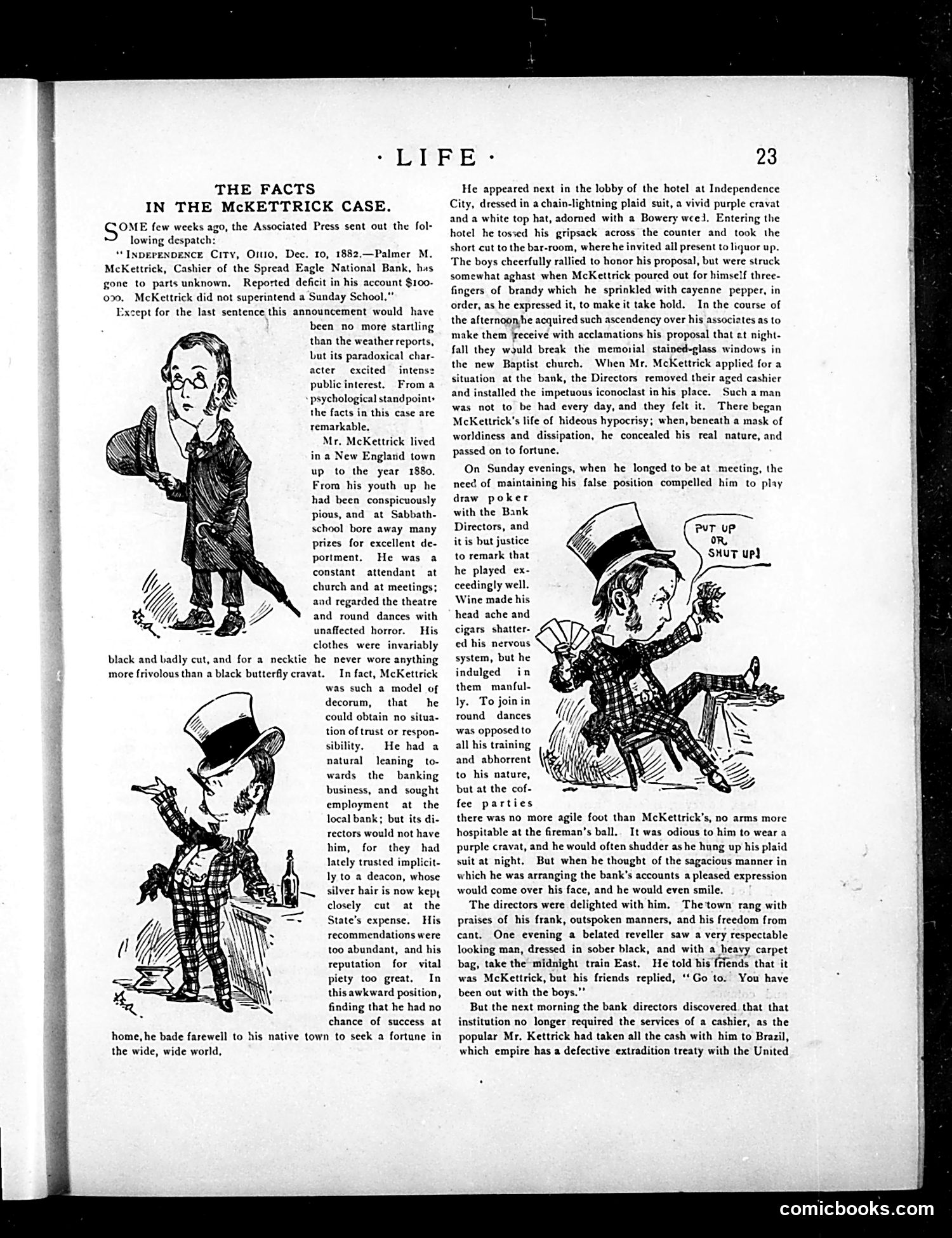
This satirical piece mocks the hypocrisy of Victorian respectability through the story of Palmer M. McKettrick, a bank cashier who embezzles $100,000. **The Setup:** McKettrick begins as an absurdly pious New England man—obsessively religious, wearing only black clothes and conservative neckties, so virtuous that banks won't hire him because his piety seems suspicious. **The Satire:** Upon moving to Independence City, he transforms into a caricature of vice: loud, drinking heavily with cayenne pepper, wearing garish plaid suits and purple cravats, vandalizing churches, playing poker, and frequenting dances. Paradoxically, this *exact* behavior makes him successful—the bank directors immediately promote him to cashier, believing only such a "modern man" can be trusted with real responsibility. **The Joke:** The cartoon exposes how late-19th-century Americans valued *appearance* of toughness and worldliness over actual moral character. McKettrick's exaggerated corruption proves more appealing to businessmen than genuine virtue. The irony: his real self—secretly still pious—remains hidden beneath the false persona, suggesting that American capitalism rewarded performance over principle.
📄 Transcribed text from this page (OCR, searchable)
Machine-transcribed from the original scan — historical spelling and the odd misread are preserved.
THE FACTS IN THE McKETTRICK CASE. OME few weeks ago, the Associated Press sent out the fol- lowing despatch: “INDI DENCE City, O1tlo, Dec. ro, 1882,—Palmer M. McKettrick, Cashier of the Spread Eagle National Bank, has gone to parts unknown, Reported deficit in his account $100- 020. McKettrick did not superintend a Sunday School.” Except for the last sentence this announcement would have been no more startling than the weather reports, Dut its paradoxical char- acter excited intens= public interest. From a psychological standpoints the facts in this case are remarkable. Mr. McKettrick lived in a New England town up to the year 1880, From his youth up he had been conspicuously pious, and at Sabbath- school bore away many prizes for excellent de- portment. He was a constant attendant at church and at meetings; and regarded the theatre and round dances with unaffected horror. His clothes were invariably black and badly cut, and for a necktie he never wore anything more frivolous than a black butterfly cravat. In fact, McKettrick was such a model of decorum, that he could obtain no situa- tion of trust or respon- sibility. He had a natural leaning to- wards the banking business, and sought employment at the local bank; but its di- rectors would not have him, for they had lately trusted implicit- ly to a deacon, whose silver hair is now kept closely cut at the State’s expense. His recommendations were too abundant, and his reputation for vital piety too great. In this awkward position, finding that he had no chance of success at home, he bade farewell to his native town to seek a fortune in the wide, wide world, > LIFE: 23 He appeared next in the lobby of the hotel at Independence City, dressed in a chain-lightning plaid suit, a vivid purple cravat and a white top hat, adorned with a Bowery weed. Entering the hotel he tossed his gripsack across the counter and took the short cut to the bar-room, where he invited all present to liquor up. The boys cheerfully rallied to honor his proposal, but were struck somewhat aghast when McKettrick poured out for himself three- fingers of brandy which he sprinkled with cayenne pepper, in order, as he expressed it, to make it take hold. In the course of the afternoonhe acquired such ascendency over his associates as to make them receive with acclamations his proposal that et night- fall they would break the memorial stained-glass windows in the new Baptist church, When Mr. McKettrick applied for a situation at the bank, the Directors removed their aged cashier and installed the impetuous iconoclast in his place. Such aman was not to be had every day, and they felt it. There began McKettrick’s life of hideous hypocrisy; when, beneath a mask of worldiness and dissipation, he concealed his real nature, and passed on to fortune, On Sunday evenings, when he longed to be at mecting, the need of maintaining his false position compelled him to play draw poker with the Bank Directors, and it is but justice to remark that he played ex- ceedingly well. Wine made his head ache and cigars shatter- ed his nervous system, but he indulged in them manful- ly. To joinin round dances was opposed to all his training and abhorrent to his nature, but at the cof- fee parties there was no more agile foot than McKettrick’s, no arms more hospitable at the fireman’s ball. It was odious to him to wear a purple cravat, and he would often shudder ashe hung up his plaid suit at night. But when he thought of the sagacious manner in which he was arranging the bank's accounts a pleased expression would come over his face, and he would even smile. The directors were delighted with him, The town rang with praises of his frank, outspoken manners, and his freedom from cant. One evening a belated reveller saw a very respectable looking man, dressed in sober black, and with a heavy carpet bag, take the midnight train East. He told bis friends that it was McKettrick, but his friends replied, ‘‘Go to. You have been out with the boys.’” But the next morning the bank directors discovered. that that institution no longer required the services of a cashier, as the popular Mr. Kettrick had taken all the cash with him to Brazil, which empire has a defective extradition treaty with the United comicbooks.com