
Life, 1883-01-11 · page 6 of 18
Life — January 11, 1883 — page 6: what you’re looking at
What you’re looking at
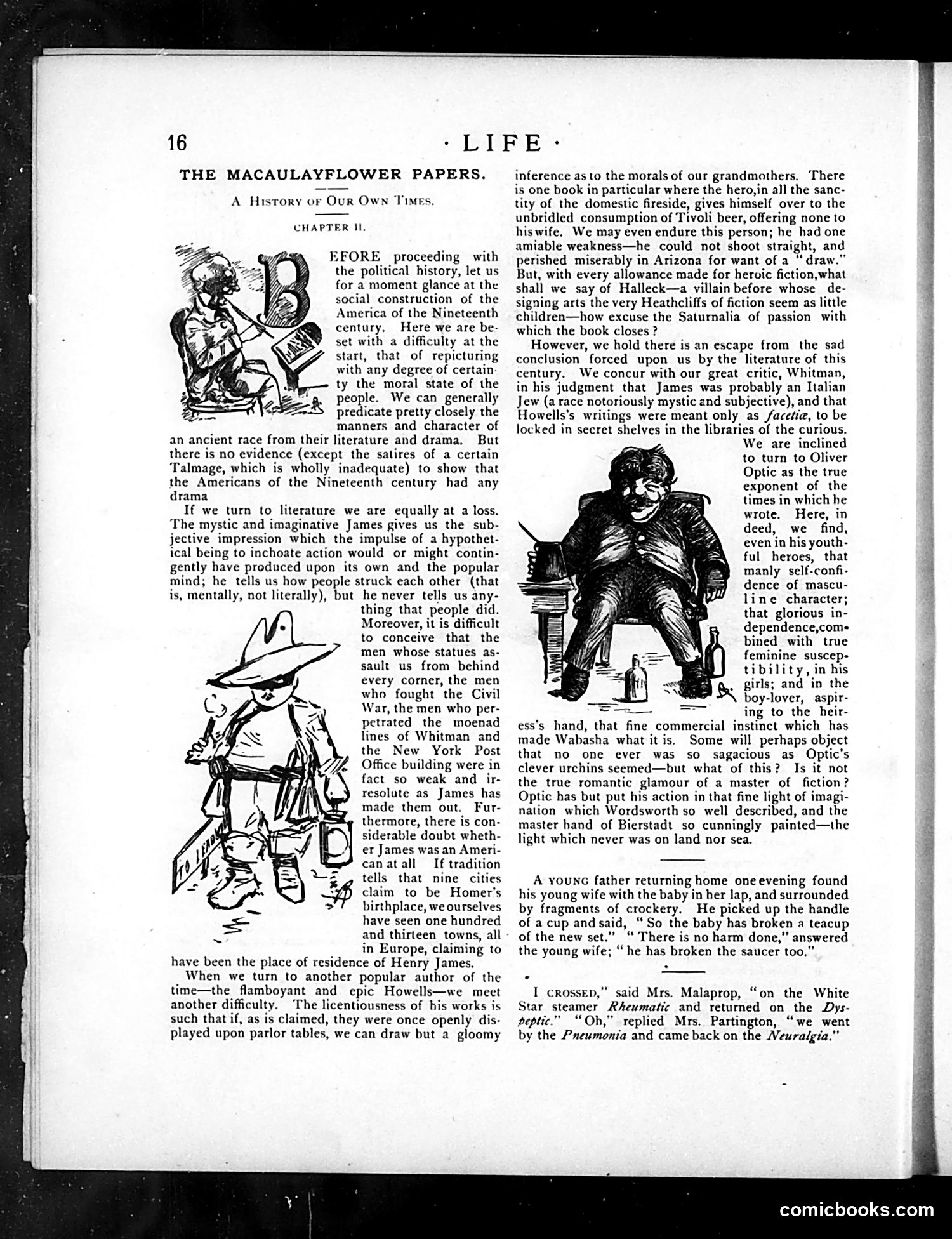
This page from Life magazine's "Macaulay Flower Papers" section contains two satirical illustrations accompanying literary criticism. The upper cartoon depicts a disheveled figure representing **James Fenimore Cooper**, the 19th-century American novelist. The satire mocks Cooper's writing style and the gap between his literary pretensions and actual literary merit. The lower cartoon shows a similarly unkempt character, likely **Oliver Optic** (the pseudonym of William T. Adams), another popular 19th-century writer. The text criticizes Optic's works as commercially successful but lacking genuine romantic or literary substance. Both illustrations use exaggerated caricature to ridicule these authors' reputations among educated critics of the time, even as their works remained popular with the general reading public. The page exemplifies Life's satirical attacks on American literary culture.
📄 Transcribed text from this page (OCR, searchable)
Machine-transcribed from the original scan — historical spelling and the odd misread are preserved.
16 THE MACAULAYFLOWER PAPERS. A History oF Our Own Times, CHAPTER Il. EFORE proceeding with the political history, let us for a moment glance at the social construction of the America of the Nineteenth century. Here we are be- set with a difficulty at the start, that of repicturing with any degree of certain- ty the moral state of the people. We can generally predicate pretty closely the manners and character of an ancient race from their literature and drama. But there is no evidence (except the satires of a certain Talmage, which is wholly inadequate) to show that the Americans of the Nineteenth century had any drama If we turn to literature we are equally at a loss. The mystic and imaginative James gives us the sub- jective impression which the impulse of a hypothet- ical being to inchoate action would or might contin- gently have produced upon its own and the popular mind; he tells us how people struck each other (that is, mentally, not literally), but he never tells us any- thing that people did. Moreover, it is difficult to conceive that the men whose statues as- sault us from behind every corner, the men who fought the Civil War, the men who per- petrated the moenad lines of Whitman and the New York Post Office building were in fact so weak and ir- resolute as James has made them out. Fur- thermore, there is con- siderable doubt wheth- er James was an Ameri- canatall If tradition tells that nine cities claim to be Homer's birthplace, we ourselves have seen one hundred and thirteen towns, all in Europe, claiming to have been the place of residence of Henry James. When we turn to another popular author of the time—the flamboyant and epic Howells—we meet another difficulty. The licentiousness of his works is such that if, as is claimed, they were once openly dis- played upon parlor tables, we can draw but a gloomy > LIFE: inference as to the morals of our grandmothers. There is one book in particular where the hero,in all the sanc- tity of the domestic fireside, gives himself over to the unbridled consumption of Tivoli beer, offering none to his wife. We may even endure this person; he had one amiable weakness—he could not shoot straight, and perished miserably in Arizona for want of a “draw.” But, with every allowance made for heroic fiction,what shall we say of Halleck—a villain before whose de- signing arts the very Heathcliffs of fiction seem as little children—how excuse the Saturnalia of passion with which the book closes ? However, we hold there is an escape from the sad conclusion forced upon us by the literature of this century. We concur with our great critic, Whitman, in his judgment that James was probably an Italian Jew (a race notoriously mystic and subjective), and that Howells's writings were meant only as facefia, to be locked in secret shelves in the libraries of the curious. We are inclined to turn to Oliver Optic as the true exponent of the times in which he wrote. Here, in deed, we find, even in his youth- ful heroes, that manly self-confi- dence of mascu- line character; that glorious in- dependence,com- bined with true feminine suscep- tibility, in his . girls; and in the boy-lover, aspir- ing to the heir- ess's hand, that fine commercial instinct which has made Wabasha what it is. Some will perhaps object that no one ever was so sagacious as Optic's clever urchins seemed—but what of this? Is it not the true romantic glamour of a master of fiction? Optic has but put his action in that fine light of imagi- nation which Wordsworth so well described, and the master hand of Bierstadt so cunningly painted—the light which never was on land nor sea. A youn father returning home oneevening found his young wife with the baby in her lap, and surrounded by fragments of crockery. He picked up the handle of a cup and said, “So the baby has broken a teacup of the new set.” ‘ There is no harm done,” answered the young wife; “he has broken the saucer too.” I crossep,” said Mrs. Malaprop, “on the White Star steamer Rheumatic and returned on the Dys- peptic.” “Oh,” replied Mrs. Partington, “we went by the Pneumonia and came back on the Meuralgia.” comicbooks.com ais iccabninatas sstaies twats