
Life, 1883-01-11 · page 3 of 18
Life — January 11, 1883 — page 3: what you’re looking at
What you’re looking at
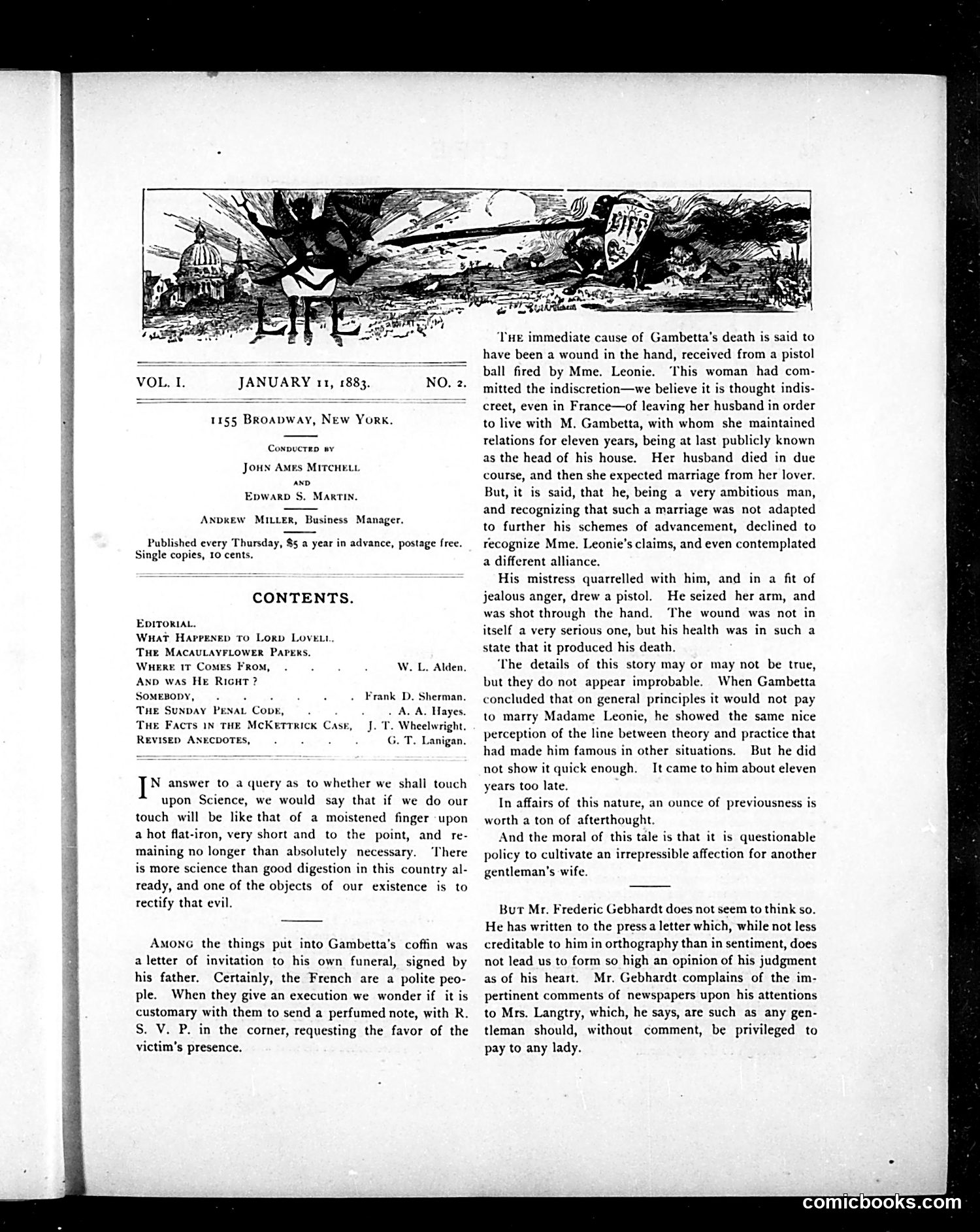
The header illustration appears to be a decorative masthead typical of 19th-century publications, showing allegorical or satirical figures in a landscape scene, though specific identities are unclear from the image. The main text discusses the death of Gambetta (a prominent French politician), describing a scandal: his mistress Mme. Leonie shot him during a quarrel over his refusal to marry her after his legitimate husband died. The editorial uses this as social commentary on the dangers of cultivated "irrepressible affection" outside marriage. A secondary item responds to criticism from Frederic Gebhardt about newspaper coverage of his attention to a Mrs. Langtry, asserting newspapers have the right to comment on public figures' conduct. This is primarily news commentary rather than visual satire.
📄 Transcribed text from this page (OCR, searchable)
Machine-transcribed from the original scan — historical spelling and the odd misread are preserved.
JANUARY 11, 1883. NO. 2. 1155 BRoapway, New York. Conpucteo ay Jouy Ames Mitcnets AND Epwarb S, Martin. ANDREW MILLER, Business Manager, Published every Thursday, $5 a year in advance, postage free. Single copies, 10 cents. CONTENTS. Epivoriat. Wuat Haprrexep to Lorp Lovett. THE MACAULAYFLOWER PaPeks. Where tt Comes From, . 4 : W. L, Alden. Anp was He Ricut? SOMEBODY, . . ‘DAY PENAL Cop! Frank D. Sherman. Tue Su: . . . . A. A. Hayes. Tue Facts in THE McKetrrick Case, J. Wheelwright. REVISED ANECDOTES, 3. T. Lanigan. N answer to a query as to whether we shall touch upon Science, we would say that if we do our touch will be like that of a moistened finger upon a hot flat-iron, very short and to the point, and re- maining no longer than absolutely necessary. ‘There is more science than good digestion in this country al- ready, and one of the objects of our existence is to rectify that evil. AmonG the things put into Gambetta’s coffin was a letter of invitation to his own funeral, signed by his father. Certainly, the French are a polite peo- ple. When they give an execution we wonder if it is customary with them to send a perfumed note, with R. S. V. P. in the corner, requesting the favor of the victim's presence. ‘Tue immediate cause of Gambetta’s death is said to have been a wound in the hand, received from a pistol ball fired by Mme. Leonie. ‘This woman had com- mitted the indiscretion—we believe it is thought indis- creet, even in France—of leaving her husband in order to live with M. Gambetta, with whom she maintained relations for eleven years, being at last publicly known as the head of his house. Her husband died in due course, and then she expected marriage from her lover. But, it is said, that he, being a very ambitious man, and recognizing that such a marriage was not adapted to further his schemes of advancement, declined to recognize Mme. Leonie’s claims, and even contemplated a different alliance. His mistress quarrelled with him, and in a fit of jealous anger, drew a pistol. He seized her arm, and was shot through the hand. The wound was not in itself a very serious one, but his health was in such a state that it produced his death. ‘The details of this story may or may not be true, but they do not appear improbable. When Gambetta concluded that on general principles it would not pay to marry Madame Leonie, he showed the same nice perception of the line between theory and practice that had made him famous in other situations. But he did not show it quick enough, It came to him about eleven years too late. In affairs of this nature, an ounce of previousness is worth a ton of afterthought. And the moral of this tale is that it is questionable policy to cultivate an irrepressible affection for another gentleman's wife. But Mr. Frederic Gebhardt does not seem to think so. He has written to the press a letter which, while not less creditable to him in orthography than in sentiment, does not lead us to form so high an opinion of his judgment as of his heart. Mr. Gebhardt complains of the im- pertinent comments of newspapers upon his attentions to Mrs. Langtry, which, he says, are such as any gen- tleman should, without comment, be privileged to pay to any lady. comicbooks.com