
Life, 1883-01-11 · page 8 of 18
Life — January 11, 1883 — page 8: what you’re looking at
What you’re looking at
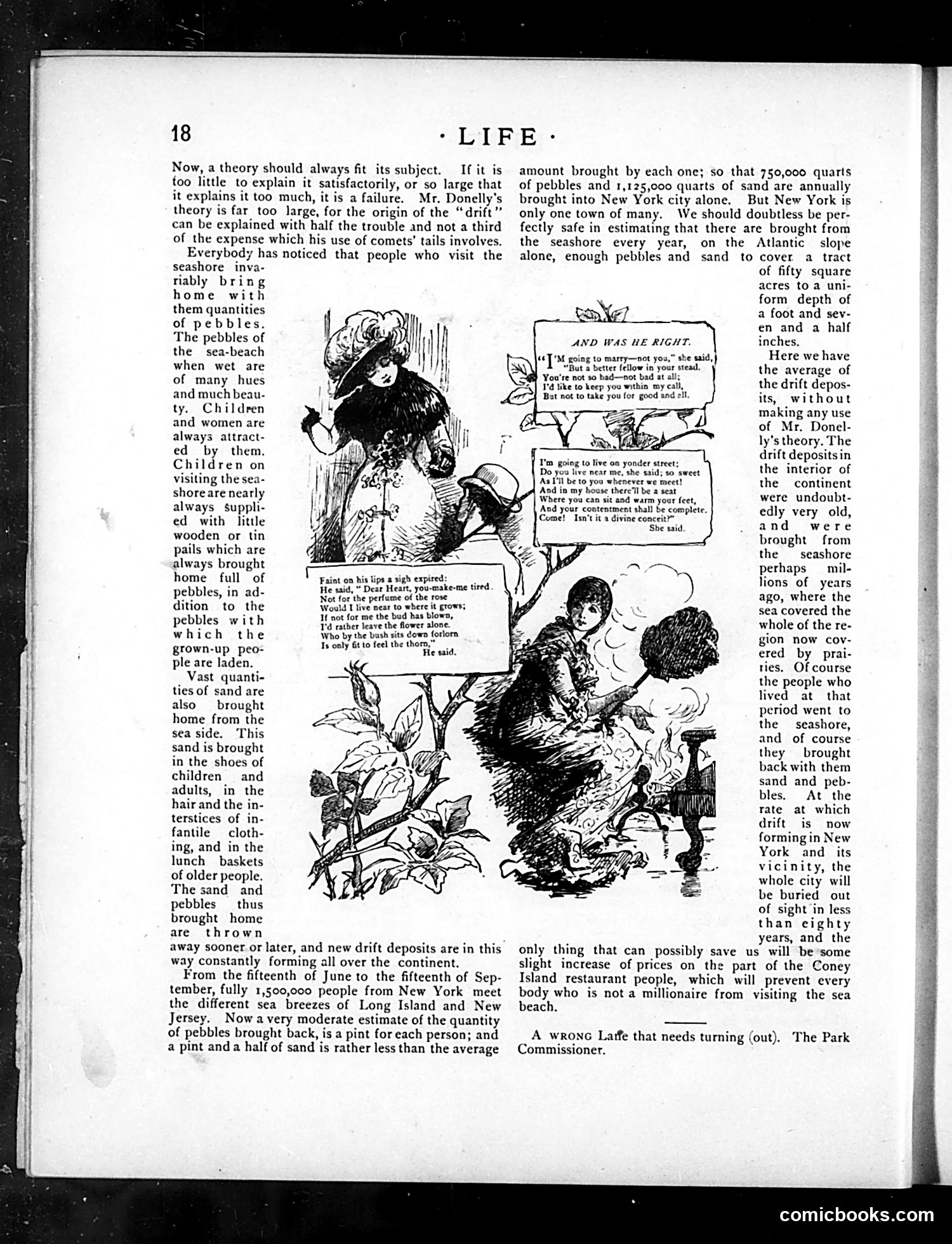
This page satirizes New York City's accumulating problem with sand and pebbles brought home from beaches by visitors. The illustration shows a couple discussing marriage plans while surrounded by decorative pebbles and sand—visual evidence of the article's complaint. The text argues Mr. Donnelly's geological theory inadequately explains the "drift" depositing massive quantities of beach material throughout the city. The author estimates 1.5 million quarts of sand enter New York annually from Coney Island and other shores. The satire highlights an absurd civic nuisance: beach-goers habitually collect souvenirs (pebbles, sand in clothing/hair), gradually burying the city under accumulated debris. The piece warns that within eighty years, Manhattan will become unrecognizable—buried beneath centuries of accumulated seashore deposits.
📄 Transcribed text from this page (OCR, searchable)
Machine-transcribed from the original scan — historical spelling and the odd misread are preserved.
Now, a theory should always fit its subject. If it is too little to explain it satisfactorily, or so large that it explains it too much, it is a failure. Mr. Donelly's theory is far too large, for the origin of the “drift” can be explained with half the trouble and not a third of the expense which his use of comets’ tails involves. Everybody has noticed that people who visit the seashore inva- riably bring home with them quantities of pebbles. The pebbles of the sea-beach when wet are of many hues and much beau- ty. Children and women are always attract- ed by them. Children on visiting the sea- shore are nearly always Ssuppli- ed with little wooden or tin pails which are always brought home full of pebbles, in ad- ‘nt on his lips a sigh expired: 3 Head, oiDear Heart, you-make-me tired Not for the perfume of the rose dition to the Would live near to where it grows: wi {not for me the bud has blown, pebbles with Ld rather leave the flower alone which the Who by the bash sits dows forlorn feel the thorn, grown-up peo- Ts coly Gtto feel the thorn,” ple are laden. Vast quanti- ties of sand are also brought home from the sea side. This sand is brought in the shoes of children and adults, in the hair and the in- terstices of in- fantile — cloth- ing, and in the lunch _ baskets of older people. The sand and pebbles thus brought home are thrown away sooner or later, and new drift deposits are in this way constantly forming all over the continent. From the fifteenth of June to the fifteenth of Sep- tember, fully 1,500,000 people from New York meet the different sea breezes of Long Island and New Jersey. Nowa very moderate estimate of the quantity of pebbles brought back, is a pint for each person; and a pint anda half of sand is rather less than the average 18 ‘LIFE: amount brought by each one; so that 750,000 quarts of pebbles and 1,125,000 quarts of sand are annually brought into New York city alone. But New York is only one town of many. We should doubtless be per- fectly safe in estimating that there are brought from the seashore every year, on the Atlantic slope alone, enough pebbles and sand to cover a tract of fifty square acres to a uni- : form depth of <p a foot and sev- en and a half inches, fe] M going to marry—neot yo. Here we have But a better fellow in your stead, the average of ia bacp yoo erin wy call the drift depos- to take you for good and cil, its, without making any use of Mr. Donel- ly’s theory. The R 2 drift deposits in whenever we meet! the continent peptone were undoubt- And your contentment shall be complete. edly very old, Corme! Inne i divine conceit?” Coandrtwere Drought from the seashore perhaps mil- lions of years ago, where the sea covered the whole of the re- gion now cov- ered by prai- ties. Of course the people who lived at that period went to the seashore, and of course they brought back with them sand and peb- bles. At the rate at which drift. is now forming in New York and its vicinity, the whole city will be buried out of sight in less than cighty years, and the only thing that can possibly save us will be ‘some slight increase of prices on the part of the Coney Island restaurant people, which will prevent every body who is nota millionaire from visiting the sea beach. A wronc Larfe that needs turning (out). The Park Commissioner. comicbooks.com caesar anal! bias