A complete issue · 52 pages · 1938
Judge — March 1938
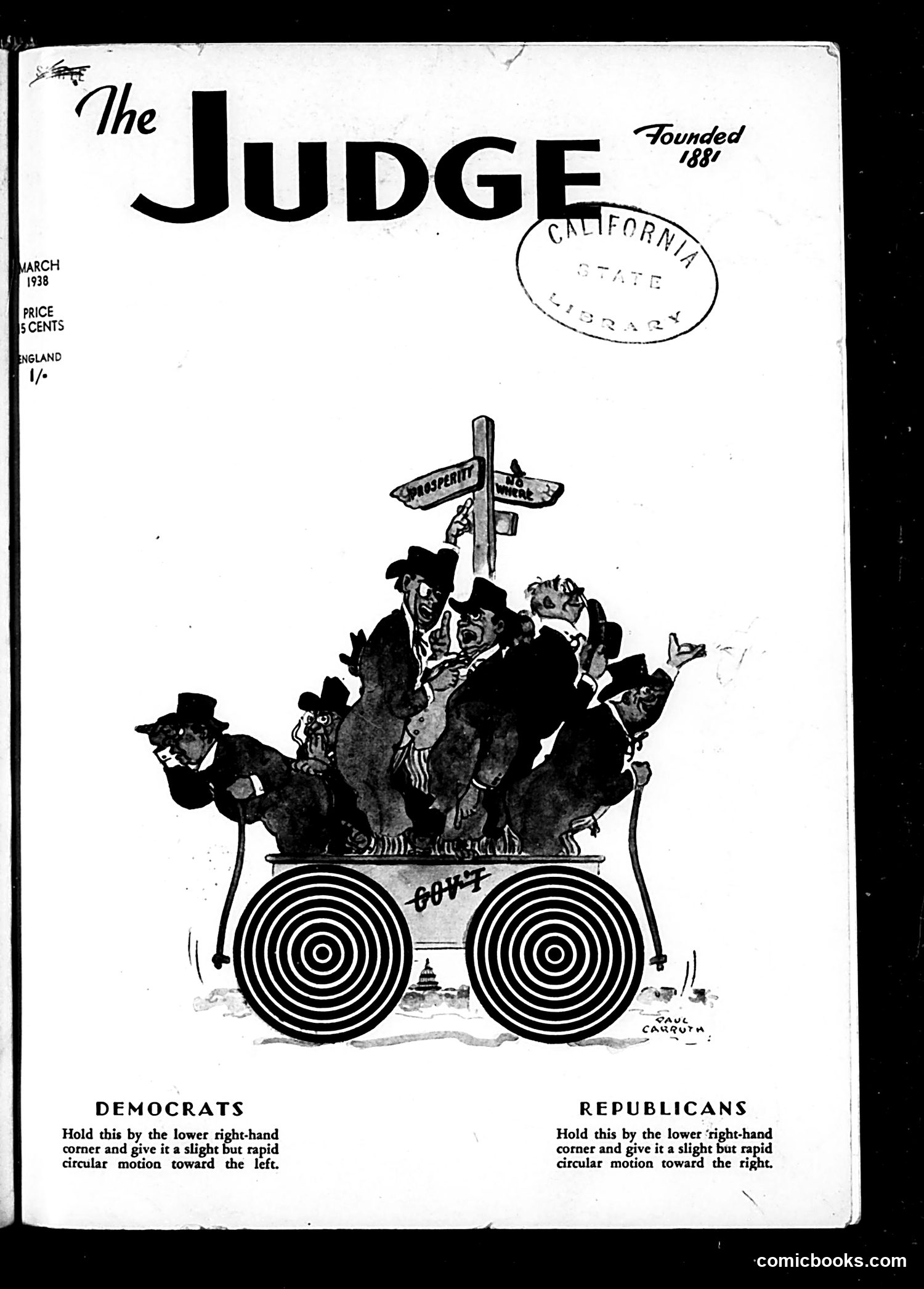
# Analysis of "The Judge" Cover, March 1938 This satirical cover depicts the 1938 political landscape as a precarious wagon balanced on two large wheels labeled "COURT." The wagon carries multiple caricatured figures representing political actors, topped by a cross labeled "PROSPERITY." The instructions at bottom reveal the cartoon's optical illusion mechanic: rotating it left (for Democrats) or right (for Republicans) makes the wagon appear to tip in that direction. This visualizes how both parties blamed each other for economic instability during the Great Depression era. The figures likely represent political leaders and institutions of the period; the cross symbolizes that prosperity—the central issue—is precariously balanced between the two parties' competing claims about how to achieve economic recovery.
# Analysis This page is **primarily advertising, not satire or political cartoon content**. It's a full-page advertisement for Union Central Life Insurance Company (Cincinnati, Ohio), founded in 1867. The ad promotes their "Family-Needs Forecast" service, which helps families plan life insurance coverage for seven different potential needs. The opening narrative describes a widowed family facing financial hardship because the father didn't anticipate future expenses. The advertisement appeals to male breadwinners' anxieties about protecting their families' security. It emphasizes that Union Central can help calculate adequate coverage through professional planning. There is no political satire or cartoon content visible—this is straightforward commercial messaging typical of Judge magazine's revenue model, mixing editorial content with advertisements.
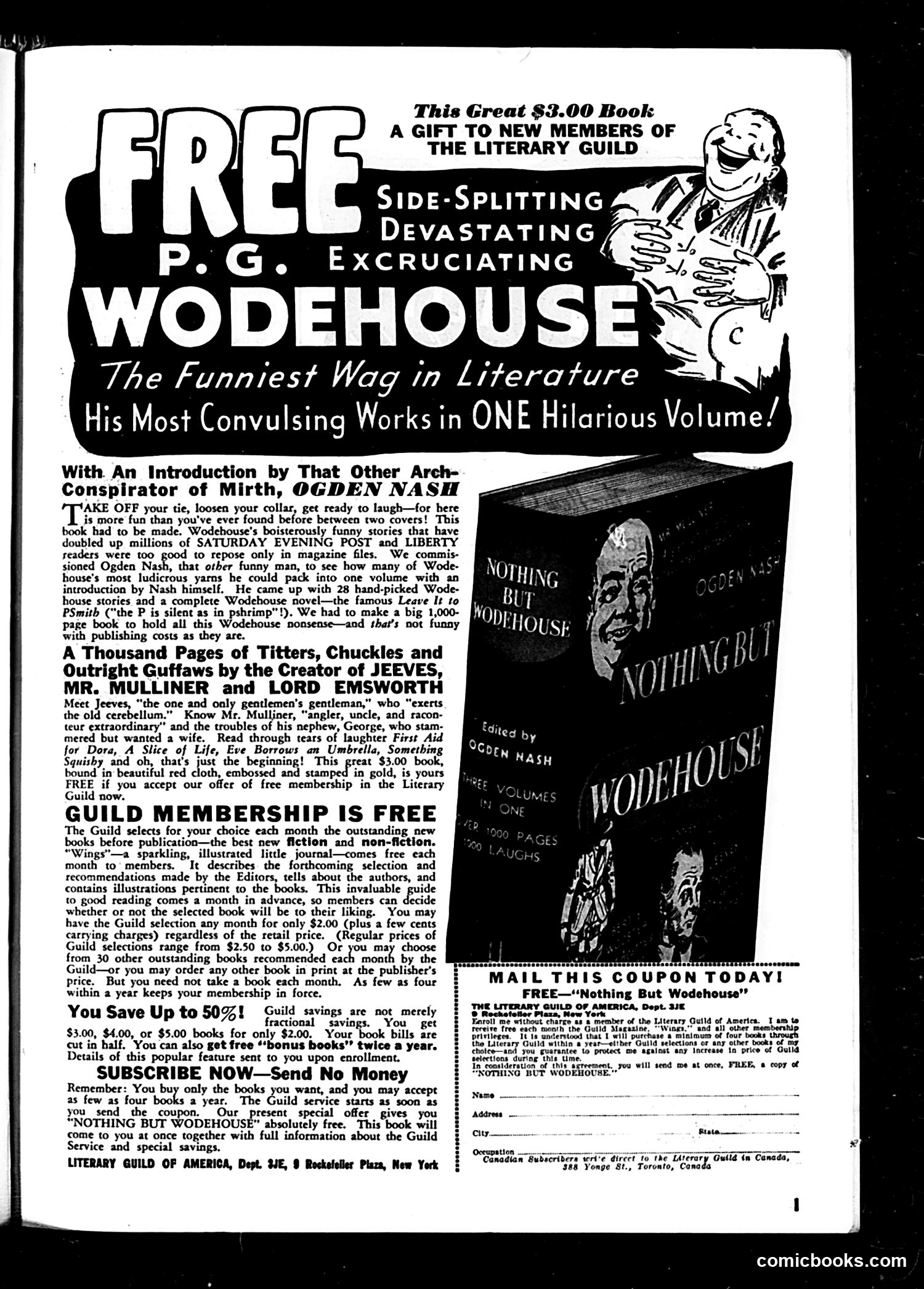
# Analysis This is primarily a **Literary Guild membership advertisement**, not political satire. The page promotes a free P.G. Wodehouse collection titled "Nothing But Wodehouse," edited by Ogden Nash, as a gift for joining the Guild. The visual humor features **Wodehouse caricatures** and comedic illustrations typical of his work—the jolly figure on the left appears to represent Wodehouse himself or his famous character Jeeves. The advertisement emphasizes Wodehouse's reputation as "the funniest wag in literature," referencing his beloved comic characters including Jeeves, Mr. Mulliner, and Lord Emsworth. The satire is **literary rather than political**—it mocks pretentious reading culture while celebrating accessible humor. The ad promises members can obtain quality books at discounted prices, positioning the Guild as an alternative to expensive individual purchases.
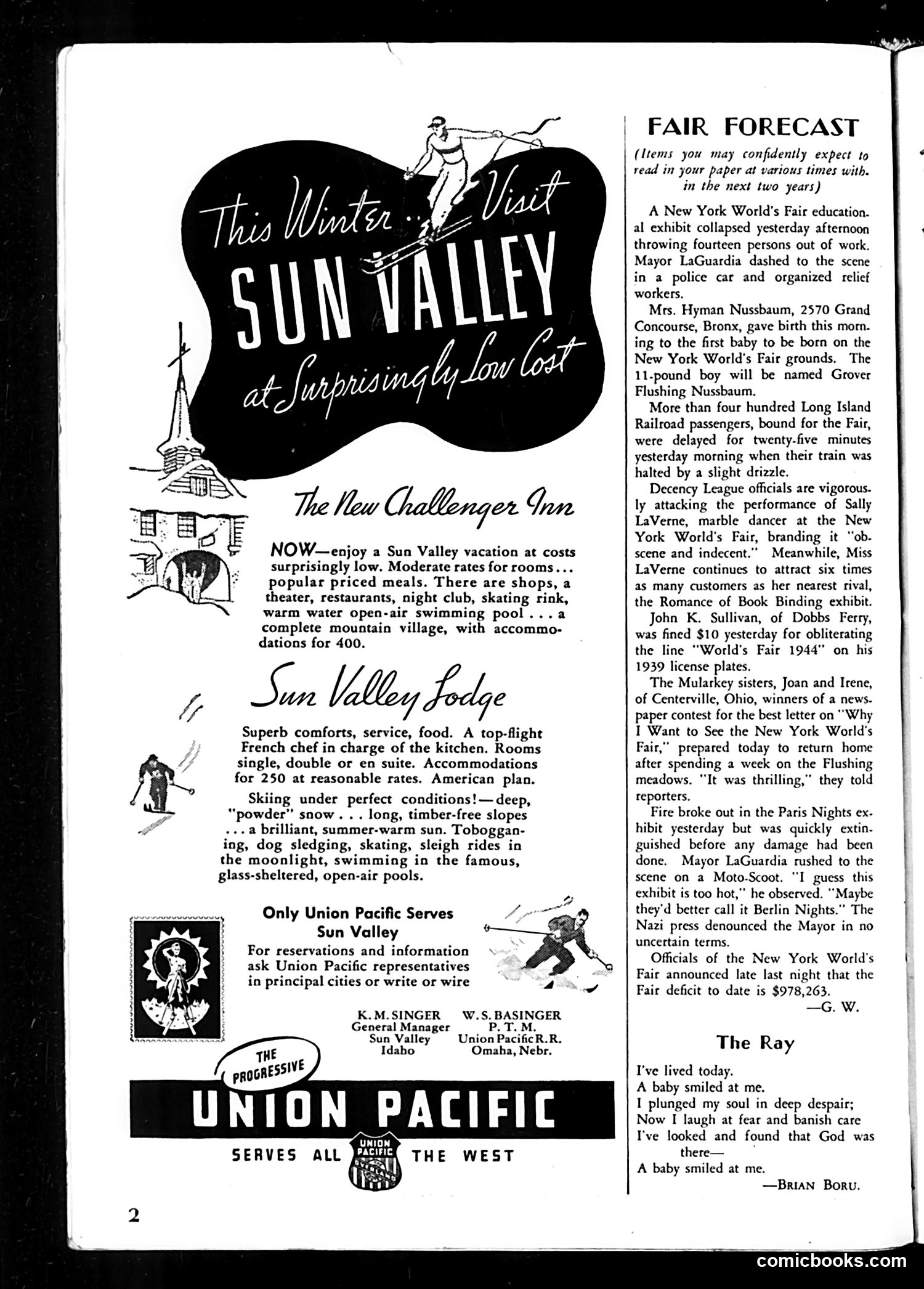
# Page Analysis This page is primarily **advertising**, not satire. The left side features two Union Pacific resort advertisements promoting Sun Valley, Idaho—"The New Challenger Inn" and "Sun Valley Lodge"—emphasizing affordable winter vacations with skiing, skiing, and amenities. The right side contains "Fair Forecast," a gossip column about the 1939 New York World's Fair. Items include: a collapsed educational exhibit, the first baby born on Fair grounds (named Grover Flushing Nussbaum), train delays, and criticism of dancer Sally LaVerne's performance as "obscene and indecent." The column notes the Fair's deficit and includes a poem, "The Ray," by Brian Boru. The content reflects mid-Depression Era promotional material and celebrity coverage rather than political commentary.
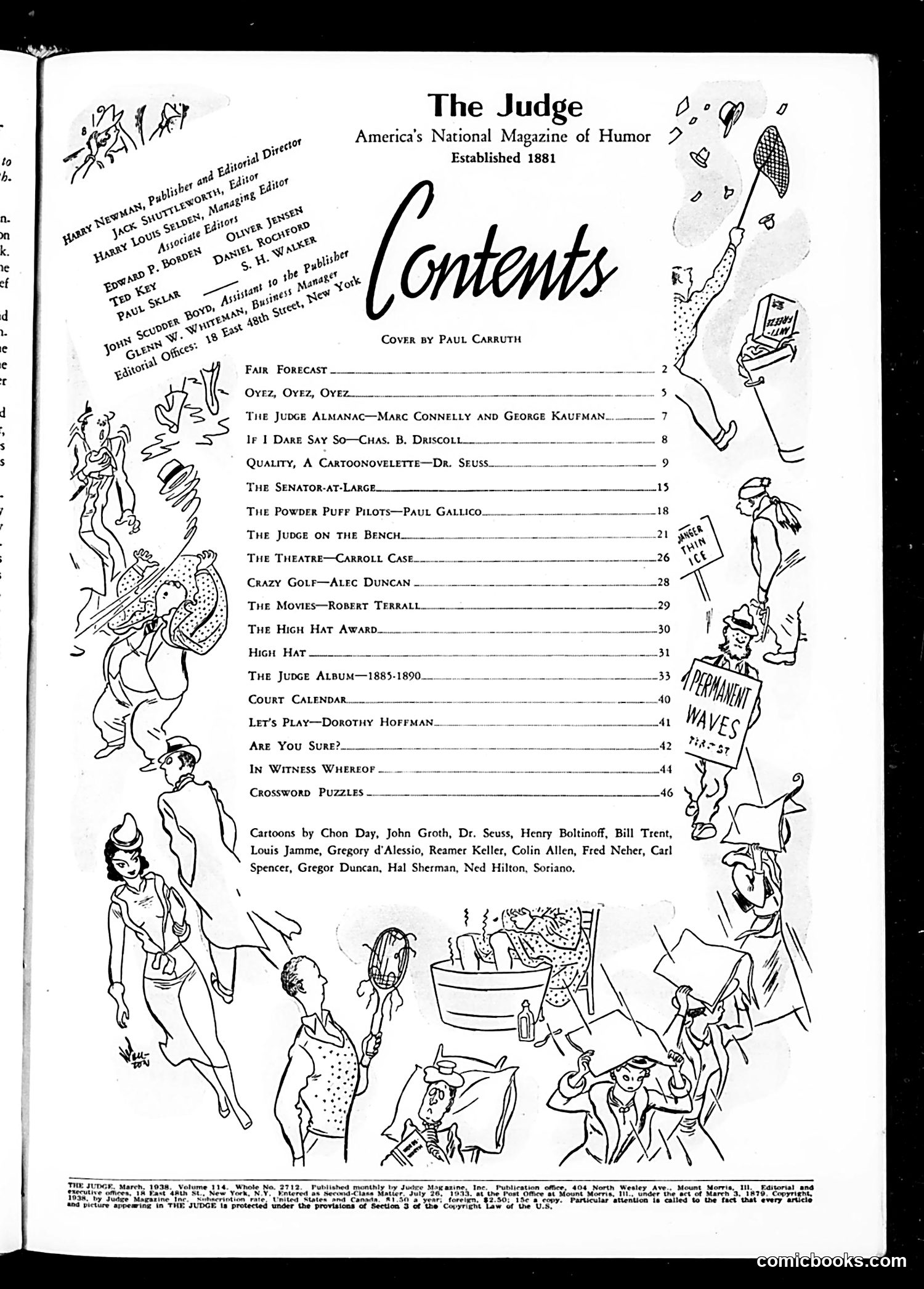
# Contents Page Analysis This is a contents page for *The Judge* magazine (March 1938), listing articles and cartoons rather than displaying finished editorial content. Notable entries include "Quality, A Cartoonnovellette" by Dr. Seuss and "The Judge Album: 1883-1890," suggesting historical retrospectives. Several pieces reference contemporary topics: "The Senator-at-Large," "The High Hat Award," and "Court Calendar" appear to offer satirical commentary on politics and social institutions. The page credits cartoonists including Dr. Seuss, John Groth, and others—prominent humorists of the era. Without seeing the actual cartoons or articles, specific political/social references remain unclear, though the magazine's established reputation for political satire suggests commentary on 1930s American governance and society.
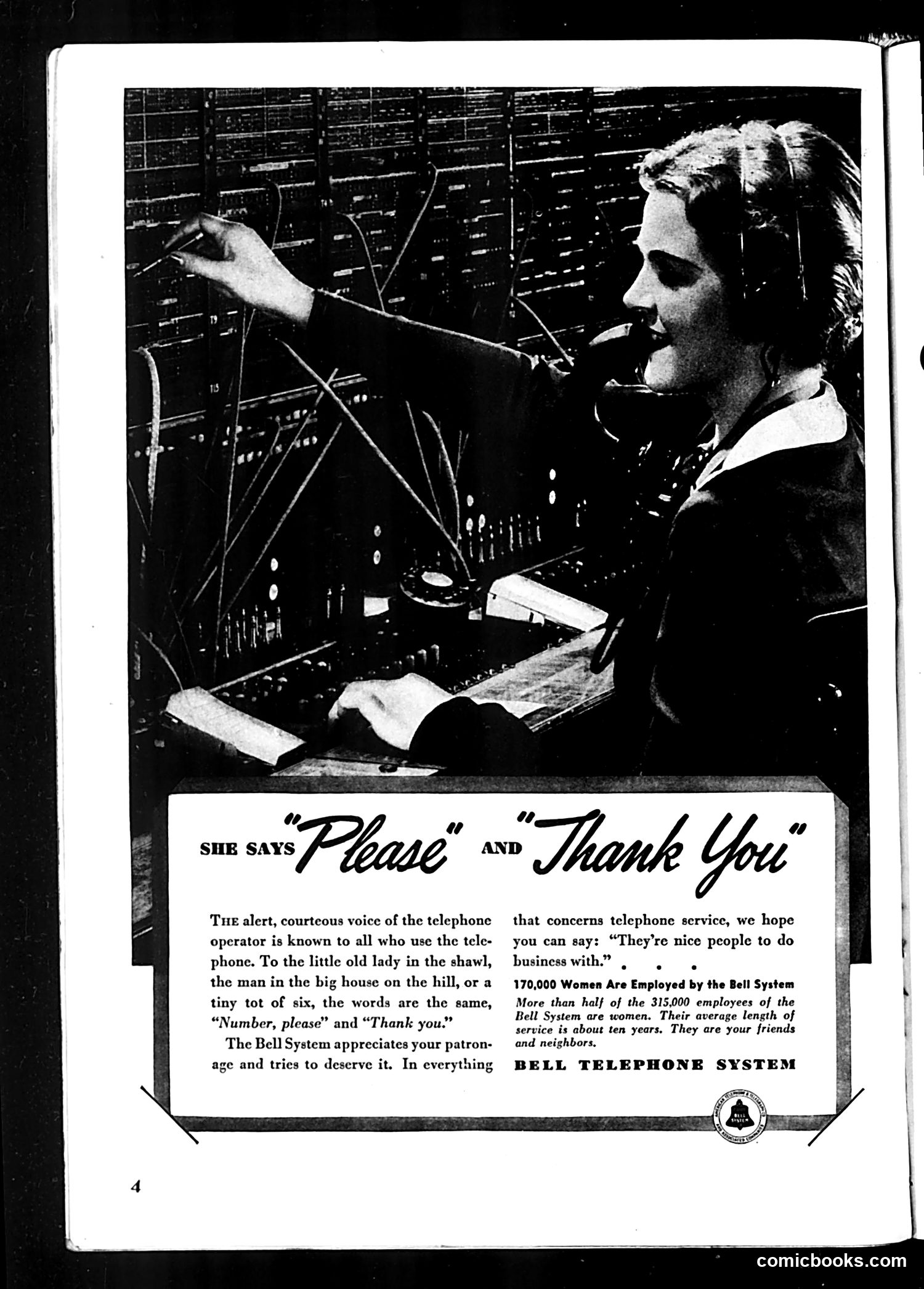
# Analysis This is a Bell Telephone System advertisement rather than political satire. It depicts a telephone operator at a switchboard, emphasizing the professional courtesy and service operators provided. The text celebrates the operator's courteous phrases—"Please" and "Thank you"—as hallmarks of quality telephone service. The advertisement notes that 170,000 women were employed by Bell System out of 315,000 total employees, highlighting their significant workforce role. It describes operators as "your friends and neighbors" with an average ten-year tenure, positioning them as trusted community members. The image and copy work together to promote Bell's service quality through human connection, appealing to customers' appreciation for politeness and personal interaction—marketing strategy that emphasizes the human element of telephone service during this era.
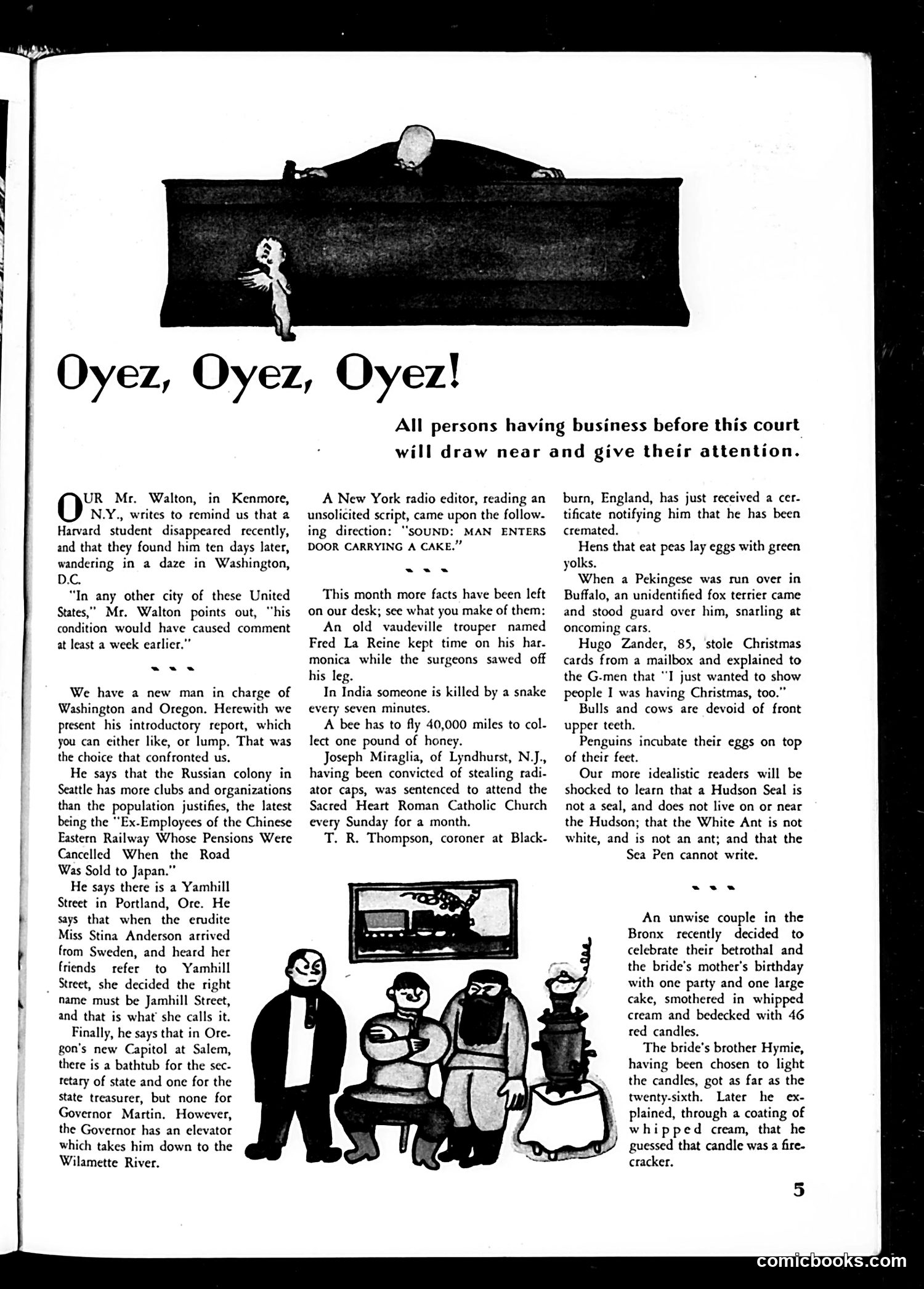
# Analysis of Judge Page The page leads with "Oyez, Oyez, Oyez!"—a traditional court crier's call—establishing a humorous "court of anecdotes" format. The content collects amusing stories and odd facts rather than presenting unified political satire. The main illustrated cartoon (bottom) depicts what appears to be a domestic scene with four figures in formal attire gathered around a cake. The accompanying text describes an "unwise couple in the Bronx" celebrating multiple occasions with one large cake, whose candles the bride's brother mistook for firecrackers when he lit them—a slapstick punchline. The page functions primarily as a humor magazine section compiling amusing incidents (a disappeared Harvard student, unusual animal facts, naming mishaps) rather than focused political commentary. The satire is gentle, situational comedy rather than sharp social critique.
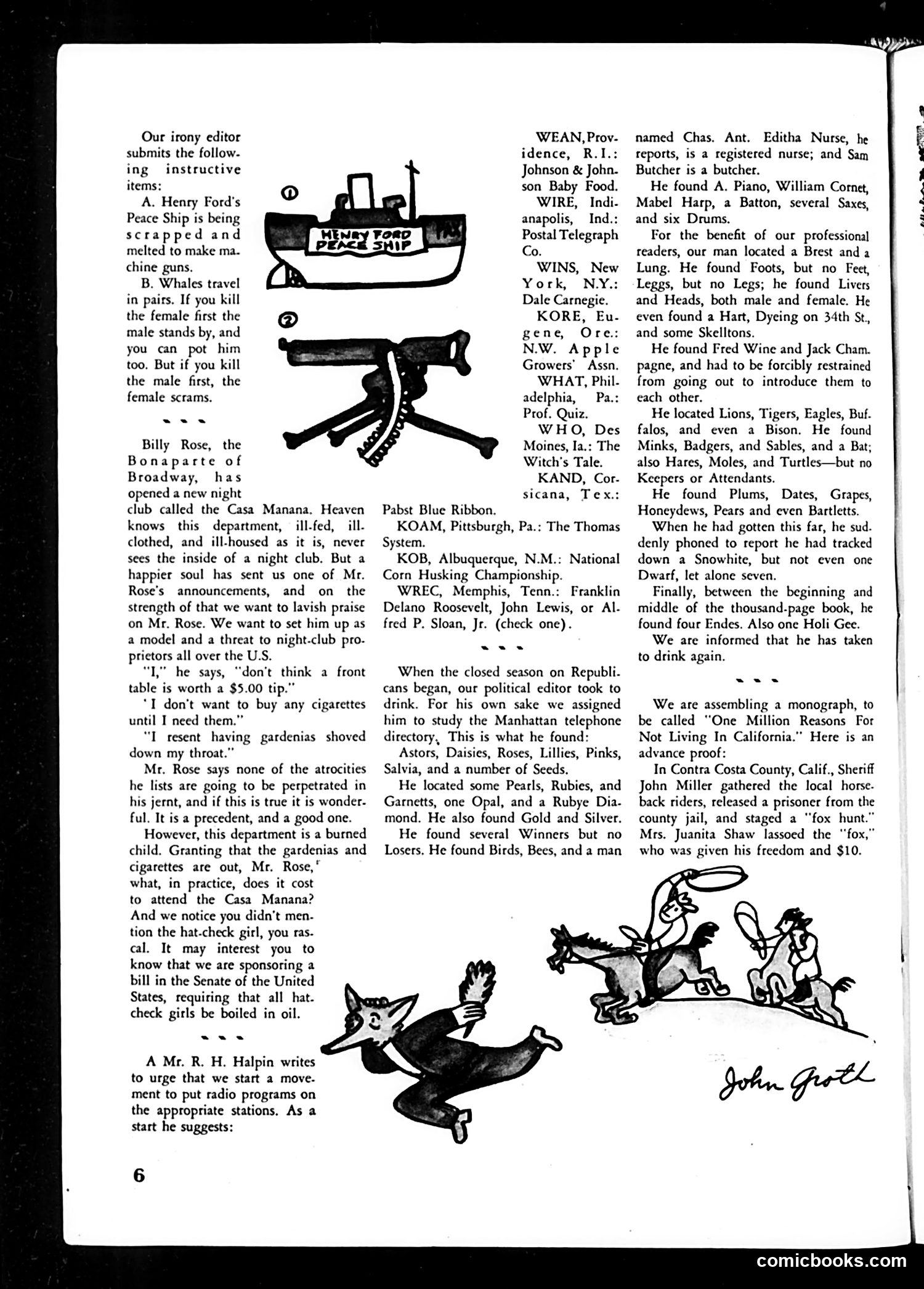
# Analysis of Judge Magazine Page This page contains satirical commentary and cartoons rather than a cohesive narrative. The main content includes: **Left column:** An "irony editor" section mocking absurd statements from various contributors—including complaints about gardeners, cigarettes, and hat-check girls at nightclubs. The satire targets pretentious complaints from the wealthy. **Center/Right:** Brief humorous reports from across America, including odd findings (animals without typical features, unusual items discovered). The tone is absurdist humor. **Cartoons:** Two illustrated gags appear—one showing a fox and another showing people in comedic situations—typical of Judge's visual humor style. **Bottom note:** A suggestion to start a radio program movement, signed by John Groth. The overall page exemplifies Judge's format: satirizing current events, social pretension, and American eccentricity through brief jokes and illustrations rather than sustained political commentary.
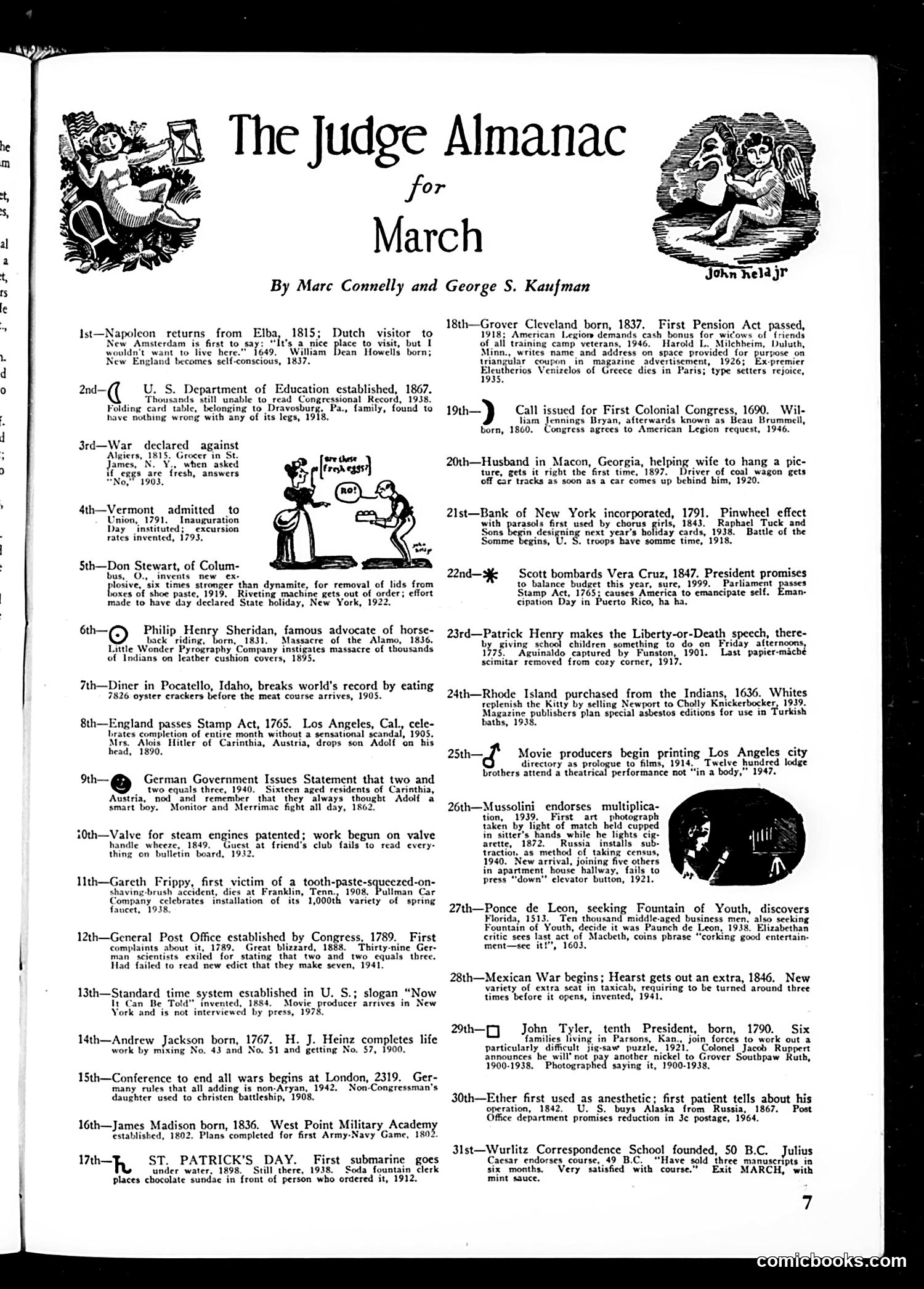
# The Judge Almanac for March This is an almanac page listing historical events for each day of March, compiled by Marc Connelly and George S. Kaufman for *Judge* magazine. The page contains two small cartoon illustrations accompanying entries, though they're generic comedic vignettes rather than political satire: One shows a figure apparently caught in an awkward domestic situation (entry 5th); another depicts what appears to be a slapstick scene (entry 8th). The entries themselves document genuine historical events—Napoleon's return from Elba, Vermont's statehood, Patrick Henry's Liberty-or-Death speech, Andrew Jackson's birth, etc.—mixed with humorous or absurd fictional "facts" typical of satirical almanacs. The format parodies serious historical reference works while entertaining readers with invented anecdotes.
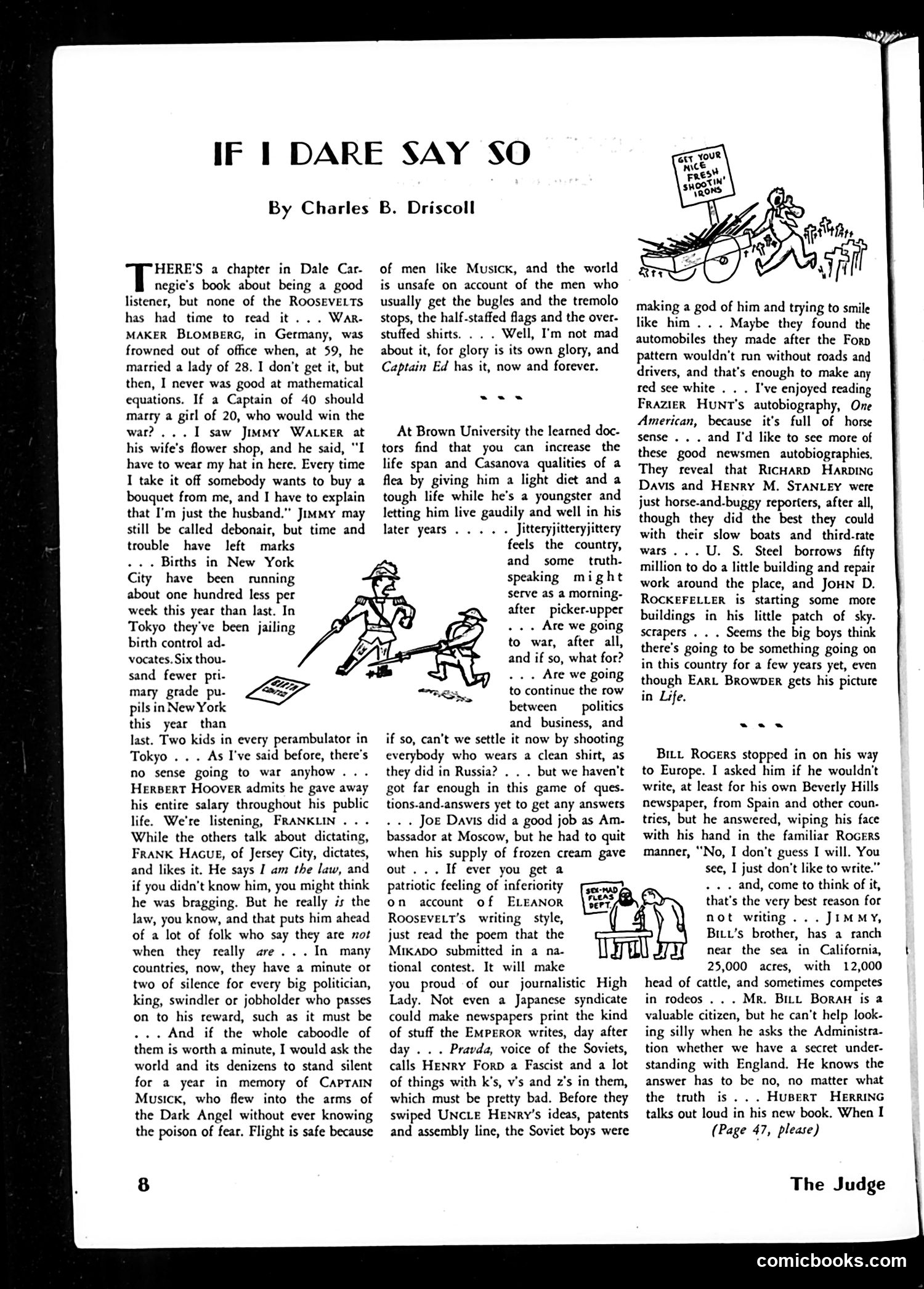
# Analysis of "If I Dare Say So" by Charles B. Driscoll This is a satirical opinion column from Judge magazine containing social and political commentary rather than traditional cartoons. The author critiques contemporary figures and trends: **Key references:** - **Herbert Hoover vs. Franklin D. Roosevelt**: Driscoll sarcastically challenges Hoover's claim of giving away his entire presidential salary, implying Roosevelt should prove similar generosity - **Captain Ed Musick**: Aviator praised for pioneering aviation safely without fear - **Eleanor Roosevelt**: Her writing style mocked as inferior - **Henry Ford**: Criticized by Soviet propaganda (Pravda) for his industrial innovations, which the Soviets later copied - **General observations**: Birth control debates in Japan vs. New York; concerns about potential war; political corruption The column's tone is cynical—mocking both American and Soviet leaders while defending working professionals like pilots and journalists who contribute without fanfare. The satire suggests America's political establishment lacks the integrity of ordinary citizens.
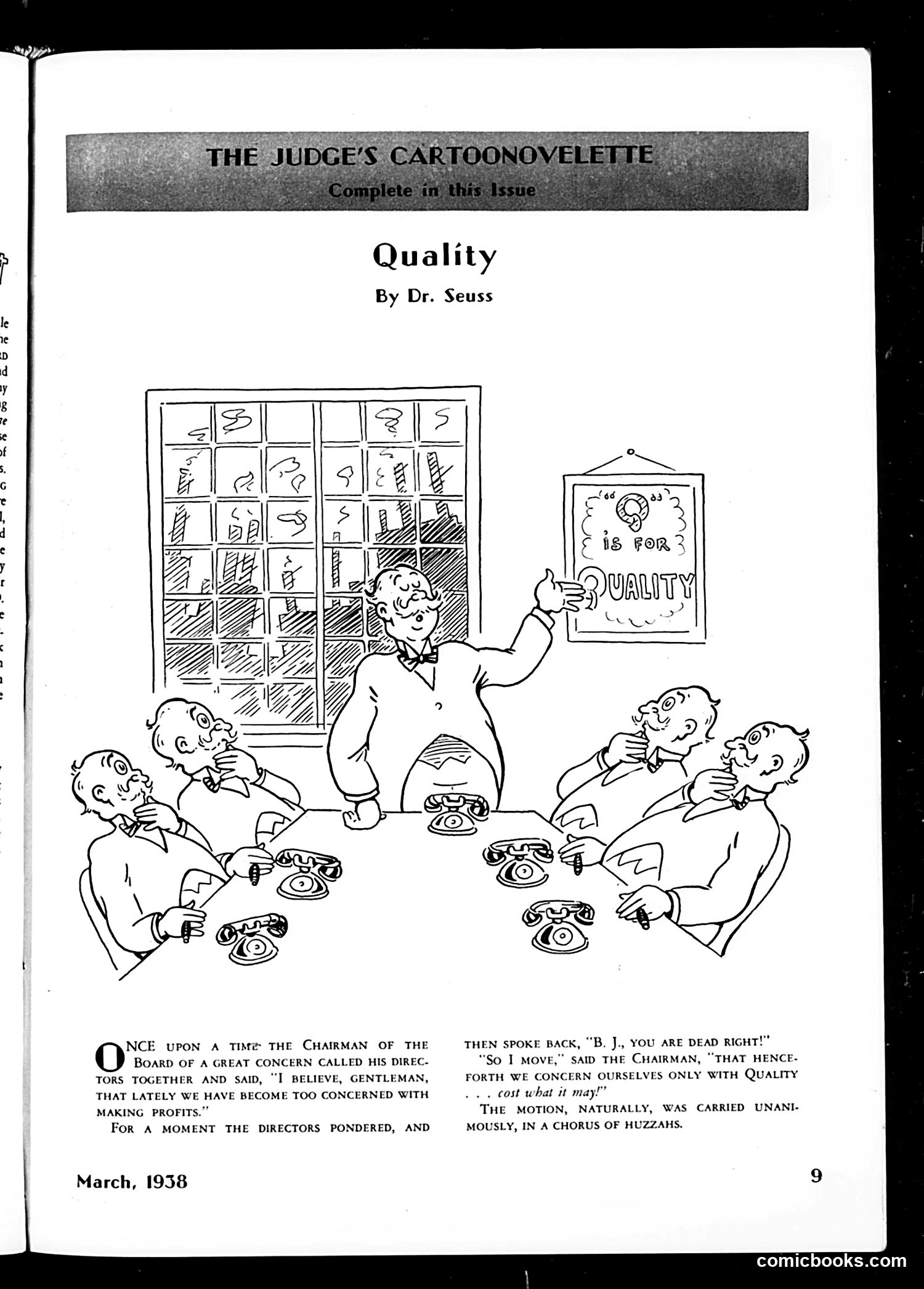
# "Quality" by Dr. Seuss (March 1938) This satirical cartoon mocks corporate hypocrisy regarding profit versus quality. A board chairman addresses his directors, proposing they abandon profit-chasing to focus solely on quality—a noble sentiment the directors enthusiastically endorse in unison. The satire lies in the obvious absurdity: the cartoon shows a massive grid behind them (resembling a factory or production schedule) filled with diagonal hatching, suggesting mass production and standardization—the opposite of genuine quality. The cartoon implies that corporate boards make such high-minded proclamations for show while actually prioritizing efficiency and profits. Seuss critiques how corporations adopt virtuous-sounding policies without genuine commitment to them. The unanimous "huzzahs" underscore the performative nature of corporate ethics—everyone agrees on paper, but the underlying systems remain unchanged. This reflects Depression-era skepticism about big business sincerity.
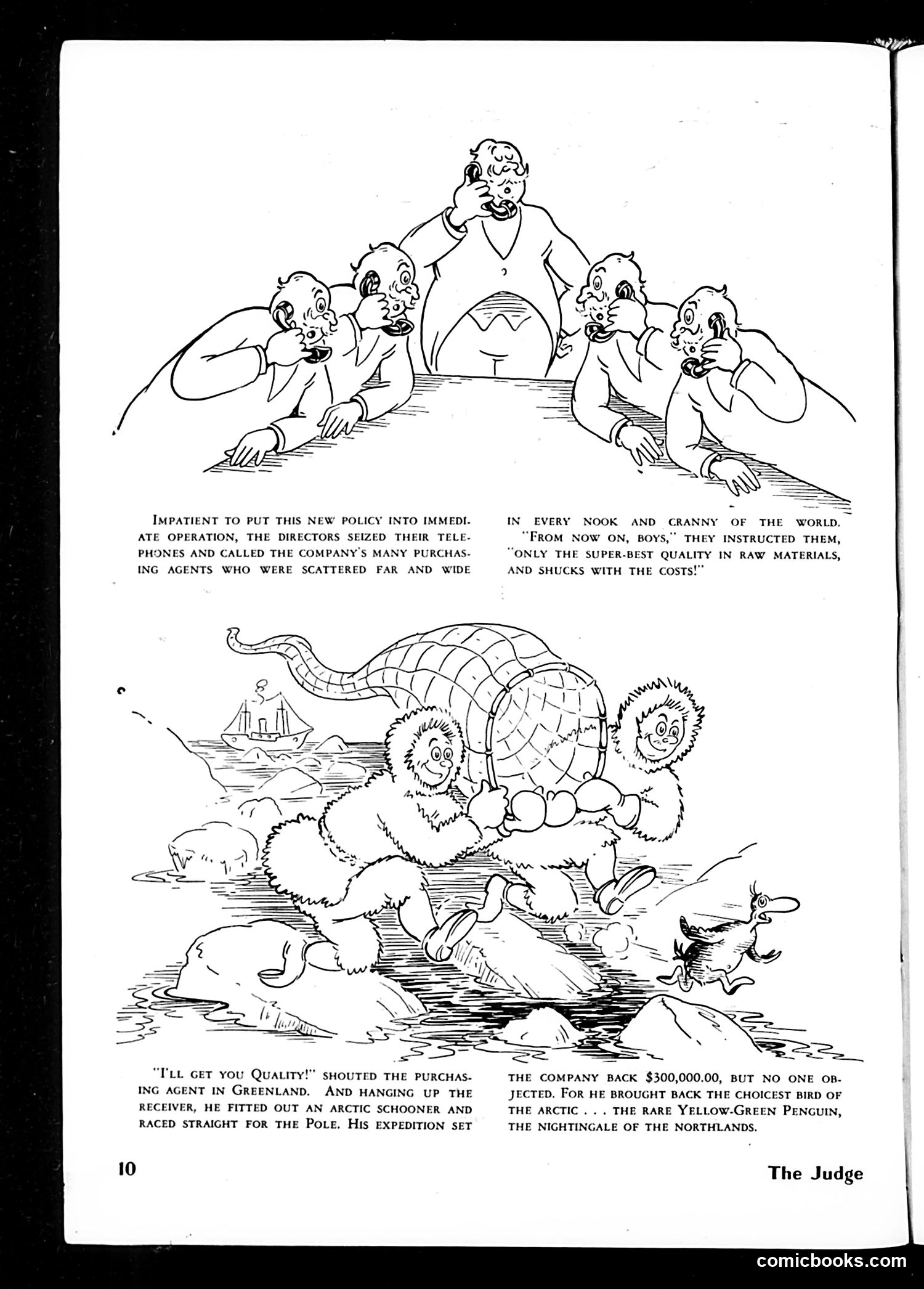
# Cartoon Analysis: "Quality at Any Cost" This satirical cartoon mocks corporate obsession with cost-cutting disguised as quality improvement. Company directors issue new directives demanding "super-best quality in raw materials" while watching costs—an inherent contradiction. The absurdist punchline: A purchasing agent in Greenland, taking the mandate literally, spends $300,000 to retrieve a rare "Yellow-Green Penguin" from the Arctic, claiming it's "the nightingale of the northlands." The illustrated expedition shows fuzzy creatures (penguins) being transported via igloo and schooner. The satire targets corporate hypocrisy—executives demand impossible standards while claiming fiscal responsibility, leading subordinates to pursue ridiculous, wasteful solutions. The exotic penguin procurement exemplifies how misguided directives produce absurd real-world consequences that contradict the original cost-saving intent. It's a commentary on corporate bureaucracy and the gap between stated values and actual practice.