
Judge, 1938-03 · page 28 of 52
Judge — March 1938 — page 28: what you’re looking at
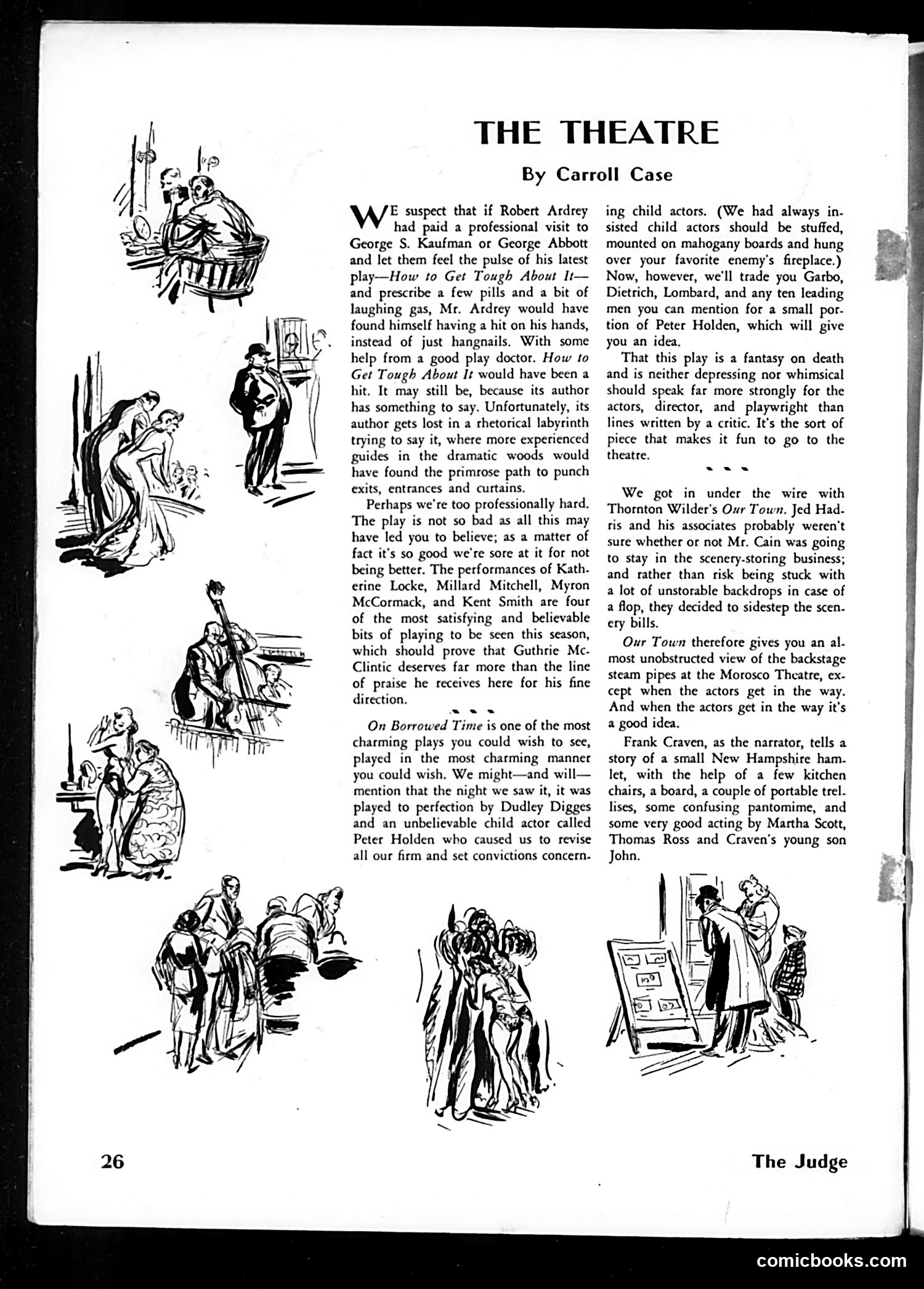
A restored page from Judge, 1938-03. Page through the whole issue in the reader above.
📄 Transcribed text from this page (OCR, searchable)
Machine-transcribed from the original scan — historical spelling and the odd misread are preserved.
THE THEATRE By Carroll Case WE suspect that if Robert Ardrey had paid a professional visit to George S. Kaufman or George Abbott and let them feel the pulse of his latest play—How to Get Tough About It— and prescribe a few pills and a bit of laughing gas, Mr. Ardrey would have found himself having a hit on his hands, instead of just hangnails. With some help from a good play doctor. How to Get Tough About It would have been a hit. It may still be, because its author has something to say. Unfortunately, its author gets lost in a rhetorical labyrinth trying to say it, where more experienced guides in the dramatic woods would have found the primrose path to punch exits, entrances and curtains. Perhaps we're too professionally hard, The play is not so bad as all this may have led you to believe; as a matter of fact it's so good we're sore at it for not being better. The performances of Kath. erine Locke, Millard Mitchell, Myron McCormack, and Kent Smith are four of the most satisfying and believable bits of playing to be seen this season, which should prove that Guthrie Mc- Clintic deserves far more than the line of praise he receives here for his fine direction. On Borrowed Time is one of the most charming plays you could wish to sce, played in the most charming manner you could wish. We might—and will— mention that the night we saw it, it was played to perfection by Dudley Digges and an unbelievable child actor called Peter Holden who caused us to revise all our firm and set convictions concern. ing child actors. (We had always in. sisted child actors should be stuffed, mounted on mahogany boards and hung over your favorite enemy's fireplace.) Now, however, we'll trade you Garbo, Dietrich, Lombard, and any ten leading men you can mention for a small por- tion of Peter Holden, which will give you an idea. That this play is a fantasy on death and is neither depressing nor whimsical should speak far more strongly for the actors, director, and playwright than lines written by a critic. It's the sort of piece that makes it fun to go to the theatre. We got in under the wire with Thornton Wilder's Our Town. Jed Had- ris and his associates probably weren't sure whether or not Mr. Cain was going to stay in the scenery-storing business; and rather than risk being stuck with a lot of unstorable backdrops in case of a flop, they decided to sidestep the scen- ery bills. Our Town therefore gives you an al- most unobstructed view of the backstage steam pipes at the Morosco Theatre, ex- cept when the actors get in the way. And when the actors get in the way it's a good idea. Frank Craven, as the narrator, tells a story of a small New Hampshire ham. let, with the help of a few kitchen chairs, a board, a couple of portable trel- lises, some confusing pantomime, and some very good acting by Martha Scott, Thomas Ross and Craven's young son John. comicbooks.com