
Judge, 1938-03 · page 38 of 52
Judge — March 1938 — page 38: what you’re looking at
A restored page from Judge, 1938-03. Page through the whole issue in the reader above.
📄 Transcribed text from this page (OCR, searchable)
Machine-transcribed from the original scan — historical spelling and the odd misread are preserved.
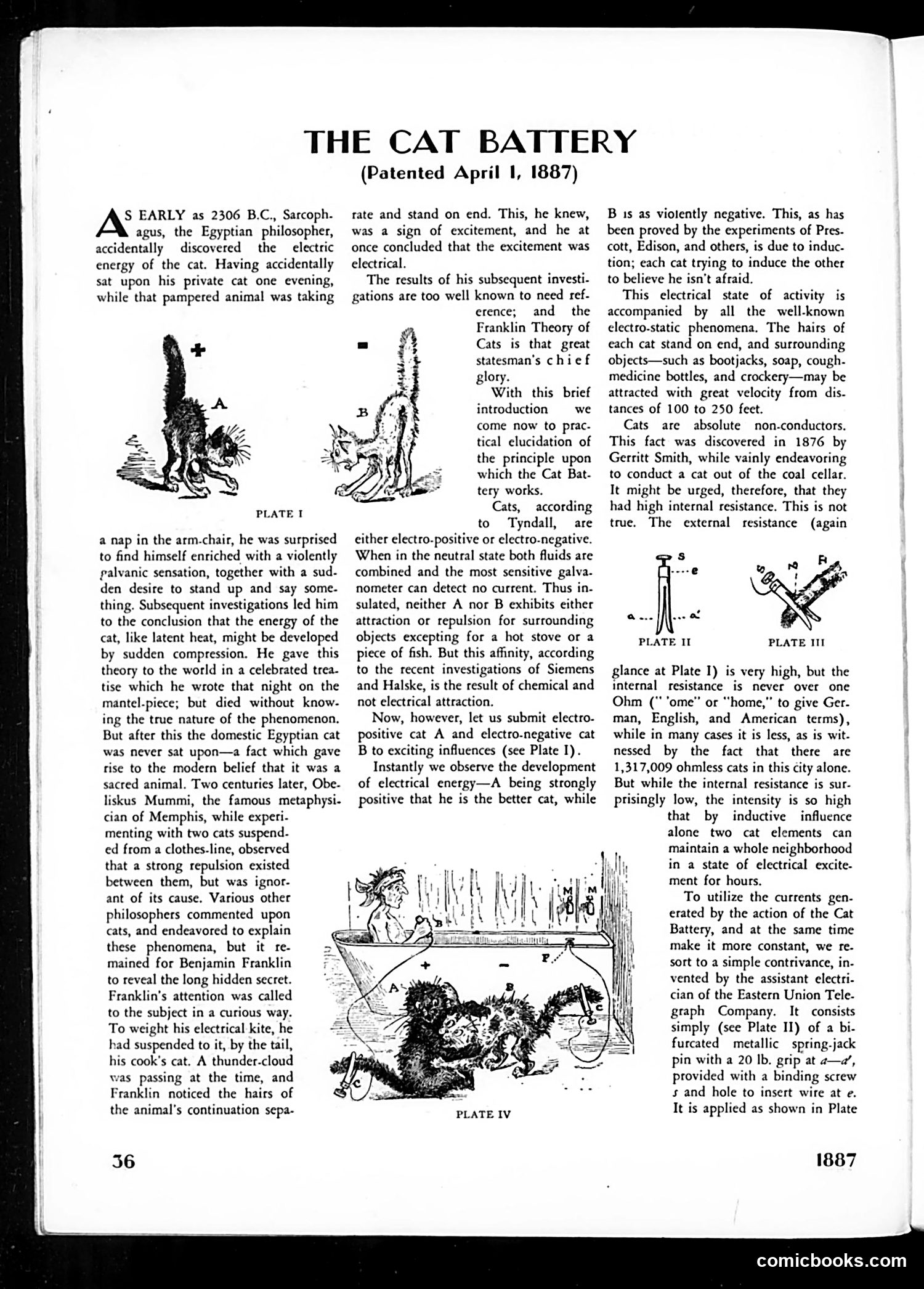
S EARLY as 2306 B.C., Sarcoph. agus, the Egyptian philosopher, accidentally discovered the _ electric energy of the cat. Having accidentally sat upon his private cat one evening, while that pampered animal was taking PLATE T a nap in the arm.chair, he was surprised to find himself enriched with a violently galvanic sensation, together with a sud- den desire to stand up and say some- thing. Subsequent investigations led him to the conclusion that the energy of the cat, like latent heat, might be developed by sudden compression. He gave this theory to the world in a celebrated trea- tise which he wrote that night on the mantel-piece; but died without know- ing the true nature of the phenomenon. But after this the domestic Egyptian cat was never sat upon—a fact which gave rise to the modern belief that it was a sacred animal. Two centuries later, Obe- liskkus Mummi, the famous metaphysi- cian of Memphis, while experi- menting with two cats suspend- ed from a clothes-line, observed that a strong repulsion existed between them, but was ignor- ant of its cause. Various other philosophers commented upon THE CAT BATTERY (Patented April 1, 1887) rate and stand on end. This, he knew, was a sign of excitement, and he at once concluded that the excitement was electrical. The results of his subsequent investi- gations are too well known to need ref- erence; and the Franklin Theory of Cats is that great statesman's chief glory. With this brief introduction we come now to prac. tical elucidation of the principle upon which the Cat Bat- tery works. Cats, according to Tyndall, are cither electro-positive or electro-negative. When in the neutral state both fluids are combined and the most sensitive galva- nometer can detect no current. Thus in- sulated, neither A nor B exhibits either attraction or repulsion for surrounding objects excepting for a hot stove or a piece of fish. But this affinity, according to the recent investigations of Siemens and Halske, is the result of chemical and not electrical attraction. Now, however, let us submit electro- positive cat A and electro-negative cat B to exciting influences (see Plate I). Instantly we observe the development of electrical energy—A being strongly positive that he is the better cat, while cats, and endeavored to explain these phenomena, but it re- mained for Benjamin Franklin to reveal the long hidden secret. Franklin's attention was called to the subject in a curious way. To weight his electrical kite, he had suspended to it, by the tail, his cook's cat. A thunder-cloud was passing at the time, and Franklin noticed the hairs of the animal's continuation sepa- PLATE IV B 1s as violently negative. This, as has been proved by the experiments of Pres. cott, Edison, and others, is due to induc- tion; each cat trying to induce the other to believe he isn’t afraid. This electrical state of activity is accompanied by all the well-known electro-static phenomena. The hairs of each cat stand on end, and surrounding objects—such as bootjacks, soap, cough. medicine bottles, and crockery—may be attracted with great velocity from dis- tances of 100 to 250 feet. Cats are absolute non-conductors. This fact was discovered in 1876 by Gerritt Smith, while vainly endeavoring to conduct a cat out of the coal cellar. It might be urged, therefore, that they had high internal resistance. This is not true. The external resistance (again 8 A or 2, ‘a @ ... [fife PLATE II PLATE III glance at Plate I) is very high, but the internal resistance is never over one Ohm ("‘ome” or “home,” to give Ger- man, English, and American terms), while in many cases it is less, as is wit- nessed by the fact that there are 1,317,009 ohmless cats in this city alone. But while the internal resistance is sur- prisingly low, the intensity is so high that by inductive influence alone two cat elements can maintain a whole neighborhood in a state of electrical excite- ment for hours. To utilize the currents gen- erated by the action of the Cat Battery, and at the same time make it more constant, we re- sort to a simple contrivance, in- vented by the assistant electri- cian of the Eastern Union Tele. gtaph Company. It consists simply (see Plate II) of a bi- furcated metallic spring-jack pin with a 20 Ib. grip at a—d’, provided with a binding screw sand hole to insert wire at e. It is applied as shown in Plate 1887 comicbooks.com