A complete issue · 52 pages · 1938
Judge — February 1938
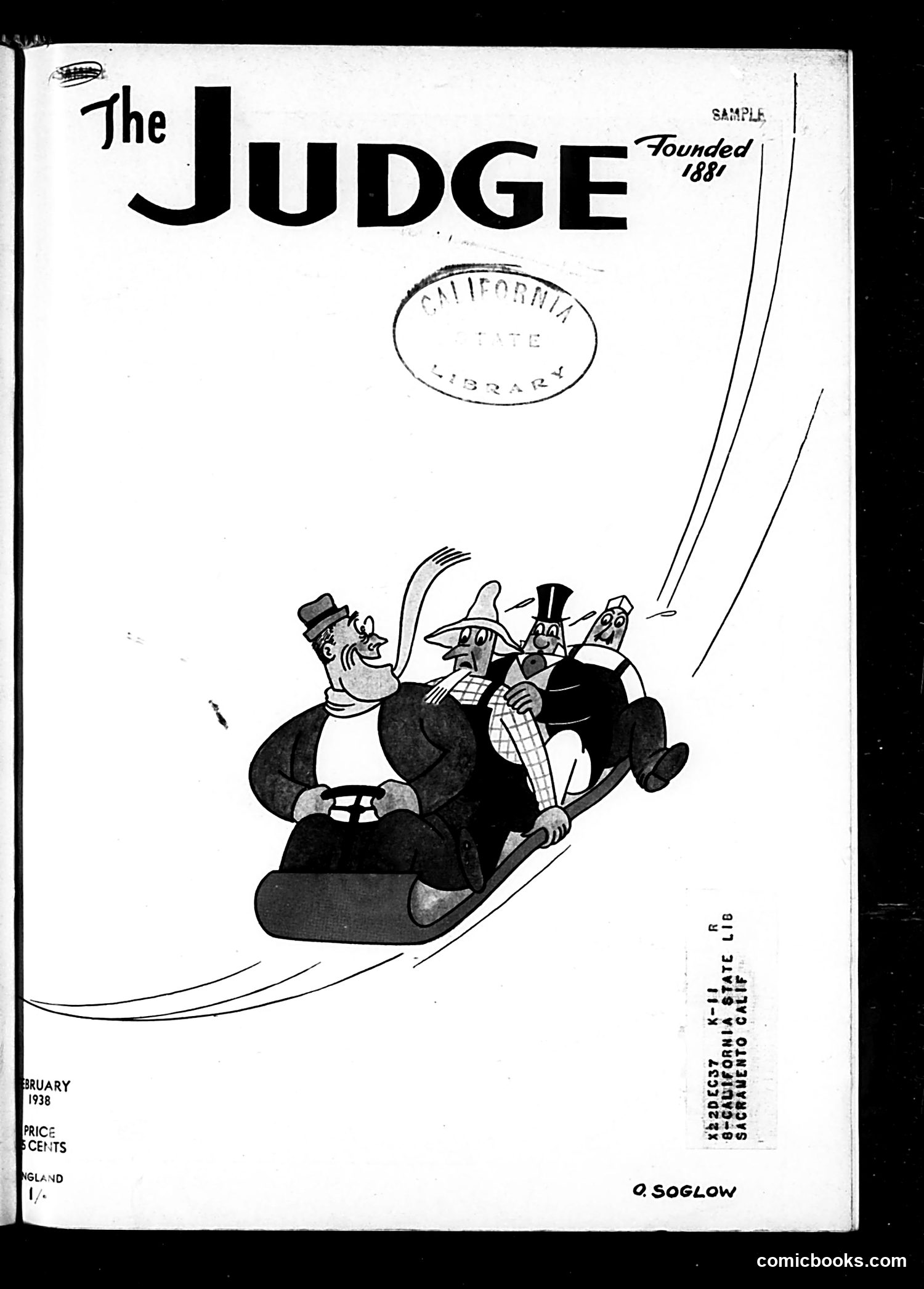
# The Judge Magazine Cover - February 1938 This cover illustration by O. Soglow depicts three caricatured figures sledding downhill together, their expressions suggesting anxiety or alarm as they descend a steep slope. The imagery appears to be political satire about economic or social conditions circa February 1938. The context likely relates to the economic recession that struck the United States in late 1937-1938, often called the "Roosevelt Recession." The figures careening downward probably represent government, business, or the general populace losing control during this financial crisis. The sledding metaphor suggests an uncontrolled, potentially dangerous descent. Without clearer identifying labels on the figures themselves, the specific targets of Soglow's satire remain uncertain, though the downward trajectory clearly critiques contemporary economic mismanagement.
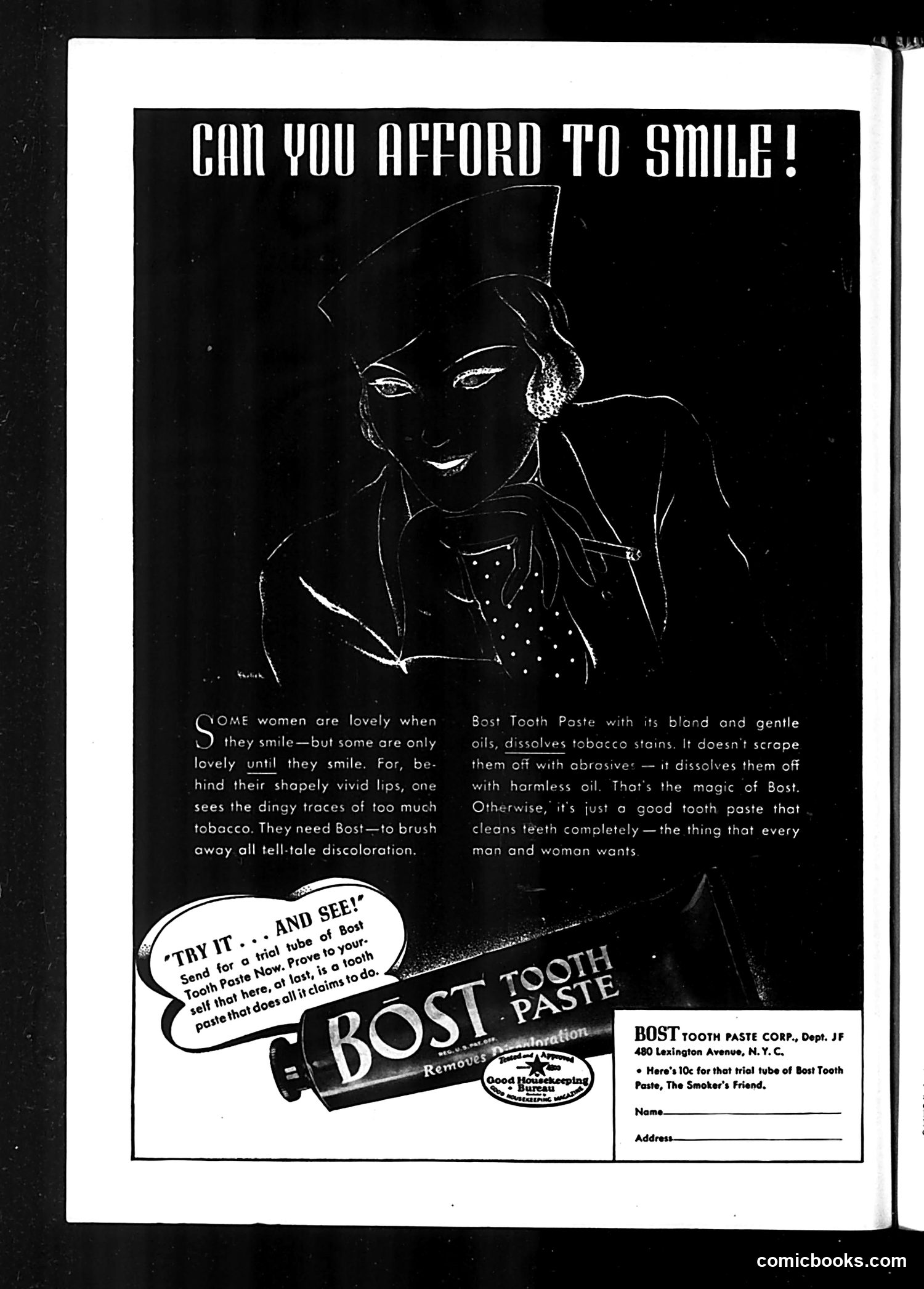
# Analysis This appears to be primarily a **commercial advertisement rather than political satire**. It's a Bost Tooth Paste ad from Judge magazine. The advertisement uses a gendered appeal common to early 20th-century advertising: it suggests that women's attractiveness depends on having a bright smile free of tobacco stains. The headline "CAN YOU AFFORD TO SMILE!" implies that without proper dental care, women should be embarrassed. The illustration shows a stylishly dressed woman in profile, and the copy emphasizes that Bost Tooth Paste "dissolves tobacco stains" without abrasive scrubbing. The ad includes a trial offer coupon (10 cents). This reflects period advertising that capitalized on social anxiety about appearance and cleanliness, particularly targeting women as consumers of personal care products.
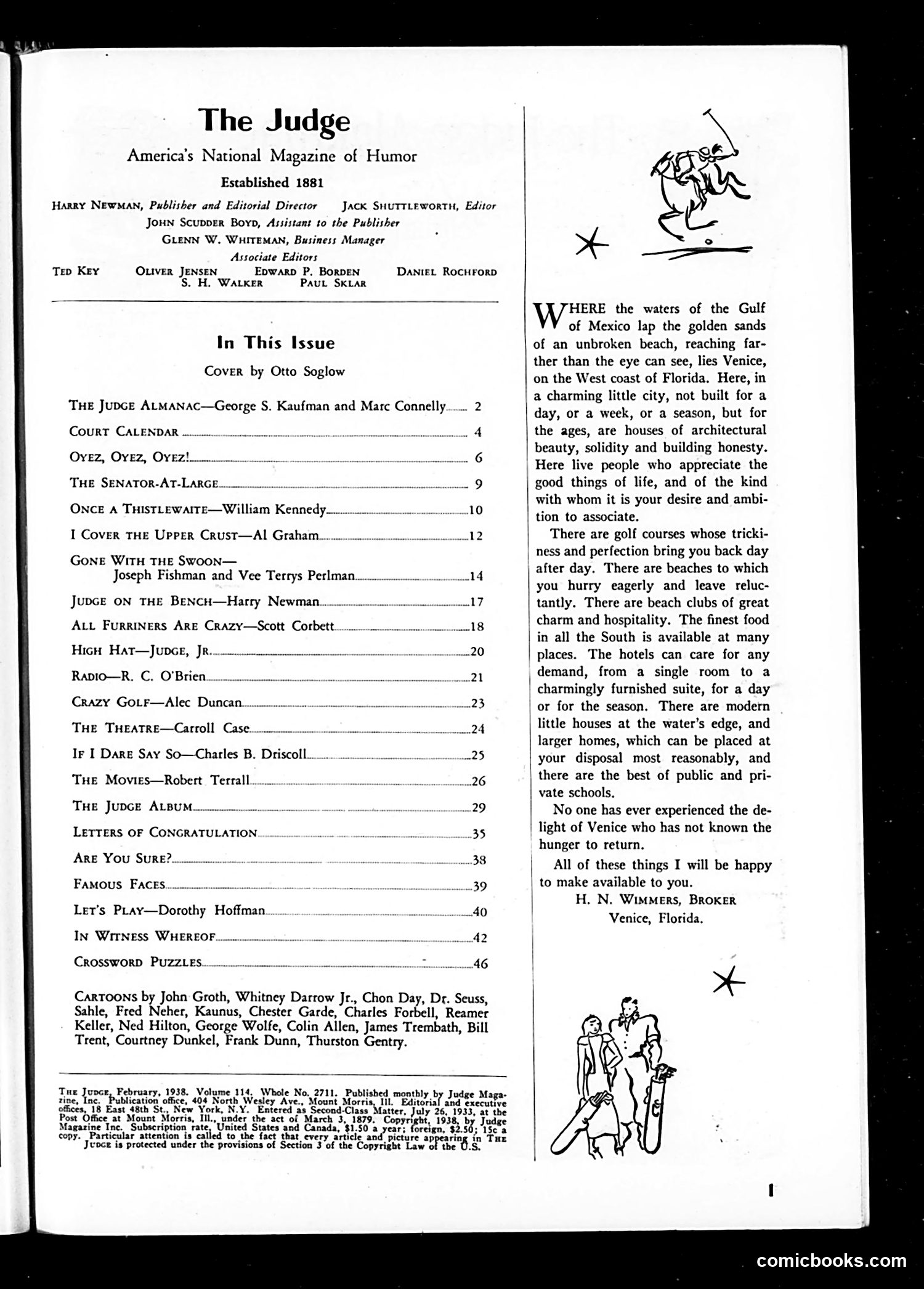
# Analysis of Judge Magazine Page This is primarily a **table of contents and masthead page** from Judge magazine (established 1881), America's leading humor publication. The page lists the issue's contents and editorial staff rather than presenting political cartoons requiring interpretation. The two small cartoons visible appear to be **decorative vignettes** rather than satirical commentary—one showing a figure with a golf club, the other depicting casual social figures. The substantial prose section is an **advertisement disguised as editorial content**, promoting Venice, Florida as a tourist destination. It's written by H.N. Wimmers (a broker) and emphasizes luxury amenities, golf courses, and hospitality—typical boosterism of 1920s Florida real estate marketing. This page reflects Judge's dual function: satirical humor magazine and vehicle for advertising revenue.
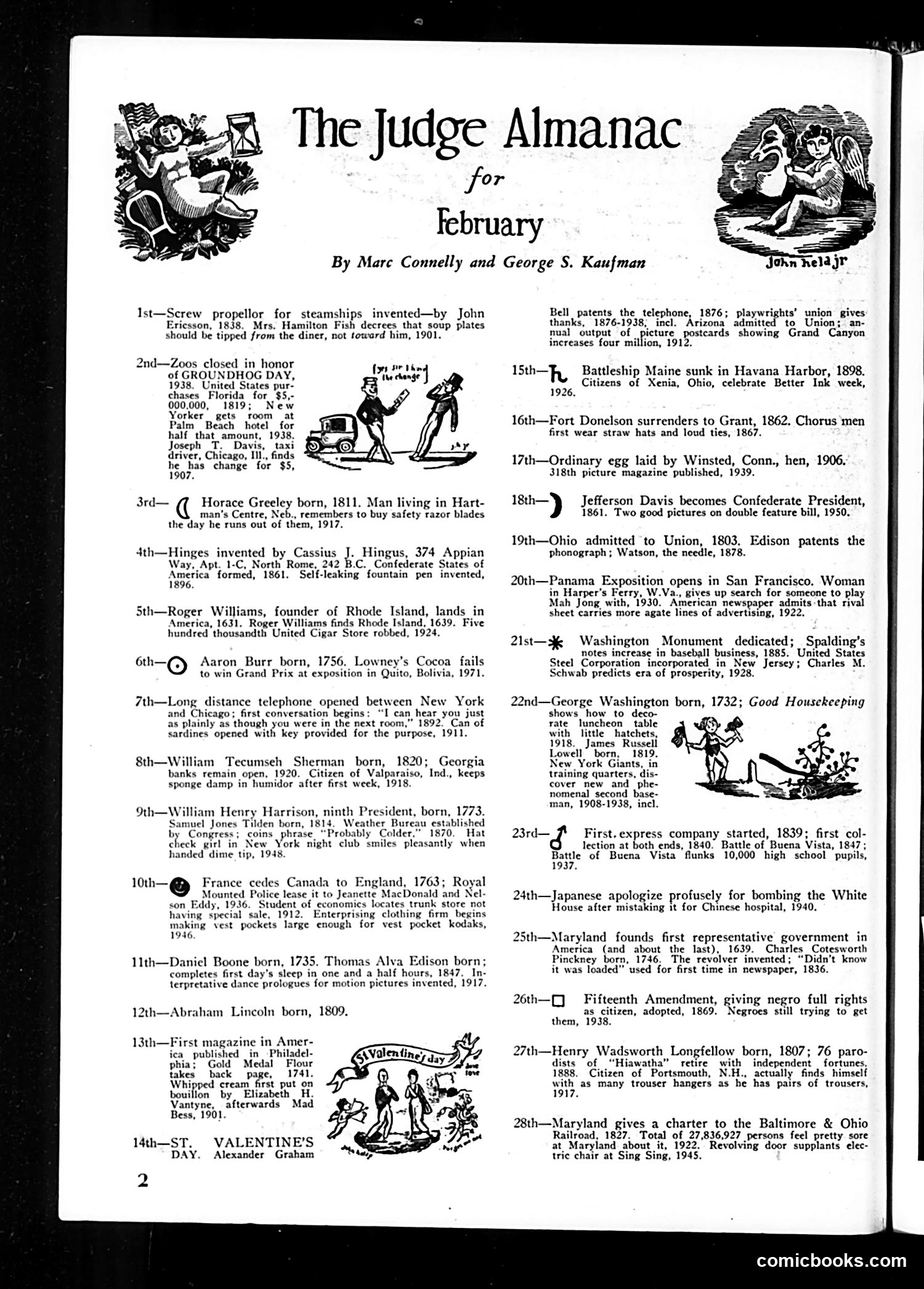
# The Judge Almanac for February This page is primarily a factual almanac listing historical events for each day in February, rather than political satire. The entries range from scientific inventions (screw propeller, 1838; telephone patents, 1876) to political events (Ohio admitted to Union, 1803; Lincoln's birth, 1809) to cultural moments (first magazine published in America, 1741; Valentine's Day). The small decorative illustrations—cherubs, couples, a man with a plow—are generic period embellishments typical of almanac design, not satirical commentary. While *Judge* magazine was known for sharp political cartooning, this particular page functions as reference material rather than satire, providing readers useful historical context alongside light decorative elements.
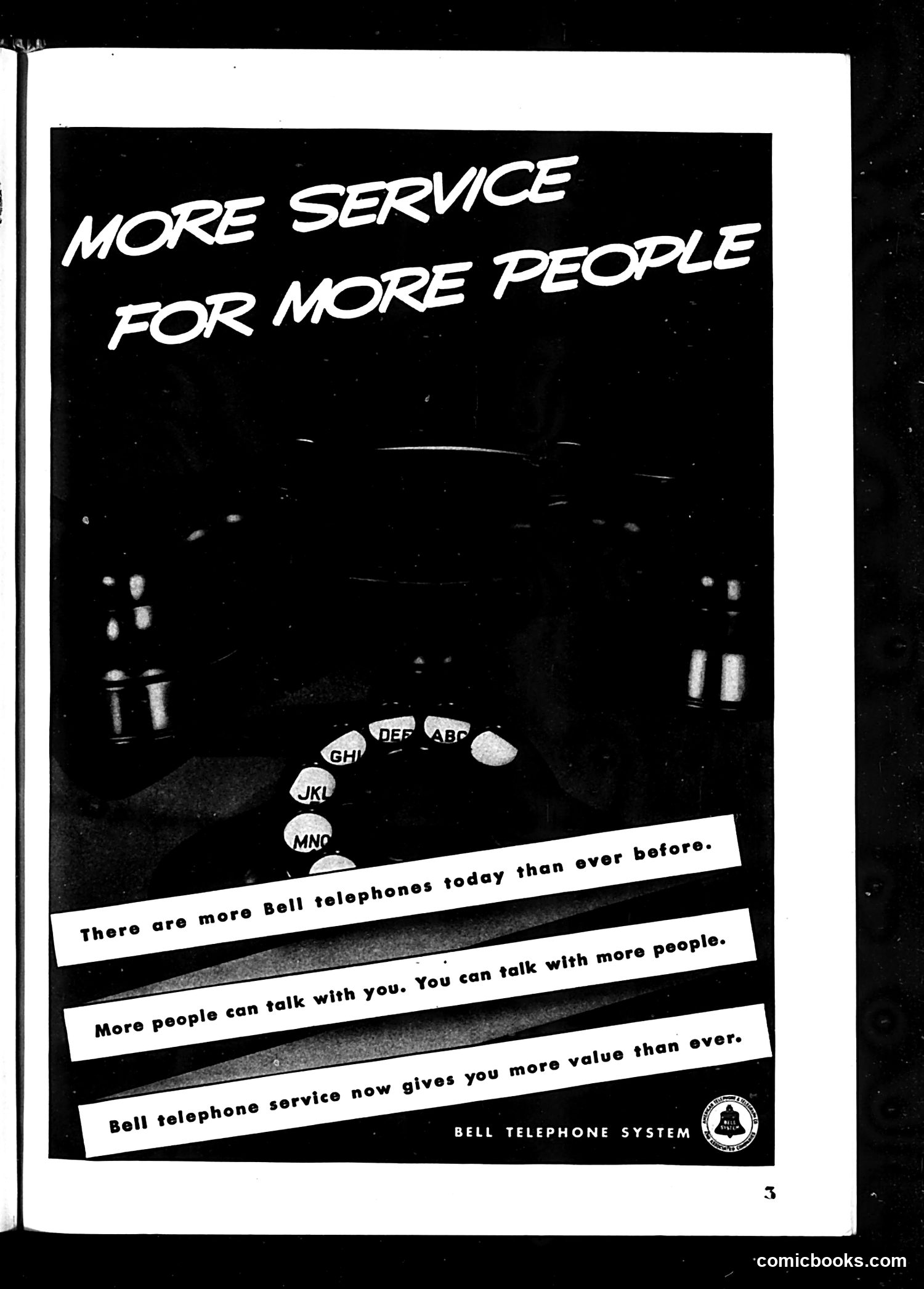
# Analysis This is a **Bell Telephone System advertisement**, not satirical content. The page promotes telephone service expansion during what appears to be the early-to-mid 20th century. The ad's messaging emphasizes growth: more telephones exist than ever before, more people can communicate simultaneously, and customers receive greater value. The telephone dial visible in the image displays letter-number combinations (ABC, DEF, GHI, JKL, MNO), representing the rotary dial system standard of that era. The headline "MORE SERVICE FOR MORE PEOPLE" reflects Bell's marketing of telecommunications infrastructure expansion as a public good. This represents typical mid-century corporate advertising positioning utility expansion as social progress—a common rhetorical strategy before modern skepticism of monopolistic telecommunications companies.
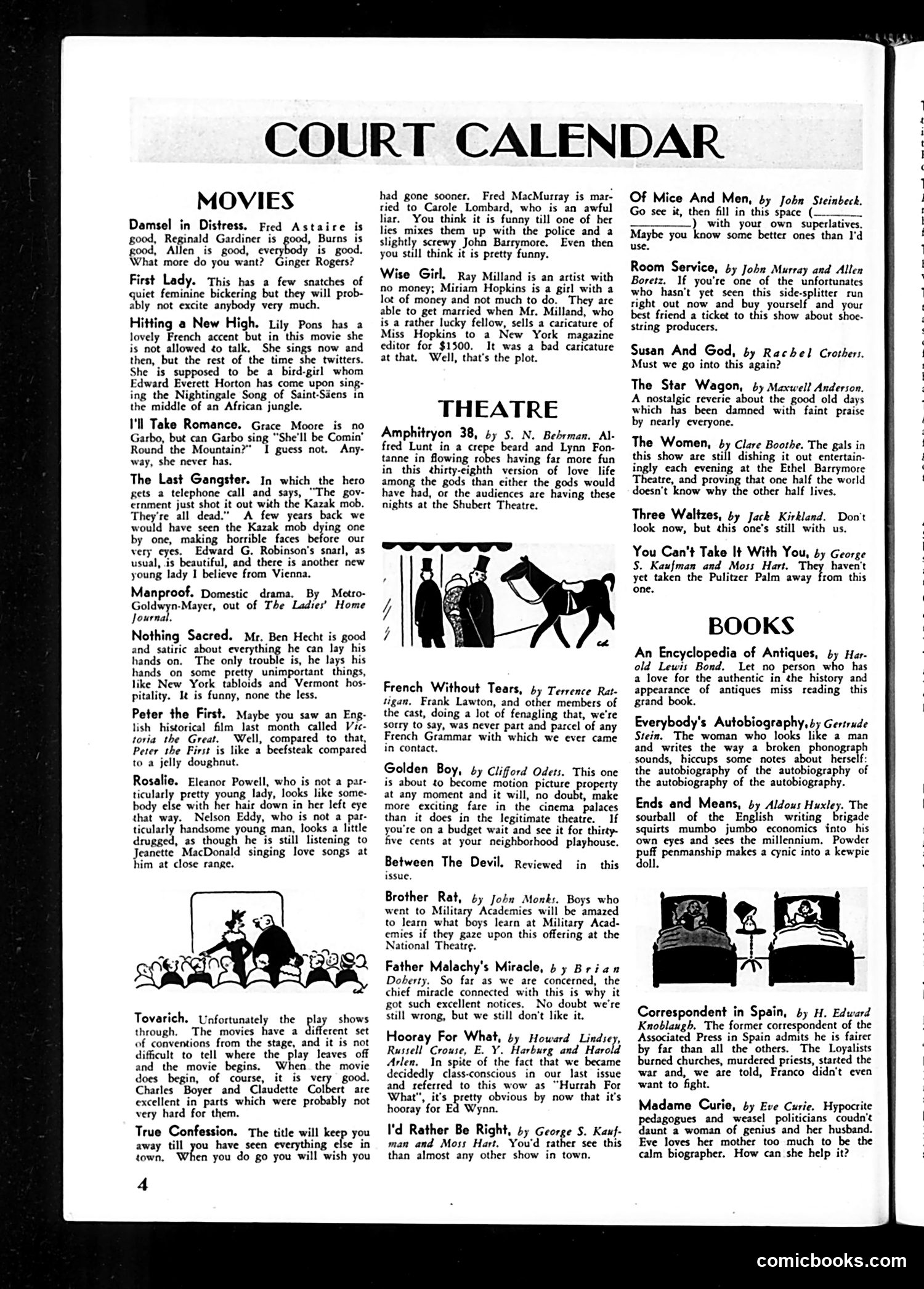
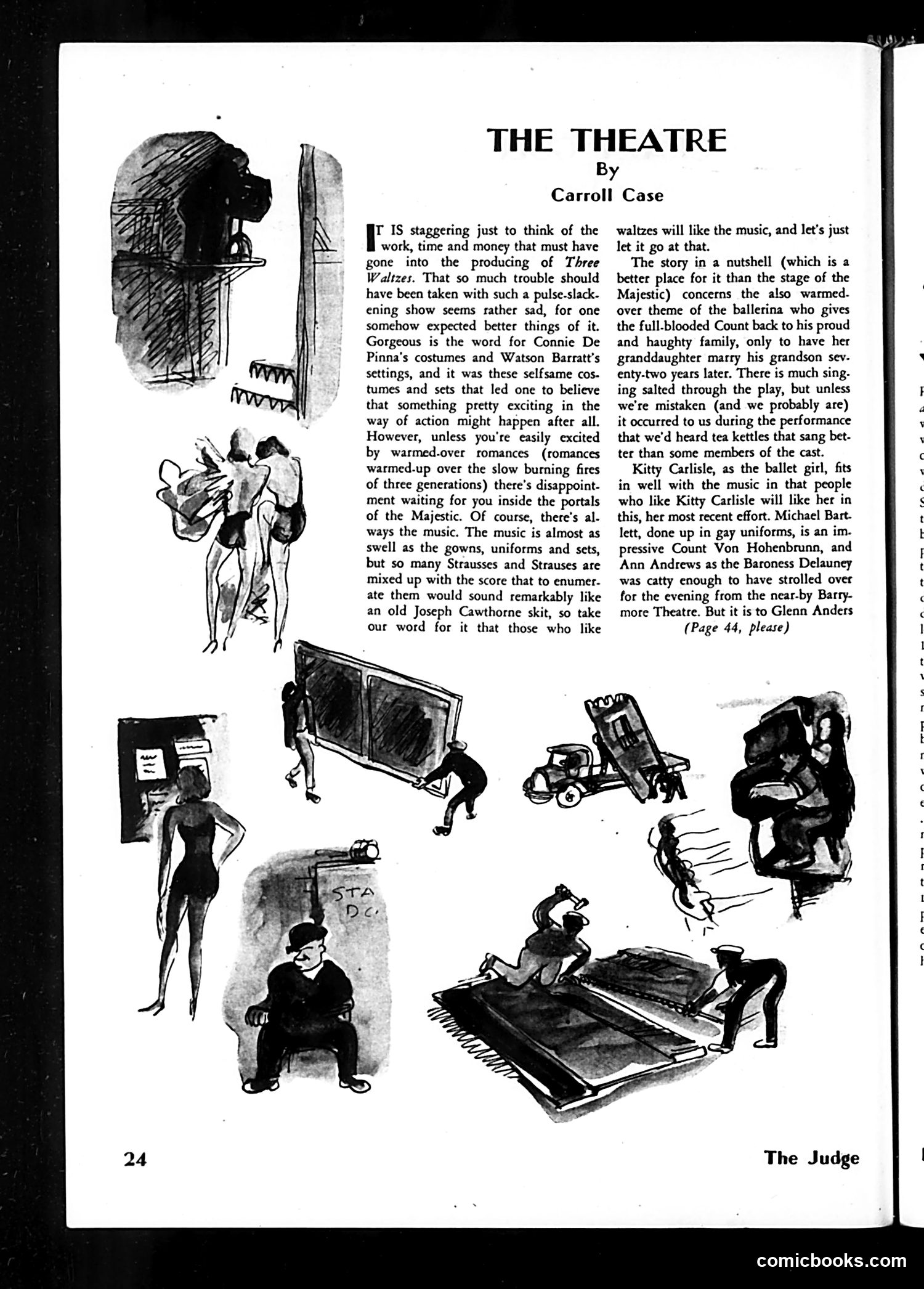
# Court Calendar Page Analysis This page from Judge magazine contains entertainment reviews (movies, theatre, books) rather than political cartoons. The only illustration is a small, stylized crowd scene at the bottom left—appears to show simplified audience silhouettes, likely generic theatrical imagery rather than political satire. The reviews themselves offer period social commentary. For example, "Ninotchka" is described as featuring a Soviet character in "bowing robes," reflecting Cold War-era attitudes toward communism. References to "Military Academies" and mentions of Spain suggest 1930s-40s historical context. This is primarily a consumer-focused entertainment guide page, not a vehicle for political satire. Any social commentary emerges incidentally through the film and theatre descriptions rather than through deliberate cartoon satire.
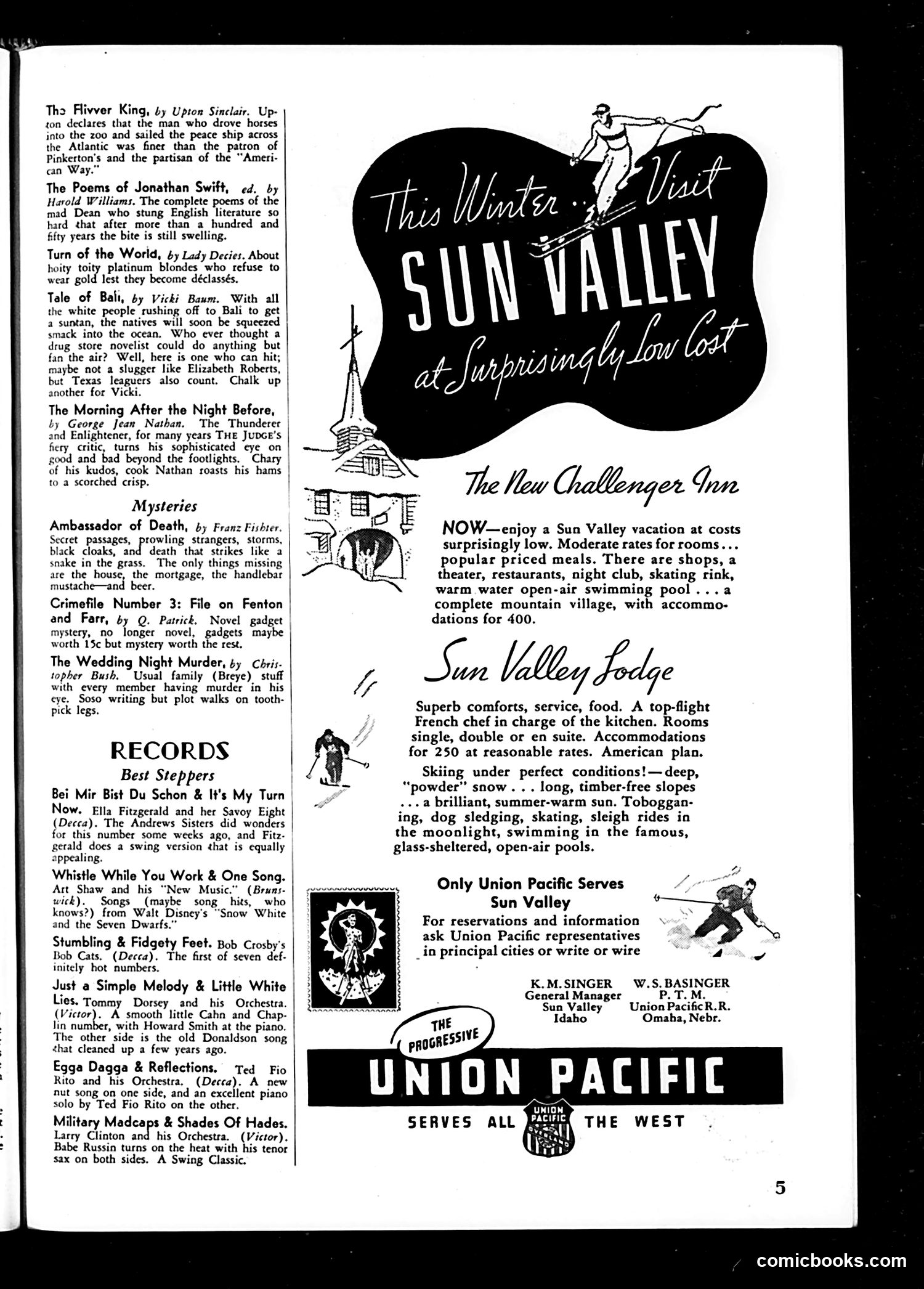
# Page Analysis This page is **primarily advertising**, not satirical content. The dominant feature is a large advertisement for Sun Valley Lodge in Idaho, promoting winter vacation amenities including skiing, sledding, and swimming pools. The ad emphasizes "surprisingly low cost" and "moderate rates," appealing to middle-class vacationers. The left column contains book reviews and a "Records" section listing musical releases—typical Judge magazine content filler rather than satire or political commentary. The only visual humor appears to be generic skiing illustrations accompanying the Sun Valley ad, showing figures in comic skiing poses. These are decorative rather than satirical. The page reflects 1930s-40s travel advertising during a period when ski resort promotion was becoming mainstream American marketing.
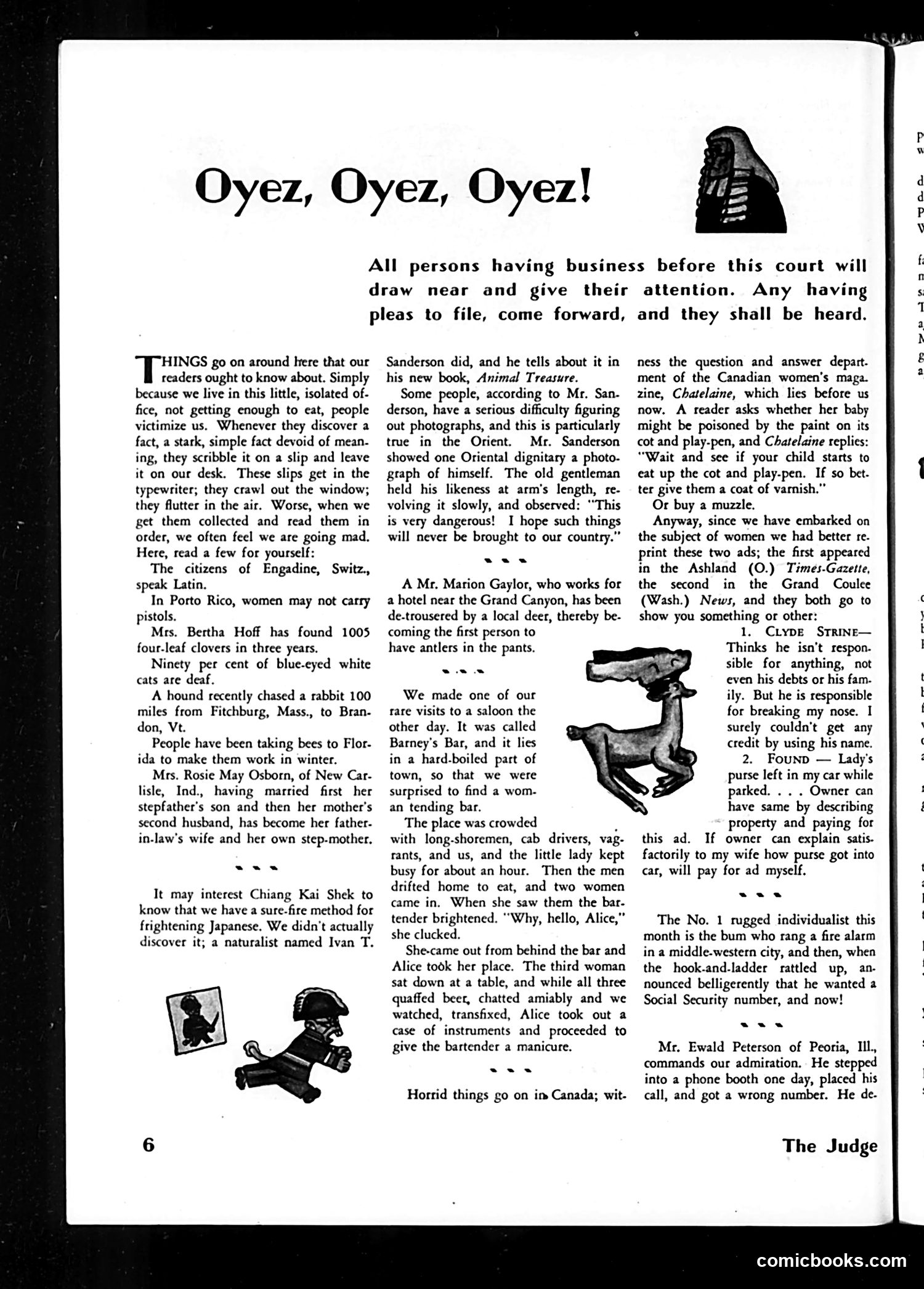
# "The Judge" Page Analysis This is a humor column titled "Oyez, Oyez, Oyez!" (a courtroom crier's traditional call). The page collects absurdist anecdotes and reader-submitted oddities rather than political cartoons. The content mocks everyday human eccentricity: a man who traveled 100 miles with a rabbit; people shipping bees to Florida for winter work; a woman who became her own stepmother through remarriage; a deer-related incident at the Grand Canyon; and a woman performing manicures in a saloon. The illustrations show period silhouettes and a small figure, likely decorative. The column's satire targets human peculiarity and illogic in ordinary life—not political figures. This represents Judge magazine's characteristic style: lighthearted social observation rather than partisan commentary, appealing to readers' sense of the ridiculous in everyday society.
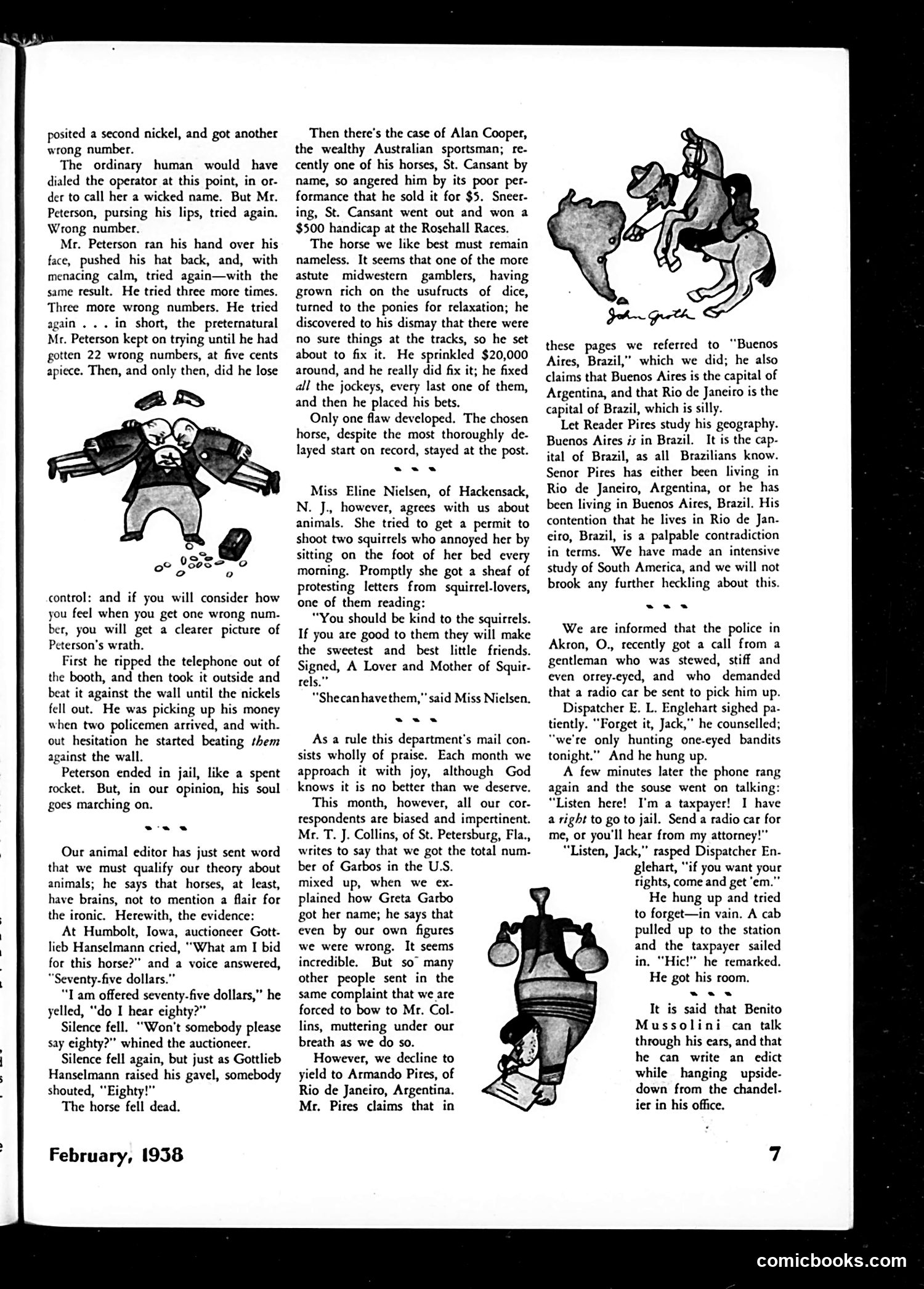
# Analysis of Judge Magazine Page (February 1938) This page contains humorous anecdotes rather than political cartoons. The illustrations are simple comic vignettes accompanying short stories: 1. **The telephone operator story**: A man repeatedly dials wrong numbers trying to reach a horse racing operation, becoming increasingly frustrated. The satire targets both his obsessive gambling and the incompetence of telephone service. 2. **The auctioneer story**: A horse literally dies during an auction after the auctioneer's repeated shouting of "Eighty!" The humor derives from absurdist exaggeration of auctioneers' loud, dramatic behavior. 3. **The dispatcher anecdote**: Police humorously handle a call about "one-eyed bandits," initially misunderstanding before realizing the caller means literal bandits. The page's tone is light, focusing on everyday American mishaps and technology failures rather than political commentary.
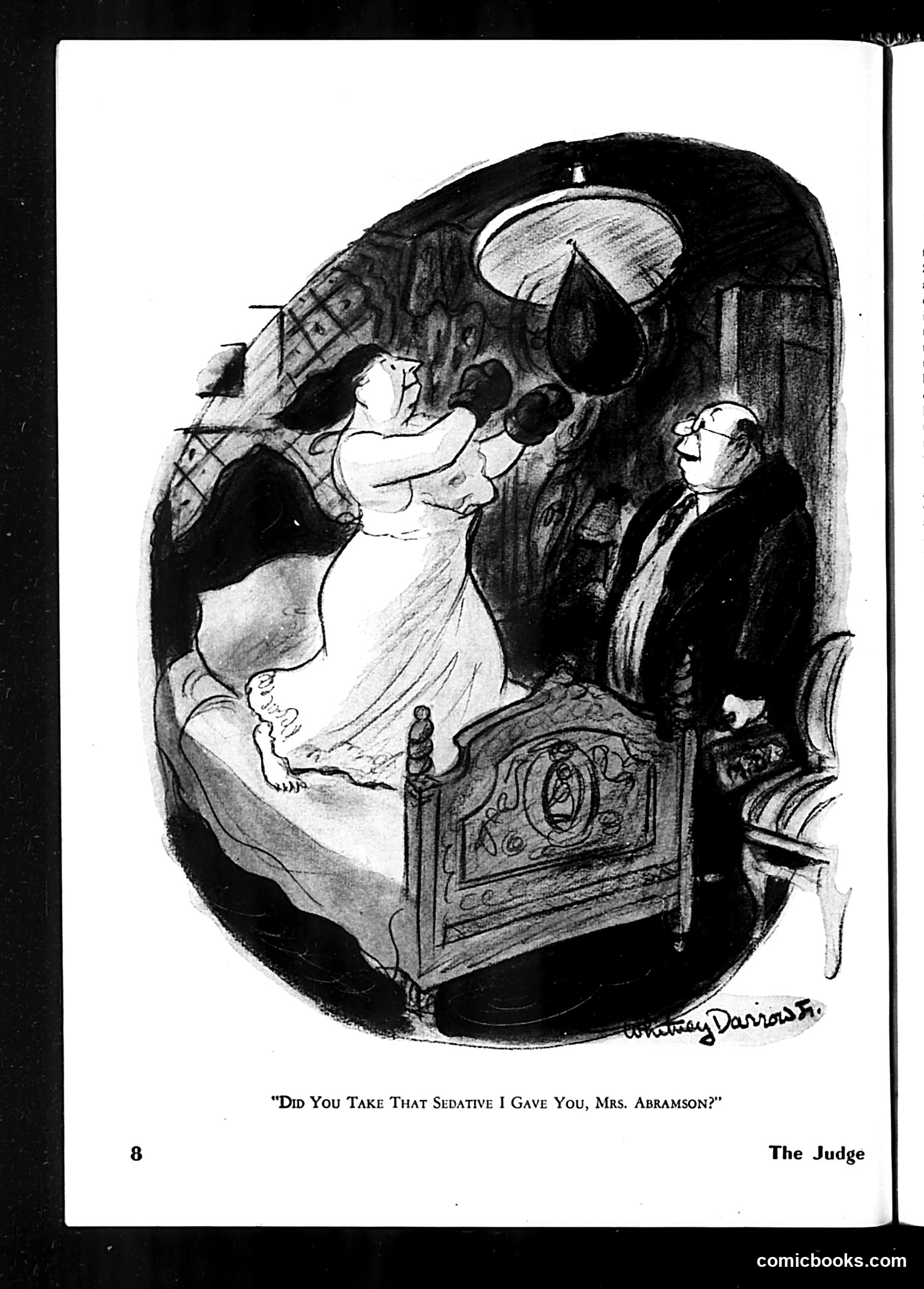
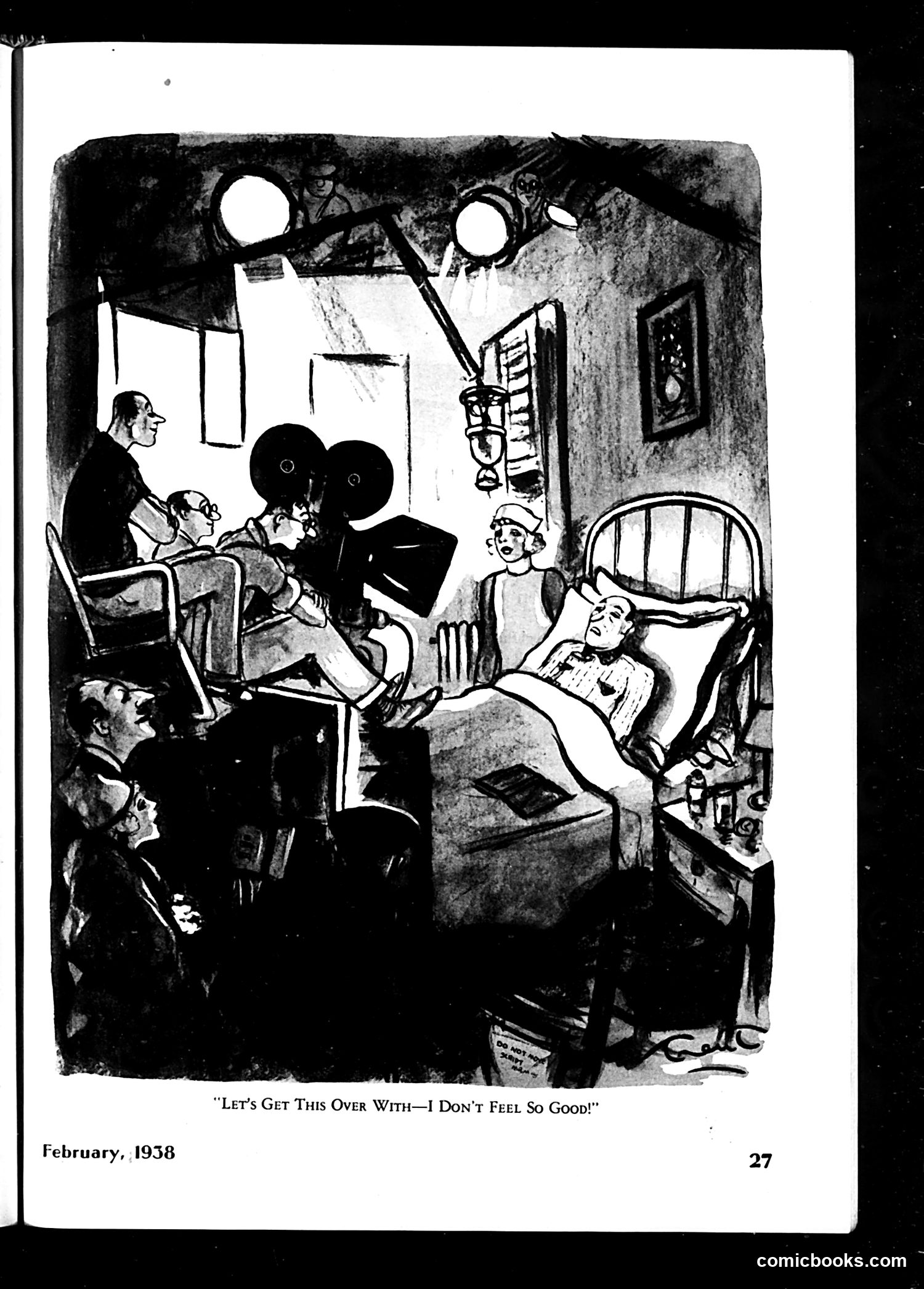
# Cartoon Analysis This single-panel cartoon from *Judge* magazine satirizes medical quackery and incompetence. A disheveled doctor (likely a charlatan) stands beside a bed where an enormously pregnant woman, Mrs. Abramson, is in apparent labor or distress, reaching upward. The doctor asks if she took the "sedative" he prescribed—suggesting his dubious medication may have caused her condition rather than helped it. The joke targets fraudulent doctors of the era who administered questionable remedies to patients, often with harmful results. The woman's exaggerated physical state and the doctor's casual, almost oblivious demeanor emphasize the satire: incompetent medical practitioners dispensing dangerous treatments while remaining indifferent to consequences. This reflects early 20th-century concerns about unregulated medical practice.
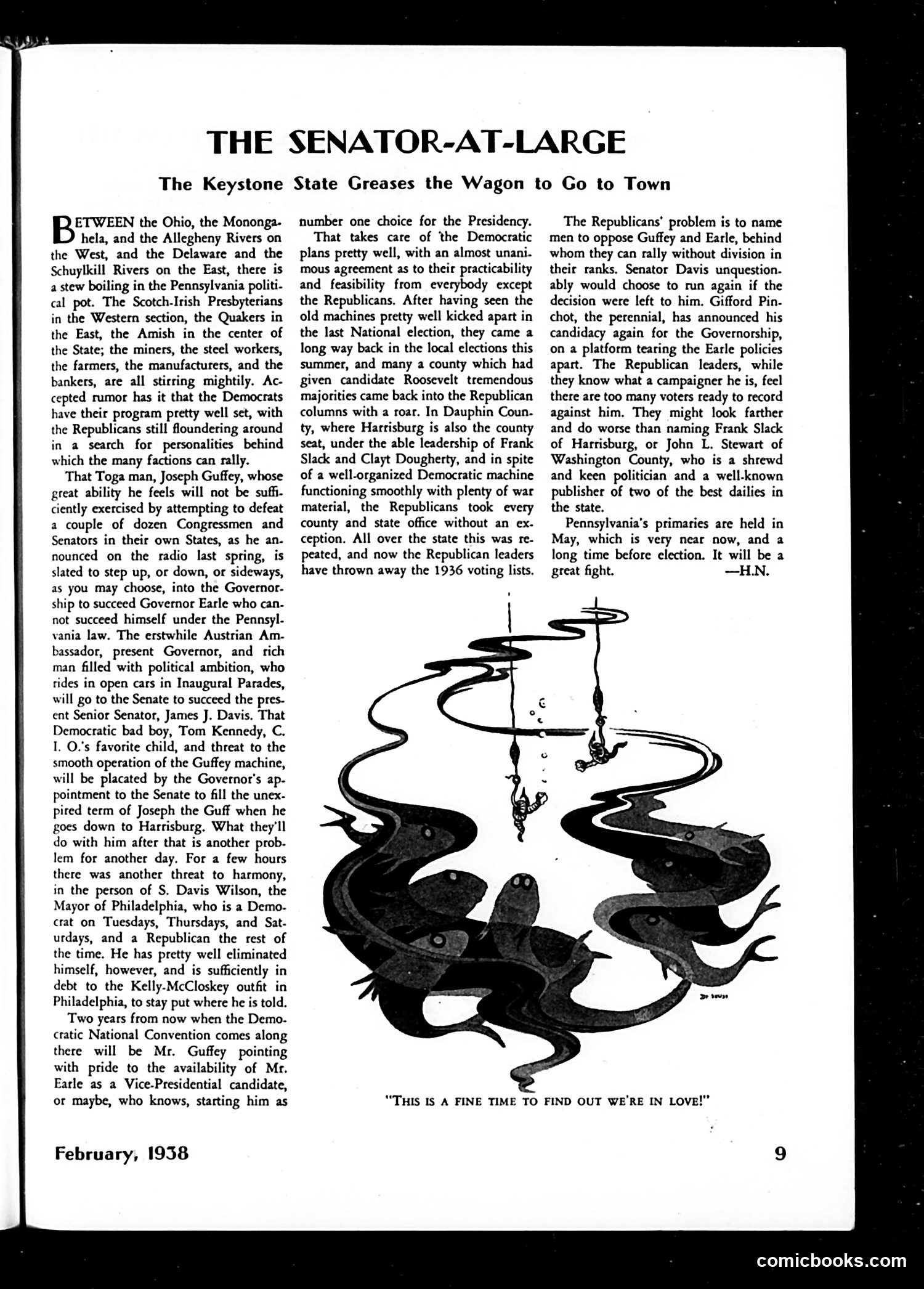
# "The Senator-at-Large" (Judge, February 1938) This satirical article and accompanying cartoon mock Pennsylvania's Democratic political machine under Joseph Guffey. The text describes an intricate shuffle of Democratic politicians—Governor Earle moving to the Senate, Guffey to the Governorship, and troublemaker Tom Kennedy (a labor organizer favored by the CIO) being placated with a Senate appointment—all orchestrated to consolidate power before the 1940 presidential cycle. The cartoon depicts this political maneuvering as tangled wagon wheels or dancing figures, visualizing the complex choreography of ambition and deal-making. The caption "This is a fine time to find out we're in love!" suggests ironic commentary on their convenient Democratic unity. The satire highlights Republican weakness: despite losses in 1936, they've regained local ground but lack coherent candidates to challenge the well-oiled Democratic apparatus. The article portrays Pennsylvania politics as a self-serving game among established elites, indifferent to ordinary voters' interests.
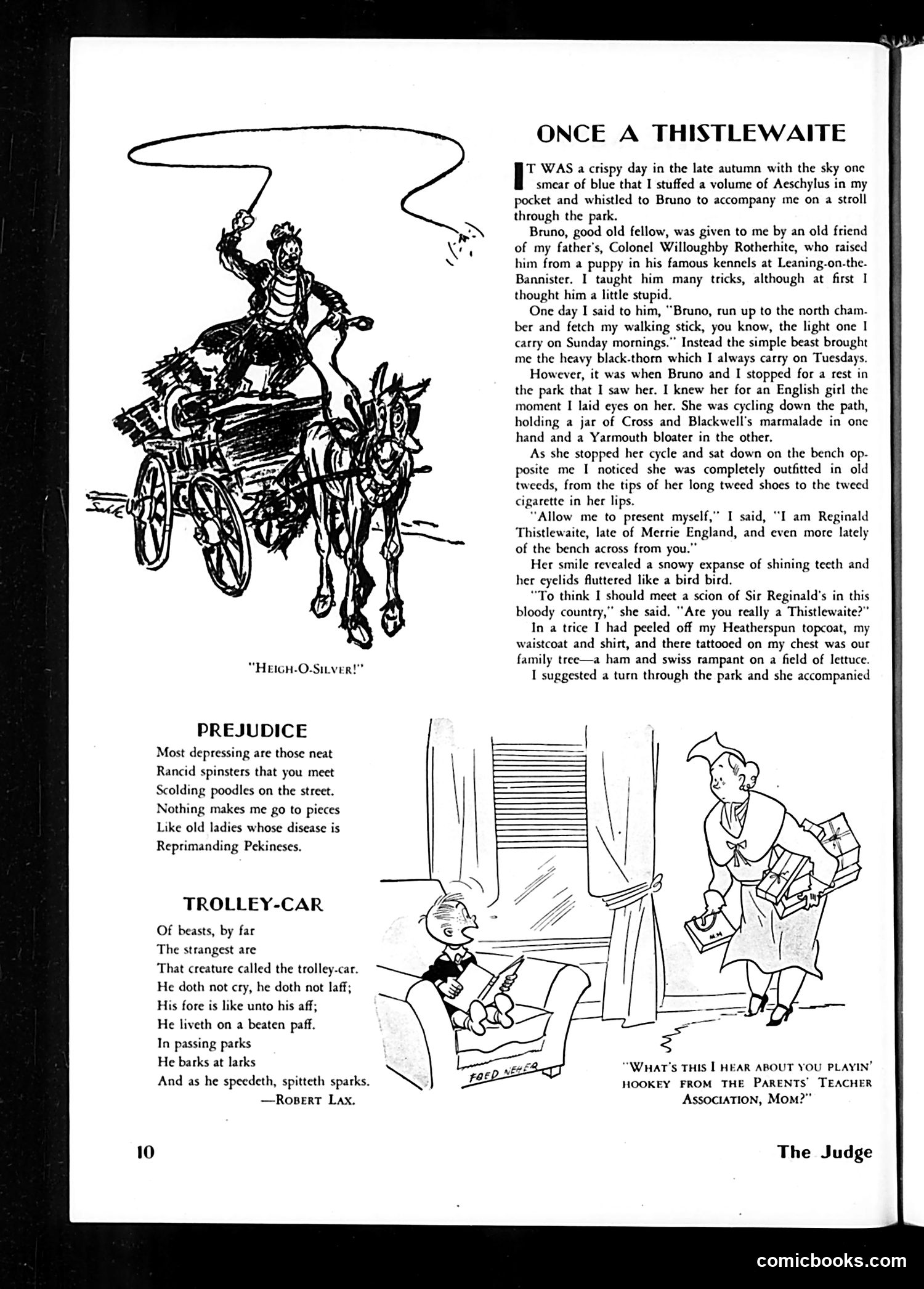
# Judge Magazine Page Analysis This page contains three distinct pieces of humor: **"Once a Thistlewaite"** is a satirical short story mocking pretentious British aristocracy and affected English mannerisms. The narrator, Reginald Thistlewaite, embodies exaggerated upper-class affectation—carrying Aeschylus, naming his dog after a colonel, and absurdly displaying a family "tree" (literally ham and swiss rampant) tattooed on his chest. The story ridicules both pompous British characters and Americans who admire them. **"Prejudice"** is a brief poem criticizing elderly spinsters who scold small dogs (poodles, Pekingeses) on streets—satirizing busybody moralism and fussy old women. **"Trolley-Car"** is a humorous verse by Robert Lax treating the electric trolley-car as a bizarre animal, poking fun at this then-new technology with absurdist descriptions of its mechanical properties. The bottom cartoon shows a mother confronting a child about skipping Parent-Teacher Association meetings—satirizing mothers' involvement in school administration and social pressure regarding parental participation.
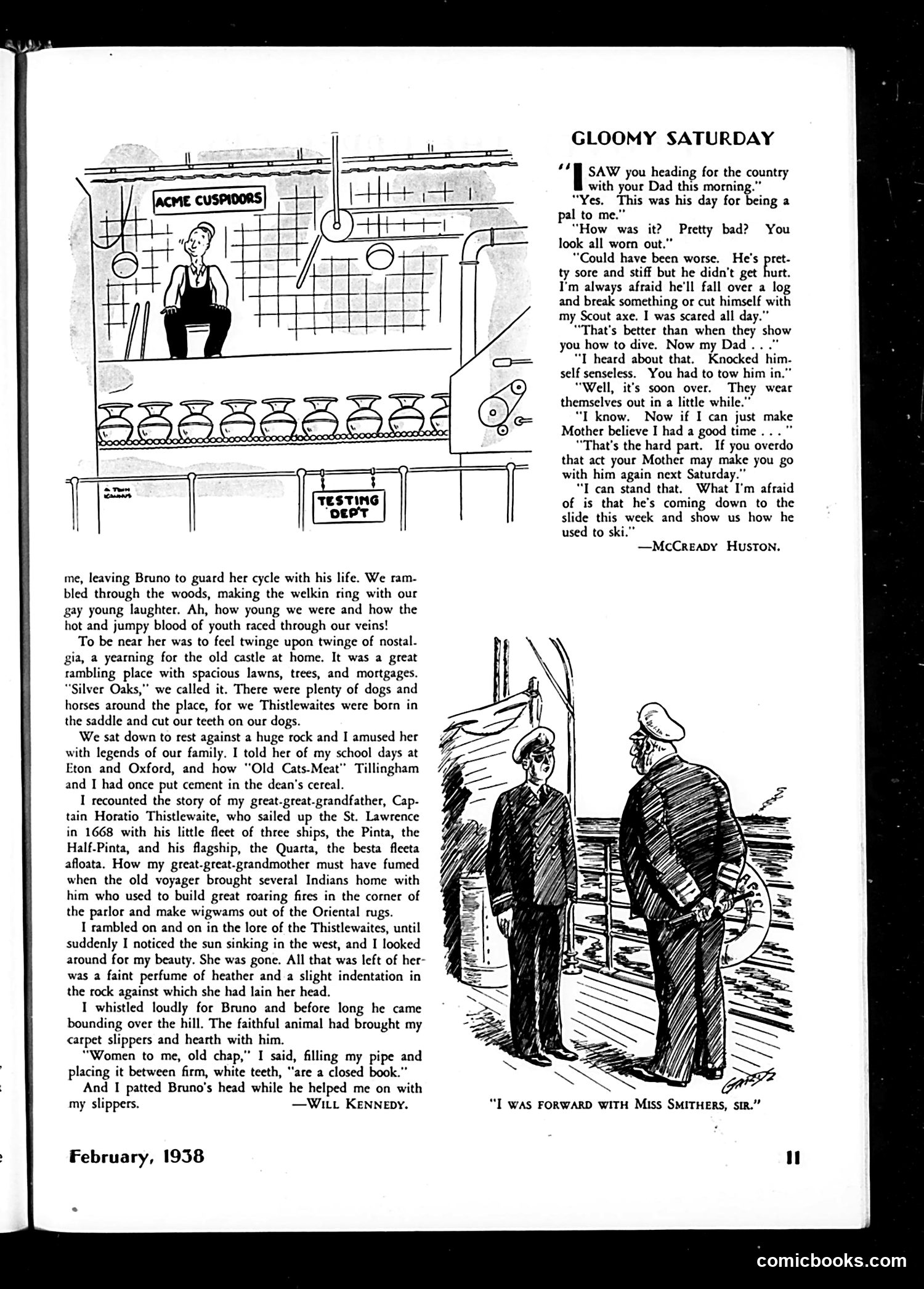
# Gloomy Saturday - Judge Magazine Content Analysis This page contains two distinct pieces: **The Cartoon (top):** A simple comic about fathers and sons. Two boys discuss their Saturday outing with their dads. The humor centers on the generational gap: fathers try to be "pals" by taking sons on activities, but these outings are exhausting and potentially dangerous—the boys worry about their fathers getting hurt or making fools of themselves (falling, diving poorly, attempting outdated ski tricks). The joke's irony: the boys must pretend they had fun to avoid repeat outings, managing their mothers' expectations. **The Story (bottom):** A lengthy satirical piece titled "I Was Forward with Miss Smithers, Sir." This appears to be mock-nostalgic fiction parodying British upper-class romance narratives. It exaggerates aristocratic pretension through absurd details (rambling estates with "mortgages," ancestors bringing Indians home who build wigwams with Oriental rugs, a dog helpfully retrieving carpet slippers). The abandoned-girlfriend ending undermines the romantic tone, suggesting the narrator's self-absorbed rambling about his family's exploits bored her away—satire of self-important upper-class storytelling.